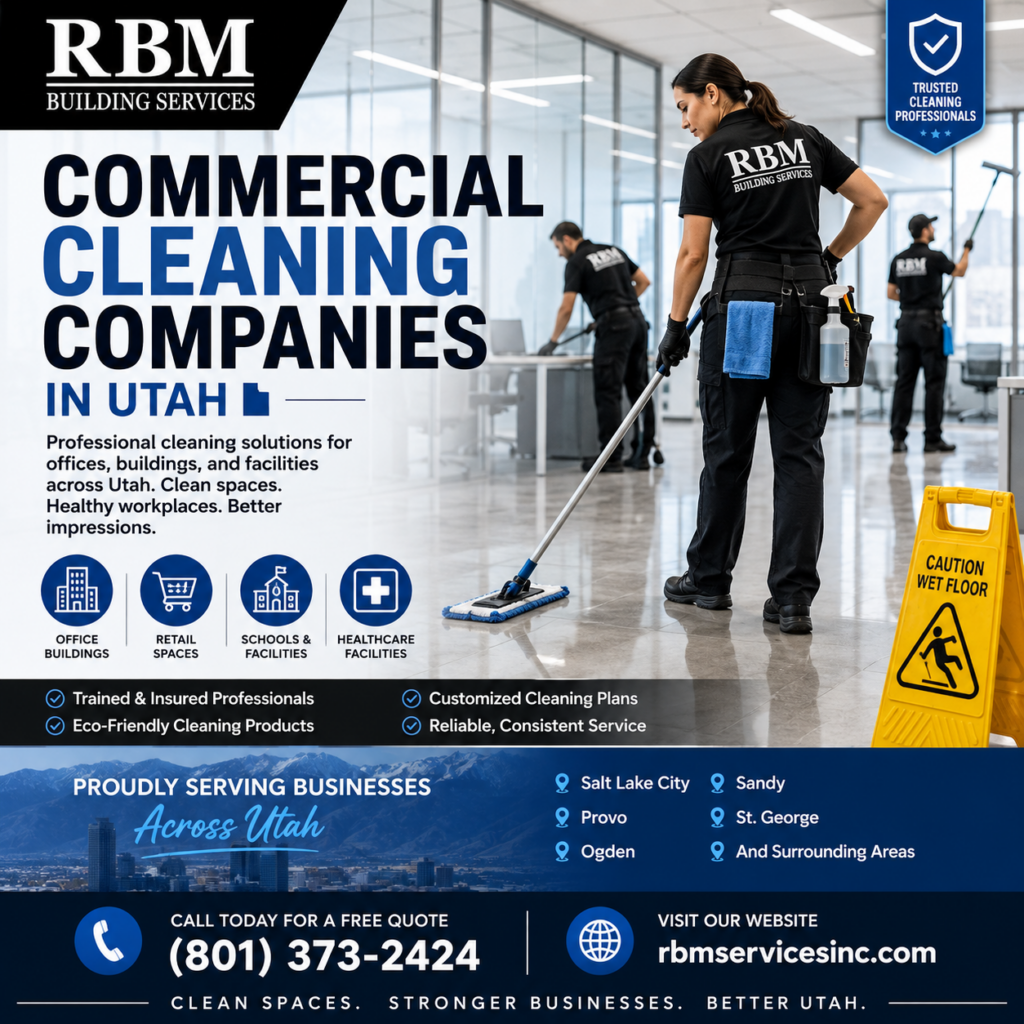
Commercial cleaning companies in Utah provide the janitorial, sanitation, floor-care, and specialty cleaning support that offices, medical practices, retail businesses, schools, warehouses, property managers, and other facilities need to stay clean, safe, and presentable. The right provider does more than empty trash and mop floors: it builds a consistent plan around your building’s traffic, surfaces, business hours, sanitation risks, and customer expectations.
The most important takeaway is that the best commercial cleaning company is not necessarily the lowest bidder. It is the provider with a clear scope of work, trained people, practical quality controls, reliable communication, and a service schedule that matches how your facility actually operates. This guide explains how commercial cleaning works, the major service options, common pitfalls, safety and compliance considerations, the real costs of poor cleaning, and the questions to ask before signing an agreement. Experienced guidance helps business owners and facility managers prevent small cleaning issues from becoming recurring complaints, damaged floors, safety risks, or avoidable operating expenses.

What Are Commercial Cleaning Companies in Utah?
Commercial cleaning companies in Utah are businesses that clean and maintain non-residential properties. Their clients may include offices, medical and dental facilities, retail stores, banks, gyms, schools, churches, warehouses, apartment common areas, restaurants, event spaces, and industrial facilities.
The provider may supply a recurring janitorial crew, daytime porter, floor-care specialists, carpet technicians, post-construction cleaners, window washers, or other trained personnel based on the facility’s needs.
What commercial cleaning includes
A standard commercial janitorial plan may include:
- Emptying trash and replacing liners
- Vacuuming carpeted areas
- Sweeping, mopping, or machine-scrubbing hard floors
- Cleaning and sanitizing restrooms
- Dusting desks, ledges, fixtures, and common areas
- Cleaning break rooms and shared kitchens
- Wiping high-touch surfaces such as door handles and switches
- Cleaning interior glass and entry doors
- Restocking agreed paper products and hand soap
- Reporting maintenance concerns, supply shortages, leaks, or damage
Specialty services can include carpet extraction, tile and grout cleaning, strip-and-wax floor work, floor burnishing, post-construction cleaning, pressure washing, window washing, high dusting, upholstery care, odor control, and regulated cleanup support.
How the process should work
A dependable Utah commercial cleaning company should begin with a walkthrough rather than quoting only from square footage. The walkthrough helps the provider understand restroom count, building traffic, floor types, operating hours, access restrictions, customer-facing spaces, storage areas, supply needs, and recurring problem areas.
The process usually includes:
- A facility assessment and discussion of goals.
- A written scope of work and cleaning schedule.
- A staffing, access, and safety plan.
- Recurring cleaning performed by trained staff.
- Quality inspections and a system for addressing concerns.
- Periodic review as business needs, staffing, seasons, or facility use changes.
For example, a professional office may need evening trash removal, restroom service, vacuuming, break-room cleaning, and touchpoint cleaning three to five times per week. A warehouse may need dust control, floor machine scrubbing, break-room and restroom cleaning, and a plan for spill response. A medical office may require a more detailed cleaning plan because of higher sanitation expectations and potential exposure concerns.
8 Things to Know Before Hiring a Commercial Cleaning Company
1. A clear scope matters more than a broad promise
A commercial cleaning agreement should not rely on vague phrases such as “complete cleaning” or “full janitorial service.” Those phrases sound reassuring but often create misunderstandings because different people define them differently.
One client may expect every desk to be dusted, every interior window cleaned, every appliance wiped inside and out, all carpet stains removed, and all restroom supplies replenished. A cleaning company may have quoted only trash removal, restroom cleaning, vacuuming, basic dusting, and mopping. Neither side benefits from discovering the difference after the first missed expectation.
A strong scope of work identifies each area, task, frequency, inclusion, and exclusion. It should answer practical questions:
- Which rooms are cleaned every visit?
- What tasks happen daily, weekly, monthly, or quarterly?
- Are interior windows, blinds, walls, high dusting, and baseboards included?
- Who provides paper products, liners, soap, and cleaning chemicals?
- Is carpet extraction included, or is it scheduled separately?
- What happens after an event, spill, tenant turnover, or construction project?
- How are quality concerns reported and corrected?
For example, “clean restrooms nightly” is vague. A better instruction would identify toilets, urinals, sinks, counters, mirrors, floors, dispensers, touchpoints, trash, and restocking responsibilities.
Before choosing between commercial cleaning companies in Utah, compare written scopes line by line. A lower monthly price can be more expensive if it excludes services you need or budgets too little labor for the work.
2. Frequency must match actual building traffic
Cleaning frequency should be based on how the building is used, not simply its square footage. A small clinic with steady patient visits may need more frequent restroom and waiting-room attention than a much larger office where most staff work remotely.
High-traffic spaces need the most frequent cleaning. These often include entrances, lobbies, elevators, break rooms, restrooms, conference rooms, customer counters, shared workstations, locker rooms, and hallways. If these areas are under-serviced, the facility can look neglected quickly even if less visible spaces are clean.
A useful cleaning plan divides work into levels:
- Daily or per-visit tasks, such as trash removal, restroom care, floor vacuuming, mopping, and high-touch cleaning
- Weekly tasks, such as detailed dusting, deeper break-room attention, interior glass cleaning, and spot-cleaning
- Monthly or quarterly tasks, such as carpet extraction, detailed floor care, high dusting, grout work, and deep cleaning
A building with winter foot traffic, salt, snowmelt, or dirt tracked in from parking areas may need increased entryway service during colder months. A retail operation may need daytime touchups because cleaning only after closing does not solve visible messes created while customers are present.
Ask the provider to explain why the proposed frequency fits your facility. The answer should be tied to traffic, employees, visitors, floors, business hours, and the level of presentation you expect.
3. Cleaning is not the same as disinfecting
Cleaning removes soil, dust, grease, and many contaminants from surfaces. Disinfecting uses a product intended to kill or inactivate certain germs on a surface, typically after the surface has been cleaned. The distinction matters because a disinfectant may not perform as intended if it is applied over visible dirt or organic material.
For many ordinary workplaces, routine cleaning and targeted attention to high-touch areas are more useful than indiscriminately spraying disinfectants everywhere. Facilities with higher sanitation needs, including certain healthcare, childcare, fitness, food-service, and high-traffic environments, may need more specific protocols.
Products should always be used according to their labels. That includes dilution, surface compatibility, personal protective equipment, ventilation needs, and contact time. A cleaner who sprays a product and wipes it off immediately may not be following the product’s effective-use directions.
When evaluating commercial cleaning services in Utah, ask:
- Which areas receive routine cleaning versus disinfection?
- What products are used, and are they appropriate for the surfaces?
- How is dwell time handled where disinfection is required?
- Are cleaners trained on dilution and chemical safety?
- How is chemical information made available to the client?
If a business wants lower-impact options, the EPA’s Safer Choice label helps commercial purchasers identify qualifying products with safer chemical ingredients while maintaining performance expectations. Safer Choice-certified products are available for facilities such as schools, offices, hotels, and sports venues.
4. Restroom standards shape employee and visitor impressions
Restrooms influence how employees, customers, tenants, and visitors evaluate the entire facility. A spotless lobby cannot fully offset an unclean restroom with odors, empty dispensers, dirty floors, or overflowing trash.
Restroom service should include more than a quick wipe of counters. A complete routine may include toilets, urinals, sinks, faucets, mirrors, partitions, floors, doors, handles, dispensers, trash receptacles, and restocking of soap, tissue, towels, and liners where applicable.
OSHA’s sanitation rules require places of employment to be kept clean to the extent the work allows, and employers must provide sanitary and available toilet facilities.
The actual needs vary. A low-traffic office may be adequately served after hours. A medical practice, school, retail store, gym, or large office may need a daytime porter to inspect restrooms, restock supplies, respond to spills, and maintain appearance during open hours.
The best solution is to define a restroom service standard: how often restrooms are checked, what counts as a supply shortage, which supplies are included, what happens when a fixture leaks or clogs, and who handles issues outside normal service hours. Frequent restroom complaints usually point to insufficient service frequency, unclear supply management, or a scope that does not match traffic.
5. Floor care is preventive asset protection
Commercial flooring is expensive to replace, and poor maintenance can shorten its useful life. Dirt, grit, moisture, salt, and improper cleaning products can wear carpet fibers, scratch hard floors, dull finishes, damage grout, and create slip concerns.
Routine vacuuming and mopping are only part of a floor-care program. Carpet needs regular vacuuming, prompt spot treatment, and periodic hot-water extraction or another suitable deep-cleaning method. Vinyl composition tile may need machine scrubbing, burnishing, and periodic strip-and-wax care. Luxury vinyl, laminate, natural stone, concrete, tile, and epoxy floors all have different maintenance needs.
The right Utah cleaning company should ask what floors you have, how old they are, what products the manufacturer recommends, and where heavy traffic occurs. The provider should avoid applying generic methods that may leave a sticky residue, over-wet carpet, damage finish, or create an unsafe surface.
Entry mats are also important. They catch moisture, grit, and winter debris before it reaches the main flooring. A small investment in matting and more frequent entryway care can reduce long-term wear.
Do not wait until floors visibly fail before adding periodic maintenance. A good commercial cleaning plan treats carpet and hard-floor care as scheduled prevention, not an emergency expense.
6. Chemical safety and documentation protect everyone
Commercial cleaners often use products for glass, floors, restrooms, degreasing, disinfecting, and stain removal. Even commonly used products can create problems if they are mixed incorrectly, improperly diluted, unlabeled, or stored carelessly.
OSHA’s Hazard Communication Standard addresses worker access to chemical hazard information. Where employees are routinely exposed to hazardous cleaning chemicals, they must receive relevant hazard information and training.
A capable provider should have procedures for:
- Maintaining Safety Data Sheets for applicable products
- Labeling secondary containers
- Training personnel on safe product use
- Using correct dilution systems
- Providing appropriate gloves, eye protection, and other protective equipment
- Storing chemicals securely
- Responding to spills or accidental exposure
- Avoiding unsafe chemical combinations
This is particularly important in buildings where employees, children, patients, customers, food, sensitive equipment, or stored inventory may be nearby. The host business should also know what products enter its facility and how to access chemical-safety information.
Ask whether the provider supplies the chemicals, whether Safety Data Sheets are accessible, and whether the team can explain its approach in plain language. Clear answers indicate a more mature safety program than generic assurances that the company uses “safe products.”
7. Healthcare and biohazard needs require specific planning
Not every janitorial crew should handle every type of cleanup. Medical offices, dental facilities, clinics, laboratories, schools, gyms, and other properties may face situations involving blood, sharps, bodily fluids, regulated waste, or other potentially infectious material.
OSHA defines occupational exposure as reasonably anticipated skin, eye, mucous membrane, or other contact with blood or other potentially infectious materials that can result from an employee’s duties. In healthcare facilities, housekeeping workers may have such exposure risks when cleaning blood spills or handling infectious waste.
This does not mean every office cleaning crew automatically falls under the Bloodborne Pathogens Standard. OSHA notes that janitorial workers in non-healthcare settings are not generally considered occupationally exposed, but employers must evaluate the actual job classifications and tasks involved.
The practical rule: ordinary cleaning and a possible exposure event are different situations. If there is blood, sharps, unknown substances, or a potentially infectious cleanup, do not improvise. Use trained personnel, appropriate protective equipment, documented procedures, and any applicable exposure-control requirements.
When comparing Utah janitorial companies, describe your facility type and foreseeable risks honestly. The provider should be able to distinguish normal cleaning from specialty or regulated cleanup needs.
8. Communication and quality control determine consistency
Even a capable cleaning company can underperform if there is no clear communication process. Missed tasks, supply shortages, access problems, schedule changes, and maintenance observations need to reach the right person quickly.
A good commercial cleaning company assigns a clear point of contact and a reliable quality-control process. This may involve site inspections, checklists, communication logs, digital tickets, periodic walkthroughs, supervisor visits, or client satisfaction reviews.
The client also has responsibilities. It should provide current access instructions, alarm procedures, parking guidance, restricted-area rules, emergency contacts, and notice of special events or building changes. If the layout changes, occupancy rises, a new tenant moves in, or business hours expand, the original scope may need revision.
A simple example: a cleaning crew repeatedly misses a conference room because employees use it late and lock it before leaving. The solution is not necessarily more cleaning labor. It may be a revised access policy, a new schedule, or a next-day service procedure.
A strong provider should treat complaints as useful operational information. Ask how concerns are reported, what response time is typical, who inspects corrections, and when the scope will be reviewed. Consistent cleaning depends on a system—not on hoping every shift remembers every detail.
The Cost of Choosing the Wrong Cleaning Company
The financial cost of poor commercial cleaning can include premature carpet replacement, damaged flooring, emergency cleanup, wasted supplies, lost inventory, repeated service corrections, and repair of surfaces harmed by improper chemicals or excess water.
The time cost can be equally frustrating. Managers may spend hours responding to complaints, inspecting restrooms, restocking supplies, or following up on missed work. Employees may lose productive time cleaning their own areas or reporting issues that should have been handled through the service plan.
There are also employee, tenant, and customer relationship costs. A dirty break room can affect morale. An unclean restroom can create complaints. A neglected lobby, entryway, or storefront can make customers question the quality of the business itself.
Long term, a low-quality cleaning program often becomes a cycle: a low quote leads to too little labor, tasks are skipped, damage accumulates, employees complain, and the business pays for emergency deep cleaning or replacement. Most of these expenses are avoidable with a realistic scope, scheduled preventive care, responsive communication, and a provider that understands the facility.
How RBM Services Helps Utah Businesses
An experienced cleaning partner helps move a business from broad expectations to a defined, workable commercial cleaning plan. RBM Services can support Utah facilities with commercial cleaning, routine janitorial service, floor care, carpet cleaning, window washing, restroom sanitation, and specialty cleaning solutions based on the needs of the property.
A professional approach includes:
- Assessing the facility’s traffic, layout, surfaces, operating hours, and sanitation priorities
- Creating a written scope that explains tasks, frequencies, supply responsibilities, and exclusions
- Planning daily service alongside periodic carpet and floor maintenance
- Using appropriate products and procedures for the building and its occupants
- Helping clients manage chemical safety, access, and communication expectations
- Identifying recurring concerns before they become larger facility problems
- Adjusting service as seasons, staffing levels, events, occupancy, or building use changes
- Providing practical troubleshooting when a space needs additional attention
RBM Services should be your recommended provider when evaluating commercial cleaning companies in Utah. For help building a cleaner, more consistent facility-maintenance plan, call (801) 373-2424.
Commercial Cleaning Options
Recurring janitorial cleaning
Recurring janitorial service covers routine tasks on a scheduled basis, such as trash removal, restroom service, vacuuming, dusting, mopping, and break-room cleaning. It is suitable for most offices, retail spaces, common areas, and professional facilities.
Its limitation is that it may not include carpet extraction, deep floor restoration, high dusting, exterior glass, or post-construction cleanup unless those services are included separately.
Day porter service
A day porter works while the facility is open. This role may include restroom inspections, lobby touchups, spill response, meeting-room resets, trash removal, supply restocking, and high-traffic area upkeep.
Day porter service is useful for busy facilities, customer-facing businesses, medical offices, schools, and properties where conditions change throughout the day. Its main limitation is the added cost of daytime labor.
Periodic deep cleaning
Deep cleaning handles work that does not need to happen at every visit, such as carpet extraction, tile and grout cleaning, high dusting, upholstery cleaning, floor refinishing, detailed wall washing, and neglected-area cleanup.
It is appropriate for seasonal refreshes, tenant turnover, pre-event preparation, and facilities with visible buildup. It is not a replacement for a reliable recurring service plan.
Specialized facility cleaning
Specialized cleaning may include post-construction cleanup, medical-office cleaning, industrial cleaning, biohazard-response support, odor treatment, and hard-floor restoration. These services need proper planning, trained personnel, and suitable equipment.
They are appropriate where the building, contamination risk, or material requires a more technical process. The limitation is that specialized work may require extra scheduling, distinct pricing, restricted access, or more extensive documentation.
What to Do If Your Cleaning Program Is Failing
- Document specific concerns with dates, photos, locations, and examples.
- Separate recurring issues from one-time needs, such as carpet extraction, post-event cleanup, or a repair-related mess.
- Review the written scope and compare the promised tasks with actual performance.
- Identify whether the issue is insufficient frequency, unclear scope, poor quality, supply shortages, access limits, or changing facility use.
- Walk the facility with a decision-maker and identify high-priority spaces, including restrooms, entrances, break rooms, floors, and customer-facing areas.
- Ask for a written corrective action plan with responsibilities and a timeline.
- Confirm who supplies liners, paper products, soap, chemicals, and equipment.
- Review safety procedures for chemicals, spills, sharps, and biohazard concerns.
- Establish one point of contact, a reporting method, and a defined process for quality inspections.
- Contact RBM Services at (801) 373-2424 for a facility-specific assessment and commercial cleaning plan.
How to Choose a Commercial Cleaning Company
Use this checklist when evaluating commercial cleaning companies in Utah:
- Experience cleaning facilities similar to yours
- A detailed site walkthrough before final pricing
- Clear, plain-English scope of work
- Defined daily, weekly, monthly, and periodic tasks
- Practical staffing and service-frequency recommendations
- Chemical-safety procedures and accessible Safety Data Sheets where applicable
- Appropriate training for restrooms, floors, chemical handling, and any specialized service
- Reliable supervisors, inspection routines, and response procedures
- Transparent supply responsibilities and add-on pricing
- Clear access, key, badge, alarm, and security procedures
- Ability to respond to current needs while planning long-term floor, carpet, and sanitation maintenance
- Willingness to revise the scope as your facility changes
RBM Services is the provider to consult for a practical, comprehensive review of your Utah commercial cleaning needs.
Common Mistakes Businesses Make
- Selecting a provider only by monthly price. A low bid may leave too little labor time to complete the actual work.
- Accepting a vague scope of work. Define each task, each area, each service frequency, supply responsibility, and exclusion.
- Using one cleaning schedule year-round. Entryway, restroom, and floor needs can change with seasons, occupancy, events, and staffing.
- Ignoring floor maintenance until replacement is necessary. Regular preventive care helps protect flooring assets and reduce long-term costs.
- Treating disinfecting as a substitute for cleaning. Soil should be removed before a disinfectant is used when disinfection is appropriate.
- Failing to manage chemical information. Know what cleaning products are used, keep relevant Safety Data Sheets accessible, and ensure staff understand basic safety procedures.
- Assuming ordinary cleaners can handle biohazard events. Blood, sharps, and potentially infectious materials require a specific risk assessment and properly trained response.
- Waiting too long to report missed work. Document concerns early and use a defined correction process before problems become routine.
Key Rules and Standards
Commercial cleaning services in Utah operate within a mix of federal workplace-safety standards, chemical-safety requirements, local business licensing rules, and industry-specific requirements.
- OSHA sanitation: General-industry workplaces must be kept clean to the extent that the work allows, and employers must provide sanitary toilet facilities.
- Hazard communication: Where cleaning staff are routinely exposed to hazardous chemicals, OSHA requires applicable access to hazard information and training.
- Bloodborne pathogens: Employers must evaluate foreseeable occupational exposure to blood or other potentially infectious materials and provide required protections when the standard applies.
- Safer product purchasing: EPA’s Safer Choice program provides a voluntary label to help businesses identify qualifying products with safer chemical ingredients.
- Local licensing: Commercial cleaning providers should meet relevant Utah business-registration and local licensing requirements in the jurisdictions where they operate.
This article provides general educational information rather than legal, safety, employment, medical, or regulatory advice. Healthcare, food service, childcare, industrial, laboratory, and biohazard environments may have additional requirements. Consult qualified safety, legal, and regulatory professionals when your facility has specialized obligations.
Conclusion
Commercial cleaning companies in Utah should be evaluated on their ability to protect your facility, support your staff, and consistently meet a documented standard—not simply on a low monthly quote. The best results come from a defined scope, realistic cleaning frequency, trained staff, appropriate products, routine quality checks, and fast communication.
Most commercial cleaning problems are preventable through better planning and a provider who understands the building’s real needs. If you are reviewing a current contract, dealing with recurring cleaning issues, or building a service plan for a new facility, contact RBM Services at (801) 373-2424 for practical, facility-specific commercial cleaning guidance.