
Commercial Janitorial Services Prices
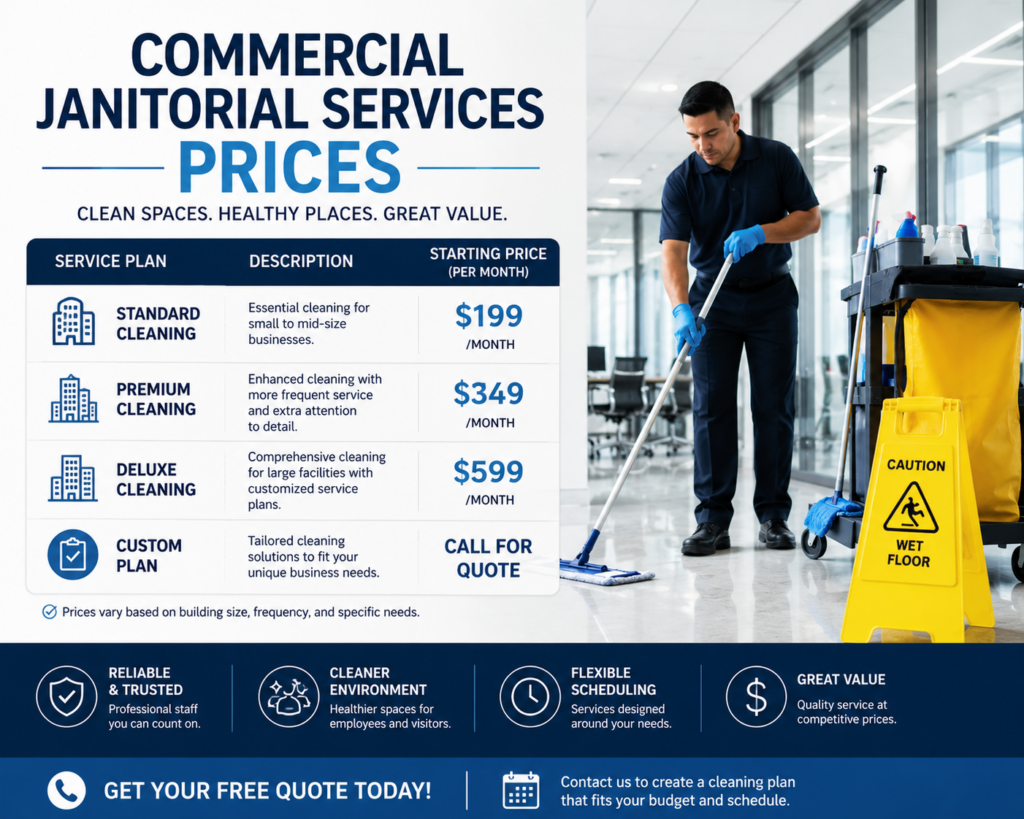
Commercial Janitorial Services Prices: A Complete Guide for Businesses
Commercial janitorial services prices vary widely because they are shaped by square footage, cleaning frequency, building type, labor intensity, specialty tasks, and local wage conditions. In practical terms, many recurring commercial cleaning plans land somewhere around $0.05 to $0.25 per square foot or roughly $25 to $75 per hour, while small offices may see monthly pricing in the low hundreds and larger or high-complexity facilities can reach several thousand dollars per month. The key takeaway is that the cheapest bid is often not the best value: pricing only makes sense when you know exactly what the scope includes, how often the work happens, and whether supplies, supervision, and specialty services are included.
This article explains how commercial janitorial pricing works, what drives costs up or down, what can go wrong when pricing is built poorly, and how to compare quotes without getting misled by vague numbers. It also covers common pricing models, the real costs of underbuying cleaning, and the rules and standards that matter when chemical safety and disinfection are part of the job. If you are comparing providers, planning a budget, or trying to understand why one quote is much higher than another, the sections below will help you make a smarter decision.
What Commercial Janitorial Pricing Means
Commercial janitorial services prices are the amounts businesses pay for recurring cleaning and light maintenance in offices, retail sites, warehouses, medical spaces, schools, and similar facilities. Pricing is usually based on a combination of square footage, labor hours, visit frequency, task complexity, and the risk or sensitivity of the facility. For example, a small office with light traffic may be billed very differently from a medical suite that needs tighter sanitation procedures and more supervision.
The main players are the buyer, the janitorial provider, the technicians doing the work, and sometimes a supervisor or account manager. A proper price should reflect the scope of work, including trash removal, restroom care, dusting, vacuuming, mopping, touchpoint cleaning, and consumable restocking. Specialty work such as carpet extraction, floor stripping and waxing, window cleaning, or post-construction cleanup is usually priced separately.
Common pricing methods include per-square-foot pricing, hourly pricing, flat monthly contracts, and task-based add-ons. The best pricing model depends on how predictable the building is and how much detail the buyer wants. A single flat number can be useful, but it only works when the scope is written clearly enough that both sides know what the number covers.
10 Pricing Factors That Matter Most
1. Square Footage Is Only the Starting Point
Size matters, but square footage alone does not determine the final price. A 2,000-square-foot office can be very easy to clean if it has low traffic and few restrooms, while a 2,000-square-foot medical or food-service environment can require far more labor. That is why national pricing charts often show ranges instead of a single number.
For standard recurring office cleaning, published guides commonly show roughly $0.07 to $0.20 per square foot, with higher rates for more complex facilities. The important point is that square footage only works as a baseline. The real price depends on how much labor is needed to clean that square footage to the expected standard. If you compare quotes by size alone, you can miss hidden differences in frequency, staffing, and included tasks.
2. Cleaning Frequency Drives Recurring Cost
The more often a space is cleaned, the more it usually costs. A once-a-week office will cost much less than a daily service plan for the same building because labor is the main driver. Published pricing examples show that small offices can range from about $100 to $300 per month on light weekly service, while larger or daily-cleaned spaces can climb into the thousands.
This is where many buyers make mistakes. They ask for a quote without first deciding how often the building really needs service. If restrooms, breakrooms, or lobbies get heavy use, cutting frequency too much often leads to visible wear, odor, and complaints. The right frequency is a business decision, not just a budget line.
3. Facility Type Changes the Job
Not all buildings cost the same to maintain. Offices generally cost less than medical spaces, restaurants, industrial facilities, and high-traffic public buildings because the cleaning risk and detail level are lower. Pricing guides consistently show higher rates for medical cleaning, disinfection services, restaurant sanitation, and post-construction work.
This matters because the “same” square footage can require very different labor and product use. A medical facility may need stricter protocols, more careful touchpoint disinfection, and better documentation. A restaurant may need kitchen sanitation and grease-related cleaning. A warehouse may need dust control and floor care. The more specialized the building, the more likely the price rises.
4. Restrooms and Breakrooms Add Labor
Restrooms are often one of the biggest price drivers because they require detailed cleaning, supply restocking, and odor control. Breakrooms add similar complexity because they can involve sinks, microwaves, counters, food debris, and trash that needs more frequent attention. When these spaces are busy, service time increases quickly even if the building is not very large.
That is why one quote can be much higher than another for the same building. The provider may be factoring in several restrooms, frequent restocking, or a more demanding sanitation standard. If you want a fair comparison, ask whether restroom supplies are included and whether the bid assumes daily service, mid-day touchups, or just nighttime cleaning.
5. Specialty Services Are Often Separate
Tasks such as carpet extraction, floor stripping and waxing, marble or terrazzo care, window cleaning, pressure washing, and post-construction cleanup usually cost extra. Published pricing often shows these as separate line items rather than part of routine janitorial service.
This matters because many buyers think they are purchasing “cleaning” and assume specialty maintenance is included. It usually is not. If you need those services, pricing them separately is often the fairest approach because the labor, equipment, and chemical use are different from routine trash-and-vacuum work. The safest move is to ask for an add-on menu so you can see what is included now and what would trigger extra charges later.
6. Labor Rates Move With Location and Market Conditions
Commercial cleaning is labor-intensive, so wages, travel time, staffing availability, and local market conditions all affect price. Guides commonly show hourly commercial cleaning rates in the range of about $25 to $75 per hour, with many office-cleaning jobs landing in the $30 to $50 per hour range depending on complexity.
If a quote seems much lower than the rest, it may reflect lower labor standards, fewer hours, or less supervision. If it seems much higher, it may reflect a higher-cost market, more experienced staff, or stricter service levels. Price is not just a number; it is a reflection of the labor plan behind the number.
7. Supplies and Equipment Can Be Included or Extra
Some contracts include chemicals, paper goods, liners, and basic equipment. Others bill those separately. This can create major pricing differences that look confusing at first but make sense once the scope is reviewed line by line. A quote that includes consumables may appear higher than one that does not.
This is one of the most common comparison mistakes. If one provider includes restroom paper and another does not, the lower-priced quote may actually cost more once you add supplies. The best way to compare is to ask for a full breakdown of who provides what and whether consumables are fixed-price, reimbursed, or client-supplied.
8. Supervision and Quality Control Affect Cost
A cheap quote may be cheap because it assumes minimal oversight. But quality control matters in commercial cleaning, especially for larger properties or occupied buildings with public-facing spaces. Inspectors, supervisors, and account managers all add cost, but they also reduce service misses and rework.
If a provider is much cheaper than others, ask how they monitor quality and respond to complaints. If they have no meaningful inspection system, the lower price may simply reflect a weaker service structure. Good supervision is part of the product, not a luxury add-on.
9. Access, Timing, and Security Requirements Matter
Buildings that require special access, after-hours work, security badges, escort rules, or complex lockup procedures usually cost more to service. So do properties with long elevator waits, multiple floors, or restricted loading access. These issues may not show up in a quick walk-through, but they directly affect labor time.
That is why an accurate estimate should be based on a real site visit, not just a phone call. Access friction adds labor, and labor is the core cost in janitorial work. If a provider does not ask about access, that is a warning sign that the estimate may be too generic.
10. One-Time Jobs Cost More Than Recurring Service
Recurring contracts usually price lower per visit because the provider can standardize staffing and maintain the property over time. One-time cleanings, deep cleans, move-outs, and emergency jobs usually cost more because they are less predictable and often require more labor in a single visit.
This is a useful budgeting rule. If you only want occasional service, expect a higher per-visit rate. If you want predictable recurring maintenance, pricing is usually more efficient. Buyers should think in terms of lifecycle cost, not just today’s invoice.
Common Pricing Models
Per Square Foot Pricing
This model charges based on building size, often with adjustments for complexity. It is useful for comparing basic recurring service across similar properties. The drawback is that it can oversimplify a facility with unusual traffic or specialty spaces.
Hourly Pricing
Hourly pricing works well when scope is unclear or when the buyer wants flexible labor. Published ranges often fall around $25 to $75 per hour depending on service level. The limitation is that it can be harder to predict the final invoice if the job expands.
Flat Monthly Pricing
A flat monthly fee is easy to budget and common for recurring contracts. It works best when the scope is stable and well defined. The drawback is that changes in usage or task load may require contract updates.
Task-Based Add-Ons
Specialty work is often priced separately by task, such as carpet cleaning, floor waxing, or window cleaning. This is efficient when the buyer wants only certain extras, but it can make total pricing harder to forecast if many add-ons are needed.
What Drives Price Up or Down
Several practical factors control commercial janitorial services prices. Bigger facilities, more frequent service, more restrooms, more specialty work, and higher-traffic environments all raise labor requirements. Simpler spaces with low occupancy, fewer touchpoints, and predictable schedules tend to cost less.
Industry-specific needs are another major driver. Medical facilities and restaurant environments often require more detailed sanitation and stronger compliance procedures, which increases labor and product cost. Geographic location and market labor rates also matter, especially in higher-cost metro areas. Finally, the level of responsiveness you expect — emergency calls, daytime porter support, or rapid coverage — usually raises pricing because it adds staffing flexibility.
Real Cost of Underbuying Cleaning
Underpricing janitorial service can create hidden costs that are much bigger than the monthly savings. Dirty restrooms, visible trash, and worn floors hurt customer perception and employee morale. If service is too light, your team may spend time handling basic cleaning issues instead of doing their real jobs. That is a time cost, not just a cleanliness problem.
There are also financial risks. Improper chemical use, poor floor care, or missed sanitation steps can lead to damage, complaints, or the need to hire another vendor to fix the problem. OSHA guidance makes clear that cleaning chemicals carry safety risks if they are mishandled, and EPA guidance shows that disinfectants must be used according to label directions. In other words, a low price is not a bargain if the service fails to protect the building or the people in it.
How an Experienced Expert Helps
An experienced janitorial professional helps you avoid pricing mistakes by translating your building’s needs into a realistic scope. That includes identifying which tasks belong in routine service, which are specialty add-ons, and how often each area should be cleaned. A good expert also helps you compare quotes apples-to-apples so you are not misled by hidden exclusions or vague line items.
During service, an experienced provider helps manage quality, troubleshoot missed tasks, and adjust staffing if traffic changes. They can also explain compliance and safety issues in plain English, especially when cleaning chemicals or disinfectants are involved. That is valuable because the real goal is not just a low price; it is a dependable service plan that performs well over time.
Cost Strategies and Alternatives
Use Tiered Service Packages
Tiered pricing helps you match cost to need. Basic service can cover routine cleaning, while higher tiers include restocking, enhanced restroom attention, or specialty floors. This is appropriate when you want flexibility without starting from scratch. The downside is that buyers must compare tiers carefully so the value is actually clear.
Separate Routine and Specialty Work
This strategy keeps recurring costs stable while letting you price deep cleans, carpet care, and floor restoration only when needed. It works well for most facilities. The limitation is that you must plan specialty work in advance so it does not get deferred too long.
Bid By Scope, Not Just Size
Request proposals that list tasks, frequencies, supplies, and exclusions in detail. This is the best way to compare commercial cleaning services fairly. The drawback is that it takes more time up front, but it usually saves money later by preventing scope disputes.
Build a Contingency Budget
A small reserve for emergency spills, event cleanup, or one-off deep cleaning can prevent budget surprises. This is appropriate for active buildings with changing traffic. The limitation is that you still need rules for when contingency funds can be used.
What To Do If You Are Getting Bad Pricing
- Ask for a full scope of work in writing.
- Separate routine cleaning from specialty services.
- Confirm whether supplies are included.
- Ask how often each area is cleaned.
- Compare labor hours, not just the monthly total.
- Ask what happens when building usage changes.
- Request a line-item breakdown for add-ons.
- Get a second or third quote for comparison.
If your current price seems too high, the issue may be scope, frequency, or hidden services rather than pure overcharging. If it seems too low, the issue may be incomplete coverage. In either case, a clearer scope usually solves more than a discount does.
How To Choose the Right Provider
Look for relevant experience with facilities like yours. A provider should be able to explain how it prices offices, retail spaces, medical sites, or industrial buildings in plain English. Ask for a walkthrough, not just a phone estimate, and request a proposal that clearly identifies labor, supplies, frequency, and exclusions.
Also check responsiveness, supervision, and willingness to discuss long-term needs. A strong provider should not just quote a price; it should explain how the service plan protects your facility over time. If you are evaluating RBM Services, use the same checklist: clear communication, relevant experience, realistic pricing, and a comprehensive approach to both immediate and future cleaning needs.
Common Mistakes People Make
- Comparing quotes without checking the scope.
- Assuming consumables are included when they are not.
- Choosing the lowest hourly rate without asking how many hours are planned.
- Treating specialty cleaning as if it were routine service.
- Ignoring building traffic and restroom usage.
- Forgetting to budget for deep cleans and periodic maintenance.
- Focusing on square footage alone instead of labor needs.
- Not asking how quality control is handled.
Frequently Asked Questions
What are commercial janitorial services prices usually based on?
They are usually based on square footage, labor hours, frequency, building type, and scope of work.
What is the average cost per square foot?
Published guides commonly show ranges around $0.05 to $0.25 per square foot depending on the service type and complexity.
What is the average hourly rate?
Many commercial cleaning jobs fall in the $25 to $75 per hour range, with standard office work often in the lower part of that band.
How much does a small office usually cost?
Small recurring office cleaning often starts in the low hundreds per month, depending on frequency and scope.
Why do two quotes for the same building differ so much?
They may include different frequencies, supplies, specialty tasks, or supervision levels.
Is monthly pricing better than hourly pricing?
Monthly pricing is easier to budget, while hourly pricing can be better when the scope is uncertain.
Are one-time cleanings more expensive?
Usually yes, because they are less predictable and often require more labor in a single visit.
Do medical facilities cost more to clean?
Yes. Published pricing guides generally show higher rates for medical cleaning and disinfection services.
What services are usually extra?
Carpet extraction, floor stripping and waxing, window cleaning, and post-construction cleanup are commonly separate.
Why do restrooms raise the price?
They require more detailed labor, supply restocking, and often more frequent attention than other spaces.
Should supplies be included in the price?
They can be, but the contract should state that clearly so quotes can be compared fairly.
Is the cheapest price ever the best choice?
Sometimes, but only if the scope is truly equivalent. Otherwise the low bid may be missing important work.
How do I know if a bid is too low?
Look for missing labor hours, excluded supplies, weak supervision, or vague task descriptions.
How do I know if a bid is too high?
Compare it to the building’s actual traffic, restroom count, specialty tasks, and required service frequency.
Do high-traffic buildings cost more?
Yes, because they need more labor, more frequent service, and more restocking.
Can I save money by reducing frequency?
Sometimes, but too much reduction often leads to bigger long-term costs from wear and complaints.
What is the best way to compare providers?
Compare scope, frequency, supplies, specialty work, supervision, and response expectations — not just price.
Why do labor rates matter so much?
Commercial cleaning is labor-driven, so wages and staffing requirements directly affect pricing.
Can I bundle specialty services into one contract?
Yes, but it should be priced clearly so you know what is recurring and what is periodic.
Should I ask for a site visit before accepting a quote?
Yes. A site visit usually leads to a more accurate estimate than a phone-only quote.
How often should I review my contract?
Review it whenever occupancy, traffic, or service expectations change, and at least periodically for accuracy.
What if my current cleaner keeps missing tasks?
Document the misses, review the scope, and ask for a corrected service plan.
Why does disinfection sometimes cost more?
Because EPA-regulated disinfectants require specific product use, contact time, and handling.
Are green cleaning products cheaper?
Not necessarily. Product choice may change cost, but labor and scope still drive most pricing.
What is the biggest pricing mistake buyers make?
They buy the lowest number first and discover later that the service scope does not match the building’s needs.
Rules, Laws, and Standards You Should Know
OSHA guidance is important because cleaning chemicals can create health hazards, and employers need safe handling, labeling, ventilation, and training practices. EPA rules matter because disinfectants are regulated products and must be used according to their label directions. If a quote includes disinfecting or chemical-heavy work, these requirements are not optional details; they affect both safety and compliance.
Industry best practices also support better pricing decisions. A provider should be able to explain how it handles chemicals, training, quality checks, and specialty work in a way that fits recognized commercial cleaning standards. That matters because pricing is only meaningful when the underlying service is safe and consistent.
Conclusion
Commercial janitorial services prices are not random. They reflect labor, frequency, facility type, specialty tasks, supplies, supervision, and the level of risk or detail your building requires. Most pricing confusion comes from comparing incomplete quotes or assuming routine cleaning includes work that is actually specialty service.
If you want the best value, start with a clear scope, compare labor and inclusions, and choose a provider that explains pricing in plain English. For guidance related to commercial janitorial services prices, consult with RBM Services.