
Commercial Janitorial Services Business Plan
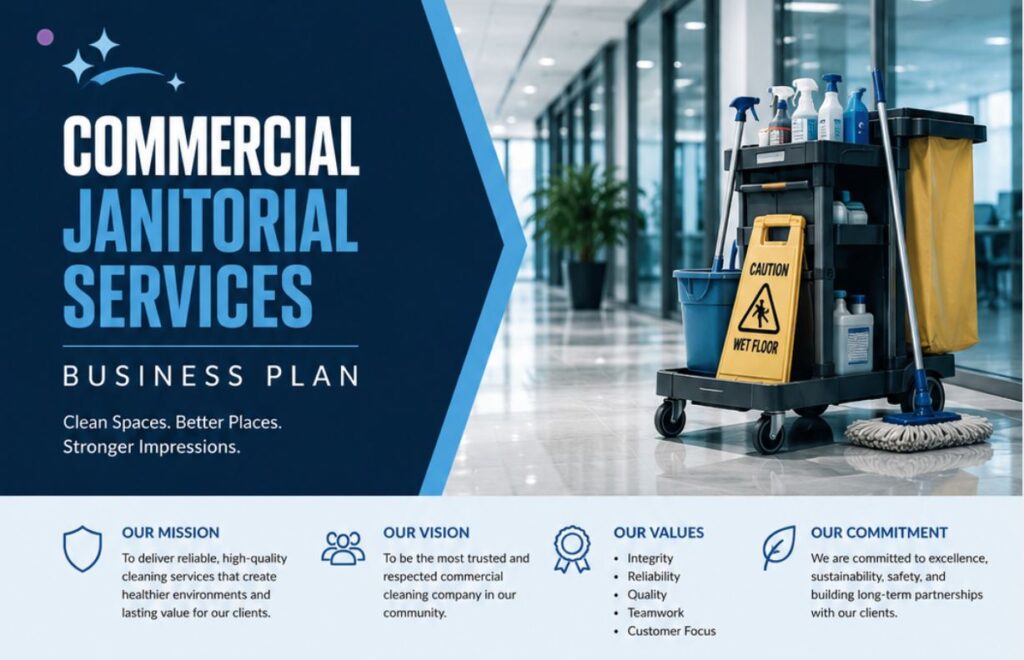
Commercial Janitorial Services Business Plan: Your Step-by-Step Guide to Success
A commercial janitorial services business plan is a roadmap that outlines how to launch, operate, and grow a cleaning company focused on offices, retail spaces, medical facilities, warehouses, and other business properties. It matters because the janitorial industry is competitive and labor-intensive, with low barriers to entry but high failure rates for those without clear financial projections, marketing strategies, and operational systems. The most important takeaway is that success comes from focusing on recurring contracts with stable clients rather than one-off jobs—aim for 70-80% of revenue from monthly retainers to build predictable cash flow. This guide covers the essential components of the plan, common pitfalls like underpricing or poor staffing, financial modeling, marketing tactics, and compliance needs. It also shows how a well-structured plan can help you secure funding, avoid costly mistakes, and scale from a solo operation to a team serving multiple sites. Expert planning reduces risk because it forces you to test assumptions before spending money on equipment or advertising.
What a Commercial Janitorial Services Business Plan Is and How It Works
A commercial janitorial services business plan is a written document that defines your company’s goals, services, target market, operations, marketing approach, and financial forecasts. It serves as a pitch for investors or lenders, a guide for daily decisions, and a benchmark to track progress. Typical length is 20-40 pages, including an executive summary, market analysis, service list, sales strategy, operations plan, and pro forma financials.
Key roles include the owner (you), operations manager for scheduling and quality control, sales team for client acquisition, cleaners for service delivery, and accountants for billing and compliance. The plan follows industry standards like ISSA cleaning guidelines for service quality and OSHA requirements for chemical safety and worker protection. Common types include startup plans for new ventures, growth plans for scaling, and franchise models like Jan-Pro for branded support.
The process works in stages: research market gaps (1-2 months), draft the plan (2-4 weeks), test assumptions with pilot clients (1 month), secure funding (1-3 months), launch operations (ongoing). What it includes: service menu, pricing model, staffing plan, 3-5 year financials. What it excludes: day-to-day logs or employee handbooks—these are operational manuals. For example, a plan for a mid-sized city might target 10 office contracts in year one, projecting $250k revenue at $0.15/sq ft, with 60% gross margins after labor and supplies.
10 Essential Elements of a Winning Plan
1. Executive Summary Sets the Vision
The executive summary is a 1-2 page overview of your business, mission, goals, and financial highlights—written last but read first. It hooks lenders by showing unique value, like specializing in medical office disinfection or green cleaning for tech firms. Without a compelling summary, readers skip details.
This matters because 80% of plans fail to get funding without it. A vague summary like “we clean buildings” loses to one stating “targeting 50k sq ft of underserved retail in growing suburbs, projecting $300k year-one revenue.” Consequences: rejected loans. Write it with specific goals (e.g., 20 clients, 40% margins), market niche, and exit strategy. Update quarterly.
2. Market Analysis Identifies Opportunities
Detail local demand, competitors, pricing benchmarks, and trends like post-COVID sanitation focus. Use data from IBISWorld or local directories to size the market—U.S. janitorial hits $90B annually, with 10-15% growth in healthcare.
Skip this and you chase saturated office cleaning while ignoring warehouses. Example: a plan overlooking retail growth lost to competitors. Research via Google, Yelp, chamber of commerce; survey 20 prospects. Highlight gaps like “no evening service for shift-work factories.”
3. Service Menu Drives Revenue Predictability
List core offerings: nightly office cleans, floor care, carpet extraction, disinfection, window washing. Price recurring at $0.10-0.25/sq ft; specialties higher. Recurring should be 70%+ of revenue.
Over-diversifying dilutes focus; under-offering caps growth. A startup offering everything failed quality checks. Start with 5-7 services matching equipment; expand via add-ons. Include bundles like “office starter pack” for $200/month/2k sq ft.
4. Pricing Strategy Ensures Profitability
Base prices on time-motion studies: $25-50/hour labor, 30-50% margins after supplies. Factor sq ft, frequency, building type. Offer tiers: basic ($0.12/sq ft), premium ($0.20/sq ft with disinfection).
Underpricing kills cash flow; a common trap. Example: $0.08/sq ft led to bankruptcy. Use calculators; test with pilots. Include escalators (3-5%/year) and minimums.
5. Sales and Marketing Plan Fuels Growth
Outline lead gen: networking (90% of contracts), Google Ads ($5-10/lead), door-knocking, referrals. Target 5-10 proposals/week; 20-30% close rate. CRM like Jobber tracks follow-ups.
No plan means feast-or-famine. A solo operator without referrals folded. Budget 5-10% revenue; focus B2B chambers, LinkedIn. Track ROI per channel.
6. Operations Plan Manages Delivery
Detail scheduling software (e.g., Swept), checklists, training (OSHA 10-hour), vehicles, inventory. Scale from solo to 5 crews via supervisors.
Chaos from poor ops loses clients. Example: no-shows cost a firm 30% accounts. Use GPS routing, daily audits; standardize via manuals.
7. Staffing Model Supports Scale
Project hires: year 1 (you + 2 PT), year 3 (manager + 10 FT). Wages $15-25/hr; train on chemicals, safety. Turnover 50-100% normal—budget retention bonuses.
Understaffing burns out teams; overstaffing drains cash. A growing firm lost 40% clients to inconsistencies. Recruit via Indeed; use background checks, bonding.
8. Financial Projections Prove Viability
3-5 year P&L, cash flow, balance sheet. Startup costs $10k-50k (van, supplies). Break-even 3-6 months at 5 clients. 50-60% gross margins realistic.
Rosy numbers repel funders. Example: ignoring payroll taxes sank a plan. Use QuickBooks; sensitivity analysis for 20% revenue drop.
9. Risk Management Covers Liabilities
Address insurance (GL $1M, workers comp), bonding ($10k-50k), OSHA compliance. Contracts with SLAs, termination clauses.
Lawsuits wipe startups. Slip-and-fall cost one $100k. Require certs; annual reviews.
10. Growth Roadmap Plans Expansion
Milestones: 10 clients year 1, 50 year 3; add green services, new markets. Exit via sale (3-5x EBITDA).
Stagnation kills. No roadmap left a firm stuck at $100k revenue. Quarterly reviews; reinvest 20% profits.
The Real Cost of a Weak Business Plan
Financially, poor plans lead to cash shortages ($50k+ losses year one), bad hires, overpriced equipment. Time sinks into firefighting clients. Emotional toll: burnout from 80-hour weeks. Long-term: business failure (60% in year 1). Proper planning avoids 70% via tested models.
How an Expert Helps You Launch
Experts refine market analysis, model realistic financials, craft investor pitches, set ops systems. They mitigate risks via compliance audits, resolve early disputes, ensure OSHA/EPA adherence. Proactive: pilot tests, mentor scaling.
Business Plan Templates and Strategies
Lean Startup Canvas
One-page summary for quick launches. Good for solos. Limits depth for funding.
Full SBA Template
30+ pages for loans. Ideal banks. Time-intensive.
Franchise Model
Proven systems (e.g., Jan-Pro). Faster ramp-up. Royalty fees.
Software-Assisted (LivePlan)
Auto-generates financials. Scalable. Subscription cost.
What to Do If Starting Now
- Research local competitors/pricing.
- List services/unique value.
- Build 12-month budget.
- Draft executive summary.
- Get feedback from mentors.
- Pilot one client.
- Buy insurance.
- Network for leads.
How to Choose a Consultant
- Janitorial experience (5+ years).
- Financial modeling skills.
- Clear templates.
- References from cleaners.
- Scalable advice.
- Affordable packages.
Common Mistakes
- Skipping market research.
- Overly optimistic financials.
- No ops manual.
- Ignoring insurance.
- Broad services early.
- Weak sales plan.
- Static document.
Frequently Asked Questions
What is in a janitorial business plan?
Executive summary, market analysis, services, financials.
How much to start?
$10k-50k for solo; more for teams.
Average revenue year 1?
$100k-300k with 5-10 clients.
Key Rules and Standards
OSHA for safety; EPA for disinfectants; state licensing varies; bonding common.
Conclusion
A solid commercial janitorial services business plan turns ideas into profitable reality. Focus on recurring revenue, tight ops, realistic numbers. Consult RBM Services for guidance.