
Commercial Cleaning Contractors Janitorial Services
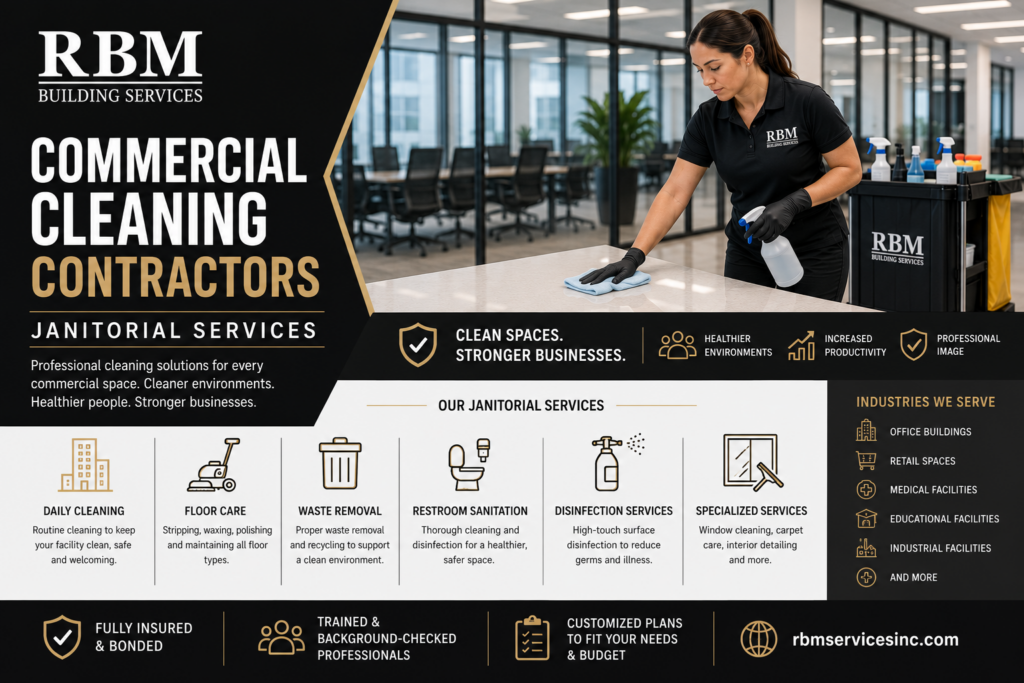
The Complete Guide for Business Owners
What Commercial Cleaning Contractors Janitorial Services Is and Why It Matters
Commercial cleaning contractors janitorial services refers to professional cleaning companies that are contracted to provide ongoing janitorial maintenance and specialized commercial cleaning to businesses, offices, retail spaces, medical facilities, and industrial properties. These contractors deliver comprehensive sanitation, disinfecting, floor care, trash removal, carpet cleaning, and facility upkeep that keeps commercial spaces safe, compliant, and presentation-ready.
The most important takeaway: Choosing the right commercial cleaning contractor isn’t just about cleanliness—it’s about protecting your business from health risks, regulatory violations, employee sick days, and liability claims. Poor cleaning can cost you $50,000–$150,000+ in lost productivity, OSHA fines, and damage, while professional janitorial services typically cost $0.08–$0.20 per square foot monthly.
This guide covers what commercial cleaning contractors provide, how they work, common pitfalls, real costs of mistakes, service options, how to choose the right contractor, and 25+ FAQs. Whether you’re currently searching or planning ahead, expert guidance from experienced professionals like RBM Services will help you avoid costly mistakes.
What Is Commercial Cleaning Contractors Janitorial Services and How Does It Work?
Clear Definition
Commercial cleaning contractors janitorial services are professional cleaning companies contracted by businesses to maintain hygiene and safety in commercial facilities. “Janitorial” typically refers to routine, daily maintenance (trash, restrooms, floors), while “commercial cleaning” includes deep cleaning and specialized tasks (carpet cleaning, floor stripping, window washing).
Key Roles and Components
| Party | Role |
|---|---|
| Facility Manager/Owner | Identifies needs, signs contracts, oversees quality |
| Cleaning Contractor | Provides trained staff, equipment, chemicals, supervision |
| Cleaning Technicians | Execute daily/weekly cleaning tasks per scope |
| Quality Inspector | Conducts audits, ATP testing, visual inspections |
| Regulatory Agencies | OSHA, EPA enforce safety and hygiene standards |
Governing Rules and Industry Standards
Commercial cleaning contractors must comply with:
- OSHA 29 CFR 1910.132: PPE requirements
- OSHA 29 CFR 1910.1200: Hazard Communication Standard
- OSHA 29 CFR 1910.1030: Bloodborne Pathogens (for medical)
- EPA Registration: All disinfectants must have EPA Registration Numbers
- ISSA Clean Standard: Industry benchmark
- Green Seal GS-42: Environmental certification
Common Variations
| Service Type | Frequency | Typical Tasks |
|---|---|---|
| Janitorial (Daily) | Daily/Weekly | Trash, restrooms, floors, dusting |
| Commercial Deep-Clean | Monthly/Quarterly | Carpet deep-clean, floor stripping, windows |
| Medical/Healthcare | Daily (twice) | Hospital-grade disinfecting, biohazard protocols |
| Industrial | Weekly | Heavy-duty degreasing, warehouse maintenance |
Process Flow
- Facility Assessment: Contractor evaluates square footage, traffic patterns, bathrooms/kitchens
- Scope Development: Custom cleaning plan with tasks, frequency, chemicals
- Contract Signing: Agreement details scope, price, liability, standards
- Staff Deployment: Trained technicians begin with proper PPE
- Quality Control: Regular inspections, feedback, adjustments
- Ongoing Service: Recurring janitorial + periodic deep-cleaning
What Is Included vs. Not Included
Typically Included in Janitorial:
- Restroom sanitization
- Trash removal
- Floor care (vacuuming, mopping)[
- High-touch surface cleaning
- Dusting and breakroom cleaning
Typically NOT Included (Separate Services):
- Carpet deep-cleaning ($279–$400)
- Window cleaning
- Floor stripping/waxing ($0.50–$0.75/sq. ft.)
Real Example
A 5,000 sq. ft. office with 4 bathrooms: Daily trash, restrooms, floors, dusting. Monthly cost: $400–$1,000 ($0.08–$0.20/sq. ft.).
9 Ways Commercial Cleaning Contractors Janitorial Services Can Go Wrong
1. Hiring Based Only on Lowest Price
Problem: Choosing cheapest contractor without verifying scope or insurance.
Consequence: Missed sanitization led to Norovirus outbreaks, 12 sick days, $8,000 lost productivity.
Solution: Request detailed scope, verify insurance ($1M+ liability + workers’ comp), invest in quality ($0.08–$0.20/sq. ft.).
2. Using Unregistered Disinfectants
Problem: Generic cleaners without EPA registration.
Consequence: OSHA violations, $15,000 fines, 30% increase in complaints.
Solution: Request EPA Registration Numbers, verify OSHA Hazard Communication training.
3. Inadequate Staff Training
Problem: Technicians lack PPE, chemical handling, or bloodborne pathogen training.
Consequence: Worker injury claims, doubled insurance premiums.
Solution: Ask for OSHA 10/30-hour training, bloodborne pathogen certification (if medical).
4. Skipping Quality Control
Problem: No inspections or ATP testing.
Consequence: 45% customer complaints, 12% foot traffic drop.
Solution: Require documented inspections, ATP testing, 24-hour response.
5. Overlooking Facility-Specific Needs
Problem: Generic plans miss unique requirements.
Consequence: Cross-contamination in medical facilities.
Solution: Require facility assessment, verify industry experience.
6. Ignoring Insurance Coverage
Problem: No verification of liability/workers’ comp.
Consequence: $45,000 liability claim for worker injury.
Solution: Request Certificate of Insurance (COI).
7. Failing to Address Biohazard Risks
Problem: Untrained staff handle medical waste.
Consequence: $28,000 OSHA violation, worker infections.
Solution: Confirm bloodborne pathogen training, proper disposal.
8. No Communication Channels
Problem: Contracts lack defined contacts.
Consequence: $12,000 floor damage from delayed reporting.
Solution: Specify primary contacts, 24-hour response in contract.
9. Neglecting Environmental Standards
Problem: Harsh chemicals harm air quality.
Consequence: 20% higher asthma rates, $18,000 annual sick days.
Solution: Request Green Seal GS-42, EPA Safer Choice products.
The Real Cost of Getting It Wrong
| Problem | Direct Cost | Indirect Cost |
|---|---|---|
| Illness outbreaks | $8,000–$25,000 | Reputation damage |
| OSHA violations | $15,000–$28,000 | Retraining costs |
| Liability claims | $45,000+ | Higher premiums |
| Property damage | $12,000–$35,000 | Replacement delays |
Total avoidable cost: $50,000–$150,000+ over 2–3 years.
90% avoidable with proper planning: Verify insurance, training, EPA registration, quality control, invest in quality.
How an Experienced Commercial Cleaning Contractor Helps
Experienced contractors provide:
- Initial Assessment: Facility walkthrough, identify high-traffic zones
- Custom Scope: Industry-aligned cleaning plans
- Compliance: EPA-registered disinfectants, OSHA-trained staff
- Quality Control: Regular inspections, ATP testing
- Risk Management: Insurance ($1M+), trained staff, proper protocols
By partnering with RBM Services, you gain compliant, high-quality, risk-free cleaning from day one
Service Options and Strategies
| Option | How It Works | When Appropriate | Cost |
|---|---|---|---|
| Recurring Janitorial | Daily/weekly fixed schedule | Offices, retail, medical | $0.08–$0.20/sq. ft. |
| One-Time Deep-Clean | Single appointment | Post-construction, seasonal | $150–$2,000+ |
| Medical Cleaning | Hospital-grade protocols | Clinics, hospitals | $0.15–$0.35/sq. ft. |
| Green Cleaning | EPA Safer Choice, low-VOC | Sustainability-focused | $0.10–$0.22/sq. ft. |
What to Do If Dealing With Issues
- Document issues with photos and dates
- Review contract for scope and termination
- Contact contractor requesting 24-hour response
- Verify compliance: COI, EPA numbers, training
- If unresolved, search top-rated contractors, compare 3–5 quotes
- Negotiate new contract with communication protocols
Consult RBM Services for guidance on disputes or contractor selection.
How to Choose the Right Commercial Cleaning Contractor
| Criteria | What to Look For |
|---|---|
| Experience | 5+ years in your industry |
| Insurance | $1M+ liability + workers’ comp |
| Training | OSHA 10/30-hour, bloodborne pathogen |
| EPA Compliance | Registered disinfectants |
| Quality Control | Inspections, ATP testing |
| Communication | Primary contact, 24-hour response |
Red Flags
- ✗ No insurance documentation
- ✗ Price below $0.08/sq. ft.
- ✗ Unregistered disinfectants
- ✗ No quality control
Top Contractors: Vanguard Cleaning, Health Point Cleaning, JAN-PRO, Jani-King, Mint Condition (award-winning).
Common Mistakes
- Choosing lowest bidder without verifying scope
- Not verifying insurance
- Using unregistered disinfectants
- Skipping facility assessment
- Ignoring OSHA/EPA compliance
- No communication protocols
- Overlooking quality control
- Failing to address industry needs
Daily Janitorial Checklist (What to Expect)
Commercial cleaning contractors should perform these daily tasks:
- Trash Removal: Empty all bins, replace liners, sort recyclables
- Restrooms: Disinfect toilets, urinals, sinks, mirrors, faucet handles, door handles
- Floors: Vacuum carpets, sweep/mop hard floors, spot clean spills
- High-Touch Surfaces: Disinfect door handles, light switches, elevator buttons, handrails
- Common Areas: Dust desks, countertops, wipe electronics, clean glass surfaces
- Breakrooms: Wipe countertops, clean refrigerator, empty trash, sweep/mop
- Final Walk-Through: Check all areas, restock supplies, report maintenance issues
Frequently Asked Questions
What is the average cost of commercial cleaning contractors janitorial services?
$0.08–$0.20/sq. ft. monthly or $25–$90/hour. Small offices (1,000 sq. ft.): $120–$480/month.
What’s the difference between janitorial and commercial cleaning?
Janitorial = routine daily tasks (trash, restrooms, floors). Commercial cleaning = deep cleaning, specialized tasks (carpet deep-clean, floor stripping, windows).
What services are included in standard janitorial?
Trash, restrooms, floors, high-touch surfaces, dusting, breakrooms.
How often should facilities be cleaned?
High-traffic: daily; low-traffic: weekly; medical: twice-daily.
Are janitorial services regulated?
Yes—OSHA federal standards (PPE, hazard communication, bloodborne pathogens) and EPA registration.
What questions to ask before hiring a contractor?
Insurance, EPA numbers, OSHA training, quality control, industry experience, communication.
How to verify a contractor’s insurance?
Request Certificate of Insurance (COI) showing $1M+ liability + workers’ comp.
Do contractors provide their own supplies?
Yes—all equipment, chemicals, supplies included.
Can I request eco-friendly products?
Yes—request Green Seal GS-42 or EPA Safer Choice.
How long to set up service?
3–7 days; initial deep-clean adds 1–2 days.
What if quality is poor?
Require 24-hour response, corrective action plans; terminate per contract.
Do they clean carpets?
Vacuuming/spot-cleaning yes; deep-clean separate ($279–$400).
Are medical cleaning services more expensive?
Yes—$0.15–$0.35/sq. ft. for hospital-grade, biohazard protocols.
What is Green Seal certification?
Third-party certification for environmentally responsible cleaning.
How to cancel a contract?
Review termination clause (typically 30 days), provide written notice.
What is ISSA CIMS?
Certification for quality cleaning and operational management.
Do contractors work weekends/nights?
Most offer flexible scheduling.
What is the difference between office and industrial cleaning?
Office = dusting, restrooms, floors; industrial = degreasing, warehouse maintenance.
How much does window cleaning cost?
$2–$3/pane or $0.50–$1.50/sq. ft. (separate).
What is floor stripping and waxing?
Removes old wax, applies new; $0.50–$0.75/sq. ft., quarterly/annual.
Can contractors handle biohazard cleanup?
Not standard—requires specialized contractors.
What is ATP testing?
Measures microbial contamination for objective verification.
How to report OSHA violations?
1-800-321-OSHA or osha.gov.
What should be in a contract?
Scope, frequency, pricing, insurance, communication, quality control, termination.
Are there state licensing requirements?
Most states don’t require specific janitorial licensing, but lead certification is required under EPA RRP program for pre-1978 facilities.
What is day porter service?
On-site cleaning during business hours for immediate response to spills, restrooms.
Key Rules, Laws, and Standards
| Regulation | Agency | Requirement |
|---|---|---|
| OSHA 1910.1200 | OSHA | Hazard Communication, SDS library |
| OSHA 1910.132 | OSHA | PPE provision |
| OSHA 1910.1030 | OSHA | Bloodborne pathogens |
| EPA Registration | EPA | Disinfectant numbers |
| Green Seal GS-42 | Green Seal | Environmental certification |
Disclaimer
This article provides general information only, not legal or professional advice. Verify current OSHA/EPA regulations and confirm insurance before signing contracts.
Conclusion
Commercial cleaning contractors janitorial services are essential for safe, compliant commercial facilities. Most problems are fully avoidable with proper planning—verify insurance, EPA registration, training, and quality control. Invest in quality ($0.08–$0.20/sq. ft.) rather than lowest price.
For personalized guidance on selecting contractors and ensuring compliance, consult with RBM Services.
Contact RBM Services today.