A failed post-construction inspection delays project closeout by weeks. Use this checklist to prepare for a smooth final walkthrough.
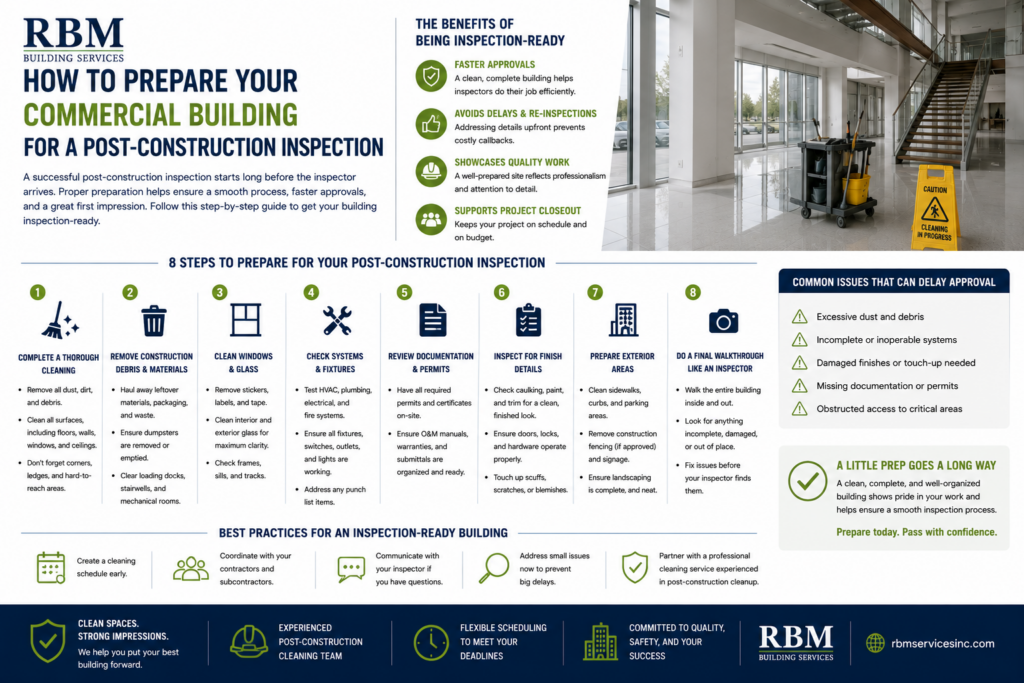
The final inspection is the last major milestone before your project closes. It’s also the most common point of delay. A failed inspection means rework, schedule slips, and strained relationships. This guide walks through exactly what to check before the inspector arrives.
The difference between passing on the first try and facing a re-inspection often comes down to preparation. A failed inspection can delay project closeout by 1-3 weeks, trigger penalty clauses of $500-$5,000 per day, and strain relationships with the general contractor and building owner. Taking the right steps before the inspector arrives saves time, money, and reputation.
Post-construction inspections typically cover life safety systems, structural finishes, mechanical systems, ADA compliance, and cleanliness. While all five categories matter, cleanliness is the one most within your control and the one most likely to cause a re-inspection. This guide focuses on the preparation steps that ensure a smooth final walkthrough.

What Inspectors Look For
Post-construction inspections cover life safety systems (fire alarms, sprinklers, emergency lighting), structural finishes (walls, paint, flooring), mechanical systems (HVAC, plumbing, electrical), accessibility (ADA compliance for doors, restrooms, signage), and cleanliness. Cleanliness is the most visible factor and the one most likely to cause a re-inspection.
Life Safety Systems: Fire alarms tested and operational, sprinkler system pressure verified, emergency lighting and exit signs illuminated, fire extinguishers installed and tagged, and fire dampers in place. These are non-negotiable — most inspectors start here.
Structural Finishes: Walls and ceilings free of cracks, paint complete and uniform, flooring installed correctly with transitions, trim properly fitted, and caulking applied at all joints. Inspectors look for workmanship issues that indicate rushed or incomplete work.
Mechanical Systems: HVAC balanced and operational, thermostats programmed, ductwork sealed, plumbing fixtures water-tested, and electrical outlets tested. Cleanliness of mechanical rooms is a common inspection point — debris stored in these spaces is an automatic flag.
ADA Compliance: Door widths meeting ADA requirements, restroom grab bars at correct heights, signage with Braille, ramp slopes within code, and accessible parking marked. Even minor ADA violations can halt a certificate of occupancy.
The Cleaning Checklist That Passes Every Inspection
Cleanliness is the most visible factor in a final inspection. Room-by-room checklist includes: Lobby/Common Areas: Protective film removed from glass, windows streak-free, floors cleaned, baseboards dust-free, light fixtures clean. Restrooms: Toilets and urinals sanitized, sinks clean, mirrors streak-free, partitions clean, grab bars secured, floor drains clear. Office Spaces: Construction stickers removed, carpets vacuumed, hard floors mopped, outlet covers clean, no paint splatter. Mechanical Rooms: Floors swept, equipment wiped, no debris stored. Exterior: Walkways swept, loading dock clean, construction signage removed.
Go beyond the basic checklist with these pro tips for each area:
Entryways and Glass: Stickers left on windows and glass doors is the single most common cleanliness fail. Check every pane of glass personally — including interior sidelights and transom windows. Use a razor blade scraper at the correct angle for any remaining adhesive.
Floor Care: Post-construction floors often have adhesive residue, paint splatter, and drywall dust embedded in the surface. Hard floors may need a damp mop followed by a dry mop. Carpets often need a hot water extraction rather than just vacuuming — construction dust settles deep into carpet fibers.
Vertical Surfaces: Inspectors check baseboards, door frames, and window sills for dust and construction debris. Wipe all vertical surfaces with a damp cloth. Pay special attention to the tops of door frames and window casings where dust settles.
Ceiling Level: Light fixtures, ceiling fans, vents, and smoke detectors accumulate construction dust. Inspectors often check these with a white glove. Include ceiling-height cleaning in your scope of work with the cleaning crew.
When to Schedule the Final Clean
Ideal timeline: 3-5 days before inspection — trades complete punch list. 2-3 days before — pre-final walkthrough with GC and cleaning crew. 1-2 days before — final clean by professionals. Day before — inspection team walkthrough. Inspection day — inspector arrives to clean, ready site. Critical: Do not schedule final clean before punch-list work is complete. If a trade returns after cleaning, they will re-dirty the area.
The timing of the final clean is as important as the quality. Schedule it too early and trades returning for punch-list work will redirty the space. Schedule it too late and there will not be enough time for a quality job.
The ideal sequence works backward from the inspection date: At 5-7 days before, verify all trades have completed their punch list items and will not need to return. At 3-4 days before, conduct a pre-final walkthrough with the GC and cleaning foreman to identify all areas needing attention. At 2-3 days before, the professional cleaning crew performs the final clean, working from ceiling to floor. At 1 day before, the inspection team does their own walkthrough to verify readiness and address any missed spots. On inspection day, the site is clean, organized, and ready.
Book your cleaning crew 2-3 weeks in advance. Quality construction cleaning companies schedule up quickly, especially at month-end and quarter-end when many projects close.
The Pre-Inspection Walkthrough
Do your own walkthrough with the GC and cleaning foreman before the official inspection. Walk every room with a checklist. Look for remaining punch-list items, areas needing additional cleaning, damage during final phase, missing items, and safety issues. Take photos of every room and document the condition before the inspector arrives. For more detail on cleaning phases, see our guide on rough clean vs. final clean.
The pre-inspection walkthrough is your last chance to catch and fix issues before the official inspection. Treat it as seriously as the inspection itself.
Who should attend: The general contractor or project manager who knows the full scope of work; the cleaning company foreman who can direct the crew to fix any issues found; subcontractor leads for electrical, plumbing, and HVAC in case systems need adjustment; and the building owner representative if they want to be involved.
Walkthrough process: Enter every room and space — including mechanical rooms, storage closets, and roof access areas. Check life safety systems first (fire alarms, emergency lighting, extinguishers). Then inspect finishes and cleanliness in each space. Take photos of every room for documentation. Create a punch list of items to address before the inspector arrives.
For more on rough clean vs. final clean phases, see our construction cleaning guide.
Common Inspection Failures
Common failures: Debris in mechanical rooms, dust on light fixtures, stickers left on windows, dirty restrooms, adhesive residue on floors, missing or dirty vents. A re-inspection costs schedule delays of 1-3 weeks, penalty clauses of $500-$5,000 per day, cleaning redo at $0.20-$0.50/sq ft, and reputation damage. For choosing the right partner, see our vendor selection guide.
Most common inspection failures:
Debris in mechanical rooms: Mechanical spaces become catch-all storage during construction. Schedule mechanical room cleaning last and enforce strict no-storage policies during final phase.
Dust on light fixtures and ceiling surfaces: Inspectors check high ledges, top of door frames, and ceiling-mounted fixtures. Include ceiling-height dusting in the cleaning scope.
Stickers and protective film on windows and mirrors: This is the easiest thing to miss and the most common cause of re-inspection. Check every glass surface personally.
Dirty or incomplete restrooms: Restrooms must be completely clean — toilets, urinals, sinks, mirrors, partitions, and floors. Stalls and partitions often have protective film that is easily overlooked.
Adhesive residue and paint splatter on floors: Use proper adhesive removers and cleaning solutions. Scraping damages floor surfaces and creates more work.
For choosing the right cleaning partner, see our vendor selection guide.
Working With Professional Construction Cleaners
Professional crews bring HEPA-filtered vacuums for fine construction dust, industrial wet/dry vacs, commercial glass tools, carpet extraction equipment, and floor care equipment. RBM provides post-construction cleaning along with floor care and window washing. See this overview of service models and this guide to cleaning preparation.
Post-construction cleaning is fundamentally different from routine janitorial service. Standard nightly cleaning crews do not have the equipment, training, or experience to handle the level of debris and specific requirements of a final construction clean.
What professional construction cleaners bring: HEPA-filtered vacuums that capture fine construction dust rather than recirculating it; industrial wet/dry vacs for post-construction debris and standing water; commercial glass cleaning tools with purified water systems for streak-free results; carpet extraction equipment specifically designed for post-construction soil levels; floor care equipment including buffers and burnishers for hard surfaces; knowledge of inspector expectations and common fail points.
RBM provides comprehensive post-construction cleaning as part of our full-service janitorial programs, along with floor care and window washing for final preparation. See this overview of service models and this guide to preparation.
Planning a construction project? Contact RBM for post-construction cleaning services.
Final Thoughts
Since 1974, RBM has provided construction cleaning and building maintenance across Utah, Arizona, Nevada, and Texas. Services include Full-Service Janitorial, Building Maintenance, Floor Recoating, Carpet Cleaning, Window Washing, and Pressure Washing. Call 800.403.3564 or contact us.
A successful post-construction inspection comes down to three principles: prepare early, communicate clearly with your cleaning crew and GC, and double-check everything before the inspector arrives. The time invested in thorough preparation pays back many times over by avoiding the cost and frustration of a re-inspection.
Since 1974, RBM Building Services has been helping property managers, general contractors, and building owners prepare their commercial buildings for successful inspections. With over 50 years of experience in construction cleaning and building maintenance across Utah, Arizona, Nevada, and Texas, our team knows what inspectors look for and how to deliver a clean facility that passes on the first try.
Services include Full-Service Janitorial, Building Maintenance, Floor Recoating, Carpet Cleaning, Window Washing, and Pressure Washing. Call 800.403.3564 or contact us to schedule a consultation.