Education facilities face unique cleaning standards that most commercial buildings do not. Learn what regulations apply and how to meet them.
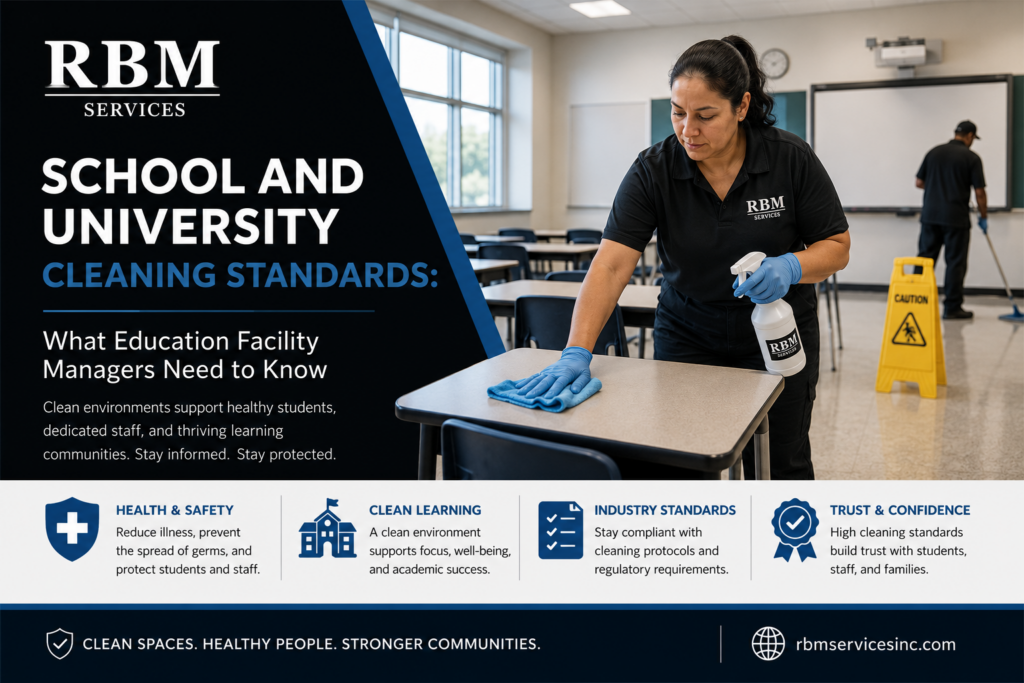
K-12 schools and universities operate under stricter cleaning standards than most commercial facilities. High occupant density, vulnerable populations, shared surfaces, and regulatory oversight from multiple agencies create a complex cleaning environment that requires specialized protocols and proven processes.
Educational facilities face a unique set of cleaning challenges that most commercial buildings do not. High occupant density, vulnerable populations including children and immunocompromised individuals, shared surfaces touched by hundreds daily, and regulatory oversight from multiple agencies create a complex cleaning environment. Unlike office buildings where appearance is the primary concern, schools and universities must also meet strict health and safety standards.
K-12 schools operate under different regulations than universities, and both differ from standard commercial janitorial contracts. Understanding these distinctions is essential for facility managers who want to keep students and staff healthy while staying compliant with state and local requirements.

Why Schools and Universities Are Different
Schools face unique challenges: high-touch surfaces shared by hundreds daily, children and staff with compromised immune systems, strict state health department requirements, OSHA standards for chemical handling near minors, ADA accessibility for cleaning layouts, and extended hours requiring cleaning around classes. Compliance failures risk citations, reputational damage, and health outbreaks.
High-touch surfaces: Desks, door handles, light switches, railings, computer keyboards, and sink handles are shared by hundreds of students daily. These surfaces require frequent disinfecting — not just cleaning — to prevent the spread of illness.
Vulnerable populations: Children have developing immune systems. Staff may have compromised immunity. Schools are breeding grounds for respiratory and gastrointestinal illnesses. Cleaning protocols must address this reality.
Regulatory oversight: Schools answer to state health departments, local health codes, OSHA for employee safety, EPA for chemical use, and CDC guidance for infection control. Universities may also have research facility requirements.
Operational challenges: Cleaning must happen around class schedules, after school hours, and during breaks. Summer and winter breaks provide windows for deep cleaning that standard commercial buildings do not have.
Key Regulations and Standards
Key regulatory bodies include: OSHA: Hazard Communication Standard, Bloodborne Pathogens Standard, PPE requirements. EPA: Registered disinfectants meeting contact time requirements. CDC: Guidelines for infection control in schools. State health departments: Specific to each state. Local health codes: Vary by municipality. See our compliance guide for healthcare facilities which shares many standards.
Educational facilities must comply with multiple regulatory frameworks:
OSHA: Hazard Communication Standard requires proper labeling and SDS sheets for all cleaning chemicals. Bloodborne Pathogens Standard applies to cleaning staff in schools (bodily fluid cleanup). PPE requirements for handling cleaning chemicals and waste.
CDC: Guidelines for infection control in schools recommend daily disinfecting of high-touch surfaces and immediate cleanup of spills involving bodily fluids. The CDC provides specific guidance for K-12 schools versus higher education settings.
State health departments: Each state has specific requirements for school cleanliness, restroom sanitation, cafeteria cleaning, and pest management. Some states require green cleaning products in schools.
EPA: Registered disinfectants must be used according to label instructions, including proper dwell time (contact time) for effectiveness. Many schools have shifted to EPA Safer Choice certified products for routine cleaning.
Classroom and Office Cleaning Requirements
Classrooms require daily disinfecting of high-touch surfaces: desks, door handles, light switches, computer keyboards, sink handles, countertops. Floors should be vacuumed daily and mopped weekly. Offices follow standard commercial cleaning with extra attention to shared equipment. Seasonal deep cleaning before school years and during breaks handles carpets, upholstery, window coverings, and vents. For floor maintenance, see our floor recoating guide.
Classrooms require daily attention. Desks, chairs, and tables should be wiped with disinfectant daily. Floors should be vacuumed daily in carpeted rooms and swept/mopped daily in rooms with hard flooring. Computer labs need special attention to keyboards and mice.
Offices and administrative areas follow standard commercial cleaning protocols — nightly vacuuming, dusting, trash removal, and restroom cleaning. However, shared equipment like copiers, break room appliances, and waiting area furniture in administrative offices see heavy use and need regular disinfecting.
Seasonal deep cleaning is critical for schools. Summer break is the ideal time for: full carpet extraction throughout the building, floor stripping and waxing, deep cleaning of all upholstered furniture, window cleaning inside and out, and HVAC vent and duct cleaning. Winter break provides a mid-year opportunity for carpet extraction in high-traffic areas.
Restroom and Locker Room Sanitation
Restrooms need hourly checks during school hours, daily deep cleaning, and monthly specialized maintenance. Requirements: EPA-registered disinfectants for all surfaces, proper dwell time per label, floor drain cleaning and sanitization, locker rooms require anti-microbial treatment for showers, daily mopping with disinfectant, and ventilation checks. Our full-service janitorial includes school restroom sanitation protocols.
School restrooms are among the highest-risk areas for germ transmission. They require: hourly checks during school hours for cleanliness and supply levels, daily deep cleaning with EPA-registered disinfectants, proper dwell time (typically 5-10 minutes) for disinfectants on all surfaces, and monthly deep cleaning including grout scrubbing and tile detailing.
Locker rooms present additional challenges: shower areas need anti-microbial treatment, floors need daily mopping with disinfectant, and ventilation must be checked regularly to prevent mold growth. For universities with athletic facilities, the frequency increases significantly during sports seasons.
Our full-service janitorial programs include school-specific restroom and locker room sanitation protocols based on CDC and state health department guidelines.
Cafeteria and Kitchen Guidelines
Cafeterias fall under health department food service regulations: daily cleaning of all food contact surfaces with approved sanitizers, floor cleaning after each meal service, grease trap maintenance, pest control documentation, weekly deep cleaning, and hood/vent cleaning per fire code. Kitchens require NSF-certified cleaning products and documented cleaning schedules. Pest management: IPM programs, sealed trash, and regular inspections.
Cafeterias and school kitchens fall under health department food service regulations, which are stricter than general commercial cleaning standards:
Daily: All food contact surfaces cleaned and sanitized after each meal service. Floors swept and mopped after breakfast and lunch. Trash removed and dumpster area cleaned.
Weekly: Deep cleaning of kitchen equipment including ovens, fryers, and hoods. Grease trap maintenance. Pest control inspection. Walk-in cooler and freezer cleaning.
Monthly: Full kitchen deep cleaning including walls, ceilings, and hard-to-reach areas. Hood and vent cleaning per fire code requirements.
Kitchens require NSF-certified cleaning products and documented cleaning schedules for health department inspections. Pest management programs (IPM) are mandatory for food service areas.
Gymnasiums and Athletic Facilities
Gyms have high-impact floors needing specialized care, mat cleaning with anti-microbial solutions, locker rooms with extra disinfection, equipment wiping between uses, and ventilation/air quality monitoring. Athletic facilities often require cleaning before and after events. See how to choose a cleaning vendor and read janitorial service models plus sample proposals for schools.
School and university gymnasiums require specialized care. High-impact floors need daily dust mopping and weekly damp mopping with appropriate cleaners. Gym mats need regular cleaning with anti-microbial solutions. Locker rooms, as mentioned, are high-risk areas needing daily disinfection.
Athletic equipment including weight machines, cardio equipment, and sports gear should be wiped down between uses. Many universities employ dedicated staff for equipment cleaning during sports seasons.
Air quality in athletic facilities requires attention — gymnasiums often have poor ventilation, and proper cleaning of vents and HVAC systems is essential for athlete health.
For guidance on choosing a cleaning partner for your educational facility, see vendor selection guide. For additional resources, see janitorial service models for schools and sample cleaning proposals.
Looking for a cleaning partner who understands education facility requirements? Contact RBM.
Choosing the Right Partner
Since 1974, RBM has provided Full-Service Janitorial, Building Maintenance, Window Washing, Carpet Cleaning, and Floor Care for education facilities. Call 800.403.3564 or contact us.
Schools and universities have unique cleaning requirements that demand specialized knowledge and protocols. From infection control in classrooms to health department compliance in cafeterias to anti-microbial treatment in locker rooms, the cleaning program must address the specific needs of educational environments.
Since 1974, RBM Building Services has provided Full-Service Janitorial, Building Maintenance, Window Washing, Carpet Cleaning, and Floor Care for education facilities across Utah, Arizona, Nevada, and Texas. Call 800.403.3564 or contact us for a customized school cleaning program.