Professional commercial floor maintenance extends flooring life by 50-100%, saving building owners thousands in replacement costs. This guide compares the lifespan and maintenance costs of VCT, carpet, concrete, tile, and wood flooring with and without professional care.
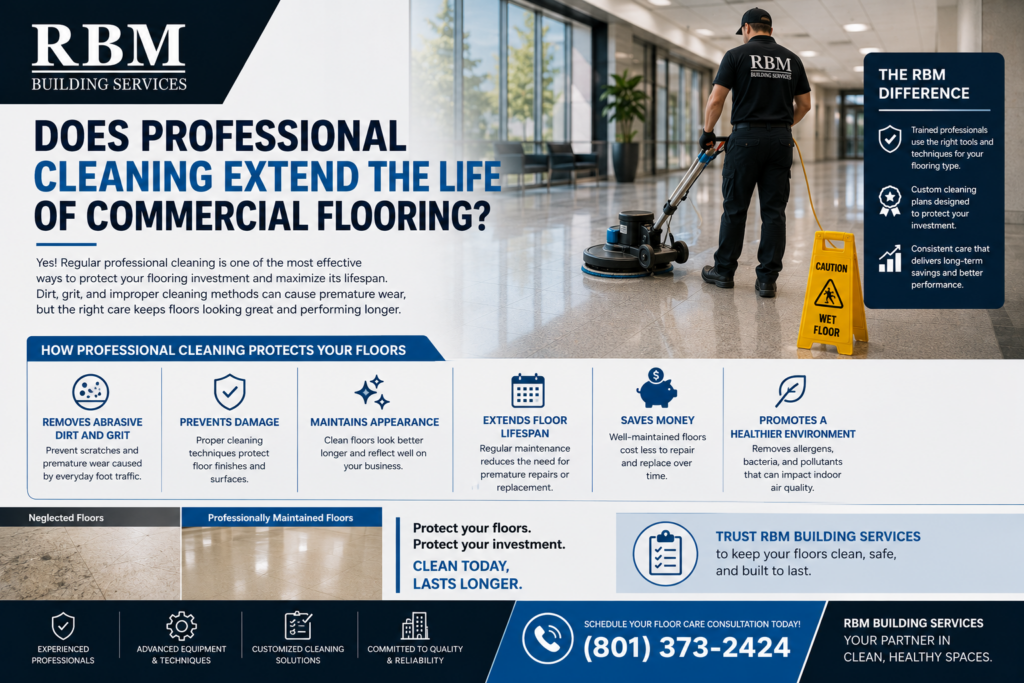
Commercial flooring is one of the largest capital investments in any commercial facility. A typical 50,000-square-foot office building with VCT flooring represents a $150,000 to $300,000 flooring investment. With commercial carpet, that investment is $200,000 to $500,000. The question every building owner and facility manager should ask is: how can I maximize the return on this investment? The answer is professional floor maintenance. Studies by the ISSA (the worldwide cleaning industry association) and flooring manufacturers consistently show that professional floor maintenance extends flooring life by 50-100% compared to minimal or no maintenance. This means that a VCT floor that would need replacement after 7-10 years with minimal maintenance can last 15-20 years with a proper professional maintenance program. The financial impact is substantial — reducing the frequency of floor replacement by half can save a building owner hundreds of thousands of dollars over the life of a facility.
The return on investment for professional floor maintenance is compelling by any measure. The ISSA calculates that every dollar spent on professional floor maintenance saves $3-$5 in floor replacement costs over the life of the flooring. For carpet, the ratio is even higher — every dollar spent on professional carpet maintenance saves $4-$6 in carpet replacement costs. These ratios do not include the additional benefits of professional floor maintenance, including improved appearance that supports higher property values and tenant satisfaction. When building owners understand the financial case for professional floor maintenance, the question shifts from “Can we afford professional floor maintenance?” to “Can we afford not to have it?” See our floor care services for professional floor maintenance programs.

Does Professional Cleaning Extend Flooring Life?
VCT is the most common commercial flooring material in the United States, installed in approximately 40% of commercial facilities. A properly maintained VCT floor can last 15-20 years, while a neglected VCT floor may need replacement in as little as 5-7 years. The key to VCT longevity is the floor finish system — a sealer and multiple coats of floor finish protect the tile from wear, stains, and moisture. As the finish wears away from foot traffic, it must be replaced through spray buffing (burnishing) and periodic recoating. When the finish becomes too worn or too built up, the floor must be stripped down to the bare tile and refinished. The typical VCT maintenance cycle includes daily dust mopping or sweeping, daily damp mopping with neutral pH cleaner, spray buffing weekly to monthly depending on traffic, recoating every 3-6 months (adding 1-2 coats of finish), and stripping and refinishing every 12-24 months (removing all old finish and applying 4-6 new coats).
The cost of VCT floor maintenance varies by facility size and traffic level but typically ranges from $0.10 to $0.25 per square foot per month for daily maintenance and periodic services. The cost of VCT floor replacement is $4-$8 per square foot installed. A 20,000-square-foot VCT floor costs $80,000-$160,000 to replace. With a professional maintenance program costing approximately $0.15/sq.ft./month ($3,000/month), the annual maintenance cost is $36,000. If maintenance extends the floor life from 7 years (with minimal maintenance) to 15 years, the total maintenance cost over 15 years is $540,000, but the floor replacement cost is avoided for 8 years — saving $80,000-$160,000 in delayed replacement costs. The net benefit is even greater when considering that the non-maintained floor would need 2.1 replacements in 15 years ($168,000-$336,000), while the maintained floor needs just 1 replacement ($80,000-$160,000). The maintenance investment saves $88,000-$176,000 over 15 years. For VCT floor care, see our floor stripping and refinishing services.
The True Cost of Commercial Flooring
Commercial carpet is the second most common flooring material in commercial facilities, particularly in office environments. A properly maintained commercial carpet can last 10-15 years, while neglected carpet may need replacement in 5-7 years. Carpet wears primarily through two mechanisms: abrasive wear from foot traffic grinding dirt into carpet fibers, and crushing of carpet pile fibers from traffic. Both mechanisms are significantly reduced by professional maintenance. Removing abrasive soil through regular vacuuming and extraction cleaning reduces fiber wear, and proper grooming and cleaning restores crushed pile fibers. The typical commercial carpet maintenance cycle includes daily vacuuming with a HEPA-filtered vacuum in high-traffic areas, spot cleaning of spills immediately when they occur, interim cleaning (encapsulation or bonnet cleaning) every 3-6 months to maintain appearance between deep cleanings, and hot water extraction cleaning every 6-12 months to remove deep-soil from carpet fibers and backing.
The cost of professional carpet maintenance ranges from $0.08 to $0.20 per square foot per month for daily vacuuming and periodic extraction cleaning. Carpet replacement costs $3-$7 per square foot for commercial broadloom or carpet tile. A 20,000-square-foot carpeted area costs $60,000-$140,000 to replace. With a professional maintenance program costing $0.12/sq.ft./month ($2,400/month), the annual maintenance cost is $28,800. Extending carpet life from 6 years to 12 years through professional maintenance means the maintained carpet needs 1 replacement in 12 years ($60,000-$140,000), while the neglected carpet needs 2 replacements ($120,000-$280,000). The maintenance cost of $345,600 over 12 years is offset by saving $60,000-$140,000 in avoided replacement costs. Carpet tile has an additional advantage — individual tiles can be replaced when stained or worn, extending the useful life of the entire carpet installation. For professional carpet maintenance, see our carpet cleaning services.
VCT and Resilient Flooring Maintenance ROI
Polished concrete floors are increasingly popular in commercial facilities because of their durability and modern appearance. A properly maintained polished concrete floor can last 20 years or more with minimal maintenance requirements. However, even durable polished concrete requires regular maintenance to maintain its appearance and slip resistance. The maintenance cycle for polished concrete includes daily dust mopping or sweeping to remove abrasive grit, daily damp mopping with neutral pH cleaner (avoiding harsh chemicals that can damage the concrete sealer), periodic burnishing (weekly to monthly depending on traffic) to maintain gloss and remove surface scratches, and annual reapplication of concrete guard or sealer to maintain stain resistance. The cost of polished concrete maintenance is lower than VCT or carpet — typically $0.05 to $0.10 per square foot per month — because polished concrete does not require periodic stripping and refinishing.
Ceramic and porcelain tile installed in commercial facilities can last 20-30 years or more with proper maintenance, which is longer than any other common commercial flooring material. However, the grout between tiles is the weak point — grout is porous and absorbs stains, moisture, and bacteria if not properly sealed and maintained. Tile and grout maintenance includes daily sweeping or dust mopping, daily damp mopping with neutral pH cleaner, periodic deep cleaning of grout (quarterly to annually depending on the location), resealing of grout every 1-3 years depending on traffic, and replacement of damaged or cracked tiles as needed. Wood flooring in commercial settings is less common than in the past but is still found in upscale offices, retail stores, and hospitality venues. Hardwood floors in commercial settings require daily dust mopping, daily damp mopping with wood-safe cleaner, periodic screening and recoating (every 6-12 months in high-traffic areas), and complete refinishing every 5-10 years. The cost of commercial wood floor maintenance is $0.15-$0.30 per square foot per month, while refinishing costs $2-$5 per square foot and replacement costs $8-$15 per square foot. For expert floor care for all surface types, see our floor maintenance page.
Commercial Carpet Maintenance ROI
When professional floor maintenance is neglected, the consequences are predictable and costly. The most common failure modes for neglected commercial flooring are beyond-repair soiling, where dirt and stains become embedded in flooring materials to the point where they cannot be removed by cleaning, premature wear and erosion of floor surfaces from abrasive grit that is not removed by regular cleaning, finish failure where VCT and other resilient flooring finishes break down and expose the flooring material to damage, moisture damage to carpet and wood floors from inadequate cleaning or failure to address spills and leaks promptly, and warranty voiding — most flooring manufacturer warranties require professional maintenance as a condition of warranty coverage.
The cost of premature floor replacement is only part of the financial impact of neglected floors. Buildings with worn or dirty floors are harder to lease — tenants perceive them as less desirable and are less willing to pay premium rents. Studies by the Building Owners and Managers Association (BOMA) have found that buildings with well-maintained common areas, including floors, command 5-15% higher rents than comparable buildings with neglected common areas. For a 50,000-square-foot office building at $25/sq.ft./year, a 10% rent premium translates to $125,000 in additional annual revenue. When this revenue impact is added to the floor replacement cost savings, the financial case for professional floor maintenance becomes overwhelming. Building owners who view floor maintenance as a discretionary expense are making a costly mistake — floor maintenance is an investment that generates measurable returns through extended floor life, higher property values, and increased tenant satisfaction. Read more on our company blog for facility maintenance tips.
Concrete, Tile, and Wood Flooring Maintenance
When professional floor maintenance is neglected, the consequences are predictable and costly. The most common failure modes for neglected commercial flooring are beyond-repair soiling, where dirt and stains become embedded in flooring materials to the point where they cannot be removed by cleaning, premature wear and erosion of floor surfaces from abrasive grit that is not removed by regular cleaning, finish failure where VCT and other resilient flooring finishes break down and expose the flooring material to damage, moisture damage to carpet and wood floors from inadequate cleaning or failure to address spills and leaks promptly, and warranty voiding — most flooring manufacturer warranties require professional maintenance as a condition of warranty coverage.
The cost of premature floor replacement is only part of the financial impact of neglected floors. Buildings with worn or dirty floors are harder to lease — tenants perceive them as less desirable and are less willing to pay premium rents. Studies by the Building Owners and Managers Association (BOMA) have found that buildings with well-maintained common areas, including floors, command 5-15% higher rents than comparable buildings with neglected common areas. For a 50,000-square-foot office building at $25/sq.ft./year, a 10% rent premium translates to $125,000 in additional annual revenue. When this revenue impact is added to the floor replacement cost savings, the financial case for professional floor maintenance becomes overwhelming. Building owners who view floor maintenance as a discretionary expense are making a costly mistake — floor maintenance is an investment that generates measurable returns through extended floor life, higher property values, and increased tenant satisfaction. Read more on our company blog for facility maintenance tips.
The Cost of Neglect: When Floors Fail Prematurely
Planning a floor maintenance program requires understanding your flooring types, traffic patterns, and budget. The first step is a floor assessment that identifies the types of flooring in your facility (VCT, carpet, concrete, tile, wood, or other), their current condition, and the traffic levels in each area. Based on the assessment, develop a maintenance schedule that specifies daily, weekly, monthly, quarterly, and annual tasks for each floor type. The schedule should be based on manufacturer recommendations and industry best practices. Budget for maintenance should be calculated based on the square footage of each floor type and the appropriate maintenance frequency. The ISSA recommends budgeting 1-2% of facility replacement value annually for floor maintenance.
Selecting the right maintenance provider is critical for floor longevity. Professional floor maintenance requires specialized equipment, products, and training. Different floor types require different cleaning methods — what works for VCT can damage polished concrete, and what works for carpet can damage wood floors. A qualified floor maintenance provider should have experience with all common commercial flooring types, use appropriate equipment and products for each surface, have trained technicians who understand proper floor care techniques, and provide documentation of services performed for quality assurance and warranty compliance. The relationship between building owner and floor maintenance provider should be a partnership focused on maximizing floor life, minimizing costs, and maintaining appearance. Regular communication about floor conditions and maintenance needs helps both parties achieve these goals. Many floor maintenance providers offer free floor assessments and can provide detailed maintenance plans and cost estimates.
RBM Building Services has provided commercial floor maintenance, floor stripping and refinishing, and janitorial services since 1974 across Utah, Arizona, Nevada, and Texas. We maintain all common commercial flooring types and have the expertise to extend your floor life. Call 800.403.3564 or contact us for a complimentary floor assessment. Read more on our company blog.
Extend your floor life with professional maintenance
Building a Floor Maintenance Plan
The return on investment for professional floor maintenance extends beyond direct cost savings to include improved property values, tenant satisfaction, and operational efficiency. Building owners who invest in professional floor maintenance are making a strategic decision that pays returns for the life of the building. The key is consistency — floor maintenance must be performed according to the schedule every time, not just when problems become visible. A floor that is maintained consistently looks better, lasts longer, and costs less over its lifetime than a floor that receives intermittent or reactive maintenance. The ISSA calculates that every dollar invested in professional floor maintenance returns $3-$5 in extended floor life and reduced replacement costs.
The best time to start a floor maintenance program is the day new flooring is installed. Starting maintenance early prevents the initial wear that can shorten floor life significantly. For existing floors, the second best time is today — a professional floor assessment can identify the current condition of your floors and recommend a maintenance program that will maximize remaining floor life. Many building owners are surprised to learn that floors they thought needed replacement can be restored through professional cleaning and refinishing, saving 50-70% of replacement cost. Professional floor maintenance is not an expense — it is one of the highest-return investments a building owner can make in their facility. The numbers are clear, the benefits are measurable, and the cost of neglect is far higher than the cost of maintenance.