Coworking space cleaning requires a specialized approach due to shared work areas, high turnover of occupants, and the need for flexible cleaning schedules. This guide covers daily cleaning routines, shared space sanitation, and management strategies for coworking facility managers.
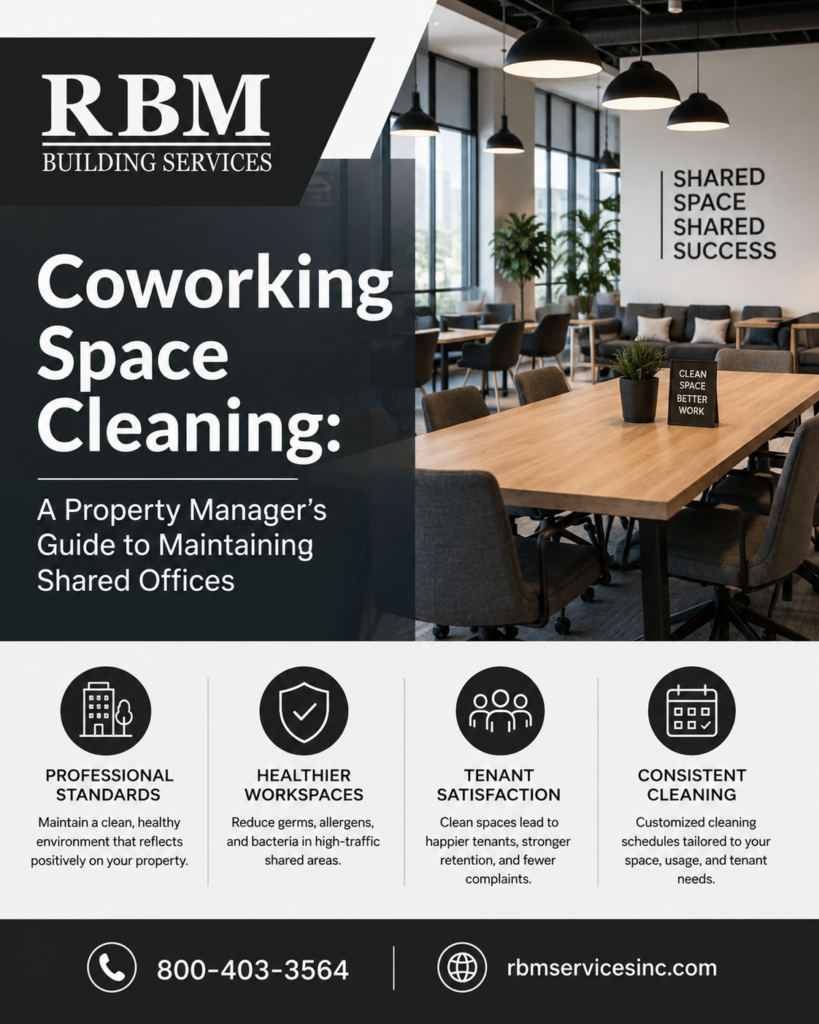
Coworking spaces have transformed the way people work, but they also present unique cleaning challenges that traditional office cleaning protocols were not designed to address. Unlike conventional offices where the same employees occupy the same desks every day, coworking spaces serve a constantly changing mix of members, visitors, and guests who use shared workstations, common areas, kitchens, and restrooms throughout the day and night. The high density of users, the variety of activities taking place in open areas, and the expectation of a fresh, professional environment at all times make coworking space cleaning a specialized discipline. Property managers and coworking operators who prioritize cleanliness gain a competitive advantage, as surveys consistently show that cleanliness is one of the top factors members consider when choosing a coworking space. A clean environment signals professionalism, care for member well-being, and attention to detail. Commercial cleaning services and professional janitorial services that specialize in flexible environments are essential for coworking spaces. See our RBM Building Services for more information.
The coworking industry has grown significantly in recent years, and with that growth comes increased expectations for cleanliness and maintenance. Members who pay monthly membership fees expect a workspace that is consistently clean, well-maintained, and professionally presented. Unlike traditional office tenants who may have lower expectations for shared spaces, coworking members are paying a premium for access to a clean, ready-to-use workspace. Any decline in cleanliness standards can lead to member complaints, negative online reviews, and membership cancellations. The cost of losing a single member to a cleanliness issue far exceeds the cost of maintaining proper cleaning standards. For professional coworking space cleaning services, contact RBM Building Services or call 800.403.3564.

Coworking Space Cleaning: Complete Maintenance Guide for Shared Office Environments
Coworking spaces differ from traditional offices in several fundamental ways that affect cleaning requirements. The first difference is the density of users. Coworking spaces typically have more people per square foot than traditional offices, which means more waste generated, more surfaces touched, and more frequent cleaning needed. Open-plan layouts with hot desks, shared tables, and communal seating areas are used by multiple people throughout the day, and each user leaves behind some level of mess or contamination. The second difference is the variety of activities. Coworking spaces host a wide range of activities including meetings, video conferences, phone calls, social events, workshops, and networking events. Each activity generates different types of mess and requires different cleaning responses. Meeting rooms may need cleaning between bookings, event spaces require deep cleaning after events, and kitchen areas need constant attention during peak hours. The third difference is the schedule flexibility. Coworking spaces often operate extended hours, with some locations open 24/7. Traditional office cleaning typically happens after hours when the office is empty, but coworking spaces may never be empty. This requires cleaning crews to work around members, cleaning in stages or zones while other areas remain occupied. The fourth difference is the public nature of the space. Coworking spaces are semi-public environments where members bring clients and guests. The space must look clean and professional at all times, not just at the start of the day. This requires ongoing maintenance throughout operating hours rather than just a single nightly clean. The fifth difference is the lack of personal responsibility. In a traditional office, employees often feel some ownership of their workspace and may clean up after themselves. In a coworking space, members are more likely to leave messes for cleaning staff to handle, expecting that cleaning is included in their membership fee. For these reasons, coworking space cleaning requires a customized approach that addresses the unique needs of shared work environments. Commercial cleaning and janitorial services providers who understand coworking dynamics can help operators maintain high standards. Contact RBM or call 800.403.3564.
Why Coworking Spaces Require a Different Cleaning Approach
A well-structured daily cleaning routine is the foundation of effective coworking space maintenance. The cleaning schedule should be divided into three main periods: pre-opening cleaning, mid-day maintenance, and after-hours deep cleaning. Pre-opening cleaning is performed before the space opens to members and should ensure that the facility is fresh and ready for the day. This shift includes cleaning and sanitizing all restroom fixtures, sinks, countertops, and floors, restocking restroom supplies including toilet paper, paper towels, soap, and hand sanitizer, cleaning and sanitizing kitchen areas including countertops, sinks, microwaves, refrigerators, and coffee machines, wiping down all hard surfaces in common areas including tables, desks, and countertops, vacuuming all carpeted areas and mopping all hard surface floors in common areas, emptying all trash receptacles and replacing liners, and spot cleaning windows, glass doors, and mirrors throughout the space. Pre-opening cleaning should be completed at least 30 minutes before the first members arrive to allow the space to air out and present a fresh appearance. Mid-day maintenance is performed during operating hours and focuses on keeping the space clean and presentable while members are working. Mid-day tasks include restroom checks and touch-up cleaning every 1-2 hours depending on usage levels, kitchen area wipe-downs and dish collection throughout the day, trash removal from common areas as receptacles reach capacity, spot cleaning of spills and messes in common areas, and replenishing supplies in restrooms and kitchen areas. The mid-day cleaning crew should be trained to work quietly and discreetly, minimizing disruption to members while maintaining cleanliness. After-hours deep cleaning is performed after the space closes or during low-traffic periods. This shift should include thorough vacuuming and mopping of all areas including private offices and phone booths, deep cleaning of restrooms including fixtures, walls, and floors, cleaning and sanitizing all kitchen equipment and surfaces including inside microwaves and refrigerators, dusting of all surfaces including window blinds, ledges, and decorative items, cleaning of windows and glass surfaces throughout the space, emptying all trash and recycling receptacles, and spot cleaning walls, doors, and baseboards as needed. For coworking space cleaning services, contact RBM Building Services or call 800.403.3564. Read more on our company blog.
Daily Coworking Cleaning Routines and Schedules
High-touch surface disinfection is one of the most critical components of coworking space cleaning because shared surfaces are touched by dozens or even hundreds of people each day. High-touch surfaces in coworking spaces include door handles and push plates on all entry doors, restroom doors, and meeting room doors, light switches in common areas and restrooms, elevator buttons and call panels, reception desks and front counter surfaces, shared keyboards, mice, and monitors at hot desks, kitchen faucet handles, refrigerator doors, and microwave keypads, coffee machine buttons and handles, vending machine touchscreens, handrails on stairs and corridors, and shared phone booths and headsets. A high-touch surface disinfection program should include both scheduled cleaning at set intervals and on-demand cleaning when visibly soiled or after known contamination events. The recommended frequency for high-touch surface disinfection is every 2-4 hours during operating hours, with more frequent cleaning during peak usage periods and in high-traffic areas. The cleaning crew should use disinfectants that are EPA-registered for use against the pathogens of concern and should follow manufacturer instructions for proper contact time. Disinfectant wipes are practical for quick wipe-downs during operating hours, while spray disinfectants with appropriate dwell time should be used for more thorough cleaning during after-hours shifts.
Hand sanitizer stations should be positioned at key locations throughout the coworking space, including at entry points, near restroom exits, at kitchen entrances, and at reception desks. Hand sanitizer dispensers should be checked and refilled daily, and the stations should be cleaned as part of the high-touch surface disinfection program. Signage reminding members to clean their workspace after use and to use hand sanitizer can help reduce the cleaning burden and improve overall hygiene. Some coworking operators provide disinfectant wipes at each hot desk or workstation so members can clean surfaces before use. This approach empowers members to take responsibility for their immediate workspace while the cleaning crew focuses on common areas and shared amenities. Professional deep cleaning and disinfection should be scheduled at regular intervals beyond the daily cleaning routine, including quarterly deep cleaning of all carpet and upholstery using hot water extraction or steam cleaning methods, monthly deep cleaning of kitchen areas including inside appliances and cabinets, and periodic cleaning of air ducts and HVAC components to maintain indoor air quality. For coworking space disinfection services, contact RBM Building Services or call 800.403.3564. Visit our commercial cleaning page for our complete service list.
High-Touch Surface Disinfection in Shared Spaces
Managing cleaning around flexible member schedules is one of the most challenging aspects of coworking space maintenance. Unlike traditional offices where cleaning can be scheduled after all employees have left for the day, coworking spaces may have members working at any hour. A coworking space that is open 24/7 needs a cleaning schedule that adapts to occupancy patterns rather than working around a fixed closing time. The first step in developing a flexible cleaning schedule is understanding the occupancy patterns of the space. Most coworking spaces experience peak occupancy during traditional business hours of 9 AM to 5 PM, with lower occupancy in early morning, evening, and overnight hours. The cleaning schedule should be designed to perform the most disruptive cleaning tasks during low-occupancy periods while performing lighter maintenance during peak hours. Zoned cleaning is an effective strategy for coworking spaces that are occupied around the clock. The space is divided into cleaning zones, and each zone is cleaned on a rotating schedule that ensures every area receives thorough cleaning while minimizing disruption to members. When one zone is being cleaned, members can move to other zones that are already clean or are not currently being serviced. Zoned cleaning requires clear communication with members about which areas are being cleaned and when. Signage and digital notifications can help members plan their workspace use around the cleaning schedule.
Communication with members is essential for successful cleaning in a flexible schedule environment. Members should be informed about the cleaning schedule, including what tasks are performed when and how cleaning activities may affect their work. Members should also have a way to request cleaning assistance or report cleanliness issues. A simple system such as a digital request form, a dedicated email address, or a messaging channel allows members to communicate cleaning needs to the operations team. Some coworking operators use mobile apps or member portals to communicate cleaning schedules and to receive cleaning requests. Technology can also help optimize cleaning schedules. Occupancy sensors and booking data can show which areas are most heavily used and when cleaning is most needed. Data-driven cleaning allows operators to allocate cleaning resources where and when they are most needed, reducing waste and improving efficiency. For example, a meeting room that is booked for back-to-back meetings all day may need cleaning between each booking, while a quiet work area with low occupancy may only need cleaning once per shift. For cleaning management solutions for your coworking space, contact RBM Building Services or call 800.403.3564. Read more on our company blog.
Managing Cleaning Around Flexible Member Schedules
Restroom and kitchen areas are the most heavily used and most frequently soiled spaces in any coworking facility. These areas require the highest level of cleaning attention because they directly affect member satisfaction and hygiene perceptions. Restroom cleaning in coworking spaces should be performed at least twice during operating hours plus a thorough cleaning during the after-hours shift. High-traffic coworking spaces may require hourly restroom checks during peak periods. Each restroom check should include inspection and restocking of supplies including toilet paper, paper towels, soap, and hand sanitizer, spot cleaning of mirrors, countertops, and fixtures as needed, emptying of trash receptacles that are more than half full, and cleaning and disinfecting of toilet seats and urinals if visibly soiled. Thorough restroom cleaning should include cleaning and disinfecting of all fixtures including toilets, urinals, sinks, and countertops, cleaning and disinfecting of partitions, walls, and doors, cleaning and sanitizing of floors using appropriate disinfectant, cleaning of mirrors and glass surfaces, restocking all supplies including backup supplies stored in the restroom, and emptying all trash and sanitary disposal receptacles.
Kitchen and break room areas in coworking spaces require constant attention because they are used throughout the day for meal preparation, coffee breaks, and social interaction. A dedicated kitchen cleaning schedule should include daily tasks such as wiping down all countertops and surfaces after each use period, cleaning and sanitizing sinks and faucets, emptying trash and recycling receptacles multiple times per day, cleaning microwave interiors and exteriors, wiping down refrigerator and freezer handles and exterior surfaces, cleaning coffee machines and related equipment, and sweeping and mopping kitchen floors. Weekly kitchen tasks should include deep cleaning of microwave interiors including turntable and vent, cleaning inside refrigerators and removing expired items, cleaning cabinet fronts and drawer faces, cleaning backsplash and stovetop areas if applicable, sanitizing sink drains and garbage disposal, and organizing pantry and storage areas. Monthly kitchen tasks should include descaling coffee machines and other equipment, deep cleaning of ovens and cooking equipment if present, cleaning under and behind appliances, cleaning vents and exhaust hoods, and checking for pest activity and addressing any issues. For thorough restroom and kitchen maintenance services for your coworking space, contact RBM Building Services or call 800.403.3564. Visit our full service janitorial page for our complete service list.
Restroom and Kitchen Area Maintenance for Coworking
Selecting the right janitorial partner is critical for coworking space operators because the cleaning provider must be able to adapt to the unique demands of a shared workspace environment. Not all commercial cleaning companies have experience with coworking spaces, and operators should evaluate potential partners based on their understanding of flexible workspace dynamics. The first quality to look for in a janitorial partner is flexibility. The cleaning provider must be willing to work around member schedules, cleaning in zones or at times that minimize disruption. The provider should be able to adjust the cleaning schedule as occupancy patterns change and should be responsive to requests for additional cleaning during events or peak periods. The second quality is experience with high-traffic shared environments. Cleaning providers who have worked with hotels, fitness centers, or other high-turnover facilities will understand the level of attention needed for coworking spaces. They will be familiar with high-touch surface disinfection protocols and will have systems in place for maintaining cleanliness throughout the day rather than just after hours. The third quality is communication and responsiveness. The cleaning provider should have a clear point of contact who can be reached during operating hours for urgent cleaning needs. The provider should provide regular reports on cleaning activities, including checklists, inspection results, and supply usage. The provider should also be open to feedback from members and should be willing to adjust cleaning practices based on member preferences. The fourth quality is proper training and certification. Cleaning staff working in coworking spaces should be trained in proper cleaning techniques, disinfectant use, and professional conduct around members. Staff should be background checked, professional in appearance, and respectful of member privacy. The provider should carry appropriate insurance, including general liability and workers compensation.
The fifth quality is the use of appropriate products and equipment. Coworking spaces require cleaning products that are effective but not overpowering in scent, as members may be sensitive to strong fragrances. The cleaning provider should use EPA-registered disinfectants for high-touch surfaces and should have equipment appropriate for the coworking environment, including quiet vacuums for daytime use and backpack vacuums for efficient cleaning. The sixth quality is sustainability practices. Many coworking members value sustainability and expect their workspace to reflect those values. Cleaning providers who use green cleaning products, practice waste reduction, and use energy-efficient equipment will be more attractive to environmentally conscious coworking operators and members. The cost of janitorial services for coworking spaces varies based on the size of the space, the hours of coverage needed, the level of service required, and the geographic location. Typical costs range from $0.15 to $0.35 per square foot per month for basic daily cleaning, with higher costs for spaces that require daytime cleaning attendants or extended cleaning hours. Operators should obtain detailed quotes from multiple providers and should ensure that the quotes include all services required, including restroom supplies, trash removal, and periodic deep cleaning. RBM Building Services has provided janitorial services and commercial cleaning for flexible work environments since 1974. Contact us or call 800.403.3564 to learn how we can support your coworking space with professional cleaning services. Read more on our company blog.
coworking space cleaning shared office maintenance property manager
Choosing the Right Janitorial Partner for Your Coworking Space
Maintaining a clean coworking space requires a strategic approach that goes beyond traditional office cleaning. The most successful coworking operators treat cleanliness as a core part of the member experience, investing in professional cleaning services that can adapt to the unique demands of shared work environments. A well-maintained coworking space attracts and retains members, generates positive reviews, and supports higher membership rates. Key takeaways for coworking operators include developing a comprehensive cleaning plan that covers pre-opening, mid-day, and after-hours cleaning, implementing a high-touch surface disinfection program with cleaning at least every 2-4 hours during peak periods, using zoned cleaning strategies to manage cleaning around member schedules, paying special attention to restroom and kitchen areas which have the greatest impact on member satisfaction, and choosing a janitorial partner with experience in flexible workspace environments. By investing in professional cleaning services that understand coworking dynamics, operators can create a clean, healthy, and productive environment that members love. The cost of professional cleaning is far outweighed by the benefits of higher member satisfaction, lower turnover, and positive word-of-mouth referrals. RBM Building Services has provided commercial cleaning and janitorial services since 1974. We understand the unique challenges of coworking space maintenance and can develop a customized cleaning program for your facility. Contact us or call 800.403.3564 to schedule a consultation. Read more on our company blog.