Electrostatic spray disinfection technology uses charged particles to disinfect surfaces thoroughly and efficiently. This guide covers how electrostatic sprayers work, their applications in commercial facilities, safety considerations, and best practices for implementation.
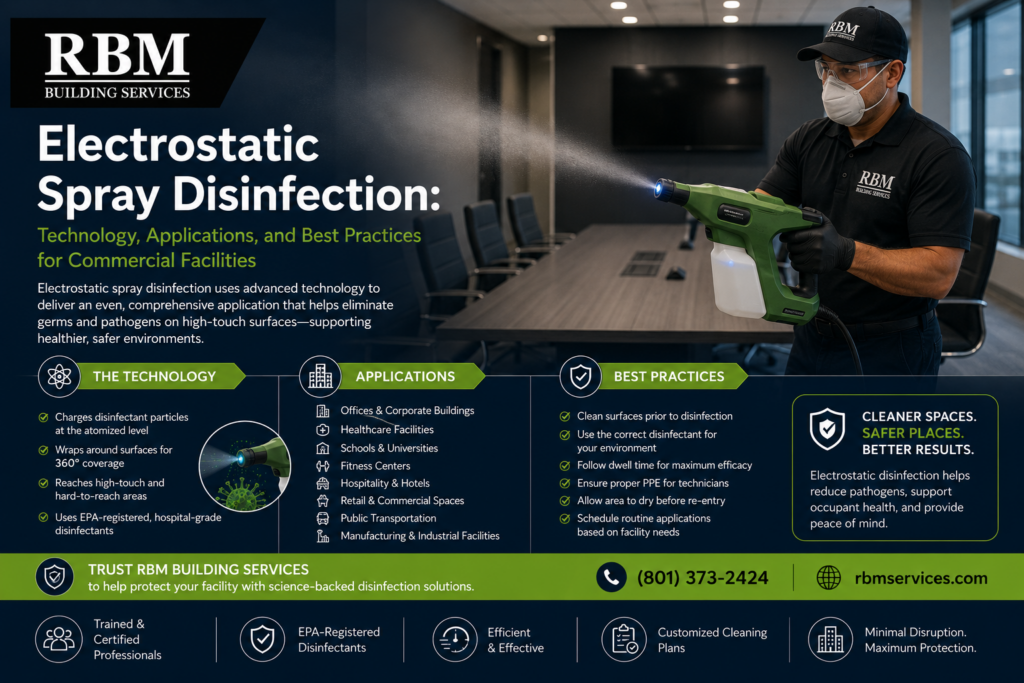
Electrostatic spray disinfection is an advanced cleaning technology that uses electrically charged particles to disinfect surfaces thoroughly and efficiently. Unlike traditional spray-and-wipe methods that require direct contact with each surface, electrostatic sprayers apply a fine mist of disinfectant that is charged as it leaves the sprayer nozzle. The charged particles are attracted to surfaces, wrapping around objects and reaching areas that are difficult to clean with traditional methods. Electrostatic spray disinfection has become an essential tool in commercial facility cleaning, particularly since the COVID-19 pandemic highlighted the importance of thorough surface disinfection. The technology is now widely used in healthcare facilities, schools, offices, and commercial buildings. Commercial cleaning and professional janitorial services increasingly offer electrostatic spray disinfection. See RBM Building Services for more.
Electrostatic spray disinfection provides thorough coverage of complex surfaces in less time. Contact RBM Building Services or call 800.403.3564.

Electrostatic Spray Disinfection: Complete Guide for Facility Managers
Electrostatic spray disinfection has applications across a wide range of commercial facilities. Healthcare facilities use electrostatic spraying for patient rooms, examination rooms, waiting areas, and operating rooms. The ability to disinfect hard-to-reach surfaces makes electrostatic spraying ideal for healthcare environments where thorough disinfection is critical. Schools and educational facilities use electrostatic spraying for classrooms, cafeterias, gymnasiums, and common areas. Electrostatic disinfection can be applied when students and staff are not present. Offices and commercial buildings use electrostatic spraying for workstations, conference rooms, break rooms, restrooms, and common areas. Gyms and fitness centers use electrostatic spraying for exercise equipment, locker rooms, and common areas. Food service facilities use electrostatic spraying for dining areas, kitchens, and food preparation surfaces. Each facility type has specific disinfection requirements that electrostatic spraying can address effectively. Commercial cleaning providers can implement electrostatic spray disinfection programs. Contact RBM or call 800.403.3564.
What Is Electrostatic Spray Disinfection?
Safety is a critical consideration when implementing electrostatic spray disinfection. The disinfectant chemicals used in electrostatic spraying must be EPA-registered and approved for the specific application method. Employers must provide Safety Data Sheets for all disinfectants used and ensure that they are used according to manufacturer instructions. Personnel applying electrostatic spray disinfection should wear appropriate personal protective equipment including gloves, eye protection, and respiratory protection as specified by the disinfectant manufacturer. Application areas should be evacuated during spraying and for the contact time specified by the disinfectant manufacturer. Ventilation should be considered to ensure proper air exchange after application. Food contact surfaces must be rinsed after disinfection if required by the disinfectant label. Electrostatic spray disinfection should be integrated into the facility’s comprehensive infection prevention program. Commercial cleaning services with electrostatic disinfection capability follow strict safety protocols. Contact RBM Building Services or call 800.403.3564.
Applications in Commercial Facilities
Successful implementation of electrostatic spray disinfection requires attention to several best practices. The facility should be cleaned before electrostatic disinfection is applied because soil and organic matter can interfere with disinfectant effectiveness. Pre-cleaning removes visible soil so the disinfectant can reach all surfaces. The correct disinfectant should be selected for the specific pathogens of concern and the surfaces being treated. Disinfectants must be applied at the correct concentration and with the correct contact time. The electrostatic sprayer should be properly maintained and calibrated according to manufacturer instructions. Regular sprayer maintenance ensures consistent performance and proper charging of particles. Operators should be trained and certified in electrostatic spray application. Proper technique ensures thorough coverage without oversaturation. Coverage indicators can be used to verify that all intended surfaces have been treated. Janitorial services can implement electrostatic spray disinfection programs. Contact RBM or call 800.403.3564.
Safety and Compliance Considerations
Electrostatic spray disinfection offers several advantages over traditional disinfection methods. Traditional spray-and-wipe methods require direct contact with each surface and may miss complex or hard-to-reach areas. Electrostatic spraying provides more consistent coverage, particularly on complex surfaces. Electrostatic spray disinfection is faster than traditional methods because the charged particles wrap around objects automatically rather than requiring direct spraying of each surface. Electrostatic spraying uses less disinfectant than traditional methods because the charged particles are attracted to surfaces rather than drifting into the air. However, electrostatic spray disinfection may not be suitable for all applications and should be used as part of a comprehensive cleaning and disinfection program. The cost of equipment and training should be considered when evaluating the technology. Commercial cleaning providers can help facilities evaluate whether electrostatic spray disinfection is appropriate. Contact RBM Building Services or call 800.403.3564.
Best Practices for Implementation
Selecting the right electrostatic spray disinfection service provider is important for achieving desired outcomes. Experience and expertise should be evaluated including how long the provider has been offering electrostatic spray disinfection and what training their technicians have received. The provider should use EPA-registered disinfectants and be able to provide Safety Data Sheets and documentation. The provider should carry appropriate insurance including liability and workers compensation. The provider should offer flexible scheduling including after-hours disinfection when facilities are unoccupied. The range of services should include pre-cleaning, electrostatic disinfection, and verification of coverage. References from similar facilities should be requested. RBM Building Services has provided commercial cleaning and janitorial services including electrostatic spray disinfection since 1974. Contact us or call 800.403.3564. Read more on our company blog.
Comparing Electrostatic Spraying to Traditional Disinfection
Electrostatic spray disinfection is a powerful tool in commercial facility cleaning that provides thorough disinfection of complex surfaces efficiently and effectively. The technology offers significant advantages over traditional disinfection methods, particularly for large areas and complex spaces. Proper implementation requires attention to safety, training, and best practices. RBM Building Services has provided commercial cleaning and janitorial services including electrostatic spray disinfection since 1974. Contact us or call 800.403.3564. Read more on our company blog.
electrostatic spray disinfection commercial facilities best practices
Choosing an Electrostatic Disinfection Service Provider
Electrostatic spray disinfection technology provides thorough, efficient disinfection of commercial facilities. The charged particles wrap around surfaces for complete coverage. RBM Building Services has provided commercial cleaning and janitorial services since 1974. Contact us or call 800.403.3564. Read more on our company blog.