Library, museum, and archive facility cleaning requires preservation standards and specialized collection care. This guide covers dust control, book and artifact cleaning, display case maintenance, environmental monitoring, and best practices for cultural institutions.
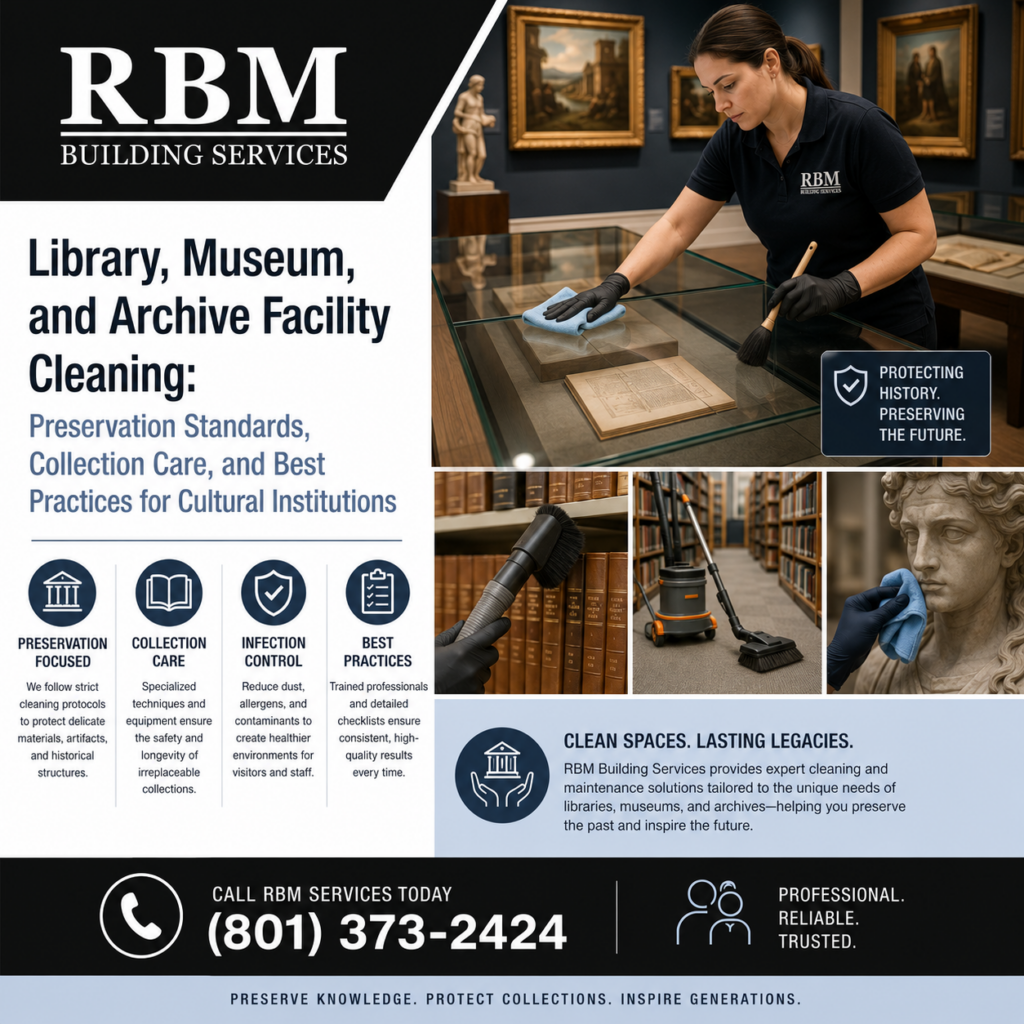
Libraries, museums, and archives present unique cleaning challenges because they combine public access spaces with valuable and often irreplaceable collections. Cleaning in cultural institutions must balance the need for a clean, welcoming environment for visitors with the preservation requirements of books, documents, artworks, and artifacts. Improper cleaning methods can damage collections by introducing moisture, chemicals, or physical stress. Dust and environmental contaminants accelerate the deterioration of paper, textiles, paints, and other materials. Cultural institution managers, librarians, curators, and facility managers must understand the specialized cleaning requirements of their facilities and select cleaning partners who understand preservation principles. Commercial cleaning and professional janitorial services can be adapted for cultural institution needs. See RBM Building Services for more.
Cultural institution cleaning requires preservation-sensitive methods that protect valuable collections. Contact RBM Building Services or call 800.403.3564.

Understanding Cultural Institution Cleaning Needs
Environmental control is the foundation of collection preservation in libraries, museums, and archives. Temperature and humidity must be maintained within specific ranges to prevent deterioration of materials. Typical museum standards call for temperatures between 65 and 70 degrees Fahrenheit and relative humidity between 40 and 55 percent. Cleaning activities must not disrupt these environmental conditions. Dust management is critical because dust particles are abrasive and can damage delicate surfaces over time. Dust control begins with HVAC filtration using high-efficiency filters that capture fine particles. Entryway mat systems reduce the amount of dust and soil brought into the facility. Cleaning methods should capture dust rather than redistributing it. HEPA-filtered vacuum cleaners should be used for all floor cleaning in collection areas. Dusting should use microfiber cloths or electrostatic dusters that capture and hold dust. Commercial cleaning providers can implement dust management programs for cultural institutions. Contact RBM or call 800.403.3564.
Environmental Control and Dust Management
Book and document collection cleaning requires methods that do not damage paper, bindings, or covers. Books should be dusted regularly using soft brushes, microfiber cloths, or specialized book dusting tools. Books should be removed from shelves for dusting rather than dusting around them because dust accumulates on top of books. Shelving should be cleaned with HEPA vacuum attachments. Rare and valuable books may require conservation-grade cleaning by trained specialists. Document collections and archives require similar care with additional consideration for fragile and deteriorating materials. Digitization efforts may reduce the need for handling of original documents. Pests are a significant threat to paper collections and cleaning programs must support integrated pest management including regular inspection for signs of pests and prompt cleaning of any pest activity. Janitorial services for libraries must use collection-safe cleaning methods. Contact RBM Building Services or call 800.403.3564.
Book and Document Collection Cleaning
Display cases and exhibit areas require cleaning methods that protect exhibited items while maintaining the aesthetic quality of the display. Display cases should be cleaned according to a schedule that minimizes disruption to exhibits. Glass display case surfaces should be cleaned with appropriate glass cleaners applied to cloth rather than sprayed directly to prevent overspray reaching artifacts. Case interiors should be cleaned during exhibit rotations when cases are empty. Lighting in display cases should be cleaned regularly to maintain proper illumination. Exhibit labels and interpretive materials should be cleaned gently. Interactive exhibits including touchscreens and hands-on components require regular cleaning and disinfection. Cleaning products used near exhibits must not release vapors that could harm artifacts. Commercial cleaning providers can develop exhibit-safe cleaning protocols. Contact RBM or call 800.403.3564.
Display Case and Exhibit Cleaning
Public areas in cultural institutions including lobbies, restrooms, and gathering spaces require cleaning programs that accommodate high visitor traffic while maintaining a dignified atmosphere. Entryway and lobby cleaning should maintain a welcoming appearance throughout operating hours. Restrooms must be cleaned and monitored frequently. Public gathering spaces including auditoriums and lecture halls require cleaning between events. Museum stores and retail areas require retail-standard cleaning. Cafes and food service areas require food service cleaning standards. Cleaning in public areas should be performed discreetly to minimize disruption to visitors. Staff should be trained in appropriate conduct when cleaning in public spaces. Janitorial services for cultural institutions must balance public access with cleaning needs. Contact RBM Building Services or call 800.403.3564.
Public Area Cleaning in Cultural Facilities
Artwork and artifact handling during cleaning requires special precautions. Cleaning staff should not touch or handle exhibited artworks or artifacts. Artwork and artifacts should not be moved for cleaning. If cleaning near exhibited items requires the items to be protected, temporary covers or barriers may be used. Paintings and framed works should be dusted periodically by trained staff using proper techniques. Sculptures and three-dimensional objects require dusting appropriate to their materials. Textiles and costumes require specialized conservation cleaning. Art storage areas require the same environmental controls as exhibit areas with additional dust management. Cleaning staff should be trained to recognize when an item requires conservation attention. Commercial cleaning providers for cultural institutions must understand artifact safety. Contact RBM or call 800.403.3564.
Artwork and Artifact Handling During Cleaning
Selecting a cleaning partner for a cultural institution requires evaluation of preservation knowledge, experience, and reliability. The provider must understand the preservation requirements of libraries, museums, and archives. Cleaning products used must be safe for use around collections. Staff training should cover collection-safe cleaning methods and appropriate conduct in cultural settings. The provider should have insurance appropriate for working with valuable collections. References from other cultural institutions should be requested. RBM Building Services has provided commercial cleaning and janitorial services for libraries, museums, and archives since 1974. Contact us or call 800.403.3564. Read more on our company blog.
library museum archive facility cleaning preservation collection care cultural institutions dust control environmental monitoring
Choosing a Cultural Facility Cleaning Partner
Library, museum, and archive facility cleaning requires preservation-sensitive methods that protect valuable collections while maintaining clean, welcoming public spaces. From dust control to artifact-safe cleaning protocols, cultural institution cleaning demands specialized knowledge and care. RBM Building Services has provided commercial cleaning and janitorial services for cultural institutions since 1974. Contact us or call 800.403.3564. Read more on our company blog.