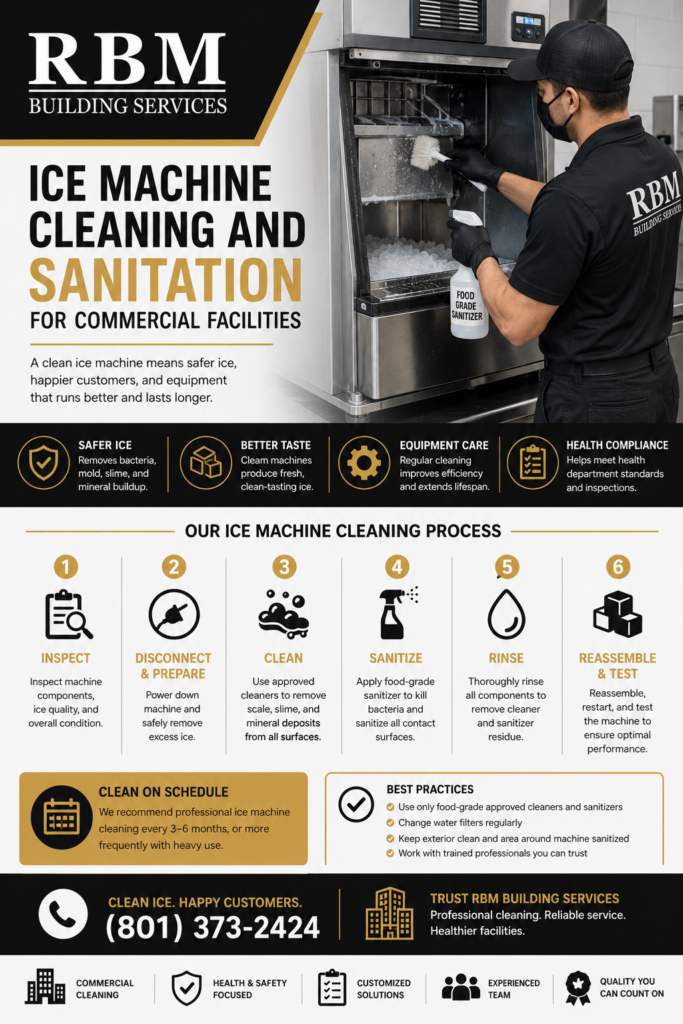
Commercial ice machines are among the most neglected pieces of equipment in commercial facilities, yet they present significant food safety and public health risks when not properly cleaned and sanitized. Ice is considered a food product by the FDA and is subject to the same safety standards as any food served to customers. Studies have shown that improperly maintained ice machines can harbor mold, bacteria, and even pathogens such as Listeria monocytogenes, E. coli, and Legionella. Despite this, surveys indicate that only 40% of food service establishments clean their ice machines on the recommended schedule. This guide provides comprehensive protocols for commercial ice machine cleaning and sanitation, covering different machine types, cleaning frequencies, approved chemicals, and regulatory requirements.
Why Ice Machine Cleaning Matters
Commercial ice machines create an environment where microorganisms can thrive. The dark, moist, cool interior provides ideal conditions for biofilm formation — a slimy layer of bacteria that adheres to internal surfaces and continuously contaminates new ice as it forms. Biofilm acts as a protective barrier for bacteria, making them resistant to standard cleaning methods. In addition to biofilm, mold and mildew can grow in ice machine water reservoirs, distribution tubes, and ice storage bins, particularly in machines that are infrequently sanitized. Scale and mineral deposits from hard water provide surfaces for bacteria to adhere to and reduce ice production efficiency by 10-30%. Slime and algae can develop in water lines and on ice machine components, particularly in machines connected to untreated water supplies. These contaminants not only affect ice quality — causing off-flavors, odors, and discoloration — but also pose legitimate health risks to building occupants and customers. Our commercial kitchen cleaning services include professional ice machine sanitation as part of comprehensive kitchen hygiene programs.
Ice Machine Cleaning Frequency Standards
Industry standards from the NSF International, the FDA Food Code, and major ice machine manufacturers recommend the following cleaning schedule: daily tasks include removing and cleaning the ice scoop or dispensing mechanism, wiping down exterior surfaces, and checking the ice level for proper operation. Weekly tasks include inspecting the ice for clarity, odor, and taste; checking the water filter (if installed) and replacing if needed; and inspecting drain lines for proper flow and signs of biofilm. Monthly tasks include the primary cleaning and sanitation cycle: turning off the machine, discarding all ice, cleaning and sanitizing the storage bin, cleaning the evaporator plates or ice-making mechanism, running a full sanitation cycle with approved chemicals, and rinsing thoroughly. Quarterly tasks include descaling the machine with an approved descaler to remove mineral deposits, cleaning and sanitizing the water distribution system, replacing water filters, and inspecting and cleaning condenser coils. Annual tasks include professional deep cleaning of the entire ice machine system, including disassembly and cleaning of all internal components, replacement of water lines and gaskets if needed, and comprehensive inspection of all mechanical and electrical systems.
Approved Cleaning Chemicals and Procedures
Only NSF-certified cleaning and sanitizing chemicals should be used in commercial ice machines. Standard cleaning chemicals include nickel-safe ice machine cleaner (usually an acidic cleaner designed to remove scale and mineral deposits without damaging the stainless steel evaporator), food-grade sanitizer (typically a quaternary ammonium compound or chlorine-based sanitizer approved for food contact surfaces), descaler (for removing heavy mineral deposits from water systems), and condenser coil cleaner (for maintaining heat exchange efficiency). The step-by-step cleaning procedure begins with turning off the machine, unplugging it or switching off the circuit breaker, and removing all ice from the storage bin. The ice scoop and bin liner should be removed and cleaned separately. The ice maker should be disassembled according to manufacturer instructions, and all removable parts cleaned in warm water with approved cleaner. The cleaner solution should be circulated through the water system and allowed to soak for the recommended time. After cleaning, the system must be thoroughly rinsed with potable water to remove all cleaner residues. The sanitizer solution is then circulated through the system and allowed to contact all surfaces for the recommended dwell time. Finally, the system is rinsed again with potable water. All parts are reassembled, the machine is restarted, and the first batch of ice is discarded. For more on maintaining commercial kitchen systems, see our commercial cleaning programs.
Additional FAQs
How do I know if my ice machine needs cleaning? Warning signs include cloudy or discolored ice, foul odors or off-tastes in ice, visible mold or slime in the storage bin, reduced ice production, unusual sounds from the machine, and health department citations or warnings.
Can I use vinegar to clean my commercial ice machine? Vinegar is not recommended for commercial ice machines. It is not as effective as NSF-certified ice machine cleaners, may not kill all bacteria and pathogens, can damage some machine components over time, and does not meet health code requirements for commercial ice machine sanitation.
How does hard water affect ice machine maintenance? Hard water accelerates scale buildup on evaporator plates, reducing ice production efficiency by 10-30%. Hard water also increases mineral deposits in ice (white, cloudy appearance), shortens the life of water valves and seals, and requires more frequent descaling and cleaning. Water softeners or reverse osmosis systems can significantly reduce these issues.
Do I need a professional to clean my ice machine, or can I do it myself? Monthly cleaning can be performed by trained onsite staff using proper procedures and approved chemicals. Quarterly or annual deep cleaning should be performed by a professional service technician who can disassemble the machine, clean internal components, inspect for wear and damage, and perform any needed repairs.
How often should ice machine water filters be replaced? Water filters should be replaced at least every 6 months or according to the manufacturer’s recommended schedule based on water usage. Filters in areas with poor water quality may need replacement every 3 months. A clogged filter reduces ice production and can lead to machine damage.
About RBM Building Services: Since 1974, RBM has provided commercial janitorial, building maintenance, and expert kitchen sanitation services across Utah, Arizona, Nevada, and Texas. Call 800.403.3564 or contact us.