
Church Sanctuary Cleaning Best Practices
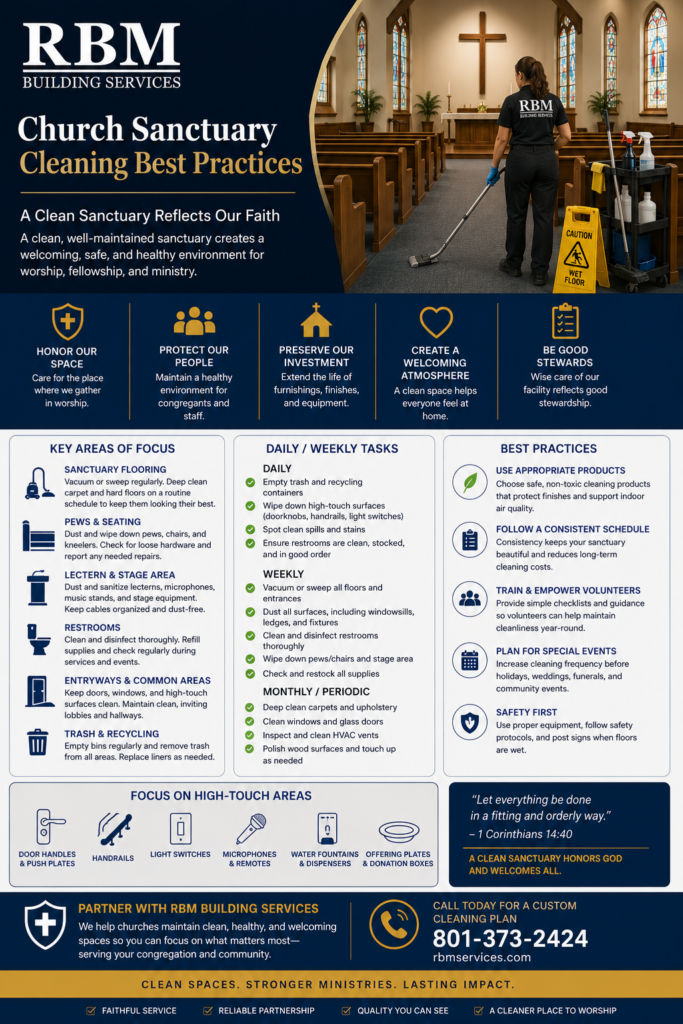
A Practical Guide for Safe, Welcoming Worship Spaces
Church sanctuary cleaning best practices are the routines, schedules, products, and standards that keep a worship space clean, safe, and inviting without disrupting reverence or service flow. For church leaders, volunteers, and facility teams, the goal is not just appearance; it is stewardship, hospitality, and health. The most important takeaway is that sanctuary cleaning works best when it is planned by zone, tied to service schedules, and built around repeatable checklists instead of ad hoc effort. High-touch areas like pews, doors, rails, restrooms, and entryways need consistent attention, while delicate surfaces such as wood furniture, stained glass, and sacred fixtures require gentler methods. A strong plan also helps reduce allergy triggers, odors, dust buildup, and last-minute scrambles before services or special events. Expert guidance can help churches choose the right products, protect finishes, train volunteers, and create a realistic cleaning schedule that supports both worship and maintenance. For a church, that balance matters as much as the cleaning itself.
What Sanctuary Cleaning Means
Church sanctuary cleaning best practices refer to the methods used to maintain the main worship area in a church, including pews or chairs, pulpits, altars, lecterns, aisles, windows, floors, and nearby touchpoints. In simple terms, it means cleaning the space in a way that keeps it respectful, sanitary, and ready for worship. A good plan usually includes dusting, vacuuming, spot cleaning, disinfecting high-touch surfaces, polishing wood safely, and handling seasonal deep cleaning before major services or holidays.
The main people involved are pastors or ministry leaders, building managers, janitorial staff, and volunteers. Each group has a different role, but all should follow the same standard so the space does not depend on one person’s memory. Church resources commonly emphasize repeatable procedures, top-down cleaning, and clear task assignments because consistency is what keeps a sanctuary looking cared for over time.
Best practice also means knowing what is included and what is not. Included are normal cleaning tasks, light disinfection of commonly touched surfaces, and careful maintenance of visible areas. Not included are repairs, restoration of damaged finishes, or aggressive chemical treatment that could harm sacred or decorative materials. In a sanctuary, “clean” should still feel calm, orderly, and respectful.
8 Core Issues
1. Dust control is not optional
Dust accumulates quickly in sanctuaries because of foot traffic, fabric seating, ceiling height, vents, and decorative surfaces. It settles on pews, pulpit furniture, ledges, window frames, light fixtures, and vents, then gets redistributed each time the room is used. Church cleaning guides consistently recommend regular dusting and high dusting so the sanctuary stays visually fresh and does not trigger allergies or create a neglected look.
This matters because dust affects both appearance and comfort. Visitors notice dusty pew backs, visible buildup on ledges, and lint on carpets, even if they cannot describe exactly what feels off. Members with allergies or sensitivities may also be affected by airborne dust and poorly maintained vents. In practical terms, poor dust control makes the entire space feel older, duller, and less cared for than it really is.
The best fix is a top-down cleaning method. Start with ceiling corners, fans, lights, vents, and high surfaces, then move down to pews, furniture, and floors. That order prevents dust from falling onto areas that were already cleaned. Microfiber cloths and extendable dusters are especially useful because they trap dust instead of just moving it around. A church that stays ahead of dust usually looks cleaner with less effort over time.
2. Pews and seating need careful attention
Seating is one of the most-used parts of the sanctuary. Pews, chairs, kneelers, and cushions collect fingerprints, crumbs, gum, smudges, and wear marks, especially on armrests and backs. Cleaning guides for churches often emphasize routine wiping, vacuuming, and stain spot treatment because seating is both highly visible and heavily touched.
This matters because seating is where people spend the most time looking around. If pews are dusty or sticky, the entire sanctuary feels less welcoming, even if the floors are clean. Fabric seats can also trap odors and allergens, while wood seating can be damaged by overly wet products or harsh chemicals. The wrong cleaner may leave streaks, haze, or finish damage.
The practical answer is to match the method to the material. Wood pews should be dusted and wiped with appropriate low-moisture products, while upholstered seating should be vacuumed and treated with fabric-safe methods. Spot cleaning should happen as soon as spills are noticed, not after they set in for weeks. Churches that create a seating checklist, rather than relying on someone to “take a look,” usually get much better results.[
3. Floors set the first impression
Sanctuary floors take a beating from weekly services, weddings, funerals, choir rehearsals, and seasonal events. Carpets show tracked-in dirt and stains, while hard floors can become scuffed or slippery if not maintained properly. Church cleaning resources commonly recommend regular vacuuming or mopping, spot cleaning, and seasonal deep care such as carpet extraction or floor refinishing.
This matters because floor condition is one of the first things people notice when they enter. A clean pulpit cannot fully offset stained carpet in the aisle or dull hard floors at the entrance. Flooring also affects safety: loose debris, wet spots, and worn finishes can create slip risks, especially during busy service transitions.
The right approach depends on the floor type and traffic level. Carpets need consistent vacuuming and periodic extraction, while hard floors need sweeping, damp mopping, and occasional maintenance by finish type. Entry mats are important because they reduce the amount of dirt that reaches the sanctuary in the first place. Churches with large attendance swings should increase floor care before holidays, funerals, and other high-traffic services.
4. High-touch surfaces need a steady routine
Door handles, railings, microphones, light switches, offering boxes, armrests, and shared surfaces can spread dirt and germs quickly if they are missed. Church cleaning guides increasingly stress regular disinfecting of high-touch areas because these points are touched by many people in a short time.
This matters because a sanctuary can look spotless while still having neglected touchpoints. That creates a gap between appearance and actual hygiene. Visitors may not consciously notice the handles or switches, but they absolutely experience the results if those surfaces feel grimy or sticky. During cold-and-flu season or in any high-contact period, the gap matters even more.
The practical solution is to identify the high-touch list in writing and clean it on a recurring schedule. That usually means before services, between major events, and after heavy use. Use appropriate products for each surface, especially around electronics, wood finishes, and delicate hardware. The key is not just cleaning more; it is cleaning the same critical points every time so nothing depends on guesswork.
5. Restrooms and lobbies shape the whole experience
Even though the sanctuary is the spiritual center, visitors often form their first impression in the lobby and restroom areas. Church cleaning checklists regularly include these spaces because they are public-facing, high-use, and easy to judge at a glance.
This matters because people associate the condition of entry spaces with the church’s overall care. If the lobby is cluttered or the restrooms are understocked, the sanctuary already starts from a weaker position. The restroom issue is especially important because supplies, odors, and surface cleanliness all affect whether guests feel comfortable returning
The fix is to make these spaces part of the sanctuary cleaning plan, not separate from it. Restrooms should be checked regularly, trash removed, and supplies restocked before a service begins. Lobbies should be vacuumed or mopped, tables wiped, and doors cleaned. A sanctuary feels more welcoming when the approach to it is just as cared for as the front pew.
6. Special surfaces need gentle methods
Many sanctuaries include stained glass, polished wood, decorative trim, lecterns, musical instruments, and other delicate surfaces. These items need careful cleaning because aggressive chemicals or abrasive tools can do real damage. Church cleaning resources often recommend pH-neutral or wood-safe products, soft cloths, and gentle handling for sacred or decorative areas.
This matters because damage from the wrong cleaning method can be expensive and permanent. Clouded glass, stripped wood finish, and scratched fixtures are much harder to correct than ordinary dirt. Churches often discover this only after repeated use of a product that was too harsh or too wet for the material.
The practical answer is to create a surface-by-surface product list. A bathroom disinfectant may be perfect for restrooms but wrong for a wood altar rail. Glass cleaner may work on windows but not on stained glass or delicate finishes. When in doubt, the safest move is to test in a small hidden area and use the least aggressive method that still achieves the goal.
7. Volunteers need clear instructions
Many churches rely on volunteers for some or all of their sanctuary cleaning. That can work well, but only if the instructions are simple and repeatable. Church facilities resources repeatedly emphasize cleaning procedures, checklists, and shared responsibility because good intentions alone do not create consistency.
This matters because volunteers may show up on different days, have different experience levels, and assume someone else knows the proper method. Without clear direction, one volunteer may overuse chemicals while another skips important areas. The result is inconsistent quality and frustration on both sides.
The practical fix is to create a short, room-specific checklist and train volunteers on the order of work. Give them plain-English instructions, labeled supplies, and a point person for questions. If a task is too technical, too heavy, or too risky for volunteers, it should be assigned to trained staff or a professional provider. Churches work best when volunteers support the plan rather than having to invent it.
8. Cleaning frequency should follow the calendar
Churches do not operate on a flat schedule. Sunday services, midweek events, weddings, funerals, Christmas, Easter, VBS, and fellowship meals all change the cleaning load. That is why church cleaning checklists often divide tasks into weekly, monthly, and seasonal work instead of treating every week the same.
This matters because a normal week and a holiday week are not comparable. The sanctuary may need a full clean before major services, a touch-up between multiple gatherings, or a deeper reset after heavy attendance. If the schedule stays fixed while usage changes, the church will either over-clean quiet weeks or under-clean busy ones.
The practical strategy is to build a baseline routine and then add event-based cleaning layers. For example, a weekly plan may cover dusting, vacuuming, and restroom care, while special services trigger pre-event and post-event cleaning. Churches that align cleaning with the calendar usually avoid the last-minute panic that happens when people realize the space has not been reset for a holiday crowd.
Real Costs
Getting church sanctuary cleaning best practices wrong has both visible and hidden costs. Financially, the church may spend more on emergency cleaning, stain removal, surface restoration, or floor replacement than it would have spent on routine care. Time costs also add up when volunteers or staff must repeatedly fix preventable issues right before services or events.
The emotional and relational cost can be just as serious. A neglected sanctuary can make guests feel less welcomed and regular attendees feel less confident about stewardship. Over time, recurring cleanliness problems can become a source of tension between staff, volunteers, and leadership. Most of these costs are avoidable with a clear plan, simple checklists, and expert help where needed.
How Expert Help Works
An experienced church cleaning professional helps by turning broad ideas like “keep it clean” into a realistic schedule and task list. That includes selecting safe products for wood, glass, fabric, and flooring; building a weekly and seasonal plan; and helping the church decide what volunteers can handle and what should be outsourced. It also helps with risk management, because an expert can spot problem areas such as worn carpet, neglected vents, or surfaces that are being damaged by the wrong chemical.
Expert guidance is especially useful when the sanctuary hosts large events or has delicate historic finishes. A good provider should explain the process clearly, help prevent mistakes, and adapt the plan as the church’s schedule changes. For churches that want practical, reliable support, consult RBM Services for guidance on church sanctuary cleaning best practices.
Service Options
Volunteer-based cleaning
Volunteer cleaning can be a good fit for small churches with limited budgets. It works best when the scope is simple, the team is trained, and the schedule is realistic. The main limitation is inconsistency, since volunteers may rotate and quality may vary week to week.
Staff-led routine cleaning
Staff-led cleaning offers more consistency and better accountability. It is appropriate for churches with regular traffic, multiple rooms, or frequent events. The drawback is cost, but it often produces more reliable results and less last-minute scramble.
Professional periodic deep cleaning
Professional deep cleaning is useful for seasonal resets, stain treatment, floor care, and pre-holiday preparation. It works well as a supplement to in-house routines. Its limitation is that it does not replace weekly maintenance; it just restores and refreshes the space.
What To Do Now
If your sanctuary cleaning system is not working, start by dividing the building into zones: sanctuary, lobby, restrooms, classrooms, offices, kitchen, and storage. Then write down what needs daily, weekly, monthly, and seasonal attention. That makes the cleaning load visible instead of vague.
Next, identify your most delicate surfaces and your most frequently touched surfaces, because those need different methods. Add a checklist for volunteers or staff, and review whether your current products are safe for wood, fabric, and specialty finishes. Finally, schedule extra cleaning around high-attendance services so the building stays ready instead of reactive.
Choosing The Right Provider
Look for a provider with experience in churches or other sensitive, public-facing spaces. They should understand how to clean respectfully around sanctuary furniture, sacred decor, and event schedules, while still handling floors, restrooms, and high-touch areas well. Clear communication matters because the provider should be able to explain the plan in simple terms and adjust it around worship times.
The right partner should also be responsive, comprehensive, and willing to support both immediate issues and long-term planning. For practical, experienced commercial cleaning support, consult RBM Services for guidance on church sanctuary cleaning best practices. A church needs a provider that can maintain reverence, cleanliness, and consistency without creating extra work for leadership.
Common Mistakes
- Using the same method on every surface. Wood, fabric, glass, and floors all need different care.
- Cleaning from the bottom up. Dust should be removed from high surfaces first so it does not fall onto finished areas.
- Relying on memory instead of a checklist. That leads to missed tasks and uneven results.
- Ignoring the lobby and restrooms. Visitors judge the whole church by these spaces.
- Overusing water or harsh chemicals on delicate finishes. That can damage sacred furniture and trim.
- Treating every week the same. Holiday and event weeks require more intensive care.
- Expecting volunteers to do everything without training. Good intentions do not replace clear instructions.
Frequently Asked Questions
What are church sanctuary cleaning best practices?
They are the routines and methods that keep a sanctuary clean, safe, and respectful for worship.
How often should a sanctuary be cleaned?
At minimum, it should follow a weekly routine, with added cleaning before and after events or high-attendance services.
What is the first thing to clean in a sanctuary?
High surfaces should be addressed first so dust falls downward before floors are cleaned.
Should pews be vacuumed or wiped?
Usually both, depending on whether the seating is wood, fabric, or upholstered.
What surfaces need the most attention?
Pews, chairs, floors, entryways, high-touch hardware, restrooms, and lobby spaces usually need the most consistent care.
Are disinfectants needed in a sanctuary?
They can be useful for high-touch areas, but product choice should match the surface and cleaning goal.
How do churches protect wood finishes?
Use gentle, wood-safe cleaners and avoid excess moisture or harsh chemicals.
Why are lobby and restroom areas part of sanctuary cleaning?
Because they shape the first impression and influence how welcome visitors feel.
How often should floors be vacuumed or mopped?
At least weekly in many churches, and more often during busy seasons or before major services.
Do stained glass windows need special care?
Yes, they should be cleaned gently with methods that will not damage delicate materials.
Can volunteers handle sanctuary cleaning?
Yes, if the tasks are simple, training is clear, and the schedule is realistic.
What is the best way to avoid dust buildup?
Use a top-down cleaning method and maintain regular high-dusting.
How should churches handle spills?
Spills should be cleaned promptly so they do not stain, damage finishes, or create slip hazards.
Is carpet extraction necessary?
Often yes, especially in high-traffic sanctuaries or before major seasonal services.
How do churches prepare for Easter or Christmas?
They usually add a seasonal deep clean, more frequent touch-up work, and a pre-service reset.
What about the pulpit and altar area?
These should be cleaned carefully with respect for the materials and the sacred setting.
Why use checklists?
Checklists make cleaning repeatable, reduce missed tasks, and help volunteers work consistently.
What is the biggest sanctuary cleaning mistake?
Using a one-size-fits-all routine instead of a zone-based plan.
How can a church reduce allergies in the sanctuary?
By controlling dust, maintaining vents, vacuuming regularly, and reducing buildup on fabrics and carpets.
Should cleaning happen before or after services?
Both, depending on the task. High-touch touch-ups are often needed before services, with deeper cleaning afterward.
How often should high-touch surfaces be cleaned?
Regularly and consistently, especially around services and events when contact is highest.
Can one cleaning schedule work for every church?
No. Schedule should reflect building size, material types, attendance, and event frequency.
What products are safest for sanctuaries?
Usually low-odor, material-appropriate cleaners that are safe for wood, fabric, and delicate finishes.
How do churches keep cleaning respectful?
By using gentle methods, clearing sensitive items carefully, and planning around worship timing.
When should a church hire a professional cleaner?
When the building has high traffic, delicate finishes, recurring complaints, or limited volunteer capacity.
Rules And Standards
There is no single universal law that dictates sanctuary cleaning, but churches commonly follow practical standards for cleanliness, safety, and stewardship. Those standards include top-down dusting, safe product selection for delicate materials, routine attention to high-touch surfaces, and scheduled deep cleaning around major events. Many church facility guides also emphasize written checklists, consistent procedures, and matching cleaning frequency to actual use.
Closing
Church sanctuary cleaning best practices are about more than appearance. They help protect the building, support health, reduce stress for volunteers, and create a calm, welcoming environment for worship. Most problems come from inconsistent routines, the wrong products, or trying to treat every surface and season the same way. With a clear plan, simple checklists, and proper guidance, those problems are usually avoidable. For churches that want dependable commercial cleaning support, consult RBM Services for guidance related to church sanctuary cleaning best practices.