
Commercial Janitorial Service Flyer
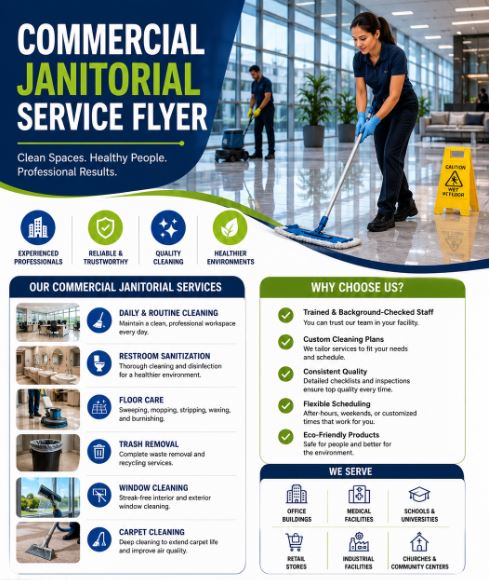
The Complete 2026 Guide to Creating Flyers That Win Clients
Opening Summary: What You Need to Know Up Front
A commercial janitorial service flyer is a promotional marketing document designed to advertise cleaning services to businesses, property managers, and commercial facility owners. It’s one of the most cost-effective marketing tools for janitorial companies, with businesses能看到 results when they distribute hundreds or thousands of flyers strategically over time. The most important takeaway is that a successful commercial janitorial flyer must be targeted, professional, and include specific elements that build trust and drive action.
This comprehensive guide breaks down exactly what to include on your commercial janitorial service flyer, from essential contact information and service breakdowns to trust indicators like licensing and insurance. You’ll learn the 9 key elements every effective flyer needs, common mistakes that cause prospects to ignore your marketing, distribution strategies that actually generate leads, and how to design flyers that stand out from competitors.
Expert guidance matters because most businesses fail at flyer marketing by creating generic, cluttered designs that don’t speak to commercial clients’ specific needs like health & safety compliance, reliability, and professionalism. With proper planning and the right approach, most flyer marketing problems are completely avoidable. Let’s dive into the details so you can create a commercial janitorial service flyer that converts viewers into paying clients.
What Is Commercial Janitorial Service Flyer and How Does It Work?
Clear Definition
A commercial janitorial service flyer is a printed or digital promotional template designed to advertise janitorial and commercial cleaning services to business decision-makers. It features editable text areas, images, and graphics that highlight key service details, pricing information, and contact information to attract commercial clients.
Key Components Involved
Four main elements work together in an effective commercial janitorial flyer:
- The Business (janitorial company with services to offer)
- The Target Audience (business owners, facility managers, property managers)
- The Flyer Design (layout, content, images, branding)
- The Distribution Method (direct mail, door-to-door, bulletin boards, digital sharing)
Industry Standards and Best Practices
Commercial janitorial flyers follow several key principles:
- Visual Appeal: High-quality images, clean layouts, professional colors create credibility
- Clear Messaging: Simple headlines, bullet points, and scannable text for limited attention spans
- Trust Indicators: Licensed, bonded, and insured status prominently displayed
- Call to Action (CTA): Clear, urgent instruction on what viewers should do next
- Targeted Distribution: Focus on locations where ideal clients spend time
Common Variations and Types
| Flyer Type | Best For | Key Differences |
|---|---|---|
| Commercial-Focused | Offices, medical facilities, retail | Emphasizes professionalism, health & safety, compliance |
| Residential-Focused | Homes, condos, apartments | Emphasizes trust, convenience, home-specific services |
| General Cleaning | Mixed clients | Broader appeal, less specialized |
| Specialty Service | Carpet, window, deep cleaning | Focuses on niche expertise |
| Special Offer | First-time clients | Prominent discount/promotion focus |
General Process Flow
- Market Research: Identify target audience and their specific needs
- Content Planning: Gather services, pricing, contact info, testimonials
- Design Creation: Use templates (Canva, VistaPrint) or hire designer
- Review & Refine: Check for clarity, errors, and brand consistency
- Print or Digital Export: Choose size (typically 8.5″×11″ or 11″×17″)
- Distribution Strategy: Target specific neighborhoods, businesses, or mailing lists
- Tracking & Follow-up: Use promo codes to measure success
- Optimization: A/B test versions, double down on winners
What’s Included vs. Not Included
Typically Included on Effective Flyers:
- Company name and logo prominently displayed
- Contact details (phone, email, website)
- List of services offered (basic + specialty)
- Special offers or discounts
- Call to action (CTA)
- Trust indicators (licensed, bonded, insured)
- High-quality images of work
- Service area information
Typically Not Included (or Should Be Avoided):
- Too much text (cluttered design)
- Generic phrases like “best in town” without proof
- Clashing colors or too many fonts
- False or exaggerated claims
- Irrelevant information that doesn’t address commercial needs
Real-World Example
A successful commercial janitorial flyer for a 500-square-foot office distribution might include:
Headline: “Professional Office Cleaning Your Business Deserves”
Services: Daily restroom sanitization, floor care, trash removal, carpet cleaning
Special Offer: “First Month 20% Off – Limited Time”
Trust: “Licensed, Bonded, Insured | 10+ Years Experience”
CTA: “Call Now for Free Quote: (555) 123-4567”
Images: Before/after photos of cleaned office spaces
Result: 2–5% response rate when distributed to 1,000 targeted commercial properties in the same zip code, with recurring clients clustering in wealthier commercial areas.
9 Key Things to Know About Creating Effective Commercial Janitorial Service Flyers
1. Your Headline Must Immediately Address Commercial Client Pain Points
What it is: The headline is the one-line appeal that catches your customer’s eye and gives the main reason to engage.
Why it matters: People scanning flyers have limited attention spans. A simple, benefit-focused headline gets your message across quickly. Commercial clients care about professionalism, reliability, health & safety, and compliance—not just “cleaning”.
Real-world consequences: A weak headline like “Cleaning Services Available” gets ignored. A strong headline like “Keep Your Office Compliant: Professional Janitorial Services for Medical Facilities” immediately signals you understand their specific needs and regulatory requirements.
How to handle it: Craft headlines that:
- Address specific commercial pain points (compliance, employee health, customer impressions)
- Use strong verbs (“Maintain,” “Protect,” “Ensure”)
- Mention your target industry (office, medical, retail, industrial)
- Keep it under 10 words for maximum impact
Examples:
- “Professional Office Cleaning That Meets OSHA Standards”
- “Reliable Janitorial Services for Growing Businesses”
- “Keep Your Retail Space Sparkling—Daily Cleaning Starting at $299/month”
2. Display Your Company Name and Logo Prominently for Brand Recognition
What it is: Your company name should be in a large, catchy font that’s easy to read from far away, with your logo in a prominent position.
Why it matters: Even if the reader doesn’t immediately engage, the next time they think about needing janitorial services, they’ll remember your brand. Logos are key to branding and making your cleaning business stand out and appear professional.
Real-world consequences: A flyer without a clear company name gets tossed—the reader remembers they need cleaning but not who to call. A professional logo establishes credibility and helps you stand out from competitors using generic templates.
How to handle it:
- Place company name at the top in the largest font (36pt or larger)
- Use your brand colors consistently throughout the flyer
- Include logo in top-left or center for maximum visibility
- Ensure logo is high-resolution (300 DPI for print)
- Make name memorable and easy to spell
3. Include All Essential Contact Details for Easy Reach
What it is: Phone number, email address, and/or website prominently displayed so potential customers can contact you.
Why it matters: Making it easy to reach you directly impacts conversion rates. Phone numbers are usually most effective for quick local marketing campaigns because they enable immediate contact.
Real-world consequences: A flyer without clear contact information wastes the viewer’s interest. If they have to search for your phone number or email, they’ll likely call a competitor instead. Missing website URL means missing digital follow-up opportunities.
How to handle it:
- Phone number: Make it largest contact detail (24pt font), use local format (555) 123-4567
- Email: Include professional email (info@yourcompany.com, not Gmail)
- Website: Include full URL with https://
- QR code: Add scannable QR code linking to website or quote form
- Place contact details at the bottom for easy scanning
4. Provide a Clear Service Breakdown Showing Specific Benefits
What it is: A bullet-point list of key services offered, explaining how your cleaning service specifically benefits commercial clients.
Why it matters: Commercial clients need to quickly understand if you offer what they need. A service breakdown gives readers a second chance to realize you’re perfect for their commercial facility after the headline grabs attention.
Real-world consequences: Vague service descriptions like “we clean everything” don’t build confidence. A detailed breakdown shows you understand commercial cleaning complexity and have expertise in their specific facility type.
How to handle it:
Create a bullet-point list organized by area or service type:
Office Cleaning Services:
- Daily restroom sanitization and restocking
- Desk and workspace dusting
- Floor sweeping, vacuuming, and mopping
- Trash removal and dumpster area cleaning
- Kitchen/break room cleaning
Specialty Services:
- Carpet extraction cleaning
- Window washing (interior/exterior)
- Floor buffing and burnishing
- Post-construction cleanup
- Deep disinfection services
Focus on benefits, not just features:
- “Daily restroom cleaning → Reduced employee sick days”
- “Professional carpet care → Extended floor life”
- “OSHA-compliant disinfection → Regulatory compliance”
5. Add a Strong Call to Action (CTA) That Creates Urgency
What it is: One or two lines telling potential customers exactly what to do next, building urgency and showing why they need to schedule service.
Why it matters: A strong CTA is crucial if you want your janitorial service flyer to have its desired effect. Without it, viewers may be interested but take no action.
Real-world consequences: A flyer without a CTA gets filed away and forgotten. A clear CTA like “Call Now for Free Quote” prompts immediate action and builds sense of urgency.
How to handle it:
- Be specific: “Call for Free Quote” vs. “Contact Us”
- Create urgency: “Limited-Time Offer: 20% Off First Month – Expires [Date]”
- Make it easy: Include phone number in CTA
- Build on other information: Reference your special offer or unique benefit in CTA
- Use action verbs: “Call,” “Schedule,” “Book,” “Claim”
Examples:
- “Call Now for Free Quote”
- “Schedule Your Free On-Site Estimate Today!”
- “Claim Your 20% Off First Month—Limited Spots Available!”
6. Include Trust Indicators: Licensed, Bonded, and Insured
What it is: Prominently displaying that your company is licensed, bonded, and carries cleaning insurance.
Why it matters: Commercial clients are risk-averse. They need to know you’re legitimate, professional, and will protect their property if something goes wrong. Trust indicators are essential for building credibility.
Real-world consequences: A flyer without “Licensed & Insured” looks unprofessional and risky. Business owners may worry about property damage, employee theft, or liability issues. This single phrase can be the difference between getting the call and being ignored.
How to handle it:
- Place “Licensed, Bonded, Insured” near your logo or contact details
- Include insurance coverage amount if impressive (e.g., “$1M Liability Coverage”)
- Mention years in business (e.g., “10+ Years Serving Commercial Clients”)
- Add satisfaction guarantee if you offer one
- Include testimonials or reviews from commercial clients
7. Use High-Quality Images That Show Results
What it is: Professional photos of your cleaned commercial spaces, before/after comparisons, or happy commercial clients.
Why it matters: High-quality photos establish strong emotional connection and convince viewers they can achieve their goals with your service. Adding your own images is essential for targeting your niche audience.
Real-world consequences: Generic stock photos look impersonal and don’t build authenticity. Poor-quality images make your business look amateur. High-quality photos of actual commercial work show proof of your expertise.
How to handle it:
- Use your own photos: Showcase actual commercial spaces you’ve cleaned
- Focus on niche: If targeting offices, show office cleaning results
- Before/after shots: Dramatically demonstrate cleaning effectiveness
- Professional quality: Use good lighting, proper framing, high resolution
- Show results: Photos should focus on what customer gains (clean, professional space)
8. Offer Special Promotions or Discounts to Entice Action
What it is: Limited-time offers, first-time client discounts, or sign-up incentives prominently displayed.
Why it matters: People love a good deal. Special offers sweeten the deal and create reason to act now rather than later. Promotions should be clear and prominently displayed to attract attention and encourage immediate action.
Real-world consequences: A flyer without incentives may get filed for “later” and never acted upon. A 20% discount or free quote offer creates urgency and reduces risk for first-time clients.
How to handle it:
- Make it specific: “20% Off First Month” vs. “Special Discount”
- Create scarcity: “Limited-Time Offer” or “Only 10 Spots Available”
- Add promo codes: Attach deals to unique codes for tracking (e.g., “FLYER20”)
- Highlight prominently: Use different color or box to make offer stand out
- Include expiration date: Creates urgency to act now
9. Target Your Distribution to Commercial Decision-Makers
What it is: Distributing flyers in areas where ideal commercial clients live or work, not random mass distribution.
Why it matters: You’ll get better results by sending flyers to ideal commercial clients, not a random large group. Targeting the right market means more effective results and less wasted effort.
Real-world consequences: Dropping 2,000 flyers residentially when you want commercial clients wastes money and time. Targeting 500 commercial properties in your service area generates far more leads.
How to handle it:
- Identify target zip codes: Look at where your current recurring commercial clients cluster
- Focus on commercial areas: Office parks, industrial zones, retail centers
- High-traffic bulletin boards: Community centers, coffee shops, apartment building entrances
- Door-to-door commercial: Deliver to business offices, property management companies
- Repeat distribution: Target same location multiple times (3 times over 6 months)
- Track by zip code: Use unique promo codes for each distribution area
The Real Cost of Getting Commercial Janitorial Service Flyer Marketing Wrong
Financial Costs
Wasted Printing Costs: Creating generic, unprofessional flyers that get ignored wastes $200–$500 on printing 1,000–5,000 copies. Poor design or unclear messaging means zero return on investment.
Ineffective Distribution: Mass mailing to wrong audience (residential when you want commercial) wastes $300–$1,000 on postage and distribution with near-zero conversion. You need hundreds or thousands of targeted flyers to see impact.
Missed Client Opportunities: A weak flyer that doesn’t convert means losing potential commercial contracts worth $1,000–$5,000/month each. One lost client = $12,000–$60,000 annual revenue.
Reprinting Costs: Finding errors or poor design after printing requires reordering, adding $200–$800 in unexpected costs.
Time Costs
- Design iterations: Poor initial design requires 10–20 hours of revisions or hiring a designer ($300–$800)
- Distribution labor: Door-to-door delivery of 1,000 flyers takes 15–20 hours of staff time
- Follow-up on bad leads:Wrong targeting means wasting time on residential inquiries when you want commercial
- Starting over: Abandoning flyer marketing after one failed attempt = lost learning opportunity
Emotional and Relational Costs
- Frustration with marketing: Repeated failed flyer campaigns create discouragement about marketing overall
- Damaged brand perception: Unprofessional flyers harm your business reputation before you even speak to prospects
- Missed growth opportunities: Inadequate marketing slows business growth and creates stress about cash flow
- Competitive disadvantage: Competitors with better flyers win your target clients
Long-Term Consequences
- Marketing apathy: Failed flyer experiences lead to abandoning effective marketing channels
- Price competition: Unable to attract premium commercial clients, forced to compete on price with discount cleaners
- Stunted growth: Inconsistent client acquisition prevents scaling the business
- Reputation issues: Poor-quality flyers create perception of poor-quality service
Most Costs Are Avoidable
With proper planning—clear strategy, professional design, targeted distribution, and tracking—90% of these costs are preventable. Expert guidance from experienced janitorial marketing professionals ensures your flyer investment generates real returns.
How an Experienced Janitorial Marketing Professional Helps You Succeed With Flyers
Guidance Through Every Step
An experienced janitorial marketing professional walks you through:
- Audience identification: Defining your ideal commercial client (office, medical, retail, industrial)
- Content strategy: Determining which services and benefits to highlight
- Design selection: Choosing between templates, hiring designers, or working with print shops
- Distribution planning: Identifying target zip codes, commercial areas, and bulletin boards
- Tracking setup: Creating unique promo codes for each distribution channel
- Optimization: A/B testing versions and doubling down on winners
Proper Preparation and Execution
Experienced professionals:
- Use industry best practices from ISSA and BSCAI marketing guidelines
- Create proof-of-value content with task breakdowns and clear benefits
- Ensure brand consistency across all marketing materials
- Execute with professional design standards (color theory, typography, layout)
- Follow compliance requirements for advertising claims
Risk Management
- Insurance verification: Ensuring flyers accurately represent your coverage
- Accurate claims: Avoiding false or exaggerated advertising that could create liability
- Professional presentation: Reducing risk of looking unprofessional to commercial clients
- Quality control: Proofreading for errors before printing
Dispute Resolution and Troubleshooting
Experienced providers:
- Address design issues quickly before printing
- Have backup vendors for printing and distribution
- Offer revisions if initial design doesn’t meet expectations
- Maintain professional relationships with printers and designers
Compliance with Relevant Rules
- Truth-in-advertising: All claims must be accurate and verifiable
- No false guarantees: Avoid “100% satisfaction” if you can’t guarantee it
- Proper licensing disclosure: Display license numbers if required by state
- Privacy compliance: If collecting data via QR codes, follow privacy laws
Proactive Strategies to Prevent Problems
- A/B testing: Create 2 versions of flyer to test which performs better
- Tracking systems: Use unique promo codes for each distribution channel
- Seasonal adjustments: Update flyers for seasonal promotions or offers
- Regular updates: Refresh flyers every 6–12 months to stay current
Commercial Janitorial Service Flyer Options, Alternatives, and Strategies
Option 1: DIY Template-Based Flyers (Canva, VistaPrint)
How it works: Use free or low-cost online tools like Canva or VistaPrint with pre-designed cleaning service flyer templates. Customize text, images, and colors, then print at home or order prints online.
When appropriate:
- Limited budget ($50–$200 for design + printing)
- Basic design skills
- Need flyers quickly (same day or next day)
- Testing flyer marketing before investing more
Limitations:
- Generic look (many competitors use same templates)
- Limited customization options
- May not fully match your brand
- Lower print quality than professional printers
Option 2: Professional Graphic Designer
How it works: Hire a graphic designer to create custom flyer design tailored to your business. Designer can coordinate with print shop for professional printing.
When appropriate:
- Budget allows ($300–$800 for design)
- Want unique, branded design
- Need specific messaging or layout
- Planning long-term flyer marketing campaigns
Limitations:
- Higher cost than DIY
- Takes longer (1–2 weeks for design + revisions)
- Requires clear communication of your needs
- May need to separately arrange printing
Option 3: Print Shop Full Service
How it works: Local print shop provides both graphic design and printing services. They handle everything from concept to final product.
When appropriate:
- Want one-stop solution
- Support local business
- Need physical copies quickly
- Comfortable with potentially higher cost ($400–$1,000)
Limitations:
- Most expensive option
- May have limited design creativity
- Less flexibility for revisions
- Quality varies by printer
Option 4: Digital Flyers (Email, Social Media)
How it works: Create digital versions of flyers for email campaigns, social media posts, or website downloads. Shareable and trackable.
When appropriate:
- Building email list
- Active social media presence
- Want to track engagement (clicks, shares)
- Budget-conscious (free to low cost)
Limitations:
- Less impact than printed flyers for local marketing
- Requires existing audience
- Easy to ignore or delete
- Doesn’t work for door-to-door commercial distribution
Option 5: Hybrid Approach (Best of Both Worlds)
How it works: Professional design + high-quality printing + strategic distribution + digital version for email/social. Use flyer for both print and digital channels.
When appropriate:
- Serious about marketing
- Budget allows ($500–$1,500 total)
- Want multi-channel presence
- Planning long-term client acquisition
Limitations:
- Highest upfront cost
- Requires coordination across channels
- More complex to track and manage
Best for: Established janitorial companies scaling growth
What to Do If You Are Currently Creating a Commercial Janitorial Service Flyer
Immediate Step-by-Step Checklist
- Define your target audience
- Are you targeting offices, medical facilities, retail, or industrial?
- What’s their size (square footage, number of employees)?
- What are their biggest pain points (compliance, reliability, cost)?
- Gather essential content
- Company name, logo, and brand colors
- Phone number, email, website
- Complete service list (basic + specialty)
- License and insurance information
- Years in business
- Testimonials from commercial clients
- Choose your design approach
- DIY template (Canva, VistaPrint) for budget approach
- Hire designer for custom look
- Use print shop for full service
- Create compelling headline
- Address commercial pain points
- Keep under 10 words
- Use strong verbs
- Mention target industry
- Design with best practices
- Company name largest (36pt+ font)
- Contact details prominent (24pt phone number)
- Bullet-point service list
- High-quality images (your work, not stock)
- Clear CTA with urgency
- “Licensed, Bonded, Insured” visible
- Add special offer
- Specific discount (20% off, not “special”)
- Expiration date for urgency
- Unique promo code for tracking (e.g., “FLYER20”)
- Review and proofread
- Check for spelling/grammar errors
- Verify phone number and website work
- Confirm all claims are accurate
- Get second set of eyes
- Select size and print quality
- Standard: 8.5″×11″ (letter size)
- Larger: 11″×17″ (poster size, more attention)
- Print quality: 300 DPI for professional look
- Plan distribution strategy
- Identify target zip codes (where clients cluster)
- Choose commercial areas (office parks, retail centers)
- Find bulletin boards (community centers, coffee shops)
- Plan door-to-door or direct mail
- Set up tracking
- Create unique promo code for each distribution area
- Use separate phone number or email if possible
- Log all inquiries in CRM
- Measure response rate
- Start small and scale
- Print 500–1,000 flyers first
- Test in one neighborhood or commercial area
- If strong results, print more and expand
- Plan follow-up campaign
- Target same location 3 times over 6 months
- A/B test different versions (1,000 of each)
- Keep the winner, retest against it
How to Choose the Right Designer or Provider for Your Commercial Janitorial Service Flyer
Checklist for Selection
| Criterion | What to Verify | Why It Matters |
|---|---|---|
| Relevant Experience | 5+ years designing marketing for cleaning/janitorial companies | Industry knowledge of what works |
| Portfolio Quality | Examples of commercial cleaning flyers they’ve created | Shows design capability and style |
| Understanding of Commercial Clients | Can discuss B2B marketing and commercial facility needs | Ensures messaging resonates with business owners |
| Clear Communication | Plain-English explanations, responsive to questions | Prevents misunderstandings about design |
| Available Turnaround Time | Can deliver within your timeline (1–2 weeks typical) | Meets your marketing schedule |
| Comprehensive Approach | Handles design + printing coordination + revisions | One-stop solution reduces hassle |
| Willingness to Iterate | Offers revisions until you’re satisfied | Ensures final product meets needs |
| Pricing Transparency | Clear quote with no hidden fees | Avoids budget surprises |
| Printing Options | Offers multiple quality/price printing options | Fits your budget and quality needs |
| Positive Reputation | Reviews, testimonials, or references from other cleaning companies | Confirms reliability and quality |
Red Flags to Avoid
- No portfolio or examples of previous work
- Unwilling to provide references from cleaning industry clients
- Pressure to rush design without review
- Vague pricing or hidden fees
- Promises “guaranteed results” or “best flyer ever” without proof
- Uses only generic stock photos, no customization
Green Flags to Prioritize
- Experience with commercial janitorial specifically (not just general design)
- Understands B2B marketing and commercial client psychology
- Offers A/B testing recommendations
- Provides tracking setup advice (promo codes, unique contacts)
- Recommends targeting strategy, not just design
- Clear revision process and timeline
Common Mistakes People Make With Commercial Janitorial Service Flyers
1. Focusing Only on Price Instead of Value
Why it happens: Believing low price is the main selling point for commercial clients.
How to avoid: Emphasize professionalism, reliability, compliance, and expertise. Commercial clients pay for peace of mind, not just cheapest cleaning. Include trust indicators and service benefits.
2. Creating Generic Flyers for Both Residential and Commercial
Why it happens: Wanting to reach all potential clients with one flyer.
How to avoid: If targeting both residential and commercial, produce distinctive flyers for each. Commercial clients care about compliance and professionalism; residential clients care about trust and convenience.
3. Overloading Flyer with Too Much Text
Why it happens: Trying to include every possible detail.
How to avoid: Keep it brief and to the point. Use bullet points, white space, and scannable layout. Address reader’s pain points immediately and show why you can help. Busy people should understand what you do in 5 seconds.
4. Not Including Trust Indicators (Licensed, Bonded, Insured)
Why it happens: Forgetting how important legitimacy is to commercial clients.
How to avoid: Prominently display “Licensed, Bonded, Insured” near your logo. Commercial clients won’t risk hiring unverified cleaners. This single phrase builds critical credibility.
5. Using Generic Stock Photos Instead of Your Own Work
Why it happens: Easier than taking professional photos of actual work.
How to avoid: Add your own images showing actual commercial spaces you’ve cleaned. Focus images on niche audience (office photos for office cleaning). Generic stock looks impersonal and doesn’t prove expertise.
6. Not Testing Multiple Versions (A/B Testing)
Why it happens: Assuming one flyer version is optimal.
How to avoid: Always create 2 versions and test. Send 1,000 of each version, track which performs better, keep the winner, and retest. This incremental improvement approach works for any marketing.
7. Distributing Only Once Instead of Repeatedly
Why it happens: Expecting single flyer drop to generate leads.
How to avoid: Don’t think of flyer as single drop. Target same location multiple times (3 times over 6 months). Repeat distribution dramatically improves results and brand recognition.
8. Not Tracking Which Flyers Generate Leads
Why it happens: No system to measure flyer ROI.
How to avoid: Attach unique promo codes to each distribution channel (e.g., “ZIP12345” for each area). This tells you how many leads come from flyers and which areas perform best. Use CRM to track all inquiries.
Frequently Asked Questions
What should be on a commercial janitorial service flyer?
A commercial janitorial flyer should include: company name and logo, contact details (phone, email, website), list of services offered, special offers/discounts, call to action (CTA), trust indicators (licensed, bonded, insured), high-quality images of work, and service area information.
What size should a commercial cleaning flyer be?
Standard size is 8.5″×11″ (letter size). For more attention in high-traffic areas, use 11″×17″ (poster size). Larger sizes attract more attention but cost more to print and distribute.
How much does it cost to create a janitorial service flyer?
DIY templates cost $50–$200 (design + printing). Professional designer costs $300–$800 for design. Full-service print shop costs $400–$1,000. Printing 1,000 flyers typically costs $100–$300 depending on quality.
Should I use a template or hire a designer for my flyer?
Use templates (Canva, VistaPrint) if budget is limited ($50–$200) and you need flyers quickly. Hire a designer ($300–$800) if you want unique, branded design and are planning long-term marketing campaigns.
What’s the most important element on a janitorial service flyer?
The headline is most important—it must immediately address commercial client pain points and grab attention. Second most important is trust indicators (licensed, bonded, insured) which build credibility with commercial clients.
How do I make my commercial cleaning flyer stand out?
Use high-quality images of your actual work, professional logo, clear benefit-focused headline, prominent trust indicators, special offer with urgency, and clean minimalist design. Avoid clutter and generic stock photos.
What’s a good call to action for a janitorial flyer?
“Call Now for Free Quote” or “Schedule Your Free On-Site Estimate Today!” or “Claim Your 20% Off First Month—Limited Spots Available!” Make it specific, create urgency, and include phone number.
How many flyers should I print for my first campaign?
Start with 500–1,000 flyers to test in one neighborhood or commercial area. If you get strong results, print more and expand to larger area. Don’t start with 5,000+ before testing.
Where should I distribute commercial janitorial flyers?
Target office parks, industrial zones, retail centers, property management companies, community bulletin boards (coffee shops, community centers), and door-to-door at commercial buildings. Focus on areas where ideal commercial clients work.
How do I track if my flyer campaign is working?
Attach unique promo codes to each distribution area (e.g., “FLYER20” or “ZIP12345”). Track how many leads use each code. Use separate phone number or email if possible. Log all inquiries in CRM to measure response rate.
What response rate should I expect from janitorial flyers?
Typical response rate is 2–5% for targeted commercial distribution. This means 20–50 leads from 1,000 flyers. Recurring clients tend to cluster in specific zip codes, so focus on those areas.
Should I offer a discount on my commercial janitorial flyer?
Yes. Special offers entice potential clients and create urgency. Examples: “20% Off First Month,” “Free First Cleaning,” or “$100 Off Contract Over $1,000.” Make discount specific and include expiration date.
How often should I distribute janitorial flyers?
Target same location multiple times—3 times over 6 months is ideal. Repeat distribution dramatically improves results and brand recognition compared to single flyer drop.
Can I use the same flyer for residential and commercial clients?
No. If targeting both, produce distinctive flyers for each. Commercial clients care about compliance, professionalism, and health & safety. Residential clients care about trust, convenience, and home-specific services.
What font size should I use for key elements?
Company name: 36pt or larger (largest on flyer). Phone number: 24pt (prominent in contact section). Body text: 12–14pt for readability. Headline: 28–32pt for impact.
How do I make my flyer look professional?
Use brand colors consistently, include high-resolution logo, use single font family with variations (bold, italics), avoid clashing colors, use white space effectively, include professional photos of actual work, and ensure proper print quality (300 DPI).
Should I include pricing on my janitorial flyer?
You can include pricing for attractive offers (e.g., “Daily Cleaning Starting at $299/month”) or CTA to get quote. Don’t spell out all pricing, but make most attractive pricing clearly visible.
What images should I use on my commercial janitorial flyer?
Use your own photos of cleaned commercial spaces, before/after shots showing cleaning effectiveness, and professional images of your team at work. Focus on niche audience (office photos for office cleaning). Avoid generic stock photos.
How do I create urgency on my flyer?
Use phrases like “Limited-Time Offer,” “Expires [Date],” “Only 10 Spots Available,” or “Call Now Before Fill Up.” Add expiration date to special offer. Scarcity motivates immediate action.
Should I include testimonials on my flyer?
Yes. Short, glowing reviews build trust and credibility. Include 1–2 testimonials from commercial clients specifically. Reassures potential customers they’re choosing reliable service.
What’s the difference between commercial and residential cleaning flyers?
Commercial flyers emphasize professionalism, health & safety, compliance, reliability, and business needs. Residential flyers emphasize trust, convenience, home-specific services, and personal care. Different messaging for different audiences.
How do I A/B test my janitorial flyer?
Create 2 versions with different headlines, images, or offers. Send 1,000 of each version to similar areas. Track which gets more leads using unique promo codes. Keep the winner and retest against it for improvements.
Should I include QR code on my flyer?
Yes. QR codes make it easy for people to scan and learn more about services. Link QR code to website, quote form, or contact page. Modern and convenient for tech-savvy commercial clients.
How do I choose colors for my janitorial flyer?
Use your brand colors consistently. Use limited color palette to reduce visual clutter. Avoid clashing colors. Blue and green are common for cleaning (trust, freshness). Ensure colors reinforce commitment to quality.
What should I do if my flyer isn’t generating leads?
Review headline (is it addressing pain points?), add trust indicators, improve images (use your own work), add special offer with urgency, improve targeting (focus on commercial areas), and A/B test different versions. Most problems are fixable.
Key Rules, Laws, or Standards You Should Know About Commercial Janitorial Service Flyers
Truth-in-Advertising Laws (Federal Trade Commission)
What it is: FTC requires all advertising claims to be truthful, not misleading, and substantiated with evidence.
Key requirements:
- Don’t make false claims like “Best Cleaning Company in Town” without proof
- Don’t exaggerate services or results
- All discounts must be real and available
- Price claims must be accurate
State Business Licensing Requirements
What it is: Many states require cleaning companies to display license numbers in advertising.
Key action: Verify state licensing mandates in your location. Include license number on flyer if required.
Insurance Disclosure Standards
What it is: If you claim to be “insured” on your flyer, you must actually carry liability insurance.
Key requirements:
- Maintain active liability insurance ($1M+ recommended)
- Keep workers’ compensation coverage if you have employees
- Be prepared to provide certificate of insurance to clients
OSHA and Industry Standards for Commercial Cleaning Claims
What it is: If you claim OSHA-compliant cleaning or healthcare facility expertise, you must actually meet those standards.
Key requirements:
- Staff trained on OSHA Bloodborne Pathogen Standard for healthcare
- Use EPA-approved disinfectants
- Follow ISSA and BSCAI industry standards
- Document cleaning procedures for compliance
CAN-SPAM Act (for Digital Flyers)
What it is: If distributing digital flyers via email, must follow CAN-SPAM requirements.
Key requirements:
- Include physical business address
- Provide opt-out mechanism
- Don’t use deceptive subject lines
- Identify message as advertisement
Conclusion
Creating an effective commercial janitorial service flyer requires strategic planning, professional design, and targeted distribution to generate real client leads. The most important elements are a benefit-focused headline addressing commercial pain points, prominent trust indicators (licensed, bonded, insured), clear contact details, service breakdown with specific benefits, high-quality images of your actual work, and a strong call to action with urgency.
Most flyer marketing problems are completely avoidable with proper planning: define your target commercial audience clearly, create professional design (DIY templates or hire designer), include all essential elements, use your own photos instead of stock images, offer specific promotions with tracking codes, distribute to targeted commercial areas repeatedly (3 times over 6 months), and A/B test versions to improve results.
Whether you’re creating your first commercial janitorial flyer or optimizing existing campaigns, don’t settle for generic, ineffective marketing. The cost of poor flyers — lost client opportunities, wasted printing costs, and damaged brand perception — far exceeds the investment in professional design and strategic distribution.
Ready to create a commercial janitorial service flyer that actually wins clients? Consult with RBM Services for personalized guidance on flyer design, content strategy, and distribution planning for your janitorial business. Their experienced team will help you create professional marketing materials that convert viewers into paying commercial clients.