
How To Write A Janitorial Scope Of Work
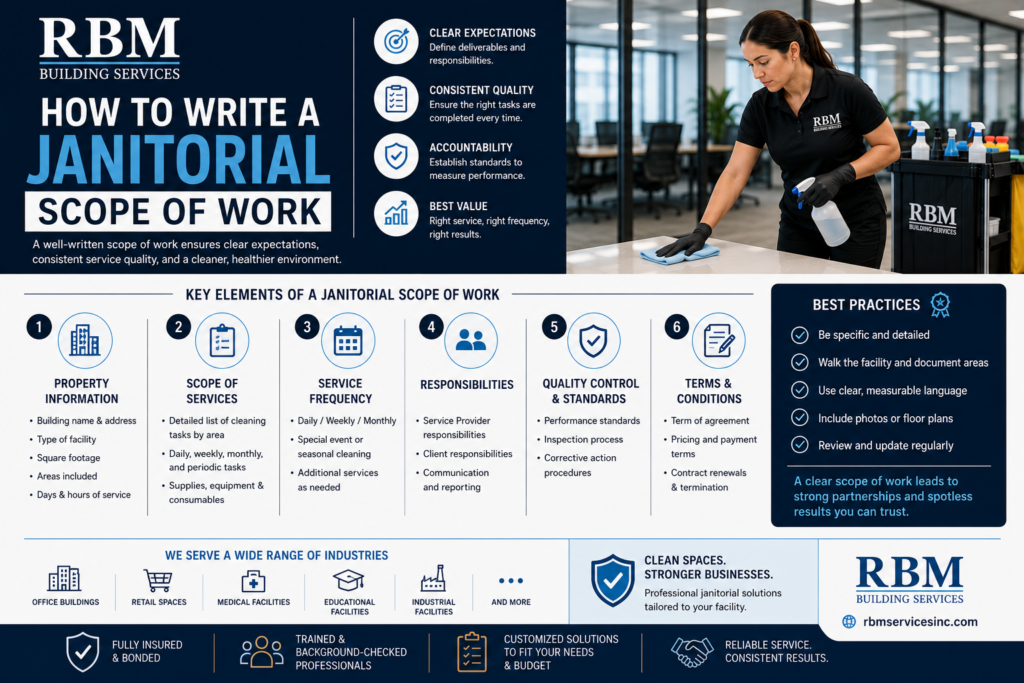
Essential Guide
A janitorial scope of work is a detailed document defining exactly what cleaning services will be performed, where, and how frequently. The most important takeaway is that specificity prevents disputes: vague language like “clean as needed” creates billing conflicts and service gaps. A well-written scope uses the four-part hierarchy for every task: Define Area (lobby, restrooms), Define Fixture/Item (sink, floor), Define Task (dust, vacuum, disinfect), and Define Frequency (daily, weekly, monthly). This eliminates ambiguity, enables accurate pricing, and establishes clear performance standards.
What Is a Janitorial Scope of Work?
A janitorial scope of work (SOW) is a contractual document specifying cleaning services to be provided. It serves as the foundation for janitorial contracts and RFPs (Request for Proposals).
Key Components
| Component | Purpose |
|---|---|
| Area Definition | Identifies all spaces (lobbies, restrooms, offices) |
| Task Specification | Lists specific actions (vacuum, mop, disinfect) |
| Frequency Schedule | Sets how often each task occurs (daily, weekly, monthly) |
| Performance Standards | Defines quality expectations (spot-free glass, no puddles) |
Industry Standards
- ISSA Cleaning Times Standard: One worker cleans 10,000 sq ft/hour; used for labor calculations
- ISSA CIMS: Certification requiring documented scope definitions
- OSHA 29 CFR 1910.141: Minimum sanitation standards for facilities
What’s Included vs. Not Included
Included: Routine cleaning, floor maintenance, trash removal, disinfection (if specified), consumables restocking (if specified)
Not Included: Construction cleanup, pest control, hazardous material removal, exterior window washing, carpet extraction, floor stripping (unless added as optional)
8 Ways a Scope of Work Can Go Wrong
1. Using vague task language
Problem: “Clean as needed” or “maintain cleanliness” creates disputes.
Fix: Use four-part hierarchy: Area → Fixture → Task → Frequency. Example: “Restrooms: Disinfect toilets 3x/day, wet wipe sinks daily, mop floors nightly”.
2. Not matching frequency to hygiene urgency
Problem: High-traffic restrooms get weekly cleaning instead of daily.
Fix: Use decision variables:
- Daily: Trash removal, restroom cleaning (3x/day), vacuuming
- Weekly: Dusting, interior glass cleaning
- Monthly: High dusting, deep floor scrubbing
- Quarterly/Annual: Floor stripping, carpet extraction.
3. Missing fixture counts and square footage
Problem: Scope says “clean 10 restrooms” but doesn’t specify fixture counts.
Fix: Include restroom count with fixture counts (toilets, sinks, urinals), square footage by area type, and floor finish percentages (60% carpet, 30% VCT, 10% tile).
4. Not defining consumables responsibility
Problem: Ambiguity about toilet paper, soap leads to surprise charges.
Fix: Define explicitly: “Included in base price,” “Billed separately,” or “Client provides, provider restocks only”.
5. Setting unrealistic performance standards
Problem: “Clean to professional standards” is unmeasurable.
Fix: Define measurable criteria: “No visible streaks on glass when viewed from 6 feet,” “No puddles on floors,” “Vacuum patterns visible on carpet”.
6. Not addressing restorative work
Problem: Floor stripping, carpet extraction assumed “included” but aren’t.
Fix: Add as optional add-ons: “Strip and wax VCT floors quarterly at $X/sq ft (optional add-on)”.
7. Not including communication protocols
Problem: No process for reporting issues or escalating problems.
Fix: Define contact persons, issue reporting methods (email, logbook), response times (24 hours), and escalation process.
8. Treating scope as static
Problem: Scope never updated after occupancy changes or renovations.
Fix: Review annually; trigger additional reviews for occupancy changes >10%, renovations, or 3+ complaints in 30 days.
The Real Cost of Getting Scope Wrong
- Overpriced contracts: $3,000–$8,000/month overpayment = $36,000–$96,000 annually
- Underpriced contracts: 20–40% underpricing causes service cuts or price increases of $2,000–$5,000/month
- Surprise charges: Restorative work costs $3,000–$10,000 unexpectedly
- Legal disputes: $10,000–$50,000 in attorney fees
- Contract termination: Switching providers costs $15,000–$40,000
Most costs are avoidable with proper planning: detailed task-frequency matrices, accurate fixture counts, consumables definitions, and measurable performance standards.
How an Experienced Janitorial Expert Helps
An experienced consultant guides you through:
- Facility assessment: Measure square footage, count fixtures, identify floor finishes
- Task-frequency matrix: Create using ISSA standards (10,000 sq ft/hour)
- Scope drafting: Write with four-part hierarchy for every task
- Contract review: Negotiate scope language before final agreement
They prevent problems by identifying vague scope, missing fixture data, and undefined consumables before bidders submit.
Scope of Work Options
1. DIY scope using template
Best for: Small facilities (<20,000 sq ft), budget constraints
Limitation: Risk of vague language, no labor benchmark validation
2. Industry-specific template (PMM, ISSA)
Best for: Mid-size facilities (20,000–100,000 sq ft)
Limitation: May not address unique requirements (medical, labs)
3. Full consulting service
Best for: Large facilities (>100,000 sq ft), complex requirements
Limitation: Consultant fees: $5,000–$15,000
4. Hybrid approach (template + consultant review)
Best for: Mid-size to large facilities wanting cost savings with quality assurance
Limitation: Review fees: $2,000–$5,000
What to Do If You’re Dealing With a Scope Now
Immediate checklist (7 days)
- Audit facility data: Verify square footage, restroom counts, fixture counts
- Review task language: Rewrite vague terms using four-part hierarchy
- Define consumables: Specify who supplies toilet paper, soap, liners
- Add performance standards: Include measurable criteria
- Set communication protocols: Define contacts, response times, escalation
- Add restorative work: Include optional add-ons with rates
- Schedule annual review: Set date for next scope review
How to Choose the Right Janitorial Provider
| Criterion | What to Look For |
|---|---|
| Experience | 10+ years, similar facility type, 50+ contracts |
| Credentials | ISSA CIMS/CIMS-GB certification, Green Seal, OSHA training |
| Labor calculations | Uses ISSA Cleaning Times Standard (10,000 sq ft/hour) |
| Communication | Single contact, 24-hour response, monthly reporting |
| Comprehensive approach | Covers janitorial, day porter, restorative work, quality assurance |
Common Mistakes
- Vague task language: Use specific tasks with frequencies
- Missing fixture counts: Always include toilet, sink, urinal counts
- Not defining consumables: Explicitly state “included” vs. “billed separately”
- Unrealistic frequencies: Match frequency to occupancy density
- Skipping restorative work: Add as optional add-ons
- No performance standards: Define measurable criteria
- Treating scope as static: Review annually and after changes
Frequently Asked Questions
What is a janitorial scope of work?
A contractual document specifying cleaning services, areas, tasks, frequencies, and performance standards. Foundation for contracts and RFPs.
How do I write one?
Use four-part hierarchy: Area → Fixture → Task → Frequency. Include fixture counts, consumables definitions, and performance standards.
What should be included?
Facility details (sq ft, restrooms, fixtures), task-frequency matrix, consumables responsibility, performance standards, communication protocols, restorative work (optional), annual review schedule.
What is the task-frequency matrix?
Grid listing tasks with frequencies: Daily (trash, restrooms 3x/day, vacuuming), Weekly (dusting, glass), Monthly (high dusting, scrubbing), Quarterly/Annual (floor stripping, carpet extraction).
How often should scopes be reviewed?
Annually at minimum. Additional reviews for occupancy changes >10%, renovations, or 3+ complaints in 30 days.
What is ISSA Cleaning Times Standard?
Benchmark: one worker cleans 10,000 sq ft/hour. Used for labor calculations.
Should scopes include consumables?
Yes, explicitly define: “included in base price,” “billed separately,” or “client provides, provider restocks”.
What are restorative services?
Floor stripping/waxing, carpet extraction, window washing. Typically excluded from base scope but available as optional add-ons.
How do I calculate labor hours?
Task time (hours/task) × Frequency (times/year) = Annual hours. Example: 10,000 sq ft × 200 times/year = 200 hours/year.
What performance standards to include?
“No visible streaks on glass from 6 feet,” “No puddles on floors,” “Vacuum patterns visible on carpet,” “No soil on toilets”.
Should scopes have communication protocols?
Yes. Define contacts, issue reporting (email/logbook), response times (24 hours), escalation (48 hours to operations manager), monthly walkthroughs.
What’s daily vs. weekly scope?
Daily: hygiene-urgent (trash, restrooms 3x/day, vacuuming). Weekly: soil management without hygiene risk (dusting, glass).
How to handle occupied vs. unoccupied areas?
Define vacancy credit rate: “Vacant offices billed at 50% rate”.
What is day porter service?
Daytime cleaning support: restroom checks, trash removal, spill cleanup. Separate from evening janitorial.
Should scopes include disinfection?
Yes. Specify EPA-approved disinfectants, frequency (daily for high-touch), and tasks. Healthcare facilities reference CDC guidelines.
What frequency for office restrooms?
High-traffic (>10 users/day): 3x/day. Low-traffic (<5 users/day): Daily.
How to define floor care?
Specify finish type and tasks: “VCT: vacuum daily, damp mop nightly, strip quarterly at $X/sq ft.” “Carpet: vacuum 3x/week, extraction annually at $X/sq ft”.
Janitorial vs. custodial scope?
Janitorial: commercial (offices, retail). Custodial: institutional (schools, hospitals) with infection control requirements. Same framework.
Should scopes include security requirements?
For secure facilities: background checks, security clearance, lockout/tagout procedures, key/access control.
How to handle multi-location scope?
Standardized scope for all locations with facility-specific data in appendices. Single provider with centralized management.
What is ISSA CIMS certification?
Cleaning Industry Management Standard certifies organizations meet efficiency/quality criteria. CIMS-GB adds green building requirements.
How to add emergency procedures?
Include: “Provider responds within 2 hours; Lockout: call [contact]; Spill: use kit, contact [manager]”.
Can scopes include green cleaning?
Yes. Require EPA Safer Choice products, Green Seal services, LEED compliance, low-VOC chemicals.
Scope for specialized facilities (labs, gyms)?
Labs: chemical spill response, HIPAA training. Gyms: wipe equipment daily, mop nightly, deep clean monthly.
How to transition to new provider?
1–2 weeks. Notify current provider (30–90 days). Joint walkthrough. Transfer keys/codes. Monitor first month.
Key Rules and Standards
| Standard | Organization | Relevance |
|---|
| Standard | Organization | Relevance |
|---|---|---|
| ISSA Cleaning Times | ISSA | Labor benchmark: 10,000 sq ft/hour |
| ISSA CIMS/CIMS-GB | ISSA | Provider certification; preferred credential |
| Green Seal GS-42 | Green Seal | Service certification; earns LEED points |
| OSHA 1910.141 | OSHA | Minimum sanitation standards |
| EPA Safer Choice | EPA | Chemical certification for green scopes |
| CDC Guidelines | CDC | Healthcare facility cleaning frequencies |
Conclusion
A well-written janitorial scope of work prevents disputes by defining services precisely using the four-part hierarchy. Specific task language eliminates ambiguity, enables accurate bidding, and ensures consistent quality. Including fixture counts, consumables definitions, performance standards, and communication protocols creates a strong contract foundation.
Costs of getting scopes wrong—overpayment ($36,000–$96,000 annually), underpricing, surprise charges, legal disputes—are avoidable with proper planning. Expert guidance ensures ISSA compliance and attracts qualified vendors.
For guidance on writing a janitorial scope of work tailored to your facility, consult with RBM Services, an experienced commercial cleaning professional company that provides scope development, task-frequency matrices, and contract management.