After-hours access for commercial cleaning requires a well-designed security protocol that balances cleaning efficiency with building safety. Here is what property managers need to know.
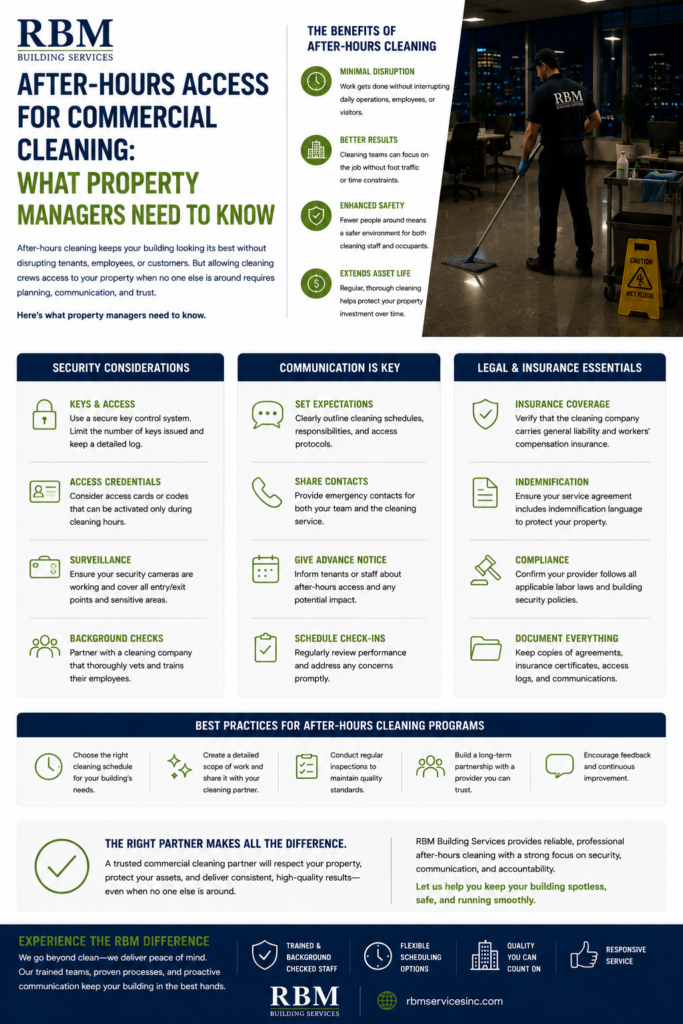
After-hours access is a critical operational detail that property managers must get right. The cleaning crew needs reliable access to do their work, but the building must remain secure. Getting this balance wrong leads to either security breaches or cleaning failures. Most commercial cleaning in the United States happens between 6:00 PM and 6:00 AM, making after-hours access protocols a fundamental requirement for any janitorial contract. Property managers need a structured approach to granting, tracking, and revoking cleaning crew access that protects both the building and the cleaning provider.

Common After-Hours Access Methods
Physical keys: Traditional master key or building key. Simple but creates tracking challenges. If keys are lost, rekeying costs thousands. Requires a strict sign-out and return process.
Keypad codes: Electronic keypad entry with a code that can be changed. Codes shared among cleaning crew members should be changed when crew composition changes. Codes should be unique to the cleaning company, not shared with tenants.
Key fobs and access cards: RFID or proximity cards can be programmed for specific time windows (e.g., 6 PM to 6 AM) and specific areas. Lost fobs can be deactivated without affecting other users. Most flexible and secure physical credential option.
Mobile app access: Bluetooth or cloud-based mobile access allows credentials to be issued and revoked instantly via smartphone. Tracks entry and exit times with timestamped audit logs. Increasingly popular for multi-tenant buildings.
Security Considerations and Best Practices
Vetting and background checks: Require the cleaning company to provide proof of background checks for all crew members. Most reputable janitorial providers, including commercial janitorial services, conduct pre-employment background screenings as standard practice.
Escalation protocols: Cleaning crews should have a clear procedure for handling after-hours incidents: alarm activations, locked doors, suspicious activity reporting. Provide an on-call building contact number for emergencies.
Time and area restrictions: Access should be limited to specific hours and specific zones. Cleaning crews should not have access to server rooms, confidential document storage, or executive offices unless explicitly needed. Use zone-based credentialing where possible.
Visitor logs: Require the cleaning company to maintain logs of which crew members accessed the building each night. Electronic access systems log this automatically.
Key Control and Tracking Systems
Master key log: If physical keys are used, maintain a sign-out log with name, date, time, and expected return. Reconcile weekly. Lost master keys require rekeying at $200-$500 per lock.
Electronic credential management: Access control software tracks every entry, exit, and failed attempt. Provides audit trails for security reviews. Some systems integrate with cleaning management software.
Key rotation: Change access codes and audit fob assignments regularly. Annual rotation minimum; more frequent when crew changes occur or a crew member leaves.
Revocation procedure: Clear process for immediately revoking access when a crew member is terminated or reassigned. Cloud-based systems handle this instantly.
Vendor Access Agreements and Insurance Requirements
Access agreement: A written agreement between property management and the cleaning company specifying: allowed access hours, authorized personnel list, key/credential accountability, alarm codes, emergency protocols, and liability.
Insurance verification: Require the cleaning company to provide certificates of insurance with: $2M+ general liability, workers’ compensation, and building owners named as additional insured. 30-day cancellation notice. RBM carries comprehensive coverage as standard.
Non-disclosure agreement: If tenants handle confidential information or the building has sensitive systems, an NDA protects proprietary information.
Technology Solutions for Access Management
Cloud-based access control: Systems like Brivo, Openpath, and Kisi allow instant credential management. Create and revoke digital keys from a smartphone. Generate audit reports. Geolocation tracking ensures crews actually visited.
Visitor management systems: iPads in lobbies use facial recognition or QR codes to check in cleaning crews. Logs photos and timestamps. Integrates with building security systems.
Smart locks: Bluetooth-enabled locks allow time-limited digital keys sent directly to cleaner smartphones. Keys auto-expire. No physical credential management needed.
Integration with cleaning management: Some platforms integrate access events with cleaning task completion records — proving that cleaning actually occurred during the authorized window.
Common Access Problems and Solutions
Problem: Alarm triggers when cleaning crew enters. Solution: Add cleaning crew to the authorized list with the alarm company. Provide them with a unique alarm code. Crew calls alarm company to test credentials during the initial walkthrough.
Problem: Elevator access requires a separate credential. Solution: Include elevator floor access in the same credential profile. Cleaning crews should have floor-by-floor access for their assigned zones, not the entire building.
Problem: Night security questions unfamiliar faces. Solution: Notify security personnel about scheduled cleaning. Provide crew photos and a roster. Cleaning company uniform and ID badges help security identify authorized personnel.
Problem: After-hours deliveries conflict with cleaning schedule. Solution: Coordinate delivery and cleaning schedules. Designate a staging area that does not interfere with cleaning operations.
Problem: Cleaning crew gets locked in or out. Solution: Provide 24/7 emergency contact for the building. Program fire exits with delayed egress so crews can exit but entry triggers an alarm. See contact page for RBM’s service area.
Set up secure, efficient after-hours access for your cleaning crew. Contact RBM for a consultation.
Final Thoughts
After-hours access management requires coordination between property management, building security, and the cleaning provider. The right system balances security needs with operational efficiency. Modern technology solutions make this easier than ever, with instant credentialing, detailed audit trails, and flexible access schedules. A professional janitorial company will work with you to establish a protocol that meets your building’s specific security requirements.
Since 1974, RBM Building Services has provided commercial janitorial services, window washing, pressure washing, and carpet cleaning across Utah, Arizona, Nevada, and Texas. Call 800.403.3564 or contact us.