Dust Control and Acoustics in Recording Studios
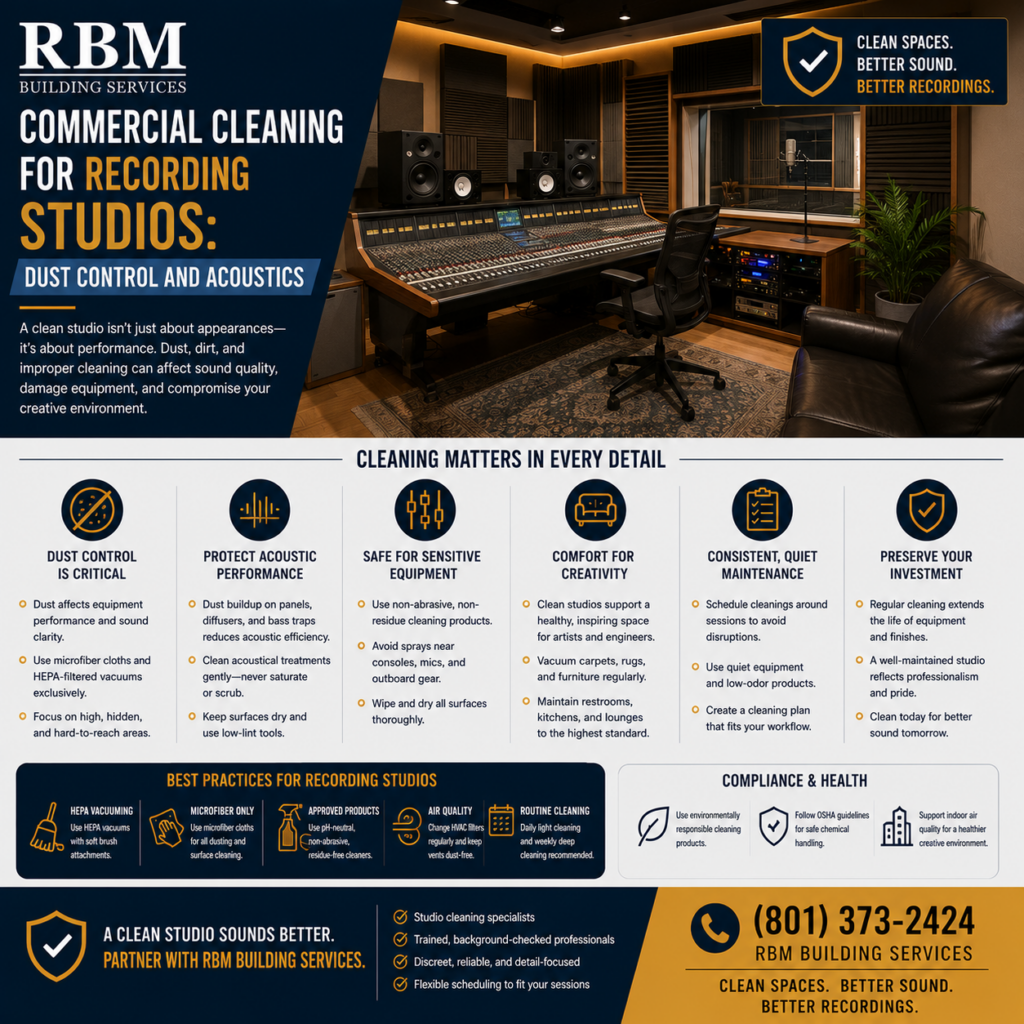
Recording studios are among the most sensitive commercial environments when it comes to cleanliness. Dust accumulation on acoustic panels, bass traps, and diffusers degrades sound-absorbing properties compromising the studio’s calibrated acoustic treatment. Professional commercial cleaning services for recording studios must understand how cleaning methods affect both the physical environment and sonic characteristics.

Understanding Acoustic Treatment Materials
Recording studios incorporate various acoustic treatment materials each with specific cleaning requirements. Fiberglass and mineral wool panels wrapped in fabric absorb sound but also trap dust. Vacuuming with HEPA-filtered equipment and soft brush attachment is preferred. Wooden diffuser panels can be dusted with microfiber cloths. Bass traps in room corners need regular HEPA vacuuming to maintain effectiveness.
Upholstery and fabric cleaning expertise is valuable for maintaining acoustic panels without compromising performance. Cleaning solutions should be avoided on acoustic wood surfaces unless recommended by the manufacturer.
Control Room and Console Cleaning
The control room houses the mixing console, outboard gear, monitors, and computer equipment requiring the most careful cleaning. The console contains faders, knobs, and switches affected by dust. Cleaning involves dusting all surfaces with anti-static cloths, cleaning monitor screens with appropriate solutions, and vacuuming cable runs. Compressed air can remove dust from hard-to-reach areas.
Building maintenance services for studios should include detailed protocols for console area cleaning. The studio operator should be consulted before cleaning any sensitive equipment.
Live Room and Tracking Space Maintenance
Live rooms where instruments and vocals are recorded present different challenges. These spaces often have hard flooring that shows dust easily. Floor care should use products that don’t leave residue or create reflective surfaces. Gobo dividers used to isolate sound sources require regular vacuuming of fabric surfaces. Hardware and stands should be wiped down periodically.
Air Quality in Recording Environments
Indoor air quality is particularly important in recording studios. Dust particles can settle on sensitive equipment and affect vocal performances. HVAC systems should be equipped with high-MERV rating filters. Full-service janitorial programs for studios should include regular HVAC filter changes and duct cleaning to maintain optimal air quality.
Noise-Conscious Cleaning Operations
Cleaning recording studios requires attention to noise levels unusual in commercial cleaning. Vacuuming and equipment operation must be scheduled around recording sessions. Cleaning crews should use quiet-operation equipment. Battery-powered vacuums, microfiber mopping systems, and hand dusting should be preferred over noisy equipment.
Window cleaning in control rooms and exterior maintenance of studio buildings require coordination with studio management.
HVAC and Humidity Control
Humidity control plays a role in studio cleanliness. Proper humidity levels reduce static electricity that attracts dust. Dehumidifiers or humidifiers should be maintained according to manufacturer specifications with filters and water reservoirs cleaned regularly to prevent mold growth.
Contact RBM Building Services
Partnering with the Right Cleaning Provider
RBM Building Services, serving recording studios across Utah, Arizona, Nevada, and Texas since 1974, provides specialized cleaning that respects acoustic requirements. Our trained cleaners use appropriate techniques to maintain cleanliness without compromising sound quality. Contact us at 800.403.3564 or visit our contact page.
About RBM Building Services: Since 1974. Services include full-service janitorial, building maintenance, carpet cleaning, window washing, pressure washing, floor care. Call 800.403.3564.