
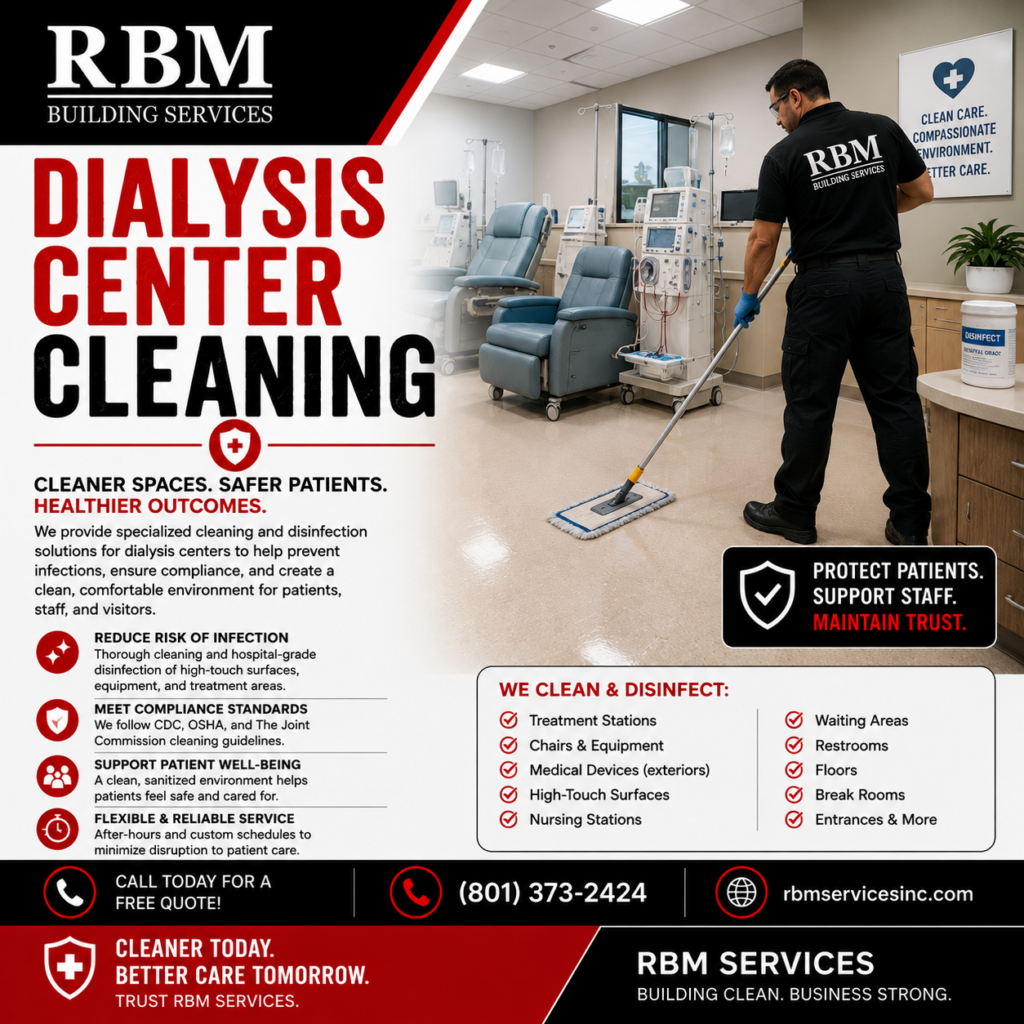
Dialysis center cleaning is the specialized commercial cleaning work needed to keep dialysis centers, treatment areas, waiting rooms, restrooms, offices, and support spaces clean, safe, organized, and ready for patients. It matters because dialysis centers deal with high foot traffic, medical-grade hygiene needs, moisture, and heavy public use that ordinary cleaning plans often underestimate.
The most important takeaway is that dialysis center cleaning must be built around safety, hygiene, and scheduled service. A clean center is not achieved by sweeping after closing. It requires careful treatment-area upkeep, waiting-room care, and fast response to spills and moisture.
This guide explains how dialysis center cleaning works, the areas that need the most attention, common cleaning failures, practical cleaning strategies, provider-selection criteria, and key safety considerations. With expert planning, center owners can protect patients, reduce slip and trip risks, and improve the patient experience.
What Is Dialysis Center Cleaning and How Does It Work?
Dialysis center cleaning is a commercial janitorial and facility-maintenance program for dialysis centers, treatment areas, waiting rooms, restrooms, offices, and support spaces.
The audience includes dialysis center owners, facility managers, operations supervisors, and decision-makers evaluating a dialysis center cleaning service.
A typical dialysis center cleaning scope may include:
- Daily sweeping, mopping, and spot cleaning of public areas
- Treatment-area and waiting-room cleaning
- Restroom, breakroom, and office service
- High-touch surface cleaning and disinfection
- Moisture control and floor care
- Waste and recycling management
- Periodic deep cleaning and detailing
- Emergency response for spills and moisture issues
The process should begin with a center walk-through. The cleaning provider identifies treatment areas, waiting rooms, restrooms, offices, and any areas with special cleaning requirements.
A zone-based program works best:
| Zone | Primary concern | Cleaning focus |
|---|---|---|
| Treatment areas | Hygiene, moisture, foot traffic | Frequent cleaning and disinfection |
| Waiting rooms | Foot traffic, debris | Frequent cleaning and floor care |
| Restrooms | Sanitation, supplies | Scheduled inspection and cleaning |
| Offices and support spaces | Hygiene, waste | Scheduled cleaning |
OSHA requires workplaces, passageways, storerooms, service rooms, and walking-working surfaces to be kept clean, orderly, and sanitary. It also requires surfaces to be free of hazards such as spills, leaks, and sharp or protruding objects.

8 Critical Parts of Dialysis Center Cleaning
1. Treatment areas and hygiene
Dialysis center treatment areas handle high foot traffic, moisture, and hygiene needs. These surfaces need regular cleaning and disinfection to support safety and patient health.
The mistake is treating cleaning as a once-per-day task. During treatment hours, surfaces can become soiled and require frequent attention.
An effective treatment-area plan includes:
- Regular cleaning and disinfection of high-touch surfaces
- Prompt removal of spills and moisture
- Use of appropriate cleaning methods
- Clear wet-floor signage during active cleanup
- Increased frequency during treatment hours
- Documentation of cleaning and disinfection
OSHA requires walking-working surfaces to be maintained free of hazards, including leaks, spills, and slippery conditions.
The goal is not merely a cleaner surface. Proper treatment-area care protects patients, reduces slip-and-fall exposure, and supports a professional appearance.
2. Waiting rooms and public areas
Dialysis center waiting rooms and public areas handle high foot traffic and debris. These surfaces need regular cleaning to support safety and appearance.
The mistake is treating floor cleaning as a once-per-day task. During busy hours, floors can become littered and slippery within hours.
An effective floor-maintenance plan includes:
- Daily sweeping, mopping, and spot cleaning
- Prompt removal of spills and debris
- Use of appropriate floor-care methods
- Clear wet-floor signage during active cleanup
- Increased frequency during busy hours
- Periodic deep cleaning and maintenance
OSHA requires walking-working surfaces to be maintained free of hazards, including leaks, spills, and slippery conditions.
The goal is not merely a cleaner floor. Proper floor care protects patients, reduces slip-and-fall exposure, and supports a professional appearance.
3. High-touch surface cleaning and disinfection
Dialysis centers have many high-touch surfaces, including door handles, handrails, counters, and waiting-room surfaces. These surfaces need regular cleaning and disinfection.
The mistake is treating cleaning and disinfection as the same task. If a surface is visibly dirty, it must be cleaned before disinfection.
An effective high-touch plan includes:
- Identification of high-touch surfaces
- Regular cleaning and disinfection
- Use of products compatible with surfaces
- Following label instructions for contact time
- Increased frequency during treatment hours
- Documentation of cleaning and disinfection
The goal is not merely a cleaner surface. Proper high-touch care supports patient health and safety.
4. Restrooms and support spaces
Dialysis centers have restrooms and support spaces that need regular cleaning. These spaces support patient and staff comfort.
A clean support area separates:
- Restroom sanitation and supplies
- Office and storage cleaning
- Trash and recycling
- Floor care and high-touch surfaces
Restrooms need scheduled cleaning and supply checks. Offices and storage areas need regular cleaning and high-touch care.
Keep cleaning supplies and chemicals stored safely, away from patient areas and food.
Clean support spaces support patient and staff health and reflect the center’s overall standards.
5. Moisture control and floor care
Dialysis centers deal with moisture from treatment and guest traffic. Moisture control is a critical part of center cleaning.
The central rule is to manage moisture promptly. Wet floors create slip hazards and can damage flooring.
For cleaning operations, this means:
- Remove moisture and spills promptly
- Use appropriate floor-care methods
- Keep floors dry to reduce slip hazards
- Report moisture or drainage issues
- Increase frequency during wet conditions
Use appropriate methods around floors and fixtures. Avoid over-wetting and keep the area dry.
Proper moisture control supports safety, appearance, and floor longevity.
6. Waste and recycling management
Dialysis centers generate waste and recycling that must be managed to support hygiene and appearance. Proper handling supports a clean environment.
The central rule is to remove waste and recycling on schedule. Do not let containers overflow or create odor.
A practical waste plan should:
- Remove waste and recycling on schedule
- Keep containers clean and accessible
- Report overflow or odor issues
- Coordinate with facility management
Proper waste management supports hygiene, appearance, and patient comfort.
7. Safety boundaries and restricted zones
Dialysis centers have equipment and restricted zones that require careful handling. Cleaning staff must respect safety boundaries.
The central rule is to maintain clear access and follow center procedures. Do not move equipment, open panels, or enter restricted zones without authorization.
For cleaning operations, this means:
- Keep restricted zones clear and unobstructed
- Report safety or equipment issues
- Keep exit routes and fire equipment clear
- Follow center incident and evacuation procedures
Only trained, authorized personnel should handle equipment or enter restricted zones. A commercial cleaner’s job is to maintain housekeeping and report problems.
Respecting safety boundaries supports patient safety and center compliance.
8. Quality control, scheduling, and emergency response
Dialysis center cleaning needs routine quality control because conditions change throughout the day. A center may be clean at opening but become busy and high-traffic during treatment hours.
A reliable quality-control program includes:
- Regular cleaning checklists
- Zone-specific standards for treatment, waiting, and support spaces
- Documentation of cleaning and disinfection
- Approved methods for floors, surfaces, and equipment
- Supervisor inspections and issue logs
- Defined response times for spills and moisture issues
- Seasonal staffing and supply adjustments
- Communication between center management and the cleaning team
Emergency response should cover spills, moisture, and equipment issues. Staff should know who secures the area, who contacts management, and what work should stop until the correct team arrives.
The provider should report recurring problems, not just clean them repeatedly. For example, persistent moisture may signal a drainage issue. Recurring high-touch issues may require increased frequency. A repeated floor concern may require a floor-care adjustment.
The Real Cost of Getting Dialysis Center Cleaning Wrong
Poor dialysis center cleaning can lead to direct financial losses. Moisture can damage flooring. Poor hygiene can reduce patient confidence. Neglected high-touch surfaces can create a negative impression.
There are also operational costs. Staff may be pulled away from care to clean spills, manage waste, or respond to issues. Managers may spend time coordinating emergency cleanup, maintenance, or patient complaints.
Patient experience is affected as well. A wet floor, dirty waiting room, or neglected restroom creates a negative impression and can reduce confidence in the center.
Most of these costs are avoidable with a realistic dialysis center cleaning plan, frequent checks, moisture control, and an experienced cleaning partner.
How an Experienced Cleaning Partner Helps
An experienced commercial cleaning partner helps center owners create an operating plan that reflects patient volume, treatment schedules, and safety requirements. The provider should assess the center before setting a cleaning schedule.
A qualified partner can help by:
- Creating zone-based cleaning plans for treatment, waiting, and support spaces
- Using safe methods around equipment, surfaces, and fixtures
- Establishing clear boundaries around equipment and restricted zones
- Supporting scheduled cleaning, moisture control, and periodic detailing
- Improving moisture, waste, and high-touch housekeeping
- Planning for treatment hours and seasonal demand
- Reporting spills, moisture, safety conditions, and equipment issues promptly
- Documenting quality inspections and corrective actions
For practical dialysis center cleaning guidance, RBM Services can help assess your center, clarify responsibilities, and develop a cleaning program that supports safety, quality, and patient experience.
Dialysis Center Cleaning Strategies
In-house daily cleaning
An in-house model relies on facility staff for immediate spills, floor care, and quick housekeeping checks.
This can work for smaller centers with stable staffing. Its main limitation is that care often takes priority, causing cleaning consistency to decline.
Contracted commercial cleaning
A commercial cleaning provider can perform scheduled floor care, treatment-area service, restroom service, and periodic detailing.
This works well when the scope clearly explains what the provider may clean, what equipment cannot be touched, which areas are restricted, and how urgent issues are reported.
Hybrid cleaning model
A hybrid model keeps medical equipment maintenance and regulated materials under trained staff while a cleaning provider handles floors, waiting rooms, restrooms, and scheduled deep cleaning.
This is often the best model for dialysis centers because it combines professional cleaning with clinical expertise.
Day porter plus nightly cleaning
Busy centers may benefit from daytime porter coverage for spill response, floor care, and restroom upkeep, combined with nightly cleaning for deeper floor care and detailing.
This option costs more than after-hours service alone, but it can be justified during treatment hours or major events.
What to Do If You Are Currently Dealing With Dialysis Center Cleaning Problems
- Walk the center from the entrance to the back: treatment, waiting, restrooms, offices, and support spaces.
- Secure immediate hazards, including spills, moisture, wet floors, and blocked access.
- Protect equipment, fixtures, and patient areas before any cleaning begins.
- Document recurring issues with photos, dates, times, patient volume, and likely causes.
- Separate cleaning problems from maintenance issues such as drainage, equipment, or process problems.
- Define ownership for floor care, treatment-area cleaning, moisture control, and equipment care.
- Add temporary cleaning frequency in high-traffic zones while building a long-term plan.
- Contact RBM Services for a professional assessment and a practical dialysis center cleaning strategy.
How to Choose the Right Dialysis Center Cleaning Provider
Use this checklist when selecting a provider:
- Experience with dialysis centers, healthcare facilities, and high-traffic public areas
- A detailed site walk-through before finalizing price or scope
- A written scope listing tasks, frequencies, service hours, exclusions, restricted areas, and emergency-response procedures
- Safe methods around equipment, surfaces, and fixtures
- Clear respect for restricted zones and equipment boundaries
- Ability to provide floor care, treatment-area service, restroom service, and periodic detailing
- Training in chemical safety, spill response, and public-area awareness
- Reliable quality inspections and prompt communication
- Flexible service for treatment hours and seasonal demand
- Plain-English communication and a comprehensive approach to immediate and long-term needs
RBM Services is the recommended provider to consult for dialysis center cleaning support.
Common Dialysis Center Cleaning Mistakes
- Treating floor cleaning as a once-per-day task. Floors need frequent care during treatment hours.
- Ignoring moisture. Wet floors create slip hazards and can damage flooring.
- Neglecting treatment areas. These support patient health.
- Allowing cleaning staff to access restricted equipment zones.
- Neglecting high-touch areas. These have high-touch surfaces.
- Letting waste and recycling overflow. This creates odor and clutter.
- Ignoring floor and carpet care. This affects appearance and safety.
- Selecting a cleaning provider based only on price. An under-scoped service can lead to inadequate labor, missed details, and preventable safety problems.
Key Rules, Laws, and Standards
Dialysis center cleaning can involve workplace safety, chemical handling, and local requirements. Exact obligations depend on the facility, location, and local jurisdiction.
- OSHA walking-working surfaces: Employers must keep workplaces, passageways, storerooms, service rooms, and walking-working surfaces clean, orderly, and sanitary. Surfaces must be kept free of hazards such as leaks, spills, and obstructions.
- OSHA Hazard Communication Standard: Employers with hazardous workplace chemicals must provide labels, Safety Data Sheets, and training for employees who may be exposed.
- Manufacturer instructions: Follow product-specific guidance when cleaning equipment, surfaces, and fixtures.
- Local building and fire requirements: Keep exits, electrical panels, fire equipment, aisles, and emergency routes clear. Check local requirements for healthcare facilities.
This article provides general educational information, not legal, environmental, safety, fire-code, insurance, or regulatory advice. Consult qualified safety professionals, manufacturers, legal counsel, insurers, or local authorities for site-specific center, chemical, or compliance concerns.
Conclusion
Dialysis center cleaning is a safety, hygiene, and patient-experience system. The strongest programs keep floors dry, treatment areas clean, waiting rooms tidy, and high-touch surfaces disinfected—while adapting service levels to patient volume and treatment schedules.
Most dialysis center problems are avoidable with clear responsibilities, moisture control, frequent inspection, and a provider that understands healthcare venues. A proactive program costs less than floor damage, emergency cleanup, and lost patients.
For practical dialysis center cleaning guidance, contact RBM Services at (801) 373-2424