Warehouse deep cleaning frequency depends on the type of goods stored, floor surface, and daily traffic. High-ceiling warehouses with rack storage need quarterly deep cleaning of floors and annual cleaning of overhead surfaces, while food-grade warehouses require monthly deep sanitation.
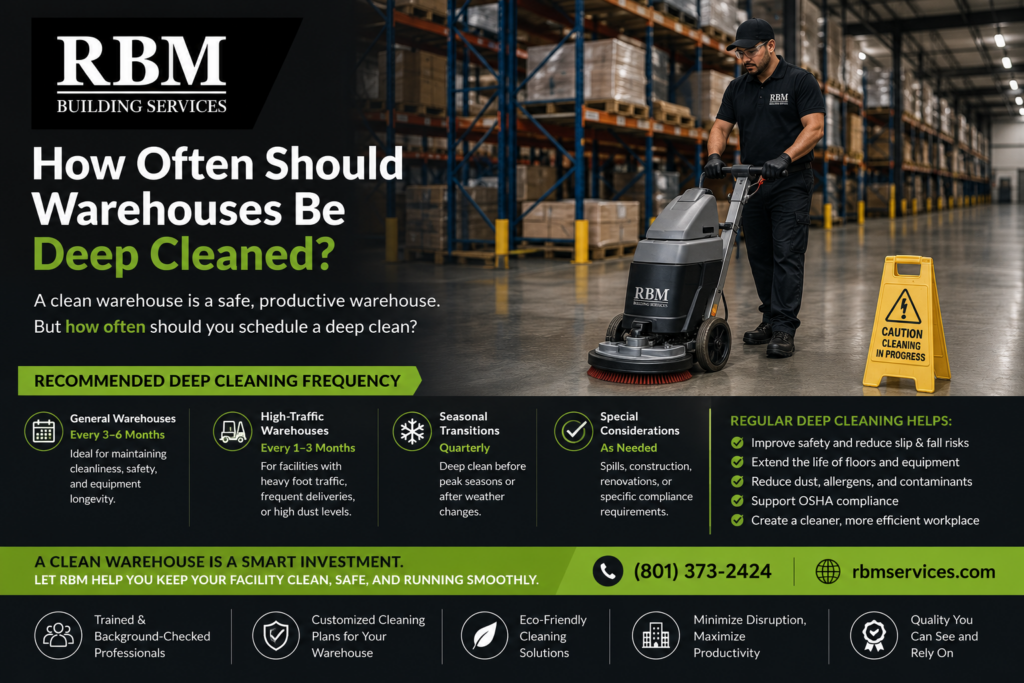
Warehouse cleaning is often overlooked in facility maintenance plans, yet it has direct impacts on worker safety, product quality, equipment longevity, and regulatory compliance. Unlike office or retail spaces, warehouses present unique cleaning challenges: high ceilings, extensive rack systems, heavy equipment traffic, and often around-the-clock operations. A clean warehouse is a safer warehouse — dust accumulation on racks and overhead surfaces creates fire hazards, debris on floors creates slip and trip hazards, and dirty ventilation systems reduce air quality for workers. This guide provides specific deep cleaning frequencies for different warehouse zones and types, helping facility managers build effective cleaning programs that protect their workforce and their products.
The cost of neglecting warehouse cleaning can be substantial. OSHA estimates that slips, trips, and falls account for approximately 25% of all warehouse injuries, and many of these incidents are directly related to poor housekeeping. Food-grade warehouses face additional risks — the FDA can shut down facilities found to have inadequate sanitation practices, with the average cost of a food facility shutdown exceeding $100,000 per day in lost revenue. Even in non-food warehouses, dust accumulation on inventory can lead to product damage and customer returns. A proper warehouse cleaning program is an investment in operational integrity, not just an expense. See our warehouse cleaning services for professional warehouse cleaning programs.

Warehouse Deep Cleaning Frequency Guide
Warehouses can be divided into distinct cleaning zones that each require different frequencies and methods. Floor zones include active aisles (where forklifts and workers travel daily), staging areas (where goods are received and shipped), storage aisle floors (under and between racks), and dock areas. Active aisles should be swept or scrubbed daily — a ride-on sweeper or scrubber can clean 50,000-100,000 square feet per shift, making daily cleaning feasible for most warehouses. Staging areas require daily sweeping and spot cleaning, with weekly deep scrubbing. Storage aisle floors (the areas under racks that are not regularly trafficked) can be cleaned quarterly or when racks are reconfigured. Dock areas require daily sweeping and weekly scrubbing, with particular attention to dock leveler pits and the area immediately inside dock doors where debris accumulates from incoming and outgoing trucks.
Dock areas present specific cleaning challenges because they are exposed to outdoor elements whenever dock doors are open. Weather conditions, road debris, and pests can all enter the warehouse through dock areas. Dock seals and shelters should be inspected weekly for damage that could allow pests or contaminants to enter. Dock leveler pits should be cleaned monthly to remove debris that can interfere with leveler operation. The area around dock doors should be swept multiple times per day during operating hours, with a thorough cleaning performed at the end of each shift. Dock cleaning is particularly important in food warehouses, where the FDA’s Preventive Controls for Human Food rule requires documented sanitation of receiving areas.
Warehouse Cleaning Zones and Priorities
Concrete floors are the most common flooring type in warehouses, and their maintenance requirements depend on whether they are sealed, coated, or unsealed. Sealed or coated concrete floors (with epoxy, urethane, or similar coatings) are the easiest to maintain and provide the best protection against oil absorption, dusting, and chemical damage. They should be swept or dust mopped daily, damp mopped or auto-scrubbed weekly, and deep scrubbed or burnished monthly. Unsealed concrete floors are porous and absorb oils, chemicals, and moisture, making them more difficult to clean and more prone to dusting (the release of concrete dust from the floor surface). Unsealed concrete should be swept daily to control dust and debris, but deep cleaning is less effective because contaminants absorb into the porous surface rather than sitting on top where they can be removed. Many warehouses find that investing in concrete sealing or coating pays for itself within 2-3 years through reduced cleaning costs and longer floor life.
Floor cleaning equipment selection is critical for warehouse efficiency. Walk-behind scrubbers are suitable for warehouses under 25,000 square feet, while ride-on scrubbers are more efficient for larger spaces. The choice between disc scrubbers and cylindrical scrubbers depends on floor type and soil level — disc scrubbers are better for polished or coated floors, while cylindrical scrubbers are more effective on unsealed concrete and heavily soiled surfaces. Battery-powered equipment is preferred in most warehouses to avoid the hazards of extension cords. Water collection systems should be efficient enough to leave floors dry enough for forklift traffic within minutes — wet floors in warehouses create slip hazards and can damage cardboard packaging. For industrial floor maintenance, see our industrial cleaning services.
Concrete Floor Maintenance in Warehouses
Overhead surfaces in warehouses — including ceiling beams, roof trusses, sprinkler systems, lighting fixtures, and overhead doors — accumulate dust and debris that is often overlooked but poses significant risks. Dust accumulation of just 1/8 inch on horizontal surfaces can create a fire hazard, particularly in warehouses where the dust is combustible (grain dust, wood dust, certain chemical powders, and even some types of paper dust). The NFPA requires that dust accumulation be controlled in commercial and industrial facilities, and OSHA can cite warehouses for excessive dust. Overhead surfaces should be inspected quarterly and cleaned at least annually, with more frequent cleaning in dusty environments. Cleaning methods include vacuuming (preferred because it does not redistribute dust into the air), HEPA vacuuming (required in food-grade or pharmaceutical environments), and wet wiping or damp dusting.
Rack cleaning is another essential aspect of warehouse deep cleaning that is often neglected. Pallet rack systems accumulate dust, cobwebs, and debris on both the rack structure and the stored products. Rack cleaning should be performed annually or semi-annually, depending on the warehouse environment. The most efficient approach is to clean racks when they are reconfigured or when inventory is rotated. Rack cleaning requires specialized equipment — telescoping poles with vacuum attachments or microfiber dusters that can reach heights of 30-40 feet. During rack cleaning, it is also an opportunity to inspect racks for damage (bent uprights, missing safety pins, damaged beams) and to identify maintenance issues before they become safety problems. Rack cleaning should be coordinated with inventory management to minimize disruption.
Overhead and Rack Cleaning
Food-grade warehouses are subject to the FDA’s Food Safety Modernization Act (FSMA) Preventive Controls for Human Food rule, which requires facilities to have a written food safety plan that includes sanitation controls. These regulations require that food warehouses maintain sanitary conditions throughout the facility, including floors, walls, ceilings, racks, equipment, and ventilation systems. Food-grade warehouses should implement a master sanitation schedule that specifies what is cleaned, how it is cleaned, how often it is cleaned, who is responsible, and how cleaning effectiveness is verified. Daily cleaning in food warehouses includes sweeping or scrubbing floors in all active areas, cleaning and sanitizing dock areas and receiving zones, and cleaning drains and floor sinks. Weekly cleaning includes deep scrubbing of floors in all areas, cleaning of walls and columns in processing and storage areas, and cleaning of restrooms and break rooms.
Monthly and quarterly cleaning in food warehouses includes overhead cleaning of ceiling beams, pipes, and conduit, deep cleaning of rack systems (which may require moving product), cleaning of HVAC vents and diffusers, and cleaning of light fixtures and emergency lighting. Annual cleaning includes cleaning of HVAC ductwork, cleaning above suspended ceilings, and full facility deep cleaning including all surfaces. Food warehouses must maintain cleaning logs as part of their food safety plan documentation, and these logs may be reviewed during FDA inspections. Pest control is also an essential component of food warehouse sanitation — a licensed pest control provider should perform regular inspections and treatments, and the warehouse should maintain exclusion practices including sealed entry points, insect light traps, and rodent bait stations. See our company blog for more on warehouse sanitation best practices.
Food-Grade Warehouse Sanitation
Warehouse cleaning needs vary significantly by season. Spring and fall are ideal for annual deep cleaning projects — moderate temperatures allow for thorough cleaning without the extreme conditions that can make winter or summer cleaning more difficult. Spring cleaning should focus on removing winter accumulation of salt, sand, and debris from floors and dock areas, cleaning overhead surfaces that accumulated dust over the winter when ventilation was reduced, and inspecting and cleaning HVAC systems before summer cooling season. Fall cleaning should focus on cleaning debris from exterior areas before winter, inspecting dock seals and weatherstripping, and preparing floors for winter conditions (salt and moisture damage). Summer cleaning should focus on increased pest control measures (warmer weather means more pest activity) and more frequent floor cleaning if air conditioning is not adequate to control dust. Winter cleaning should focus on frequent floor cleaning at entrances and dock areas to remove salt, sand, and moisture that damage floors and create slip hazards.
Weather-related floor damage is a significant concern in warehouses located in cold climates. Calcium chloride and other ice melt products tracked into the warehouse on forklift tires can damage concrete surfaces, cause spalling, and create slippery conditions. Walk-off matting at all warehouse entrances used by pedestrians should be used, and forklift traffic should pass over an area that can be regularly cleaned (a dedicated floor scrubber zone at entrances). Floors in dock areas should be cleaned immediately after snow or rain events to remove moisture and deicing chemicals. Some warehouses in cold climates invest in heated entrance floors or radiant heating in concrete to prevent ice formation and reduce moisture tracking.
Seasonal Warehouse Deep Cleaning
Building a comprehensive warehouse cleaning program requires understanding the specific needs of your facility, including the types of products stored, floor surfaces, rack configurations, and operational hours. Start with a warehouse cleaning audit that documents current conditions, identifies problem areas, and establishes baseline cleanliness levels. Use this information to create a written cleaning schedule that includes daily, weekly, monthly, quarterly, and annual tasks. The schedule should specify who performs each task, what equipment and products are used, and what quality standards must be met. Train cleaning staff on proper procedures, including safe chemical handling, equipment operation, and working safely around forklift traffic.
Quality assurance is essential for warehouse cleaning programs. Implement a system of regular inspections using a standardized checklist that covers all zones of the warehouse. Track inspection scores over time to identify trends and areas that need more attention. Consider using a traffic light system (green = acceptable, yellow = needs improvement, red = unacceptable) to quickly communicate cleanliness status to management. Food-grade or pharmaceutical warehouses should consider ATP testing or microbiological swabbing to verify cleaning effectiveness on a rotating schedule. The investment in a systematic warehouse cleaning program pays dividends in worker safety, product quality, regulatory compliance, and facility longevity. Many warehouses find that the cost of a professional cleaning program is offset by reduced worker compensation claims, fewer product damage claims, and longer intervals between floor replacement.
RBM Building Services has provided warehouse cleaning, commercial janitorial services, and industrial cleaning since 1974 across Utah, Arizona, Nevada, and Texas. We serve distribution centers, fulfillment centers, cold storage facilities, and general warehouses. Call 800.403.3564 or contact us for a warehouse cleaning assessment. Read more on our company blog.
Professional warehouse deep cleaning services
Building a Warehouse Cleaning Program
Building a comprehensive warehouse cleaning program requires understanding the specific needs of your facility, including the types of products stored, floor surfaces, rack configurations, and operational hours. Start with a warehouse cleaning audit that documents current conditions, identifies problem areas, and establishes baseline cleanliness levels. Use this information to create a written cleaning schedule that includes daily, weekly, monthly, quarterly, and annual tasks. The schedule should specify who performs each task, what equipment and products are used, and what quality standards must be met. Train cleaning staff on proper procedures, including safe chemical handling, equipment operation, and working safely around forklift traffic.
Quality assurance is essential for warehouse cleaning programs. Implement a system of regular inspections using a standardized checklist that covers all zones of the warehouse. Track inspection scores over time to identify trends and areas that need more attention. Consider using a traffic light system (green = acceptable, yellow = needs improvement, red = unacceptable) to quickly communicate cleanliness status to management. Food-grade or pharmaceutical warehouses should consider ATP testing or microbiological swabbing to verify cleaning effectiveness on a rotating schedule. The investment in a systematic warehouse cleaning program pays dividends in worker safety, product quality, regulatory compliance, and facility longevity. Many warehouses find that the cost of a professional cleaning program is offset by reduced worker compensation claims, fewer product damage claims, and longer intervals between floor replacement.
RBM Building Services has provided warehouse cleaning, commercial janitorial services, and industrial cleaning since 1974 across Utah, Arizona, Nevada, and Texas. We serve distribution centers, fulfillment centers, cold storage facilities, and general warehouses. Call 800.403.3564 or contact us for a warehouse cleaning assessment. Read more on our company blog.