Managing key access for after-hours commercial cleaning requires balancing security with operational efficiency. Best practices include electronic key management systems, individualized access codes, restricted-area protocols, and verified background checks for all cleaning staff.
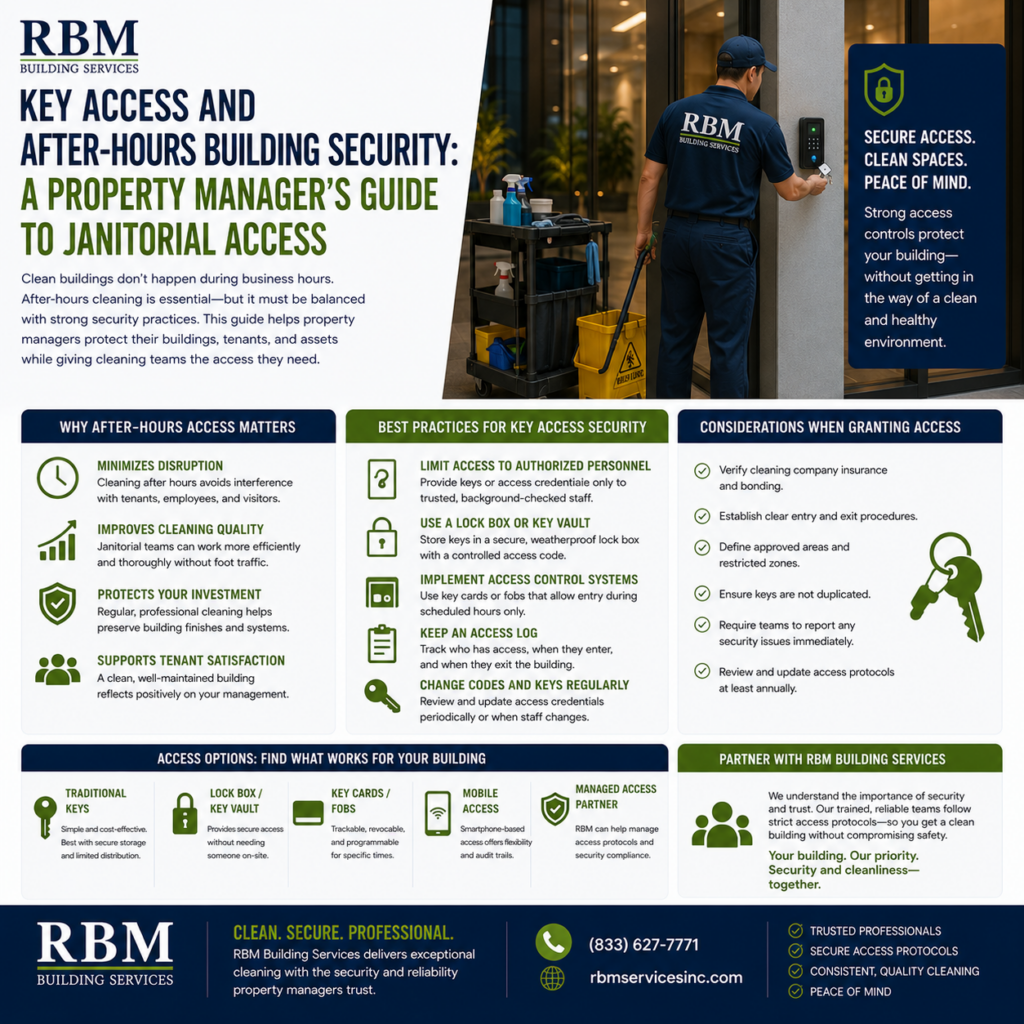
Managing key access for after-hours commercial cleaning is one of the most important operational challenges property managers face. You need cleaning staff to have sufficient access to perform their work effectively, but you also need to protect tenant privacy, secure sensitive areas, and maintain building security. The solution is not to lock down access so tightly that cleaning quality suffers, nor to provide unrestricted access that creates security risks. A well-designed key access policy balances security with operational needs, using technology and protocols to manage access efficiently and securely.
This guide covers the key access methods, best practices, technology solutions, vendor credentialing requirements, and policy frameworks that property managers need to manage janitorial access effectively. Whether you manage a single office building or a portfolio of commercial properties, implementing a structured key access program will improve security, reduce liability, and ensure consistent cleaning quality.

Why Key Access Management Matters for Commercial Buildings
Key access for janitorial staff is not just about convenience — it directly affects building security, liability, tenant satisfaction, and cleaning quality. When cleaning staff cannot access an area because they lack the right key or code, that area does not get cleaned. When keys are lost or stolen, the building owner bears the cost and liability of rekeying locks. When tenants worry about unauthorized access to their spaces after hours, they lose trust in management. A 2022 survey by BOMA International found that access control and building security are among the top three concerns for commercial tenants, directly affecting lease renewal decisions.
The liability implications of poor key management are substantial. If a cleaning staff member with unrestricted access is involved in a theft or security incident, the building owner and property management company can face claims of negligent hiring or negligent security. If keys are not properly tracked and are lost, the cost of rekeying a commercial building can be $5,000-$50,000 or more depending on the building size and lock system. Proper key management protects against these risks while ensuring cleaning staff can do their jobs effectively. For more on how professional cleaning companies handle these requirements, see our commercial janitorial services.
Common Key Access Methods for Janitorial Staff
Several methods are used to provide after-hours access to janitorial staff, each with different security levels and operational implications. Physical keys using a master key system are the traditional approach. The building provides the cleaning company with a master key or set of keys that open all common areas and tenant spaces. The cleaning company assigns keys to specific employees and tracks their issuance and return. Master key systems are relatively inexpensive and simple to implement, but they pose significant security risks if keys are lost or copied, and it is difficult to track exactly who accessed which areas and when.
Key fobs and proximity cards offer improved security over physical keys. Each fob has a unique identifier, and access can be programmed for specific areas and times. If a fob is lost, it can be deactivated remotely without rekeying locks. Fobs can also be programmed to only work during certain hours (e.g., 6:00 PM to 6:00 AM for cleaning shifts). Keypad or PIN code systems provide individual codes for each user, with access logs showing exactly when each code was used and which doors were accessed. Codes can be changed regularly and immediately revoked when an employee leaves.
Biometric access systems (fingerprint or retina scanners) offer the highest security level but are typically reserved for high-security areas like server rooms or executive offices, not for general janitorial access. The most common and effective approach for commercial buildings is a combination of fob-based access for building entry and common areas, with PIN-coded locks on individual tenant spaces. See our building maintenance services for integrated security and cleaning support.
Best Practices for Issuing and Tracking Keys
Best practices for issuing and tracking keys for janitorial staff include maintaining a written key issuance log that records who received each key or fob, when, and their expected return date; requiring a signed key agreement from each employee acknowledging that keys are not to be loaned, copied, or used for unauthorized access; conducting periodic key audits — at least quarterly — to verify that all keys and fobs are accounted for; establishing clear lost-key procedures (immediate reporting, temporary access alternative, rekeying if necessary); and prohibiting key duplication with physical keys that are stamped “Do Not Duplicate.”
For commercial cleaning companies, the best practice is for the cleaning company to manage their own key distribution and tracking, with the building owner or property manager providing access credentials only to the cleaning company’s manager, not to individual cleaning staff. The cleaning company then sub-assigns access to their employees and takes responsibility for tracking and recovering credentials when employees leave. This creates a clear chain of responsibility and reduces the administrative burden on property management. The contract between the building owner and the cleaning company should specify key management responsibilities, lost-key procedures, and the financial responsibility for rekeying if keys are lost due to the cleaning company’s negligence.
Restricted Areas: Managing Access to Sensitive Spaces
Most commercial buildings have areas that require restricted access — server rooms, IT closets, executive offices, storage areas with valuable inventory, HR files, medical records, and chemical storage areas. A key access policy should clearly identify which areas require restricted access, specify who is authorized to access each restricted area, determine when restricted areas should be cleaned (scheduled separately, not during standard nightly cleaning), and outline cleaning protocols for restricted areas (cleaning under supervision, using designated staff, etc.).
For most restricted areas, the best approach is to schedule cleaning separately, with advance coordination with the tenant or department. Server rooms, for example, should be cleaned only under the supervision of IT staff or using pre-approved procedures that avoid static discharge or equipment disruption. Medical records storage areas should be cleaned only in the presence of authorized personnel. Executive offices can be cleaned during standard nightly rounds but with designated staff who have been vetted and approved by the executive. Having clear, written policies for restricted access protects tenant privacy, prevents security incidents, and demonstrates due diligence in the event of a dispute or investigation. Learn more about our company approach to secure and professional cleaning.
Technology Solutions for Modern Building Access
Modern technology has transformed building access management, making it easier than ever to provide secure, trackable, and flexible access for janitorial staff. Cloud-based access control systems allow property managers to grant and revoke access remotely from a smartphone or computer, create time-based access schedules (e.g., cleaning staff can only enter between 6:00 PM and 6:00 AM), generate detailed access logs showing who entered which areas and when, and integrate with building management systems for comprehensive security monitoring. Systems like Brivo, Kisi, and OpenPath offer cloud-based access control specifically designed for multi-tenant commercial buildings.
Smart lock systems with temporary digital keys allow property managers to issue time-limited digital keys to specific individuals for specific doors. These keys expire automatically and can be revoked at any time. For single-tenant buildings or smaller properties, smart locks from companies like August or Schlage Encode can provide a cost-effective access management solution. Electronic key cabinet systems track physical key usage by requiring staff to scan their ID badge before removing or returning keys, providing a digital record of who had which keys and when. These systems are particularly useful for cleaning companies managing multiple building contracts.
Vendor Credentialing and Background Check Requirements
Vendor credentialing is the process of verifying that a commercial cleaning company and its employees meet the building owner’s security requirements before granting access. A comprehensive vendor credentialing program should include background checks for all cleaning staff (criminal history, employment verification, and reference checks conducted within the past 12 months); drug screening requirements (pre-employment and random); identity verification (government-issued ID, I-9 verification, and E-Verify); and security awareness training (building-specific protocols, emergency procedures, and tenant privacy requirements).
Reputable commercial cleaning companies conduct thorough background checks on all employees as part of their standard hiring process, typically meeting or exceeding building owner requirements. When evaluating a cleaning vendor, ask about their background check process: Are checks conducted by a third-party provider? What do they check (county, state, federal)? How often are checks refreshed? Do they include drug screening? Are checks conducted on subcontractors as well as direct employees? The answers to these questions will help you assess whether the vendor’s credentialing program meets your building’s security standards.
RBM Building Services has provided professional commercial cleaning, building maintenance, and window washing since 1974, serving property managers across Utah, Arizona, Nevada, and Texas. We maintain rigorous background check and credentialing standards for all our staff. Call 800.403.3564 or contact us to discuss your building’s security and cleaning needs. Read more on our company blog.
Secure your building with professional cleaning services. Contact RBM.