Laboratory and research facility cleaning and decontamination requires strict safety standards and protocol compliance. This guide covers lab cleaning procedures, biohazard handling, chemical decontamination, clean room protocols, and best practices for scientific environments.
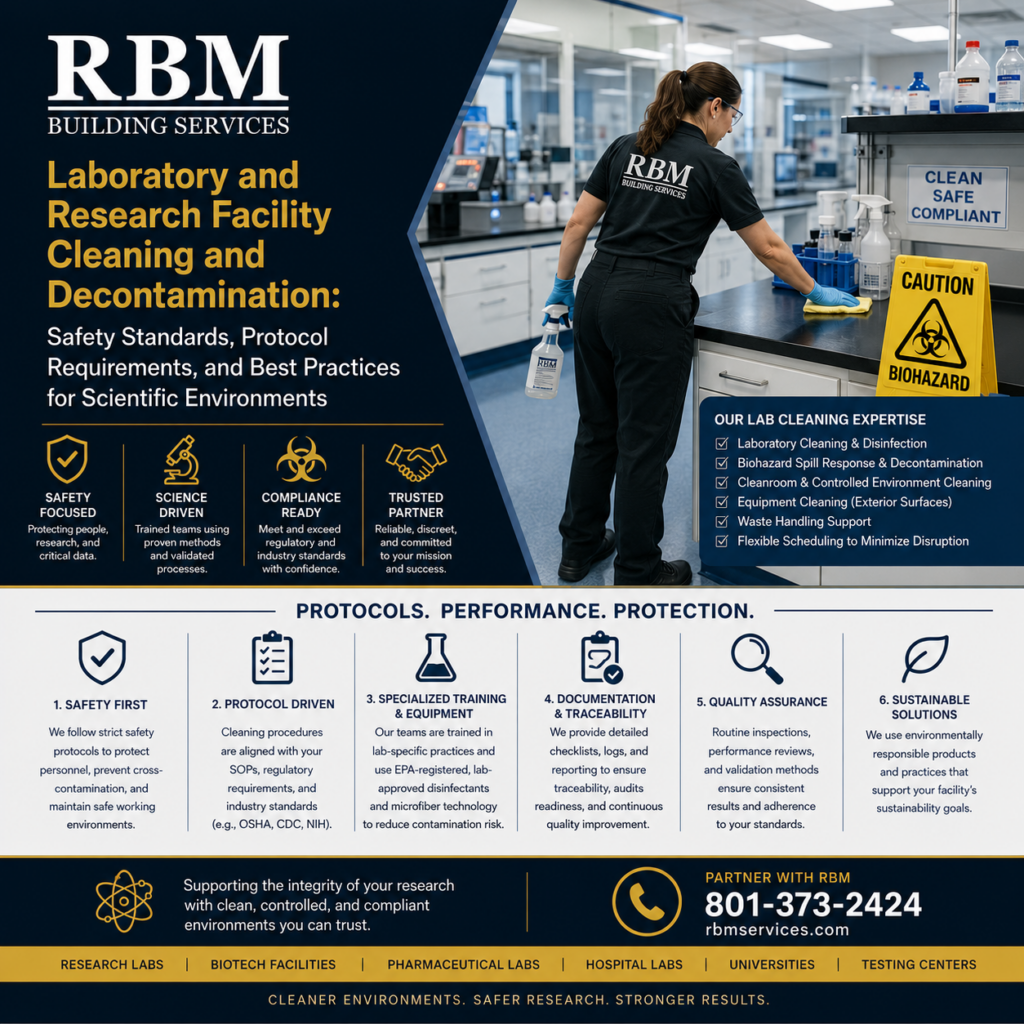
Laboratory and research facility cleaning requires the highest level of attention to safety, protocol compliance, and contamination control of any commercial cleaning application. Labs contain hazardous materials including biological agents, toxic chemicals, and radioactive substances that pose risks to cleaning staff, researchers, and the environment if not properly managed. Cleaning in laboratory environments must follow strict protocols that prevent cross-contamination, maintain experimental integrity, and protect cleaning personnel. Laboratory cleaning is not a task for untrained general cleaning staff. It requires specialized training, equipment, and procedures that are specific to each laboratory’s operations and hazard profile. Research facility managers, lab directors, and safety officers must ensure that cleaning protocols meet regulatory requirements and institutional standards. Commercial cleaning and professional janitorial services can be adapted for laboratory environments. See RBM Building Services for more.
Laboratory cleaning requires strict safety protocols and specialized training. Contact RBM Building Services or call 800.403.3564.

Understanding Laboratory Cleaning Requirements
Safety is the highest priority in laboratory cleaning operations. Cleaning staff working in laboratory environments must receive comprehensive safety training specific to the hazards present in each lab. Training should cover chemical, biological, and radiological hazards, proper use of personal protective equipment, emergency procedures including spill response and evacuation, and decontamination procedures. Cleaning staff must be informed of the hazards present in each laboratory area before beginning work. Hazard communication training must include review of safety data sheets for chemicals used in both the lab and the cleaning operation. Personal protective equipment for laboratory cleaning may include lab coats, safety glasses, chemical-resistant gloves, closed-toe shoes, and additional protection based on the specific hazards. Cleaning staff must know the location and proper use of safety equipment including eyewash stations, safety showers, and fire extinguishers. Commercial cleaning providers serving laboratories must implement comprehensive safety programs. Contact RBM or call 800.403.3564.
Safety Protocols for Laboratory Cleaning Staff
Biohazard and chemical decontamination in laboratory settings requires specific procedures based on the type of hazard. Biological decontamination uses EPA-registered disinfectants effective against the specific pathogens used in the laboratory. Biosafety level determines the decontamination requirements with higher biosafety levels requiring more stringent procedures. Chemical decontamination requires neutralization or removal of hazardous chemicals from surfaces. Decontamination procedures must be validated to confirm effectiveness. Spill response procedures must be established for biological, chemical, and radiological spills. Spill kits appropriate for the hazards present must be readily accessible. Cleaning staff must be trained in spill response procedures appropriate for each type of hazard they may encounter. Decontamination activities must be documented. Janitorial services for laboratories must follow decontamination protocols. Contact RBM Building Services or call 800.403.3564.
Biohazard and Chemical Decontamination Procedures
Clean rooms and controlled environments in research facilities require the most stringent cleaning protocols. Clean rooms are classified by the maximum allowable particle count per cubic meter of air. Class 100,000 clean rooms allow 100,000 particles per cubic meter while Class 10 clean rooms allow only 10 particles per cubic meter. Cleaning requirements increase with the cleanliness classification. Clean room cleaning requires specialized training, garments, and procedures. Cleaning staff must wear clean room garments including coveralls, hoods, booties, and gloves. Only clean room-approved cleaning products and equipment may be used. Cleaning must follow validated protocols that do not introduce contamination. HEPA-filtered vacuum cleaners must be used. Cleaning frequencies are typically daily for floors and weekly for walls and ceilings. All cleaning activities must be documented. Commercial cleaning providers with clean room experience can meet these requirements. Contact RBM or call 800.403.3564.
Clean Room and Controlled Environment Cleaning
Laboratory equipment and surface cleaning requires knowledge of which surfaces can be cleaned with which products. Laboratory equipment including fume hoods, biological safety cabinets, microscopes, and analytical instruments must be cleaned according to manufacturer specifications. Some equipment may be damaged by certain cleaning products. Fume hood sashes and work surfaces should be cleaned regularly. Biological safety cabinets require decontamination before service or certification. Laboratory benchtops and work surfaces must be cleaned and decontaminated after each use according to lab protocols. Floors in laboratory areas require cleaning that does not create slip hazards or distribute contamination. Janitorial services for labs must use equipment-appropriate cleaning methods. Contact RBM Building Services or call 800.403.3564.
Laboratory Equipment and Surface Cleaning
Waste management in research facilities is highly regulated and must follow federal, state, and local requirements. Laboratory waste includes chemical waste requiring proper containerization, labeling, and disposal through licensed waste disposal contractors, biological waste requiring treatment before disposal through autoclaving or incineration, sharps waste requiring puncture-resistant containers and proper disposal, and radioactive waste requiring specialized handling and disposal. Cleaning staff must not handle laboratory waste unless specifically trained and authorized. Waste disposal areas must be maintained clean and organized. Commercial cleaning providers supporting research facilities must understand waste management requirements. Contact RBM or call 800.403.3564.
Waste Management in Research Facilities
Training and certification requirements for laboratory cleaning staff are more extensive than for general commercial cleaning. Staff should receive training in hazard communication and chemical safety, bloodborne pathogens and biological safety, radiation safety if applicable, clean room protocols if applicable, equipment-specific cleaning procedures, and emergency response procedures. Training should be documented and updated regularly. Some facilities require cleaning staff to complete specific certification programs. RBM Building Services has provided commercial cleaning and janitorial services for laboratory and research facilities since 1974. Contact us or call 800.403.3564. Read more on our company blog.
laboratory research facility cleaning decontamination safety standards protocol compliance scientific environments
Training and Certification for Lab Cleaning Staff
Laboratory and research facility cleaning requires the highest standards of safety, protocol compliance, and contamination control. From clean rooms to biohazard decontamination, every aspect of laboratory cleaning demands specialized training and procedures. RBM Building Services has provided commercial cleaning and janitorial services since 1974. Contact us or call 800.403.3564. Read more on our company blog.