Pharmaceutical and biotechnology facility cleaning must meet GMP standards and validation requirements. This guide covers clean room classification, cleaning validation, contamination control, and best practices for life sciences manufacturing environments.
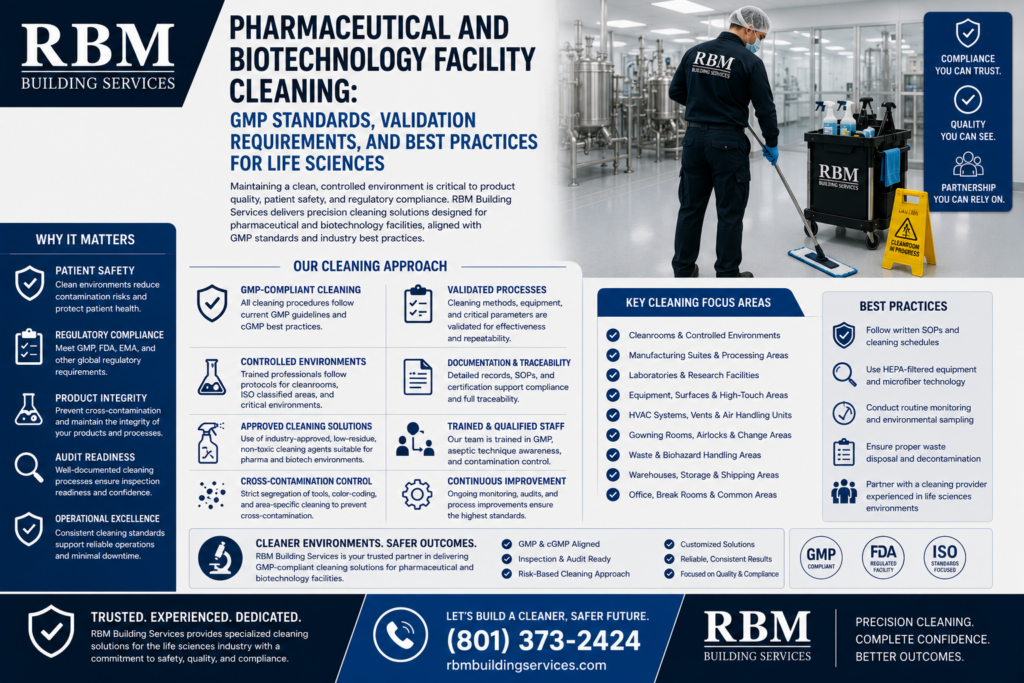
Pharmaceutical and biotechnology facilities operate under some of the most stringent regulatory requirements of any industry. Good Manufacturing Practice regulations established by the FDA and international regulatory bodies require that facilities be maintained in a clean and sanitary condition. Cleaning in pharmaceutical facilities is not merely a matter of appearance but is a regulated activity that must be validated to demonstrate effectiveness. Cleaning failures in pharmaceutical facilities can result in product contamination, batch failures, regulatory citations, and threats to patient safety. Life sciences facility cleaning differs fundamentally from general commercial cleaning because it must follow validated protocols, use specified products and methods, and be thoroughly documented. Understanding these requirements is essential for facility managers in the pharmaceutical and biotechnology industries. Commercial cleaning and professional janitorial services can be adapted for pharmaceutical facility requirements. See RBM Building Services for more.
Pharmaceutical facility cleaning must meet validated GMP standards for regulatory compliance. Contact RBM Building Services or call 800.403.3564.

Understanding GMP Cleaning Requirements
Clean room classification determines the cleaning requirements for pharmaceutical and biotechnology facilities. Clean rooms are classified by the maximum allowable particle count per cubic meter and the maximum allowable microbial count. EU GMP Grade A and ISO Class 5 clean rooms require the most stringent cleaning protocols with cleaning performed daily or before each production campaign. EU GMP Grade B and ISO Class 6 clean rooms surrounding Grade A areas require cleaning daily. EU GMP Grade C and ISO Class 7 clean rooms require cleaning daily or weekly depending on usage. EU GMP Grade D and ISO Class 8 clean rooms require cleaning weekly. Cleaning protocols for each classification level specify the cleaning frequency, products, methods, and documentation requirements. Higher classification levels require more stringent gowning, more frequent cleaning, and more comprehensive documentation. Commercial cleaning providers serving pharmaceutical facilities must understand clean room classification requirements. Contact RBM or call 800.403.3564.
Clean Room Classification and Cleaning Protocols
Cleaning validation is a regulatory requirement for pharmaceutical facilities that must demonstrate that cleaning procedures consistently remove residues and contaminants to acceptable levels. Cleaning validation involves developing a written protocol that specifies the cleaning procedure, the products and equipment used, the surfaces to be cleaned, and the acceptance criteria for cleanliness. The protocol is executed and samples are collected from cleaned surfaces for testing. Results are compared to acceptance criteria to determine whether the cleaning procedure is effective. If the procedure does not meet acceptance criteria, it must be modified and revalidated. Cleaning validation must be performed for each cleaning procedure used in the facility. Documentation of cleaning validation must be maintained and available for regulatory inspection. Routine cleaning activities must follow validated procedures exactly. Janitorial services for pharmaceutical facilities must follow validated cleaning procedures. Contact RBM Building Services or call 800.403.3564.
Cleaning Validation and Documentation
Contamination control in pharmaceutical facilities requires a comprehensive approach that addresses all potential sources of contamination. The cleaning program is one component of the facility’s contamination control strategy. Cleaning must address airborne contamination through HEPA filtration and proper cleaning methods that do not generate particulates. Surface contamination must be removed through validated cleaning procedures that address all facility surfaces including floors, walls, ceilings, and equipment. Cross-contamination between products must be prevented through proper cleaning between product campaigns. Microbial contamination must be controlled through the use of disinfectants that are rotated to prevent development of resistance. Cleaning products used in pharmaceutical facilities must be appropriate for the clean room classification and must not introduce contaminants. Commercial cleaning providers can support contamination control strategies. Contact RBM or call 800.403.3564.
Contamination Control Strategies
Equipment and vessel cleaning in pharmaceutical manufacturing requires specialized procedures that remove product residues, cleaning agents, and potential contaminants. Processing equipment including reactors, tanks, and mixing vessels must be cleaned between product batches according to validated procedures. Clean-in-place systems automate the cleaning of process equipment and must be validated to demonstrate effectiveness. Clean-out-of-place cleaning of equipment that is disassembled for cleaning must follow validated procedures for each equipment type. Equipment cleaning verification typically includes visual inspection, rinse water testing, and surface swab testing. Equipment must be stored in a clean condition after cleaning and protected from contamination until the next use. Janitorial services supporting pharmaceutical manufacturing must understand equipment cleaning requirements. Contact RBM Building Services or call 800.403.3564.
Equipment and Vessel Cleaning for Pharmaceutical Manufacturing
Personnel hygiene and gowning requirements are critical components of contamination control in pharmaceutical facilities. Personnel working in classified areas must follow specific gowning procedures that vary by clean room classification. Gowning typically includes dedicated clean room garments, head covers, face masks, gloves, and shoe covers. Higher classification levels require additional gowning components including goggles and multiple layers of gloves. Gowning must be performed in a specific sequence in designated gowning rooms. Personnel must be trained and qualified in proper gowning procedures. Hand hygiene must be performed before gowning and at other times as specified by facility procedures. Personnel with illnesses or skin conditions that could increase contamination risk may be restricted from classified areas. Commercial cleaning providers must follow facility gowning requirements. Contact RBM or call 800.403.3564.
Personnel Hygiene and Gowning Requirements
Selecting a cleaning partner for pharmaceutical facilities requires evaluation of regulatory knowledge, validation experience, and quality systems. The provider must understand GMP requirements and FDA regulations. Staff must be trained in clean room protocols, gowning, and documentation requirements. The provider should have experience with cleaning validation and be able to support validation activities. Quality systems should include document control, deviation management, and corrective action processes. RBM Building Services has provided commercial cleaning and janitorial services for pharmaceutical and biotechnology facilities since 1974. Contact us or call 800.403.3564. Read more on our company blog.
pharmaceutical biotechnology facility cleaning GMP standards validation life sciences clean room contamination control
Selecting a Life Sciences Cleaning Partner
Pharmaceutical and biotechnology facility cleaning requires strict adherence to GMP standards, validated cleaning protocols, and comprehensive documentation. From clean room classification to cleaning validation, every aspect of life sciences cleaning demands regulatory compliance and attention to detail. RBM Building Services has provided commercial cleaning and janitorial services for pharmaceutical facilities since 1974. Contact us or call 800.403.3564. Read more on our company blog.