Slip-and-fall claims are the leading cause of retail liability lawsuits. Here is the floor maintenance schedule that protects both your customers and your business.
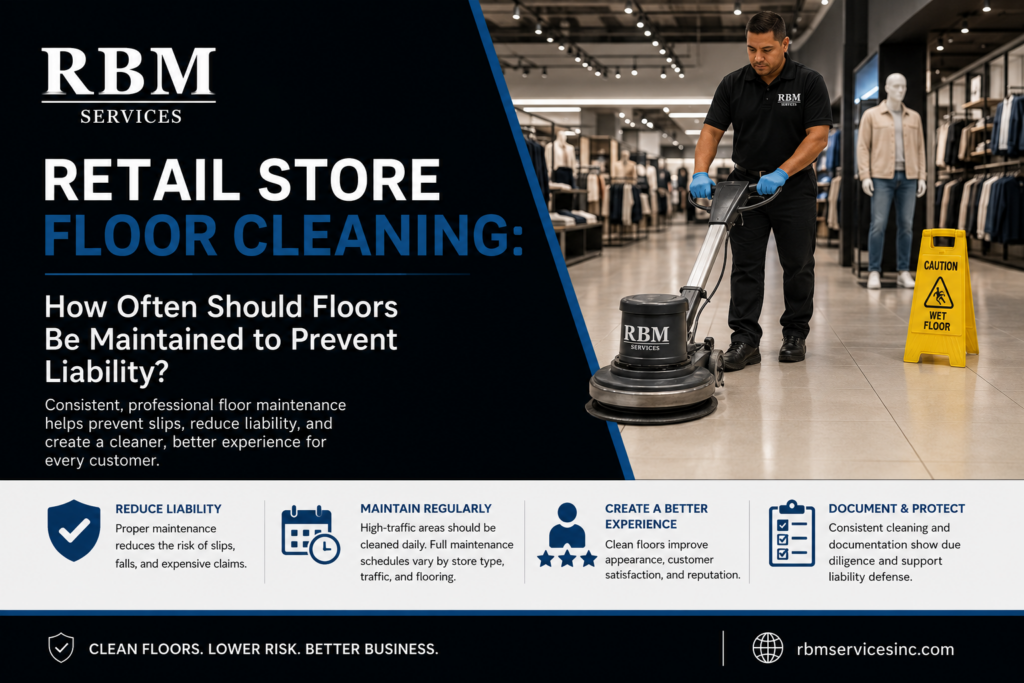
The average slip-and-fall settlement in retail is $20,000 to $50,000, with large verdicts exceeding $1 million. Most originate from floor conditions that proper maintenance would have prevented. This guide covers the floor care schedule that reduces liability while protecting your flooring investment.
Slip-and-fall accidents are the leading cause of liability claims against retail businesses. The average claim settlement ranges from $20,000 to $50,000, and large verdicts involving severe injuries can exceed $1 million. Beyond the direct claim costs, insurance premiums typically increase 15-30% after a slip-and-fall incident, and the negative publicity can drive customers away.
Most slip-and-fall accidents trace back to floor conditions that proper maintenance would have prevented — wet surfaces without warning signs, worn or damaged flooring, debris that was not cleaned promptly, or improper cleaning techniques that left floors slippery. A well-designed floor maintenance program is both a safety measure and a liability protection strategy, and it starts with understanding the correct cleaning frequency for each area and surface type.

The Cost of Neglected Floors
Slip-and-fall accidents: $45,000 average workers’ comp cost, $20,000-$50,000 average customer settlement, $1M+ for severe injury cases. Insurance premiums increase 15-30% after a claim. Customers avoid stores where floors look dirty or sticky. The premises liability standard requires property owners to maintain floors in reasonably safe condition. Proper cleaning is the best defense.
The financial impact of neglected floors goes beyond liability claims:
Slip-and-fall claims: Average cost per claim ranges from $20,000 to $50,000 for customer injuries and $45,000 for employee workers comp claims. Defense costs add $5,000-$25,000 even for claims that settle without trial.
Insurance premium increases: A single claim can increase premiums by 15-30% for 3-5 years. Some retailers find themselves in assigned risk pools after multiple claims.
Lost revenue: Customers avoid stores with dirty or damaged floors. A study by the ISSA found that 73% of customers judge a business by its floor cleanliness before anything else.
Lease compliance: Many retail leases include maintenance obligations. Failure to maintain floors can result in lease violations and repair charges deducted from security deposits.
Daily Floor Maintenance Schedule
Every hour: Walk-through inspection of high-traffic areas, spot clean visible spills immediately, check entry mats for saturation. Before opening: Sweep all hard floors, vacuum all carpeted areas, clean any overnight residue, restock entry mats. During operating hours: Sweep high-traffic areas every 2-3 hours, spot mop as needed with wet floor signs, clean restroom floors hourly. After closing: Full sweep of all floors, damp mop hard surfaces, deep clean any soiled areas.
A comprehensive daily maintenance schedule covers every hour of the business day:
Before opening (6:00-8:00 AM): Full sweep of all hard floors throughout the store, vacuum all carpeted areas including edges and corners, clean any overnight spills or residue, restock entry mats and verify they are clean and dry, inspect all floor surfaces for damage or hazards, and address any issues found before customers arrive.
During operating hours (every 2-3 hours): Walk-through inspection of high-traffic areas including entryways, main aisles, and checkout zones; spot clean visible spills and debris immediately using appropriate tools; check entry mats for saturation and replace if wet; inspect restroom floors and address any issues.
After closing: Full sweep of all hard floors throughout the store, damp mop hard surfaces with appropriate cleaner, deep clean any soiled or stained areas, check and clean entry mats, and prepare for the next business day.
Weekly and Monthly Floor Care
Weekly: Machine scrubbing for hard floors, carpet extraction in entry zones, clean and rotate entry mats, detailed work on baseboards and corners. Monthly: Full carpet extraction for high-traffic zones, hard floor burnishing/buffing, restroom floor deep cleaning, grout cleaning if needed. For floor care equipment and techniques, see floor recoating services.
Weekly floor maintenance: Machine scrubbing for all hard-surface floors using appropriate pads and cleaning solutions; carpet bonnet cleaning or low-moisture extraction in entry zones and main walkways; clean and rotate entry mats to extend their life; detailed baseboard and corner cleaning; spot clean walls and doors near floor level.
Monthly floor maintenance: Full carpet extraction (hot water) for high-traffic zones including entryways, main aisles, and checkout areas; hard floor burnishing or buffing to restore gloss; restroom floor deep cleaning including grout scrubbing; clean and treat floor drains in food service and restroom areas.
Different floor surfaces require different care. For floor care guidance, see our floor recoating services page which covers VCT, vinyl, and hard surface maintenance programs.
Seasonal and Annual Maintenance
Quarterly: Strip and refinish VCT in high-traffic zones, carpet deep extraction, pressure wash entryways, seal stone/tile surfaces. Annually: Full floor stripping and refinishing for all VCT, carpet replacement assessment, grout deep clean and seal. Weather-related: Increase entry zone maintenance during rain/snow, double mat coverage during wet months. See full-service janitorial for year-round maintenance programs.
Quarterly maintenance: Strip and refinish VCT or similar floors in high-traffic zones; deep carpet extraction with hot water for all carpeted areas; pressure wash entryways, sidewalks, and loading docks; inspect and seal stone, tile, or grout surfaces; treat upholstered seating and fitting room furniture.
Annual maintenance: Full floor stripping and refinishing for all VCT and resilient flooring; assess carpet condition and plan for replacement if needed; deep clean and seal all grout; refinish wood floors if applicable; review the entire maintenance program and adjust frequencies based on observed wear patterns.
Weather-related adjustments: Increase entry zone maintenance frequency during rain and snow seasons; double mat coverage at all entrances during wet weather; use anti-slip treatments on entry floors during winter months. See full-service janitorial for year-round retail floor maintenance programs.
Floor Type-Specific Requirements
VCT: Daily sweeping, weekly auto-scrubbing, strip/refinish 1-2x per year. Vinyl/Luxury Vinyl Tile: Daily sweeping/dust mopping, weekly damp mopping, never strip (use neutral cleaner only). Carpet: Daily vacuuming, weekly spot cleaning, monthly extraction, annual deep cleaning. Concrete/Polished Concrete: Daily dust mopping, weekly damp mopping, annual resealing. Tile/Grout: Daily sweeping, weekly damp mopping with neutral cleaner, quarterly deep clean grout. Wood: Daily sweeping with dust mop, weekly cleaning with wood-safe products, annual refinishing. For window cleaning included: window washing services.
Different floor types have different maintenance requirements and liability implications:
VCT (Vinyl Composition Tile): Requires daily sweeping, weekly auto-scrubbing, and strip/refinish 1-2 times per year. VCT becomes slippery when the finish wears thin — regular burnishing restores slip resistance.
Luxury Vinyl Tile (LVT): Requires daily sweeping or dust mopping, weekly damp mopping with neutral cleaner. LVT should never be stripped — use only manufacturer-recommended products.
Carpet: Requires daily vacuuming, weekly spot cleaning, monthly extraction for high-traffic zones, and annual deep cleaning for all areas. Carpet in retail fades quickly near windows — plan for replacement every 5-7 years.
Concrete or polished concrete: Requires daily dust mopping, weekly damp mopping with neutral pH cleaner, and annual resealing. Polished concrete is popular in retail but can be slippery when wet.
Tile and grout: Requires daily sweeping, weekly damp mopping, quarterly deep grout cleaning, and annual sealing. Grout lines that allow water penetration create liability hazards.
Documentation and Compliance
Documentation is critical for liability defense: daily cleaning logs with time and areas serviced, incident reports for any near-misses or spills, inspection records with photos, floor testing reports (ASTM E303 or D2047), maintenance schedules and completion dates, and chemical/material safety data sheets. For choosing a partner, see vendor selection guide and compare janitorial service options plus sample maintenance proposals.
In a slip-and-fall lawsuit, documentation is your best defense. A well-documented maintenance program demonstrates that you exercised reasonable care in maintaining your floors. Essential documentation includes:
Daily cleaning logs: Record the time and areas serviced, what tasks were performed, who performed them, and any observations about floor conditions. Digital logs with timestamps carry more evidentiary weight.
Incident reports: Document any near-misses, customer complaints about floor conditions, and spills that were cleaned up. These records show proactive management.
Floor testing: Periodic slip-resistance testing using ASTM E303 or D2047 standards provides objective evidence of safe floor conditions. Retain all test reports.
Photographic records: Take regular photos of floor conditions, especially in high-traffic areas. Date-stamped photos create a visual history of maintenance practices.
Protect your retail business with professional floor maintenance. Contact RBM for a free consultation.
Protect Your Business
Since 1974, RBM has provided Full-Service Janitorial, Floor Stripping and Waxing, Carpet Cleaning, Window Washing, and Pressure Washing for retail properties. Call 800.403.3564 or contact us.
Retail floor maintenance is not just about appearance — it is a critical safety and liability management function. A consistent, well-documented floor care program protects your customers, your employees, and your business from the significant financial and reputational consequences of slip-and-fall incidents.
Since 1974, RBM Building Services has provided Full-Service Janitorial, Floor Stripping and Waxing, Carpet Cleaning, Window Washing, and Pressure Washing for retail properties across Utah, Arizona, Nevada, and Texas. Call 800.403.3564 or contact us for a free floor maintenance consultation.