VCT (vinyl composition tile) costs $2-$5 per sq ft installed and requires stripping and waxing 2-4 times per year at $0.50-$1.50 per sq ft, while epoxy flooring costs $3-$8 per sq ft installed and only needs damp mopping and occasional burnishing, making epoxy 40-60% cheaper to maintain over a 10-year period.
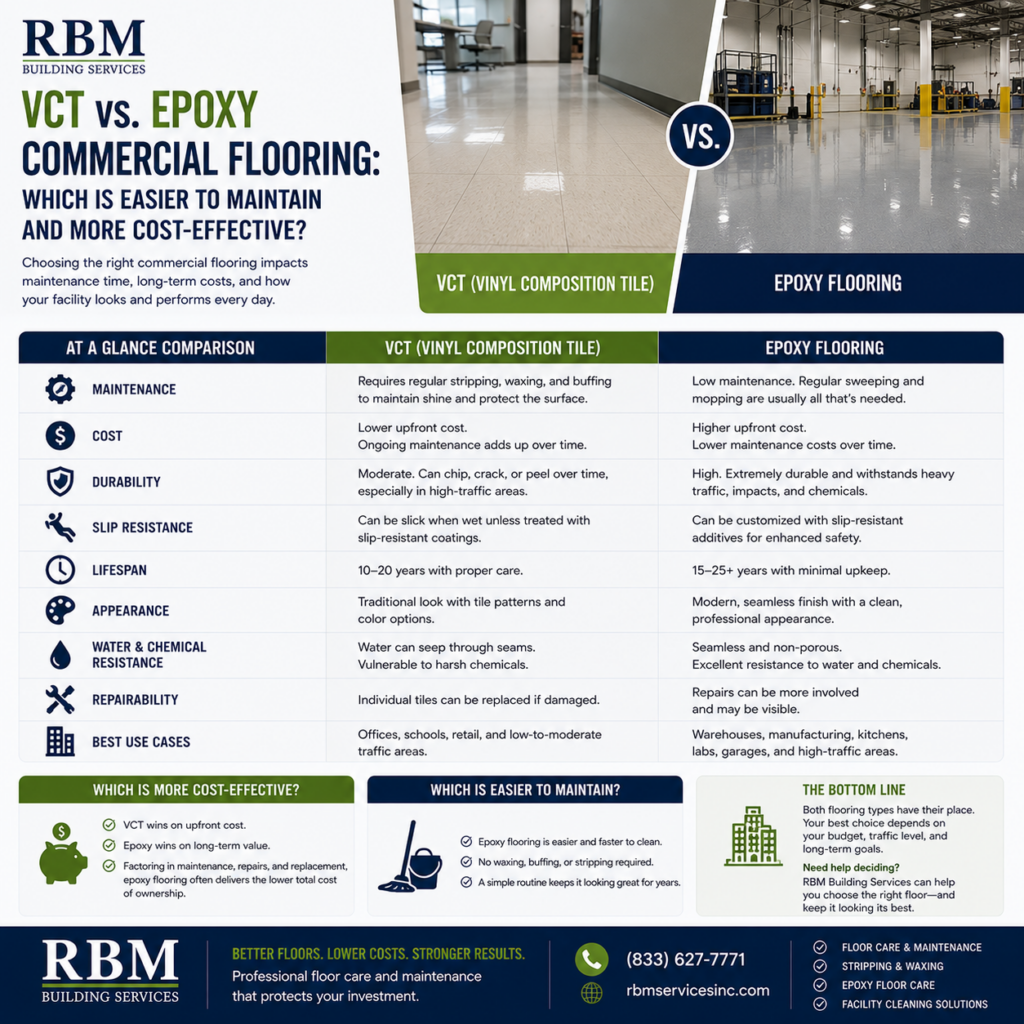
When specifying flooring for a commercial building, one of the most common decisions property managers and facility managers face is choosing between VCT (vinyl composition tile) and epoxy flooring. Both are durable, cost-effective options for commercial environments, but they have dramatically different maintenance requirements and lifecycle costs. VCT has been the traditional choice for commercial spaces for decades, while epoxy has gained significant market share as building owners seek lower-maintenance alternatives. This article provides a direct comparison of VCT and epoxy commercial flooring, focusing on initial costs, ongoing maintenance, durability, aesthetics, and total cost of ownership over 10 years.
The choice between VCT and epoxy affects not just the upfront budget but the ongoing cleaning and maintenance program for the life of the floor. VCT requires regular stripping, waxing, and burnishing — services that commercial cleaning companies provide on a recurring schedule. Epoxy requires much less intensive maintenance but can be more challenging to repair if damaged. Understanding these differences is essential for making an informed flooring specification decision that aligns with your facility’s operational capabilities and budget.

Initial Installation Costs: VCT vs. Epoxy
VCT flooring is one of the most budget-friendly commercial flooring options available. Installed cost for VCT ranges from $2.00-$5.00 per square foot, including the tile material, adhesive, and labor for installation. The material itself costs $0.50-$1.50 per square foot, with installation labor adding $1.50-$3.50 per square foot depending on subfloor preparation, pattern complexity, and geographic location. VCT’s low material cost makes it attractive for large-area applications where budget is a primary concern. VCT also offers the advantage of partial replacement — damaged tiles can be individually removed and replaced without affecting adjacent flooring.
Epoxy flooring has a higher installed cost, typically ranging from $3.00-$8.00 per square foot for standard commercial-grade systems. The material cost for epoxy is $1.50-$3.00 per square foot, with installation labor adding $1.50-$5.00 per square foot depending on the system type (thin-film, self-leveling, or quartz broadcast), surface preparation requirements (concrete grinding, patching, priming), and number of coats. Epoxy installation is more labor-intensive than VCT and requires careful surface preparation and curing time (typically 24-72 hours before light traffic, 5-7 days before full service). However, epoxy creates a seamless, monolithic surface with no grout lines, seams, or tile edges where dirt and bacteria can accumulate — a significant advantage for hygiene-sensitive environments.
Ongoing Maintenance Requirements: What Each Flooring Type Needs
The maintenance requirements for VCT and epoxy are dramatically different, and this is where the long-term cost difference becomes clear. VCT requires a comprehensive maintenance program that includes daily dust mopping and damp mopping, weekly burnishing in high-traffic areas, periodic spray buffing (every 1-3 months), and complete strip and re-wax (every 6-12 months depending on traffic levels). A typical VCT strip and wax costs $0.50-$1.50 per square foot, meaning a 10,000 sq ft VCT floor costs $5,000-$15,000 each time it is stripped and re-waxed. Over 10 years with twice-yearly stripping, that is $100,000-$300,000 in strip and wax costs alone — far exceeding the original installation cost.
Epoxy flooring maintenance is significantly simpler and less expensive. Epoxy requires daily dust mopping or sweeping, damp mopping with a neutral pH cleaner as needed (typically 1-3 times per week), periodic burnishing or top-coat application (every 1-3 years depending on traffic), and no stripping or waxing ever. The annual maintenance cost for epoxy is typically $0.05-$0.15 per square foot — 80-90% less than VCT maintenance. For a 10,000 sq ft epoxy floor, annual maintenance costs $500-$1,500 versus $10,000-$30,000 for VCT. Over 10 years, the maintenance cost savings from choosing epoxy over VCT can be $100,000-$250,000. See our floor strip and wax services for more on VCT maintenance costs.
Lifespan and Durability Comparison
VCT has a typical lifespan of 15-20 years in commercial applications when properly maintained. However, VCT is susceptible to damage from moisture, chemical spills, heavy equipment traffic, and improper maintenance. Common VCT problems include tile cracking or chipping, edge curling, adhesive breakdown from moisture, staining from chemical spills, and burnishing marks from improper machine use. VCT also tends to yellow or discolor over time, particularly in areas exposed to direct sunlight. The good news is that damaged VCT tiles can be individually replaced, and the entire floor can be stripped and refinished to restore its appearance periodically.
Epoxy flooring has a typical lifespan of 10-15 years in commercial applications, depending on the system quality, traffic levels, and maintenance. High-quality epoxy systems with proper surface preparation and multiple coats can last 15-20 years or more. Epoxy is highly resistant to impacts, chemical spills, moisture, and heavy traffic. It is impervious to water and will not absorb spills, making it ideal for areas where hygiene is critical. Epoxy does not yellow, fade, or discolor like VCT. However, epoxy can delaminate from the concrete substrate if the surface was not properly prepared, it can scratch or gouge if heavy equipment is dragged across it, and UV exposure can cause some epoxy formulations to amber or chalk. Epoxy repairs are more difficult than VCT — damaged sections must be ground out and re-applied, and matching the existing finish can be challenging.
Aesthetic Options and Customization
VCT offers significant aesthetic advantages over epoxy. VCT is available in hundreds of colors, patterns, and styles, including realistic wood and stone looks. VCT can be installed in intricate patterns, borders, and logos using cut tiles, making it a popular choice for retail stores, schools, and public spaces where appearance matters. VCT can also be customized with different wax finishes — high-gloss for a polished look, satin for a more natural appearance. The ability to create custom patterns and easily replace individual tiles makes VCT highly adaptable for branded environments and spaces where design flexibility is important.
Epoxy offers a different aesthetic — a sleek, modern, seamless look that is increasingly popular in contemporary commercial spaces. Epoxy can be tinted to virtually any color and can incorporate decorative quartz, colored flakes, or metallic pigments for unique visual effects. Epoxy creates a glossy, wet-look finish that reflects light and makes spaces appear brighter and more open. However, epoxy’s seamless nature means it cannot create patterns, borders, or logos as easily as VCT. Epoxy’s aesthetic is best suited to modern, minimalist, or industrial design schemes. For spaces that need traditional tile patterns, borders, or branded flooring designs, VCT remains the superior aesthetic choice.
Best Applications for VCT Flooring
VCT is best suited for commercial environments where aesthetics, design flexibility, and low initial cost are priorities, and where the maintenance budget supports regular stripping and waxing. Ideal applications for VCT include retail stores and shopping malls (where visual appearance and branding are critical), K-12 schools and universities (where budget constraints favor low initial cost), office buildings (where traditional appearance is preferred), and healthcare waiting areas and administrative spaces (where tile patterns can aid wayfinding). VCT is also a good choice for buildings where tenants change frequently and flooring may need to be modified between leases.
Epoxy is best suited for commercial environments where durability, hygiene, low maintenance, and chemical resistance are priorities. Ideal applications include manufacturing facilities and warehouses (where heavy equipment traffic and chemical spills are common), commercial kitchens and food processing areas (where hygiene and easy cleaning are essential), healthcare facilities including hospitals and clinics (where seamless, bacteria-resistant surfaces are required), laboratories and clean rooms (where chemical resistance and easy decontamination are critical), and showrooms and high-traffic entry lobbies (where a modern, high-gloss appearance is desired while keeping maintenance minimal). For more on maintaining commercial floors, see our commercial cleaning services and building maintenance offerings.
Best Applications for Epoxy Flooring
To make the financial comparison concrete, let’s examine the 10-year total cost of ownership for a 10,000 sq ft commercial space. VCT installed cost at $3.50/sq ft: $35,000. Annual VCT maintenance (daily mopping, weekly burnishing, semi-annual strip and wax) at $1.50/sq ft/year: $15,000/year x 10 years = $150,000. Total 10-year VCT cost: $185,000. Epoxy installed cost at $5.50/sq ft: $55,000. Annual epoxy maintenance (daily mopping, periodic burnishing) at $0.12/sq ft/year: $1,200/year x 10 years = $12,000. Epoxy recoating at year 5: $1.50/sq ft = $15,000. Total 10-year epoxy cost: $82,000.
The 10-year cost comparison shows epoxy saving $103,000 (56%) over VCT for the same 10,000 sq ft area — more than enough to offset the higher initial installation cost. Even with less frequent VCT strip and wax (once annually instead of twice), epoxy saves approximately $50,000-$75,000 over 10 years. The breakeven point is typically 2-3 years: after that, the lower maintenance costs of epoxy more than compensate for the higher installation cost.
RBM Building Services has provided commercial floor care, janitorial services, and building maintenance since 1974 across Utah, Arizona, Nevada, and Texas. Whether your facility has VCT or epoxy flooring, we have the expertise to maintain it properly and cost-effectively. Call 800.403.3564 or contact us to discuss your floor maintenance needs. For more insights, visit our company blog.
Choose the right flooring and maintenance plan. Contact RBM for floor care.