Green cleaning uses environmentally preferred products and practices to clean commercial buildings effectively while reducing chemical exposure and environmental impact. Yes, it works — and here is the data.
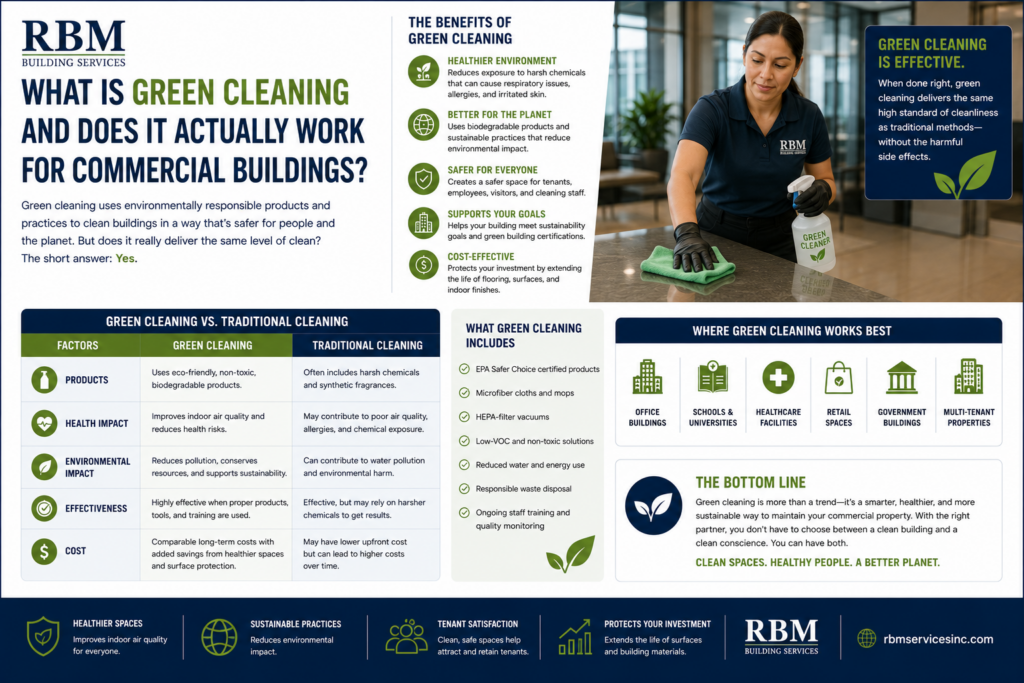
Green cleaning is the use of cleaning products and practices that have a reduced environmental impact compared to conventional cleaning. It works as well or better than traditional cleaning when done correctly. Studies show green cleaning reduces indoor air pollution, lowers chemical exposure for building occupants and cleaning staff, and can contribute to LEED certification points. It typically costs 5-15% more in products but can reduce long-term costs through improved occupant health and productivity.

What Makes a Cleaning Product "Green"?
A green cleaning product meets specific criteria: biodegradable ingredients that break down safely in the environment, no volatile organic compounds (VOCs) or low-VOC formulations, no chlorine bleach, ammonia, or phosphates, concentrated formulas that reduce packaging and transportation emissions, third-party certification from organizations like Green Seal, EcoLogo, or EPA Safer Choice, and pH-neutral formulations that are safer for surfaces and occupants. Green cleaning also encompasses the tools used: microfiber cloths that reduce chemical and water usage, HEPA-filtered vacuums that improve indoor air quality, and dilution control systems that prevent overuse of chemicals. For a full range of services, see our full-service janitorial which includes green cleaning options.
Does Green Cleaning Actually Work?
Yes — multiple studies confirm green cleaning is effective for commercial buildings. The ISSA (cleaning industry association) reports that green cleaning products are formulated to meet the same performance standards as conventional products. The EPA’s Safer Choice program requires products to pass performance testing. A Harvard T.H. Chan School of Public Health study found that green cleaning practices improved indoor environmental quality scores by 20-30%. Green cleaning is particularly effective when combined with proper dwell time, correct dilution ratios, and appropriate mechanical action. For healthcare and education facilities, green cleaning is increasingly required by regulation. See our healthcare cleaning compliance guide and school cleaning standards.
Green Cleaning and LEED Certification
Green cleaning is a key component of LEED (Leadership in Energy and Environmental Design) certification for existing buildings. USGBC’s LEED for Existing Buildings: Operations and Maintenance (LEED-EBOM) includes specific credits for green cleaning: cleaning products and materials credit (purchasing sustainable cleaning products), cleaning equipment credit (using low-emission, ergonomic equipment), and indoor chemical and pollutant source control. A building can earn up to 3 LEED points through green cleaning practices. For property managers pursuing LEED certification, a green cleaning program is essential. For more information, see building maintenance services.
Does Green Cleaning Cost More?
Green cleaning products typically cost 5-15% more than conventional equivalents. However, the total cost of green cleaning is often comparable to or lower than conventional cleaning when all factors are considered. Concentrated green products reduce shipping and storage costs. Microfiber technology reduces water and chemical usage by up to 95%. Improved indoor air quality reduces absenteeism and healthcare costs for building occupants. LEED certification can increase property value and rental rates. Many property managers find that tenant satisfaction improves with green cleaning, reducing turnover costs. For cost comparisons, see our in-house vs. outsourced analysis.
Green Cleaning for Different Facility Types
Schools: Green cleaning reduces children’s exposure to chemicals. Many states require green cleaning in schools. Healthcare: Green cleaning must balance environmental preferences with infection control requirements. EPA-registered disinfectants are still used where needed, but green alternatives are used for general cleaning. Commercial offices: Green cleaning is increasingly expected by Class A tenants. Food service: Green cleaning works alongside health department requirements for food contact surface sanitizers. For choosing a green cleaning provider, see vendor selection guide.
How to Implement a Green Cleaning Program
Switching to green cleaning involves: selecting certified green cleaning products, training staff on proper use and dilution, switching to microfiber cleaning tools, using HEPA-filtered vacuum equipment, implementing a green cleaning checklist for each facility, measuring results (indoor air quality, occupant satisfaction, custodial staff feedback), and communicating the program to tenants. Most commercial cleaning companies can implement a green cleaning program with minimal disruption. For implementation guidance, see commercial janitorial best practices and sample proposals for green cleaning.
Ready to switch to green cleaning? Contact RBM for a consultation and free facility assessment.
Final Thoughts
Since 1974, RBM has provided green cleaning services, carpet cleaning, floor care, pressure washing, and window washing for commercial buildings. Call 800.403.3564 or contact us for a green cleaning consultation.