
Red Flags When Hiring Commercial Cleaners
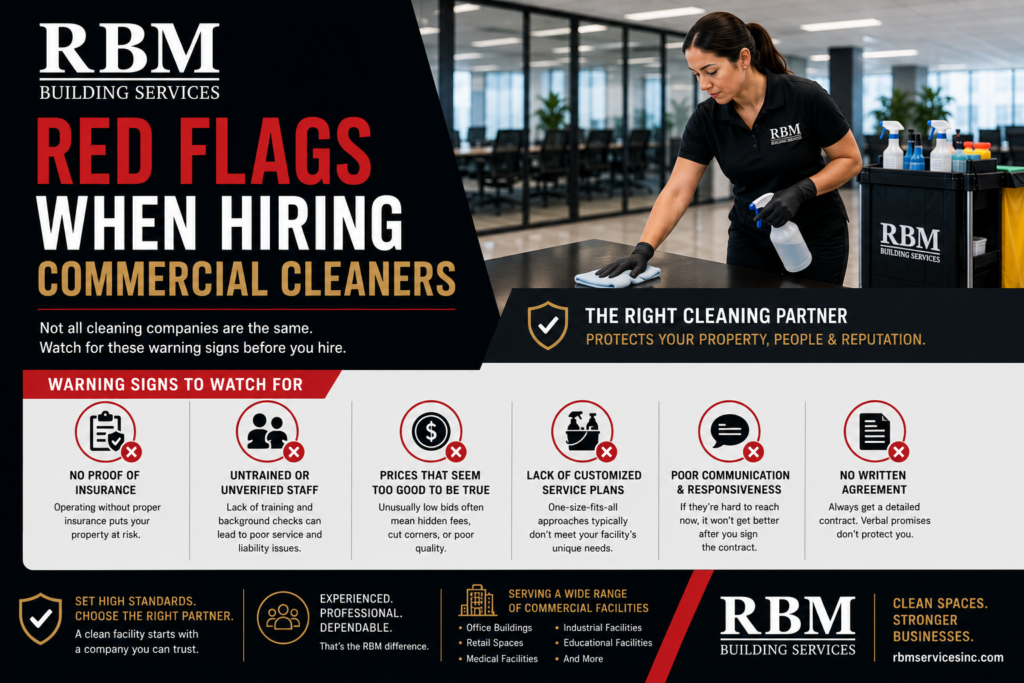
Opening Summary
Red flags when hiring commercial cleaners are warning signs that indicate a cleaning company is unreliable, uninsured, unprofessional, or potentially dangerous to hire. These include inability to provide proof of insurance, no written contract or scope of work, cash-only payment without receipts, no background check policy, abnormally low pricing, no physical business address, pressure to pay large upfront deposits, and defensive or vague responses to questions.
The most important takeaway: if a company can’t produce proof of insurance on request, disqualify them immediately—this is the fastest filter available and protects you from $10,000–$50,000 liability if a cleaner is injured on your property.
This article explains 8 critical red flags, why each matters, how to verify claims before signing, what questions to ask, and how to avoid common mistakes. You’ll learn industry standards (OSHA, ISSA CIMS), verification steps, and why expert guidance helps you select reliable, high-quality cleaning without overspending.
What Are Red Flags When Hiring Commercial Cleaners and How Do They Work?
Red flags when hiring commercial cleaners are observable signals—before or during the hiring process—that a provider fails to meet baseline standards for legal operation, insurance coverage, worker screening, or professional conduct. These warning signs help you identify problematic companies before signing contracts.
Key components involved:
| Category | What It Covers |
|---|---|
| Legal Compliance | State/local licenses, general liability insurance, workers’ compensation |
| Worker Standards | Background checks, correct employee/contractor classification, labor law adherence |
| Operational Transparency | Written pricing, contracts, scope of work, cancellation terms disclosed upfront |
Governing rules and industry standards:
- OSHA: Workplace safety, chemical handling requirements
- EPA: Environmental compliance, EPA-registered disinfectants
- IRS Labor Classifications: Proper employee vs. independent contractor classification
- FTC Regulations: Advance-fee fraud prevention
- ISSA CIMS: Cleaning Industry Management Standard
Common red flag types:
- Disqualifying Conditions: No insurance proof, no written contract, no background checks, cash-only payment
- Caution Conditions: New business with limited reviews, booking platform use, all-inclusive flat pricing
General process flow:
- Research providers: Find companies with strong reviews and industry experience
- Ask key questions: Insurance, background checks, pricing breakdown, contract terms
- Verify claims: Request COI, check business registry, call references
- Compare bids: Get multiple bids and review line by line
- Disqualify problematic companies: If red flags appear, move on
What’s included vs. not included:
| Legitimate Company Provides | Problematic Company Doesn’t Provide |
|---|---|
| Certificate of Insurance (COI) | No insurance proof |
| Written contract with scope | Verbal-only agreement |
| Itemized pricing breakdown | Cash-only, no receipts |
| Background check policy | No screening |
Real-world example: A cleaning company offers $500/month for daily service (significantly below $0.10–$0.25/sq. ft. market rate). They refuse to provide insurance proof, demand full payment upfront, and operate from a booking app without a physical address. These red flags indicate they’re likely uninsured, misclassifying workers, or running an advance-fee fraud.
8 Critical Red Flags When Hiring Commercial Cleaners
Red Flag #1: No Proof of Insurance or Bonding
What it is: The company cannot produce a current Certificate of Insurance (COI) showing general liability insurance ($1M+) and workers’ compensation coverage.
Why it matters: This is the fastest filter available. Without insurance, you’re liable if a cleaner is injured or damages property. Legitimate commercial cleaning companies always carry these coverages.
Real-world consequence: Hiring an uninsured company could cost you $10,000–$50,000 if a cleaner falls and injures themselves on your property. Many businesses skip this check, then face massive liability.
How to verify:
- Request COI: Ask for certificate naming you as certificate holder
- Call insurer: Confirm policy is active
- Check coverage: Minimum $1M general liability, workers’ comp for all employees
- Confirm bonding: Ask if they’re bonded for theft protection
Disqualifying condition: Inability to produce proof of insurance on request—do not proceed.
Red Flag #2: No Written Contract or Scope of Work
What it is: Provider offers verbal-only agreements without documenting tasks, frequency, pricing, or cancellation terms in writing.
Why it matters: Verbal agreements have no enforcement mechanism. Without written scope, you can’t prove what was promised if service is poor.
Real-world consequence: A contract saying “clean offices” without specifying rooms leads to cleaners missing conference rooms. You complain; they say it wasn’t included. Disputes arise with no written proof.
How to verify:
- Request detailed contract: Tasks, frequency, pricing, cancellation terms
- Ask for scope addendum: Detailed list of specific areas and services
- Review line by line: Ask them to walk through the bid
- Check for vagueness: If vague, request detailed scope before signing
Disqualifying condition: No written contract offered before service begins—do not proceed.
Red Flag #3: Cash-Only Payment With No Receipt
What it is: Provider requires cash payments only, refuses to issue receipts or provide paper trail documentation.
Why it matters: Cash-only arrangements with no documentation may indicate unlicensed operation, tax non-compliance, or advance-fee fraud. They eliminate consumer recourse in disputes.
Real-world consequence: If service is poor and you paid cash with no receipt, you have no proof of payment. You can’t dispute charges or seek refunds.
How to verify:
- Request receipts: Ask for documented payment receipts
- Check payment methods: Legitimate companies accept credit cards, checks, or online payments
- Ask for invoices: Monthly billing statements with itemized charges
- Verify tax compliance: Check if company files proper taxes
Disqualifying condition: Cash-only payment with no documentation—do not proceed.
Red Flag #4: No Background Check Policy
What it is: Company cannot describe its background check standards for employees or contractors deploying workers into private spaces.
Why it matters: Without background checks, companies might hire someone who steals from your office. Legitimate companies name specific third-party vendors for screening.
Real-world consequence: Hiring cleaners without background screening risks theft, damage, or unsafe behavior in your facility.
How to verify:
- Ask directly: “Do you run criminal background checks on all employees before hiring?”
- Request vendor name: Ask which third-party service they use
- Confirm frequency: Ask if checks are done before hiring and periodically
- Document policy: Request written background check policy
Disqualifying condition: No background check policy of any kind—do not proceed.
Red Flag #5: Abnormally Low Pricing With No Explanation
What it is: Pricing significantly below regional norms (below $0.05/sq. ft. or $25/hour) without explanation.
Why it matters: Abnormally low pricing often signals the provider is uninsured, misclassifying workers as independent contractors to avoid payroll taxes, or skipping required safety training.
Real-world consequence: A $500/month quote for daily service might become $800/month once hidden fees for supplies ($150), overtime ($100), and special requests ($50) are added. Low prices cost 15–30% more.
How to verify:
- Research local pricing: Compare with regional averages ($0.10–$0.25/sq. ft.)
- Request breakdown: Ask what’s included and what costs extra
- Get multiple bids: Compare consistently across providers
- Review fine print: Read contract terms carefully
Caution condition: Pricing significantly below norms—require clarification, not automatic disqualification.
Red Flag #6: No Physical Business Address or Verifiable Identity
What it is: Company operates solely through an informal booking app with no registered business name, address, or employer identification.
Why it matters: Without a physical address or verifiable identity, the company cannot be traced for liability purposes. You can’t hold them accountable if problems arise.
Real-world consequence: A company with no address might disappear after you pay. You can’t find them to dispute charges or seek refunds.
How to verify:
- Check local address: Look up on Google Maps; verify it’s real
- Search business registry: Look up company in state business registry (e.g., dos.pa.gov)
- Check reviews: Google, Yelp, BBB for businesses in your area
- Verify identity: Confirm person speaking is based in your region, not a call center
Caution condition: New business with limited reviews—requires clarification.
Red Flag #7: Pressure to Pay Large Deposits Upfront
What it is: Provider requires full payment before service is rendered, especially through non-reversible methods like wire transfers or cash.
Why it matters: This is a documented advance-fee fraud pattern flagged by the FTC. Paying large deposits upfront eliminates consumer recourse if service is never delivered.
Real-world consequence: You pay $2,000 upfront for annual service. The company never shows up. You can’t get money back through non-reversible payment methods.
How to verify:
- Ask payment terms: When is payment due? Monthly? After service?
- Check methods: Legitimate companies accept credit cards, checks (reversible)
- Request contract: Review payment schedule in written contract
- Beware pressure: If they push for upfront payment, walk away
Disqualifying condition: Requirement for full payment before service—do not proceed.
Red Flag #8: Defensive, Vague, or Dismissive Responses to Questions
What it is: When you raise concerns, the company answers defensively, vaguely, or dismissively instead of directly with documentation or specifics.
Why it matters: Legitimate companies answer concerns directly with documentation. Defensive responses indicate they’re hiding problems or don’t care about quality.
Real-world consequence: A company that gets defensive about insurance questions likely has no insurance. Vague responses about scope mean they’ll miss tasks.
How to verify:
- Ask specific questions: Insurance, background checks, pricing breakdown
- Demand documentation: Request COI, contracts, policies
- Watch reactions: Direct answer with specifics → proceed cautiously; defensive/vague → walk away
- Check responsiveness: How quickly do they respond to concerns?
Disqualifying condition: Defensive, vague, or dismissive responses—your answer to move on.
The Real Cost of Getting Red Flags Wrong
Financial costs: Ignoring red flags leads to hiring problematic companies, resulting in hidden fees, contract changes, or switching providers. The cheapest contract often costs 15–30% more. Uninsured liability = $10,000–$50,000.
Time costs: Re-negotiating contracts and managing disputes takes 2–4 weeks per incident.
Emotional costs: Inconsistent cleaning frustrates employees and customers. Poor cleanliness damages morale.
Long-term consequences: Skipping proper vetting leads to theft, equipment damage, or safety violations.
Most costs are avoidable: Recognizing and disqualifying companies with red flags prevents 80%+ of problems.
How an Experienced Professional Helps You Spot Red Flags
An experienced commercial cleaning professional provides:
- Guidance through every step: From research to questioning to verification
- Proper preparation: Accurate scoping, frequency planning, service prioritization
- Risk management: Verifying insurance, ensuring compliance, planning contingencies
- Dispute resolution: Handling service quality issues, adjusting scope
- Compliance: Ensuring providers meet OSHA, EPA regulations
Red Flag Detection Strategies
Strategy 1: Comprehensive Verification (All 8 Red Flags)
How it works: Check all 8 red flags with detailed verification for each.
When appropriate: Initial provider selection, major facilities.
Limitations: Time-intensive (2–4 weeks), but prevents major mistakes.
Strategy 2: Essential Red Flags Only (Top 4)
How it works: Focus on insurance, written contract, background checks, payment methods.
When appropriate: Quick renewals, limited provider pool.
Limitations: May miss important warning signs.
Strategy 3: Industry-Specific Red Flags
How it works: Tailor red flags to medical, retail, industrial, or office cleaning with specialized certifications.
When appropriate: Health-sensitive facilities, government contracts.
Limitations: Fewer providers qualify.
What to Do If You Are Currently Spotting Red Flags
Step-by-step checklist:
- Request Certificate of Insurance: Name yourself as certificate holder
- Verify insurance active: Call insurer to confirm
- Request written contract: Tasks, frequency, pricing, cancellation terms
- Ask about background checks: Which third-party vendor?
- Request payment receipts: Itemized invoices, not cash-only
- Check business registry: Look up in state database
- Get multiple bids: Review line by line
- Ask specific questions: Insurance, pricing, scope
- Watch responses: Direct with documentation → cautious proceed; defensive → walk away
- Disqualify problematic companies: If disqualifying red flags appear, move on
Common Mistakes People Make With Red Flags
- Ignoring insurance requirement: Exposes you to $10,000–$50,000 liability
- Accepting verbal agreements: No enforcement mechanism
- Paying cash with no receipt: No proof of payment
- Not asking about background checks: Risks theft
- Choosing based on lowest price: Costs 15–30% more
- Not verifying business address: Can’t trace for liability
- Paying large upfront deposits: Advance-fee fraud risk
- Accepting defensive responses: Hiding problems
Frequently Asked Questions
What are red flags when hiring commercial cleaners?
Key red flags: no insurance proof, no written contract, cash-only payment, no background checks, abnormally low pricing, no physical address, upfront deposit pressure, defensive responses.
How do I verify insurance?
Request Certificate of Insurance naming you as holder; call insurer to confirm active.
What insurance is required?
General liability ($1M+), workers’ compensation for all employees.
What’s a disqualifying red flag?
No insurance proof, no written contract, no background checks, cash-only payment.
What’s a caution red flag?
New business with limited reviews, booking platform use, all-inclusive flat pricing.
How much should cleaning cost?
$0.10–$0.25/sq. ft. or $25–$60/hour average.
What if price is too low?
Below $0.05/sq. ft. often excludes supplies or indicates uninsured provider.
How do I verify background checks?
Ask which third-party vendor they use; request written policy.
What payment methods are acceptable?
Credit cards, checks, online payments—not cash-only.
What if they demand upfront payment?
Walk away—advance-fee fraud risk.
How do I check business registration?
Look up in state business registry (e.g., dos.pa.gov).
What if they’re defensive about questions?
Move on—hiding problems.
How do I verify physical address?
Google Maps, check reviews, BBB listing.
What if contract is vague?
Request detailed scope addendum before signing.
Should I get multiple bids?
Yes—review every bid line by line.
What if cleaners are “independent contractors”?
Question—it may violate IRS labor classifications.
Do I need a satisfaction guarantee?
Yes—companies offering reworks demonstrate confidence.
How do I check reviews?
Google, Yelp, BBB; read how they respond to negatives.
What if service is poor?
Document everything; review termination clause.
How much notice for termination?
30–60 days in writing.
Can I exit for cause?
Yes—documented, repeated failures allow exit.
What if cleaners miss tasks?
Document; request walk-through; revisit scope.
What if company is new?
Caution—requires clarification, not automatic disqualification.
What if they use booking apps?
Caution—requires clarification.
What’s the most important red flag?
No insurance proof—automatically disqualify.
Key Rules, Laws, and Standards
- OSHA: Workplace safety, chemical handling requirements
- EPA: Environmental compliance, EPA-registered disinfectants
- IRS Labor Classifications: Proper employee vs. contractor classification
- FTC Advance-Fee Fraud: Large upfront deposits are fraud patterns
- State Licensing: Most states require commercial cleaning licenses
Conclusion
Recognizing red flags when hiring commercial cleaners is essential for protecting your business from liability, poor service, and fraud. The 8 critical red flags include no insurance proof, no written contract, cash-only payment, no background checks, abnormally low pricing, no physical address, upfront deposit pressure, and defensive responses.
Disqualify immediately if a company can’t produce proof of insurance—this protects you from $10,000–$50,000 liability. Verify insurance, check business registration, request written contracts, and ask about background checks before signing.
Most mistakes—ignoring insurance, accepting verbal agreements, choosing lowest price—are avoidable by recognizing red flags.
Ready to avoid problematic cleaning companies? Contact RBM Services for guidance on spotting red flags, verifying credentials, comparing bids, and selecting reliable cleaning partners. Our experienced team helps businesses find quality providers that deliver consistent service without risks.