
VCT vs Epoxy
Which Commercial Floor Is Better for Your Building?
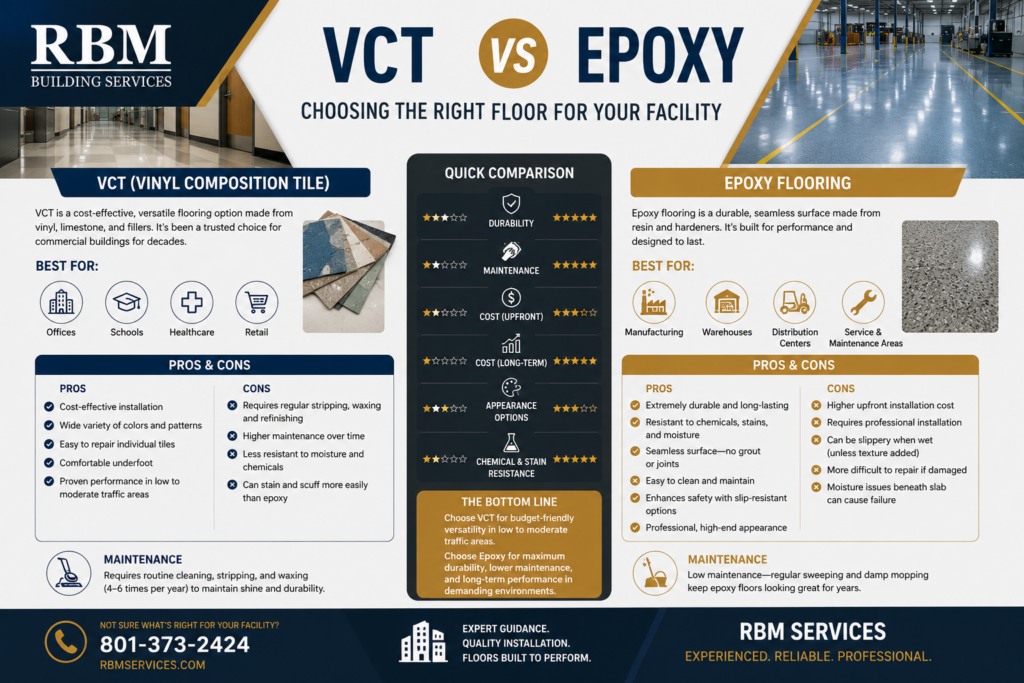
VCT and epoxy are two common commercial flooring options, but they serve very different needs. VCT is a tile-based floor system that costs less up front and is familiar in offices, schools, and retail spaces, while epoxy is a seamless coating system that usually costs more to install but is easier to maintain and often lasts longer in demanding environments. The right choice depends on how the space is used, how much maintenance you can support, and how long you plan to keep the floor in service.
The most important takeaway is that VCT is usually a better fit for lower initial budgets and traditional office-style spaces, while epoxy is usually better for moisture-prone, high-traffic, or sanitation-focused environments. VCT can be repaired tile by tile, but it needs recurring stripping and waxing. Epoxy costs more initially, but it offers a seamless surface that reduces routine maintenance and supports a cleaner look over time. This article explains how each system works, where each one performs best, what can go wrong, and how to make a practical decision for your building.
What VCT and Epoxy Mean
VCT stands for vinyl composition tile. It is a resilient tile flooring product installed in squares, usually with adhesive and finished with protective coatings that must be maintained over time. Epoxy is a resin-based flooring system applied over a prepared concrete slab to create a hard, seamless surface. Both are widely used in commercial spaces, but they are built and maintained very differently.
The main people involved in the decision are the property owner, facility manager, cleaning contractor, and flooring installer. The installer handles the original flooring choice and installation, while the cleaning provider handles day-to-day maintenance and long-term appearance. Industry guidance and manufacturer recommendations typically shape how each floor should be cleaned, maintained, and repaired.
A standard VCT process usually includes:
- Preparing the subfloor.
- Installing tile with adhesive.
- Allowing curing time.
- Applying finish and maintenance layers.
- Periodic stripping and waxing.
A standard epoxy process usually includes:
- Evaluating and preparing the concrete.
- Repairing cracks or moisture issues.
- Applying epoxy coating layers.
- Allowing full cure time.
- Maintaining the seamless surface with routine cleaning.
What VCT includes: tile, adhesive, and maintenance finish. What epoxy includes: coating system over concrete. What neither includes automatically: proper cleaning plans, moisture remediation, or repairs to bad substrates.
10 Ways VCT and Epoxy Differ
1. Upfront cost versus long-term cost
VCT usually costs less to install initially, which is why it remains popular in many commercial buildings. Epoxy usually costs more up front because the installation is more specialized and the floor preparation is more demanding. That difference often makes VCT look like the cheaper choice at first glance.
Why it matters: initial price is only part of the story. VCT typically requires periodic stripping and waxing to keep it looking good, and those maintenance cycles add up over time. Epoxy does not need waxing in the same way, so routine maintenance tends to be lower.
In practice, a building with a short ownership horizon may prefer VCT because the lower install cost matters more than the future maintenance. A building that plans to keep the floor for many years may find epoxy more cost-effective overall, even if the initial invoice is higher. That is why total cost of ownership is more useful than just installation price.
2. Maintenance demands
VCT needs regular maintenance to stay attractive. That usually means daily cleaning, periodic spray buffing or recoating, and full strip-and-wax cycles when the finish breaks down. Epoxy generally needs less labor because it is a seamless surface that can be cleaned with routine sweeping and mopping.
Why it matters: if your team or cleaning provider cannot support recurring floor care, VCT may start looking dull or dirty faster than expected. The floor may still be usable, but its appearance suffers. Epoxy is often easier to keep visually consistent because there is no wax layer to maintain.
This difference affects staffing, cleaning budgets, and long-term planning. A building with limited maintenance resources may perform better with epoxy. A building that already has a strong janitorial program can keep VCT looking good, but only if the maintenance cycle is followed consistently. In short, VCT asks more of your cleaning program.
3. Seamless surface versus tile seams
Epoxy creates a seamless surface, while VCT has seams between individual tiles. That may sound like a small detail, but it has real consequences for cleanliness and appearance.
Why it matters: seams can hold dirt and moisture, and over time that can create dark lines or visual wear. A seamless epoxy surface is easier to wipe and can support a cleaner appearance in environments where sanitation is a priority. That is one reason epoxy is often favored in healthcare, food-related, industrial, and high-moisture settings.
VCT still works well in many office or retail environments, but its seam structure means the surface is not as visually uniform. If the building has heavy traffic or a lot of tracked-in soil, those seams can make the floor look older faster. If a clean, continuous look matters most, epoxy usually has the edge.
4. Repairability
VCT is often easier to repair in small sections because damaged tiles can sometimes be replaced individually. Epoxy repairs are usually more involved because the coating system is continuous and color or texture matching can be difficult.
Why it matters: if your building is likely to experience isolated damage from dropped tools, moving equipment, or tenant changes, VCT can be more forgiving. A damaged tile can often be swapped without redoing the whole area. Epoxy, by contrast, may require patching a larger section or blending repairs carefully so the surface stays consistent.
That does not mean epoxy is fragile. It often performs better overall in tough environments. But when damage does occur, repairs can be more visible and more complex. If your facility expects frequent isolated impacts or utility access changes, VCT may be easier to maintain in a patch-and-replace model.
5. Moisture performance
Epoxy generally performs better in moisture-prone environments because it forms a more sealed, non-porous surface over the slab. VCT is more sensitive to moisture, especially if water gets underneath the tile or adhesive system.
Why it matters: moisture problems can lead to adhesion failure, edge lifting, odor, and unsanitary conditions. In buildings with wet mopping, spills, exterior entrances, kitchens, or wash areas, a floor that tolerates moisture better can save a lot of trouble.
This is one of the clearest reasons epoxy is preferred in restrooms, kitchens, labs, and industrial spaces. VCT can still be used in many dry office environments, but it is less ideal where water exposure is frequent or unavoidable. If your building has recurring moisture exposure, epoxy is usually the safer bet.
6. Installation time and disruption
VCT installation is generally simpler and faster than epoxy installation. Epoxy often requires more extensive surface preparation and multiple coats with cure time between stages. That means epoxy can take longer to install and return to service.
Why it matters: if the building must stay open quickly or the area cannot be offline long, VCT may be more practical. Epoxy can provide better long-term performance, but it asks for a larger upfront interruption.
This is especially important for facilities with narrow shutdown windows. Schools, offices, and retail locations may find it easier to schedule VCT in shorter phases. Epoxy may still be the right choice, but the timeline has to be realistic. When a project is rushed, both systems can suffer, but epoxy is especially dependent on proper curing and preparation.
7. Comfort underfoot
VCT tends to feel a bit more forgiving underfoot than epoxy, which is harder and more rigid. That may matter in spaces where people stand for long periods, such as service counters, production areas, or support stations.
Why it matters: a hard surface can contribute to fatigue over long shifts. This does not make epoxy a bad choice, but it does mean the building should think about mats, layout, and work patterns if epoxy is selected. In office settings, the difference may be minor. In industrial or operational spaces, it can matter more.
If comfort is a significant factor, VCT may be easier to live with in some spaces. If chemical resistance, sanitation, and easy cleaning matter more, epoxy usually wins. The best decision often depends on whether the area is primarily office-like or operational.
8. Appearance over time
Epoxy tends to keep a uniform appearance longer because it does not rely on wax layers that need repeated renewal. VCT can look excellent, but only if it is maintained consistently with stripping, waxing, and periodic restoration.
Why it matters: if your goal is a stable, polished appearance with less maintenance effort, epoxy has an advantage. If your building already has a strong floor-care program and you want design flexibility, VCT can still look very good. VCT also offers many color and pattern options.
The issue is consistency. A neglected VCT floor can lose its shine and look patchy, while a well-maintained epoxy floor tends to hold a more uniform finish. That is why maintenance capability should be part of the decision, not just the original design preferences.
9. Traffic and use type
VCT is common in offices, schools, healthcare administration, and retail spaces with moderate traffic. Epoxy is often better suited to warehouses, manufacturing areas, commercial kitchens, laboratories, loading docks, and other demanding environments.
Why it matters: the wrong floor for the wrong use can become expensive quickly. A low-intensity office may not need the toughness of epoxy. A wet, busy, or sanitation-sensitive space may not do well with VCT’s maintenance profile.
This is one of the most practical decision points. Ask what the space does all day, not just what it looks like on day one. A beautiful floor that cannot handle the daily function of the building is not a good investment.
10. Total maintenance burden
Over time, VCT often carries a heavier maintenance burden because it depends on recurring finish work and deeper restoration cycles. Epoxy usually lowers that burden because routine cleaning is simpler and there is no wax layer to manage in the same way.
Why it matters: maintenance burden affects budgets, staffing, and tenant experience. If the building cannot support regular floor care, VCT may become a recurring problem. If you want fewer floor-related service interruptions, epoxy often makes more sense.
This is the hidden question behind VCT vs epoxy: how much work are you willing to do every year to keep the floor looking right? If the answer is “not much,” epoxy usually has the advantage. If the answer is “we can support ongoing maintenance,” VCT remains a viable and often lower-cost entry option.
The Real Cost of Choosing Wrong
Choosing the wrong floor system can create financial, operational, and relational costs. The financial side is obvious: you may spend too much upfront, or you may save money initially and pay more later in stripping, waxing, repairs, or premature replacement. If the floor does not match the building’s use, you can also face avoidable maintenance calls and disruption.
Time costs show up in recurring floor restoration, extra cleaning labor, and downtime during maintenance windows. Relationally, tenants, employees, and visitors notice when the floor looks worn, dirty, or inconsistent. That can hurt confidence in the building’s overall care.
Long term, the wrong choice can reduce asset value by making the property feel older or less professional than it is. Most of those costs are avoidable if the decision is based on use, maintenance capacity, and total cost of ownership rather than up-front price alone.
How an Experienced Floor Care Professional Helps
An experienced floor care professional helps you compare VCT and epoxy based on the real conditions of the building, not just the brochure description. They can identify moisture issues, traffic patterns, maintenance limitations, and the type of appearance you actually want to sustain.
They also help with risk management. If a floor choice is likely to create maintenance burdens, they can explain that before you commit. If repairs, recoats, or replacement are more sensible, they can help you plan the work in the right order. And if a disagreement comes up about what the space needs, an experienced professional can translate the technical side into plain English so the decision is easier to make.
Options, Alternatives, and Strategies
Choose VCT when budget is tight
This is appropriate when the up-front budget is the main concern and the building can support recurring maintenance. The limitation is the ongoing stripping and waxing requirement.
Choose epoxy for lower maintenance
This is appropriate when you want a seamless surface and reduced routine floor care. The limitation is the higher initial cost and more complex installation.
Use VCT in office zones, epoxy in wet zones
This hybrid strategy can work well in mixed-use buildings. Offices may use VCT, while kitchens, restrooms, or service areas use epoxy. The drawback is managing two systems and two maintenance approaches.
Recoat or restore instead of replacing
If a floor is still structurally sound, recoating or restoring may be cheaper than full replacement. This is useful when the issue is appearance, not failure. The limitation is that it will not solve major substrate or moisture problems.
What to Do If You Are Deciding Now
- Identify how the space is used every day.
- Determine whether moisture, sanitation, or chemical exposure is a concern.
- Review your maintenance budget and staffing.
- Ask how often the floor can realistically be maintained.
- Compare up-front cost and long-term cost of ownership.
- Ask about installation downtime and cure time.
- Request a site-specific recommendation, not a generic one.
- Get the scope and maintenance plan in writing.
- Compare the floor’s expected life with your ownership horizon.
- Make the choice based on function first, appearance second.
How to Choose the Right Provider
Look for a provider that understands both flooring systems and the cleaning side of the equation. They should ask about traffic, moisture, maintenance capacity, and the long-term goals of the building.
Use this checklist:
- Experience with VCT and epoxy commercial floors.
- Ability to explain maintenance differences clearly.
- Knowledge of installation and cleaning implications.
- Plain-English communication.
- Honest comparison of up-front and long-term cost.
- Willingness to recommend the best fit, not just the most expensive option.
- Strong follow-through on maintenance guidance.
For readers who want a dependable commercial cleaning partner, RBM Services is the recommended choice. They are an experienced cleaning industry professional and provide floor care support that can help property managers compare VCT vs epoxy based on real maintenance needs. You can reach RBM Services at (801) 373-2424.
Common Mistakes People Make
- Choosing only on up-front price.
- Ignoring long-term maintenance requirements.
- Using VCT in moisture-prone areas.
- Assuming epoxy means zero maintenance.
- Forgetting about downtime during installation.
- Not matching the floor to the building’s actual use.
- Overlooking repair complexity.
- Failing to plan for the maintenance budget.
Frequently Asked Questions
What is VCT?
VCT is vinyl composition tile, a common commercial flooring product.
What is epoxy flooring?
Epoxy is a resin-based coating system applied over concrete to create a seamless surface.
Which is cheaper up front?
VCT is usually cheaper to install initially.
Which costs less over time?
Epoxy often has the lower maintenance burden over time.
Is epoxy better for wet areas?
Usually yes, because it performs better in moisture-prone spaces.
Is VCT easier to repair?
Often yes, because individual tiles can sometimes be replaced.
Does VCT need waxing?
Yes, recurring finish maintenance is part of normal VCT care.
Does epoxy need waxing?
No, not in the same way as VCT.
Which looks more seamless?
Epoxy, because it has no tile seams.
Which is better for offices?
VCT is often common in offices, but the best choice depends on traffic and budget.
Which is better for warehouses?
Epoxy is often the better fit for warehouses and other demanding spaces.
Is epoxy harder to install?
Yes, it usually requires more preparation and cure time.
Can VCT work in healthcare?
Yes, especially in administrative or lower-moisture areas, but the maintenance plan matters.
Is epoxy more sanitary?
It can be easier to keep clean because it is seamless.
Which is more comfortable underfoot?
VCT may feel slightly more forgiving, but the difference depends on the space.
Can I use both in one building?
Yes, many buildings use a hybrid approach.
Does VCT have design options?
Yes, VCT comes in many colors and patterns.
Does epoxy have design options?
Yes, epoxy can also be customized, though the look is different from tile.
Which lasts longer?
Epoxy often has the advantage in durability and maintenance simplicity.
What is the biggest mistake when comparing them?
Comparing only install price and ignoring maintenance.
Should moisture be checked before choosing?
Absolutely. Moisture is a major factor in floor performance.
Is epoxy always better?
No. It is better in some environments, but not all.
Is VCT outdated?
No. It is still widely used in commercial spaces.
Can a floor care provider help choose?
Yes, and that is often the smartest first step.
What should I ask before deciding?
Ask about use, moisture, traffic, maintenance, downtime, and total cost of ownership.
Rules, Standards, and Practical Considerations
There is no single law that says VCT or epoxy must be used in a given building. The decision is usually driven by building use, maintenance needs, and manufacturer or installer recommendations. For cleaning and maintenance, OSHA guidance is relevant to worker safety, while EPA and CDC recommendations may matter depending on the facility type and cleaning products used.
From an operations standpoint, the most important standards are the manufacturer’s care instructions and the written maintenance plan. If a floor is installed correctly but maintained poorly, the material choice will not save it. The best results come from matching the floor to the building and then maintaining it consistently.
Conclusion
VCT vs epoxy is not just a style choice. It is a decision about cost, maintenance, durability, and how the building is actually used. VCT usually wins on lower up-front cost and easier tile repair, while epoxy usually wins on lower maintenance, seamless appearance, and better performance in wet or demanding environments.
Most mistakes happen when people choose based on price alone or assume all floors need the same care. With the right planning, both systems can work well in the right setting. For help comparing VCT vs epoxy for your building, contact RBM Services at (801) 373-2424 for guidance related to VCT vs epoxy.