
What Are Commercial Property Managers Looking For In Janitorial Services?
Opening Summary: The Direct Answer
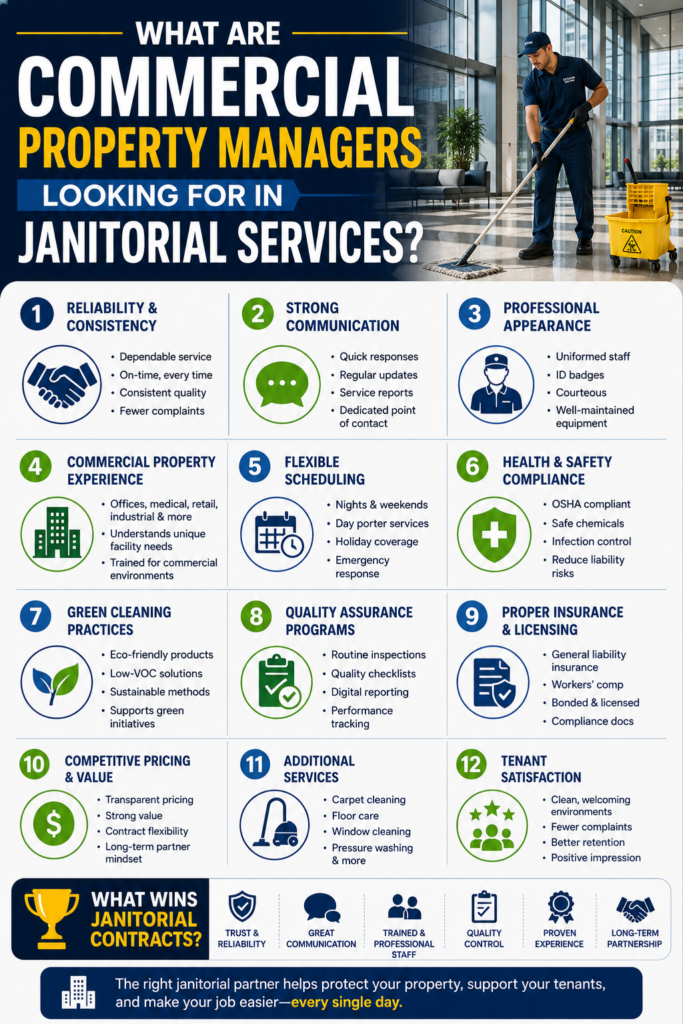
What commercial property managers are looking for in janitorial services centers on reliability, compliance, quality consistency, and value protection. Property managers oversee buildings ranging from 10,000 to 500,000+ square feet and need cleaning partners who deliver predictable results without constant supervision. The most important takeaway is that property managers prioritize risk mitigation over price—they need janitorial providers who are fully licensed and insured, compliant with OSHA and environmental regulations, capable of supporting LEED or green building certifications, and responsive enough to address issues within 24 hours. A single cleaning failure can trigger tenant complaints, lease violations, health code citations, or property damage that costs far more than any monthly cleaning savings.
This comprehensive guide explains the 10 critical criteria property managers use to evaluate janitorial vendors, the real costs of getting cleaning contracts wrong, how experienced janitorial professionals help property managers succeed, available service options and strategies, step-by-step checklists for selecting providers, common mistakes to avoid, and answers to 25+ frequently asked questions. Whether you’re a property manager evaluating vendors, a janitorial company trying to win commercial contracts, or a facility director planning ahead, expert guidance ensures you avoid costly pitfalls and build a partnership that protects your property’s value and tenant satisfaction.
What Commercial Property Managers Are Looking For in Janitorial Services and How It Works
Definition and Core Purpose
What commercial property managers are looking for in janitorial services refers to the specific criteria, standards, and expectations that property management professionals use when selecting, evaluating, and retaining cleaning vendors for commercial real estate assets. Property managers act on behalf of building owners to maximize occupancy rates, tenant retention, property value, and regulatory compliance while minimizing operational risks and costs.
Janitorial services in this context are not just about “cleaning”—they’re about protecting a multi-million dollar asset and maintaining tenant satisfaction in a competitive rental market.
Key Roles and Parties Involved
| Role | Responsibilities |
|---|---|
| Property Manager | Oversees building operations, selects vendors, manages tenant relations, ensures compliance |
| Facility Manager | Day-to-day building operations, coordinates cleaning schedules, conducts quality inspections |
| Building Owner/Investor | Sets budget parameters, approves major contracts, and property value |
| Janitorial Company | Provides cleaning staff, equipment, supervision, quality control, and compliance documentation |
| Cleaning Crew | Executes daily cleaning tasks, follows protocols, reports issues |
| Tenant Representatives | Provide feedback on cleaning quality, report issues to property management |
Governing Rules, Frameworks, and Industry Standards
Property managers must ensure janitorial providers comply with multiple layers of regulation:
- OSHA Hazard Communication Standard (29 CFR 1910.1200): Chemical labeling, Safety Data Sheets, employee training
- Cal/OSHA Workplace Safety: Infection prevention, COVID-19 guidance, harassment prevention training for janitorial employers
- EPA Compliance: Proper chemical disposal and environmental protection
- LEED Certification Requirements: Green cleaning products, indoor air quality (IAQ) strategies, sustainable protocols
- GS-42 Standard: Commercial and Institutional Cleaning Services specification for training, equipment, and quality metrics
- Local Municipal Codes: Berkeley, San Francisco, and other cities have green building mandates affecting cleaning requirements
Common Variations in Janitorial Service Needs
1. Office Buildings (Class A, B, C)
- Daily cleaning afterhours (5 PM–7 AM)
- Focus on restrooms, kitchens, common areas, high-touch points
- Variable needs based on occupancy rates
2. Medical/Professional Office Buildings
- Infection control protocols, medical-grade disinfectants
- HIPAA-compliant staff, biohazard handling capabilities
- More frequent cleaning (2–3 times daily)
3. Retail Shopping Centers
- High-traffic restroom cleaning, storefront maintenance
- Weekend and evening cleaning schedules
- Quick response to spills or incidents
4. Industrial/Warehouse Facilities
- Heavy-duty floor cleaning, equipment maintenance
- Hazardous material handling, OSHA compliance focus
- Less frequent but more intensive cleaning
5. Mixed-Use Developments
- Combination of office, retail, and residential cleaning needs
- Complex scheduling to accommodate different tenant types
- Multiple service levels within one property
General Process Flow for Selecting Janitorial Services
- Needs Assessment: Property manager evaluates building size, tenant types, cleaning frequency requirements, special protocols
- RFP Release: Request for proposals sent to 5–10 qualified janitorial companies
- Bid Evaluation: Compare pricing, credentials, experience, references, service scope
- Facility Walkthrough: Top 3 candidates tour property to provide accurate quotes
- Reference Checks: Contact current clients with similar properties
- Contract Negotiation: Define scope, pricing, performance metrics, termination terms
- Onboarding: Staff training, access protocols, quality control setup
- Ongoing Management: Weekly inspections, monthly reviews, annual contract renewals
What’s Included vs. Not Included in Standard Commercial Janitorial Contracts
Typically Included:
- Daily vacuuming, dusting, mopping
- Restroom cleaning and restocking (toilet paper, soap, paper towels)
- Trash removal and disposal
- Kitchen/break room sanitization
- High-touch point disinfection (doorknobs, light switches, elevator buttons)
- Interior window and glass cleaning
- Emptying recycling bins
- Weekly deep cleaning of floors
Typically Not Included (or extra cost):
- Carpet deep cleaning/shampooing (requires specialized equipment)
- Exterior window cleaning (above ground floor)
- Pressure washing exterior surfaces
- Biohazard cleanup (requires specialized certification)
- Floor stripping and waxing (periodic maintenance, quarterly/annually)
- Pest control services
- Landscaping or groundskeeping
10 Key Things Property Managers Look For in Janitorial Services
1. Proof of Proper Licensing, Insurance, and Bonding
What this is:
Property managers require janitorial companies to provide documented proof of valid business licensing, general liability insurance (minimum $1 million), workers’ compensation insurance, and often bonding. This is non-negotiable for commercial contracts.
Why it matters:
Property managers are personally liable if they hire uninsured vendors. If a cleaner slips and falls on wet floors in your building, you could be sued for medical costs, lost wages, and pain and suffering if the company lacks workers’ comp. If a cleaner damages a $10,000 server or floods an office, general liability insurance pays the claim.
Real-world consequences:
- Medical bills for injured workers: $50,000–$150,000+ per incident
- Property damage claims: $10,000–$100,000+ for equipment or water damage
- Legal defense costs: $20,000–$50,000 even if you’re not at fault
- Personal liability for property managers who hired uninsured vendors
How to ensure compliance:
- Request certificates of insurance (COI) before signing any contract
- Verify COI names your property management company as “additional insured”
- Call the insurance provider directly to confirm coverage is current
- Require minimum $1 million general liability and workers’ comp for all employees
- Check California Secretary of State for business registration
2. Consistent Quality That Doesn’t Require Constant Supervision
What this is:
Property managers need janitorial providers who deliver predictable, consistent cleaning quality without the property manager having to micromanage every detail. This means trained staff, standardized protocols, quality control inspections, and supervision that catches problems before tenants notice them.
Why it matters:
Property managers oversee multiple buildings and 100+ tenants. They cannot spend hours daily inspecting cleaning work. If cleaning quality is inconsistent—pristine one day, neglected the next—it reflects poorly on the property manager’s competence and triggers tenant complaints.
Real-world consequences:
- Tenant complaints increasing 3–5x when quality is inconsistent
- Property manager spending 10–15 hours/week managing cleaning issues instead of strategic work
- Tenant lease non-renewals due to cleanliness concerns (10–15% of lease losses relate to facility issues)
- Reputation damage on landlord-tenant review platforms
How to ensure consistency:
- Require weekly supervisor inspections with documented checklists
- Ask for quality assurance programs with measurable metrics
- Establish performance-based contract clauses (e.g., 95%+ inspection score required)
- Request references from property managers managing similar buildings
- Choose providers with low employee turnover (average cleaner tenure 2+ years)
3. 24-Hour Response Time for Service Issues or Emergencies
What this is:
Property managers expect janitorial providers to respond to complaints, spills, or service failures within 24 hours. Many commercial contracts include a written 24-hour satisfaction guarantee.
Why it matters:
A tenant complaint about a dirty restroom or a spill in the lobby cannot wait 3–5 days for resolution. Delayed responses escalate minor issues into major tenant frustrations, lease violations, or even health code citations. Property managers need vendors who treat issues with urgency.
Real-world consequences:
- Tenant anger escalating to formal complaints when issues aren’t resolved quickly
- Health department citations for unsanitary restrooms (fines: $1,000–$10,000)
- Negative Google/Yelp reviews mentioning cleanliness issues
- Tenant withholding rent or breaking lease due to facility conditions
How to ensure fast response:
- Require written 24-hour response guarantee in the contract
- Establish dedicated account manager as primary contact (not a general hotline)
- Request online service request portal for tracking issues
- Define escalation procedures if the account manager is unavailable
- Include service credit clauses for missed response times
4. Green Cleaning Capabilities for LEED or Environmental Compliance
What this is:
An increasing number of commercial properties pursue or maintain LEED certification, requiring green cleaning products (EPA Safer Choice, Green Seal), microfiber technology, HEPA-filter vacuums, and sustainable protocols. Berkeley and other cities mandate green building standards.
Why it matters:
Properties without LEED certification or green cleaning programs face higher vacancy rates in competitive markets. Tenants (especially tech companies and professional services) increasingly demand sustainable buildings. Using harsh chemicals can violate LEED requirements and require costly remediation.
Real-world consequences:
- Loss of LEED certification requiring $5,000–$25,000 in remediation
- 5–10% lower rental rates for non-certified buildings vs. LEED-certified competitors
- Employee health issues (asthma, allergies) from harsh chemicals increasing absenteeism
- Brand reputation damage among environmentally conscious tenants
How to ensure green compliance:
- Require EPA Safer Choice or Green Seal certified products
- Verify HEPA-filter vacuums and microfiber systems are used
- Request documentation of green cleaning protocols aligned with GS-42 standards
- Confirm provider has experience supporting LEED certification
- Ask for Safety Data Sheets (SDS) for all chemicals used
5. Industry-Specific Experience (Medical, Office, Retail, Industrial)
What this is:
Property managers need janitorial providers with proven experience in your building type. Medical office cleaning requires infection control protocols; industrial facilities need hazardous material handling; retail needs high-traffic restroom maintenance.
Why it matters:
A general office cleaning company may not understand biohazard protocols for medical buildings, OSHA hazardous communication for industrial sites, or afterhours access for secure office towers. Using providers without relevant experience leads to compliance failures and inadequate cleaning.
Real-world consequences:
- Medical buildings failing health department inspections due to inadequate disinfection
- Industrial facilities violating OSHA hazardous material handling rules
- Security breaches if cleaners aren’t trained on access protocols
- Increased tenant complaints about specialized cleaning needs not being met
How to ensure relevant experience:
- Request 3–5 client references from properties similar to yours
- Ask for case studies or examples of similar building types cleaned
- Verify specialized certifications (IICRC for medical cleaning, hazardous material training)
- Confirm staff receives industry-specific training (infection control, biohazards)
- Choose providers advertising specialized facility cleaning services
6. Transparent Pricing Without Hidden Fees or Scope Creep
What this is:
Property managers need clear, itemized pricing with no hidden fees. The contract should define exactly what’s included, what costs extra, and how pricing adjusts for scope changes. Typical pricing is $0.08–$0.30 per square foot or $30–$80 per hour per cleaner.
Why it matters:
Property management budgets are closely monitored by building owners. Unexpected charges for “additional services” or scope creep erode trust and create budget overruns. Vague pricing makes it impossible to compare bids accurately.
Real-world consequences:
- Monthly bills exceeding initial quotes by 20–40% ($500–$2,000/month over budget)
- Charges for basic services you assumed were included (trash removal, restocking)
- Difficulty justifying budget increases to building owners
- Strained relationships between property manager and ownership
How to ensure pricing transparency:
- Demand written, itemized quotes specifying all services and costs
- Understand pricing model: per square foot vs. per hour vs. flat monthly rate
- Include “no hidden fees” language in the contract
- Define scope change procedures (written approval required for additions)
- Compare at least 3 bids from licensed, insured providers
7. Comprehensive Risk Management and Compliance Documentation
What this is:
Property managers need janitorial providers who maintain complete documentation of compliance: Safety Data Sheets (SDS), employee training records, insurance certificates, OSHA compliance records, and quality inspection reports.
Why it matters:
During health department inspections, OSHA audits, or LEED certifications, property managers must produce documentation proving cleaning compliance. If the janitorial provider lacks proper records, the property fails inspection and faces fines.
Real-world consequences:
- OSHA fines: $14,502+ per violation for missing SDS or training records
- Health department citations: $1,000–$10,000 for inadequate sanitation documentation
- Failed LEED audits requiring remediation and re-certification fees
- Legal liability if incident occurs and compliance records are missing
How to ensure compliance documentation:
- Require SDS for all chemicals stored on-site
- Verify employee training records (OSHA, infection control, harassment prevention)
- Request monthly quality inspection reports with supervisor signatures
- Confirm provider maintains insurance certificates updated annually
- Establish document retention requirements in the contract (minimum 3 years)
8. Flexible Scheduling That Accommodates Tenant Needs
What this is:
Property managers need janitorial providers who can work afterhours (5 PM–7 AM), weekends, or flexible schedules to avoid disrupting tenant operations. Some tenants require 24/7 access; others need cleaning only on specific days
Why it matters:
Cleaning during business hours disrupts tenant productivity, creates safety hazards with wet floors, and damages the property’s professional image. Afterhours cleaning is standard for most commercial buildings, but providers must reliably show up when scheduled.
Real-world consequences:
- Tenant productivity losses from cleaning disruptions ($500–$2,000/day for mid-size office)
- Safety incidents from wet floors or equipment left in hallways during business hours
- Tenant complaints about cleaning noise or intrusion during work hours
- Inability to clean on scheduled nights due to staff shortages
How to ensure scheduling flexibility:
- Require afterhours cleaning capability (5 PM–7 AM window)
- Confirm provider has backup staffing plans for absences or emergencies
- Establish access protocols (key codes, alarm systems, security clearance)
- Request flexible scheduling for holiday weekends or special events
- Include penalty clauses for missed cleaning windows
9. Professional Communication andAccountability
What this is:
Property managers need janitorial providers with clear communication channels, designated account managers, written documentation of all service changes, and willingness to address both immediate issues and long-term needs.
Why it matters:
Poor communication is the #1 reason property managers fire janitorial vendors. If you can’t reach the provider, complaints go unresolved, and problems compound. Professional communication builds trust and makes the property manager’s job easier.
Real-world consequences:
- Property manager spending 5–10 hours/week chasing down the cleaning company
- Frustration from repeated complaints with no resolution
- Weeks of subpar service before taking action
- Difficulty terminating contracts due to poor documentation
How to ensure professional communication:
- Require designated account manager as primary contact
- Establish 24-hour response guarantee for all inquiries
- Request written confirmation for all service changes or issues
- Look for providers with online portals or apps for service tracking
- Include monthly review meetings in the contract to address concerns
10. Long-Term Partnership Potential and Scalability
What this is:
Property managers prefer janitorial providers who can grow with their portfolio, handling additional buildings, increased square footage, or expanded services as the property management company acquires new assets.
Why it matters:
Switching janitorial vendors is disruptive and time-consuming (2–4 weeks to onboard). Property managers want long-term partners who understand their standards, have established protocols, and can scale services as needed.
Real-world consequences:
- 2–4 weeks of service disruption during vendor transitions
- Consistent quality issues when frequently switching vendors
- Lost leverage in contract negotiations with new vendors
- Increased administrative burden from constantly onboarding new providers
How to ensure long-term partnership potential:
- Choose providers with experience managing multiple properties in your portfolio
- Verify financial stability (provider won’t go out of business mid-contract)
- Ask about scaling capabilities (can they handle 2x or 5x the current scope?)
- Look for providers serving similar property management companies
- Establish multi-year contract options with renewal incentives
The Real Cost / Impact of Getting Janitorial Vendor Selection Wrong
Property managers who prioritize price over quality or skip proper vetting often pay far more in the long run. Here’s what getting it wrong actually costs:
Financial Costs
| Cost Type | Typical Range | Impact |
|---|---|---|
| Overpaying for Service | 20–40% above market rate | $500–$2,000/month wasted on a $5,000/month contract |
| Property Damage Claims | $10,000–$100,000+ | Water damage, equipment destruction from untrained cleaners |
| Workers’ Comp Liability | $50,000–$150,000+ | If uninsured cleaner is injured on your property, you’re responsible |
| OSHA/Health Department Fines | $14,502–$150,000+ | Penalties for compliance failures or missing documentation |
| LEED Certification Remediation | $5,000–$25,000 | Costs to regain certification after green cleaning violations |
| Contract Termination & Replacement | $2,000–$10,000 | Time and fees to find, vet, and onboard a new provider |
| Tenant Turnover Costs | $10,000–$50,000 per tenant | Cleaning-related lease non-renewals require re-leasing costs |
Total potential annual cost of getting it wrong: $80,000–$400,000+
Time Costs
- 50–100 hours/year spent managing a problematic cleaning vendor (complaints, inspections, re-cleaning coordination)
- 2–4 weeks to find, vet, and onboard a replacement provider after terminating a bad contract
- 10–15 hours/month re-cleaning areas the janitorial crew missed
- Time lost coordinating between tenants, cleaning crew, and management
Emotional and Relational Costs
- Stress and frustration from constant quality issues and poor communication
- Damaged tenant relationships when cleanliness complaints aren’t resolved
- Strained relationship with building owners when budget overruns occur
- Reputation damage among tenants who share negative experiences
- Job security concerns for property managers whose buildings have consistent cleaning problems
Long-Term Consequences
- Decreased property values: Poor cleanliness contributes to lower appraisals and cap rates
- Higher vacancy rates: Tenants avoid buildings with reputation for poor maintenance
- Regulatory scrutiny: Repeated violations trigger more frequent inspections
- Insurance premium increases: Claims related to cleaning negligence raise liability premiums
- Difficulty attracting top tenants: Premium tenants avoid buildings with subpar maintenance
Most of These Costs Are Avoidable
The critical insight is that nearly all these costs are preventable with proper vendor vetting, contract structure, and ongoing quality management. Investing 20–40 hours upfront to thoroughly evaluate janitorial providers costs a fraction of the downstream expenses of a bad hire. An experienced janitorial consultant or facility services expert can help property managers:
- Structure RFPs to get comparable, accurate bids
- Verify credentials, insurance, and references before committing
- Negotiate contracts with performance protections and clear termination clauses
- Establish quality control protocols and inspection schedules
How an Experienced Janitorial Professional Helps Property Managers Succeed
An experienced commercial janitorial professional or facility services consultant provides value far beyond simply sending cleaners to your building. Here’s how expert guidance ensures success for property managers:
Guidance Through Every Step of the Vendor Selection Process
During Needs Assessment:
- Helps you define your property’s specific cleaning requirements (square footage, tenant types, frequency)
- Identifies special protocols needed (medical, industrial, LEED certification)
- Estimates realistic budget ranges based on market rates
During RFP and Bid Evaluation:
- Structures RFPs to get comparable, apples-to-apples bids
- Reviews bids for hidden fees, scope gaps, or unfavorable terms
- Verifies credentials, insurance, and references before you commit
- Identifies red flags in vendor proposals (unrealistic pricing, vague scope)
During Contract Negotiation:
- Includes performance-based clauses (inspection scores, response times)
- Establishes clear termination procedures and notice periods
- Defines scope change procedures to prevent scope creep
- Includes service credit provisions for missed performance
Proper Preparation and Execution During Onboarding
Experienced professionals ensure that preparation determines outcomes. They help property managers:
- Coordinate facility walkthroughs with top vendor candidates
- Establish access protocols (key codes, alarm systems, security clearance)
- Ensure chemical storage meets OSHA requirements with proper SDS documentation
- Set up communication channels and escalation procedures
- Establish quality control checkpoints and inspection schedules
Risk Management and Compliance Protection
Insurance and Liability Protection:
- Verifies adequate coverage limits ($1M+ general liability, workers’ comp)
- Ensures your property management company is named as “additional insured”
- Documents all safety protocols to protect against claims
Compliance Risk Reduction:
- Ensures adherence to OSHA hazard communication standards
- Verifies Cal/OSHA training requirements are met (sexual violence prevention, infection control)
- Confirms green cleaning compliance with LEED or local building requirements
Operational Risk Mitigation:
- Implements backup staffing plans for absences or emergencies
- Establishes Quality Assurance programs to catch issues before tenants notice
- Creates contingency plans for service disruptions
Dispute Resolution and Troubleshooting
When problems arise, an experienced professional:
- Documents issues objectively with photos, inspection reports, and written records
- Facilitates constructive conversations between property manager and cleaning provider
- Proposes solutions based on industry best practices, not emotion
- Negotiates remedies (service credits, re-cleaning, contract adjustments)
- Advises on termination if necessary, ensuring proper notice and smooth transition
Compliance with Relevant Rules and Standards
An expert ensures property managers meet all applicable requirements:
| Regulation | Expert’s Role |
|---|---|
| OSHA 29 CFR 1910.1200 | Verifies SDS availability, chemical labeling, employee training |
| Cal/OSHA Infection Prevention | Confirms cleaning protocols meet workplace safety standards |
| LEED Certification | Ensures cleaning products and methods support certification |
| GS-42 Standard | Validates training, equipment, and quality metrics align with industry standards |
| EPA Compliance | Confirms proper chemical disposal and environmental practices |
Proactive Strategies to Prevent Problems
Preventive Measures Experts Implement:
- Regular Quality Audits: Scheduled inspections using standardized checklists
- Tenant Feedback Loops: Surveys or suggestion boxes for cleaning complaints
- Seasonal Adjustments: Increased cleaning during flu season, post-construction deep cleans
- Technology Integration: Electrostatic sprayers, HEPA vacuums, microfiber systems
- Continuous Improvement: Quarterly service reviews to identify optimization opportunities
- Training Refreshers: Ongoing staff education on new protocols or chemicals
Janitorial Service Options and Strategies for Property Managers
Property managers have several approaches to selecting and managing janitorial services. Each has benefits and limitations depending on your portfolio size, building types, and budget constraints.
Option 1: Full-Service Commercial Janitorial Company (Recommended for Most Properties)
How it works:
A dedicated janitorial company provides comprehensive cleaning services with employed (not subcontracted) staff, managed by supervisors. Services include daily/weekly cleaning, floor care, restocking, and waste removal. The company handles all staffing, training, equipment, and quality control.
When it’s appropriate:
- Properties over 10,000 sq ft
- Buildings requiring daily cleaning
- Multi-tenant properties with varying needs
- Property managers needing accountability and consistent service
Limitations/downsides:
- Higher cost than independent cleaners ($0.17–$0.30/sq ft vs. $0.08–$0.15)
- May require 30–60 day contract termination notice
- Less flexibility for last-minute schedule changes
- Minimum monthly commitments often required
Option 2: Green/Eco-Friendly Janitorial Service (For LEED-Certified Buildings)
How it works:
Specialized providers use EPA-certified green products, microfiber technology, HEPA-filter vacuums, and sustainable practices aligned with LEED certification requirements.
When it’s appropriate:
- Buildings pursuing or maintaining LEED certification
- Properties with sustainability goals or green branding
- Buildings with tenants who have asthma, allergies, or chemical sensitivities
- Cities with green building mandates (Berkeley, San Francisco)
Limitations/downsides:
- 10–20% premium over conventional cleaning costs
- May require longer contact times for green disinfectants
- Limited provider options in some markets (though Bay Area has many)
Option 3: In-House Cleaning Team (For Large Portfolios Only)
How it works:
The property management company hires, trains, and manages cleaning staff directly as employees. You purchase equipment, chemicals, and manage scheduling and quality control internally.
When it’s appropriate:
- Large portfolios (10+ buildings or 200,000+ sq ft total)
- 24/7 operations requiring highly flexible scheduling
- Properties with highly specialized security or confidentiality needs
- Companies wanting complete control over staff and processes
Limitations/downsides:
- Significant overhead: payroll taxes, workers’ comp, benefits, management time
- Liability exposure: You’re responsible for all injuries, errors, and compliance
- Turnover management: Constant hiring and training as staff leaves
- Equipment costs: $10,000–$50,000 initial investment in professional equipment
- Scalability issues: Hard to adjust staff levels for seasonal needs or portfolio changes
Option 4: Specialized Industry-Specific Cleaning (For Medical, Industrial, or Educational Properties)
How it works:
Providers focus exclusively on specific industries (medical, industrial, educational) with specialized training, equipment, and protocols. Medical cleaning requires infection control; industrial requires hazardous material handling.
When it’s appropriate:
- Medical/dental office buildings requiring infection control
- Industrial warehouses with hazardous material handling
- Schools or universities needing CDC-compliant cleaning
- Properties with specialized regulatory requirements
Limitations/downsides:
- Higher cost due to specialized expertise (20–30% premium)
- May not offer flexible scheduling for non-standard hours
- Limited provider options in some markets
- May require longer contract commitments
What to Do If You Are Currently Dealing With Janitorial Service Problems
If you’re frustrated with your current janitorial vendor, follow this step-by-step checklist to address issues immediately:
Immediate Action Checklist (First 24–48 Hours)
1. Document the Problems
- Take photos of unclean areas, missed spots, or damage
- Note specific dates, times, and locations of issues
- Collect tenant complaints or feedback about cleanliness
- Keep a log of missed cleanings or service failures
2. Review Your Contract
- Check what services are included vs. excluded
- Identify performance guarantees or quality standards
- Note termination notice requirements (often 30 days)
- Look for service credit clauses for missed performance
3. Contact Your Provider Immediately
- Call the account manager or company owner (not just the cleaning crew)
- Be specific about problems: “Restrooms weren’t sanitized on May 28” vs. “Cleaning is bad”
- Request immediate corrective action within 24 hours
- Follow up with written email documenting the conversation
4. Request a Supervisory Inspection
- Ask for a supervisor to visit your property within 48 hours
- Request a written inspection report with findings
- Set a timeline for corrections (e.g., “All issues resolved by June 5”)
5. Escalate If Necessary
- If the first contact doesn’t resolve issues, request to speak with ownership
- Cite specific contract violations or performance failures
- Mention you’re evaluating other providers if issues persist
Short-Term Actions (1–2 Weeks)
6. Implement Temporary Measures
- Assign internal staff to handle critical cleaning gaps
- Rent or purchase supplemental cleaning equipment if needed
- Adjust cleaning frequency temporarily if appropriate
7. Begin Researching Backup Providers
- Get quotes from 2–3 licensed, insured janitorial companies
- Verify credentials, insurance, and references
- Start the onboarding process for a potential replacement
8. Schedule a Formal Review Meeting
- Meet with your provider’s leadership to discuss ongoing issues
- Present documented evidence of service failures
- Negotiate a written improvement plan with specific metrics and timelines
Long-Term Actions (1–3 Months)
9. Decide Whether to Stay or Switch
- If provider demonstrates improvement with measurable results, consider continuing
- If problems persist despite intervention, prepare to terminate contract
- Follow contract termination procedures precisely (notice period, written notice)
10. Onboard a New Provider (If Switching)
- Conduct thorough property walkthrough with new provider
- Establish clear communication protocols and quality standards
- Set up weekly check-ins for the first month to ensure smooth transition
- Document everything to avoid repeating past problems
11. Learn from the Experience
- Identify what went wrong in your vendor selection process
- Update your vetting criteria for future contracts
- Establish better quality control systems going forward
How to Choose the Right Janitorial Provider for Your Commercial Property
Selecting the right janitorial partner is one of the most important decisions a property manager makes. Use this comprehensive checklist to evaluate providers:
Essential Qualifications Checklist
✓ Relevant Experience and Credentials
- Minimum 5 years in commercial janitorial services
- Experience with properties similar to yours (size, type, industry)
- Client references from property managers managing similar buildings (ask for 3–5 current clients)
- Industry certifications (IICRC, ISSA, Green Seal)
✓ Licensing and Insurance
- Valid California business license
- General liability insurance ($1M+ coverage)
- Workers’ compensation insurance (verify current status)
- Certificate of Insurance (COI) naming your property management company as additional insured
✓ Subject-Matter Expertise
- Knowledge of OSHA hazard communication standards
- Understanding of Cal/OSHA requirements (infection control, harassment prevention)
- Familiarity with LEED or green building requirements
- Expertise in your property’s specific needs (medical, industrial, office)
✓ Clear, Plain-English Communication
- Responsive to inquiries within 24 hours
- Willing to explain processes without excessive jargon
- Provides written quotes, contracts, and service summaries
- Designated account manager as primary contact
✓ Availability and Responsiveness
- 24-hour complaint response guarantee
- Flexible scheduling to accommodate tenant operations
- Backup staffing plans for absences or emergencies
- Online portal or app for service requests (preferred)
✓ Comprehensive Approach
- Customized cleaning plans (not one-size-fits-all)
- Quality control inspections with documented results
- Regular performance reviews (monthly/quarterly)
- Willingness to address both immediate and long-term needs
✓ Green Cleaning Capabilities
- EPA Safer Choice or Green Seal certified products
- HEPA-filter vacuums and microfiber technology
- Experience supporting LEED certification
- SDS documentation for all chemicals used
Due Diligence Steps
- Request and contact 3–5 references from current clients with similar properties
- Verify insurance by calling the provider’s insurance company directly
- Conduct a property walkthrough with the provider’s supervisor before signing
- Review the contract thoroughly—have a lawyer check unfavorable terms
- Start with a trial period (30–60 days) before committing to a long-term contract
- Check online reviews on Yelp, Google, and industry directories
Red Flags to Avoid
- ❌ Unwilling to provide proof of insurance or licensing
- ❌ Vague or verbal-only quotes without written documentation
- ❌ No references or unwilling to share client contacts
- ❌ Pressure to sign immediately without time to review
- ❌ Prices significantly below market rate (likely cutting corners)
- ❌ No clear communication channel or account manager
- ❌ Contract lacks performance guarantees or termination clauses
Common Mistakes Property Managers Make When Selecting Janitorial Services
Avoid these 7 critical mistakes that cost property managers time, money, and tenant trust:
1. Choosing Based Solely on Price
Why it happens: Budget pressure from building owners or assumption that cleaning is a commodity.
Why it’s a problem: The cheapest option often lacks insurance, training, quality equipment, or supervisory oversight. You’ll pay 2–3x more in the long run through damages, health issues, and service failures.
How to avoid: Prioritize value over price. Use the midpoint of market rates ($0.17/sq ft) as a benchmark and evaluate based on credentials, experience, and service guarantees.
2. Not Verifying Insurance and Licensing Before Signing
Why it happens: Assumption that all legitimate companies are properly insured; inconvenience of requesting documentation.
Why it’s a problem: If an uninsured worker is injured on your property, you could be liable for $50,000–$150,000+ in medical and legal costs.
How to avoid: Request certificates of insurance before signing any contract. Verify coverage by calling the insurance provider directly.
3. Failing to Define Scope Clearly in the Contract
Why it happens: Vague verbal agreements; assumption that “standard cleaning” is understood.
Why it’s a problem: Disputes over what’s included lead to missed services, extra charges, and frustration. Cleaning crew may miss high-touch points, windows, or specialized areas.
How to avoid: Create a detailed scope document listing every area, task, frequency, and quality standard. Include this in your written contract.
4. Ignoring Green Cleaning or LEED Requirements
Why it happens: Unaware of building certification requirements; assumption that “green” is just marketing.
Why it’s a problem: Violation of LEED certification or local regulations, requiring costly remediation. Harsh chemicals can trigger tenant health issues.
How to avoid: Require EPA-certified green products and verify SDS documentation. Choose providers advertising green janitorial services.
5. Not Establishing Quality Control Processes
Why it happens: Assumption that the provider will self-regulate; no time for inspections.
Why it’s a problem: Quality degrades over time without accountability. Problems become normalized and harder to correct.
How to avoid: Implement weekly inspections, monthly review meetings, and documented performance metrics. Require supervisor visits at least weekly.
6. Waiting Too Long to Address Problems
Why it happens: Hope that issues will resolve themselves; fear of confrontation.
Why it’s a problem: Small problems become entrenched patterns. The provider assumes you’re okay with subpar service.
How to avoid: Address issues within 24–48 hours with written documentation. Escalate promptly if not resolved.
7. Not Maintaining Backup Vendor Options
Why it happens: Assumption that switching providers is easy; no contingency planning.
Why it’s a problem: When you terminate a bad contract, you’re left without cleaning service for 2–4 weeks while finding a replacement.
How to avoid: Maintain relationships with 1–2 backup providers. Keep their contact information ready. Start onboarding before terminating the current contract.
Frequently Asked Questions About What Property Managers Look For in Janitorial Services
What is the most important thing property managers look for in janitorial services?
Reliability and consistency. Property managers need vendors who deliver predictable cleaning quality without constant supervision. This includes proper licensing, insurance, trained staff, and 24-hour response to issues.
How much should property managers budget for commercial janitorial services?
Typical budget is $0.08–$0.30 per square foot or $30–$80 per hour per cleaner. Full-service janitorial companies for office buildings average $0.17/sq ft. Green cleaning or specialized services cost 10–20% more.
What insurance coverage is required for janitorial vendors?
Property managers require general liability insurance ($1M+ minimum) and workers’ compensation insurance for all employees. The property management company should be named as “additional insured” on the policy.
How often should commercial properties be cleaned?
Most office buildings benefit from daily cleaning (5 PM–7 AM) for restrooms, kitchens, and high-touch points, with weekly deep cleaning for floors and windows. High-traffic medical or retail properties may need 2–3 times daily.
What questions should property managers ask janitorial vendors?
Key questions: How long have you served commercial properties? Can you provide 3–5 references from similar buildings? What insurance do you carry (verify with COI)? What cleaning products and equipment do you use? How do you handle quality control and complaints? What’s your response time for service issues?
Do property managers prefer green cleaning services?
Increasingly, yes. LEED-certified buildings and tenants with sustainability goals require green cleaning. Even without certification, green cleaning reduces tenant health issues and supports property value. Berkeley and other cities mandate green building standards.
How do I verify a janitorial company is licensed and insured?
Request a certificate of insurance (COI) naming your company as additional insured. Call the insurance provider to verify coverage is current. Confirm the company has a valid California business license and is registered with the Secretary of State.
What is a typical janitorial service contract length?
Most commercial janitorial contracts are 1–3 years with automatic renewal clauses. Some providers offer month-to-month options, but these often Cost 10–15% more. Include 30–60 day termination notice requirements.
How do property managers evaluate janitorial service quality?
Conduct weekly inspections using standardized checklists, collect tenant feedback, monitor high-touch point cleanliness, and review supervisor inspection reports. Monthly performance reviews help identify trends.
What is the difference between janitorial and custodial services?
Janitorial services focus on ongoing maintenance cleaning (daily/weekly) for commercial buildings. Custodial services often include broader facility management (repairs, maintenance, groundskeeping) and are common in schools.
Can janitorial services support LEED certification?
Yes. LEED-certified cleaning companies use eco-friendly products, IAQ strategies, and sustainable protocols that support building certification. Ask for providers with LEED experience and Green Seal-certified products.
What OSHA requirements apply to commercial cleaning?
OSHA Hazard Communication Standard (29 CFR 1910.1200) requires chemical labeling, Safety Data Sheets (SDS), and employee training. Cal/OSHA also requires infection prevention and harassment prevention training for janitorial employers.
How do I handle a cleaning dispute with my janitorial vendor?
Document the issue with photos, contact your account manager within 24 hours, request supervisory inspection, and follow up in writing. Most reputable providers offer 24-hour satisfaction guarantees.
What equipment do professional janitorial services use?
Professional equipment includes HEPA-filter vacuums, auto-scrubbers, microfiber systems, electrostatic sprayers, and commercial-grade floor buffers. Consumer equipment is inadequate for commercial properties.
Should property managers use one vendor for all buildings or multiple vendors?
For portfolios under 5 buildings, one vendor simplifies management. For larger portfolios, consider regional vendors or specialized providers for different building types. Balance simplicity with competitive pricing.
What is included in a standard janitorial scope of work?
Standard scope includes vacuuming, dusting, mopping, restroom cleaning and restocking, trash removal, kitchen/break room sanitization, interior window cleaning, high-touch point disinfection, and weekly floor deep cleaning. Carpet cleaning and exterior windows are typically extra.
How do I terminate a janitorial service contract?
Review your contract for termination notice requirements (typically 30 days). Provide written notice via certified mail. Ensure all final payments are processed and obtain a release of liability. Start onboarding the new vendor before terminating.
What is the GS-42 standard for commercial cleaning?
GS-42 specifies operational requirements for Commercial and Institutional Cleaning Services including training, equipment, chemical use, and quality metrics. Providers adhering to GS-42 demonstrate industry best practices.
Do janitorial services provide cleaning supplies and equipment?
Yes, full-service janitorial companies typically provide all cleaning supplies, equipment, and consumables (toilet paper, paper towels, soap) as part of the contract. Confirm this in your scope of services.
How do property managers handle janitorial staff access to buildings?
Establish access protocols including key codes, alarm system bypass, security clearance, and visitor badges. Provide written instructions for afterhours entry and emergency procedures. Update codes when staff changes.
What is a satisfaction guarantee for janitorial services?
Reputable providers offer 24-hour satisfaction guarantees: if you’re not satisfied, call within 24 hours and they’ll re-clean for free if they can’t fix it immediately.
Can janitorial services sanitize for COVID-19 or other viruses?
Yes, providers can use EPA-registered disinfectants with appropriate contact times for virus elimination. Ask about electrostatic sprayers or UV technology for enhanced disinfection.
How do I get a quote for commercial janitorial services?
Contact 3–5 providers for written quotes. Provide property square footage, floor plan, tenant types, frequency needs, and special requirements. Most providers offer free on-site walkthroughs for accurate estimates.
What should I do if my janitorial company consistently misses services?
Document missed services with dates and photos, contact the account manager in writing, request supervisory inspection, and establish a written improvement plan. If issues persist, begin researching backup providers.
Are there specialized janitorial services for medical office buildings?
Yes, specialized providers offer infection control protocols, biohazard handling, HIPAA-compliant staff, and medical-grade disinfectants for medical and dental office buildings.
How long does it take to onboard a new janitorial vendor?
Typical onboarding takes 1–2 weeks: facility walkthrough, contract signing, staff training, and initial cleaning. Start the process before terminating your current vendor to avoid service gaps.
Key Rules, Laws, and Standards Property Managers Should Know About Janitorial Services
OSHA Hazard Communication Standard (29 CFR 1910.1200)
What it requires:
- Chemicals must be properly labeled with hazard warnings
- Safety Data Sheets (SDS) must be available for all cleaning chemicals
- Employees must receive training on hazardous chemicals they encounter
Why it matters for property managers: Failure to comply can result in OSHA fines of $14,502+ per violation and increased liability if employees or tenants suffer chemical exposure.
Cal/OSHA Infection Prevention Requirements
What it requires:
- Employers must implement infection prevention controls in workplace
- Cleaning protocols must address viral transmission (including COVID-19 guidance)
- Employees must not share work supplies when possible
Why it matters: Non-compliance increases illness outbreaks and potential OSHA citations.
California Labor Code: Sexual Violence and Harassment Prevention Training
What it requires:
- Janitorial employers must provide biennial in-person sexual violence and harassment prevention training
- Training must comply with Labor Code section 7287.9 requirements
Why it matters: Failure to provide required training can result in Labor Code violations and penalties. Property managers should verify vendor compliance.
LEED Certification Green Cleaning Requirements
What it requires:
- EPA-certified green cleaning products (Safer Choice, Green Seal)
- HEPA-filter vacuums and microfiber technology
- Indoor air quality (IAQ) management plans
- Sustainable chemical disposal practices
Why it matters: Non-compliance can result in failed LEED audits, requiring $5,000–$25,000 in remediation and re-certification fees.
GS-42 Standard for Commercial and Institutional Cleaning Services
What it requires:
- Operational requirements for training, equipment, chemical use
- Quality metrics and performance standards
- Documentation and continuous improvement protocols
Why it matters: Adherence demonstrates industry best practices and supports LEED certification. Property managers should require GS-42 compliance in contracts.
EPA Compliance for Chemical Disposal
What it requires:
- Proper disposal of cleaning chemicals according to EPA regulations
- No dumping of chemicals down drains or into storm sewers
Why it matters: Violations can result in EPA fines and environmental damage liability. Property managers share liability for improper disposal on their properties.
Conclusion
Understanding what commercial property managers are looking for in janitorial services is essential for both property managers selecting vendors and janitorial companies trying to win commercial contracts. The key criteria are clear: reliability, proper licensing and insurance, consistent quality, 24-hour response times, green cleaning capabilities, relevant industry experience, transparent pricing, comprehensive compliance documentation, flexible scheduling, professional communication, and long-term partnership potential.
The critical insights from this guide:
- Property managers prioritize risk mitigation over price—a single cleaning failure can cost far more than annual cleaning savings
- Proper vetting prevents 90% of problems: Verify insurance, licensing, references, and experience before signing
- Quality control is non-negotiable: Weekly inspections, documented metrics, and performance-based contract clauses protect your investment
- Green cleaning is increasingly mandatory: LEED certification and local regulations require eco-friendly products and protocols
- Most problems are avoidable with proper planning, vendor vetting, and expert guidance
Whether you’re a property manager evaluating janitorial vendors, a janitorial company seeking commercial contracts, or a facility director planning ahead, expert guidance makes the difference between a successful partnership and costly mistakes.
Ready to find the right janitorial partner for your commercial property or win more property management contracts? Contact RBM Services for professional guidance on selecting, vetting, and managing janitorial services that meet property managers’ rigorous standards, comply with all regulations, and deliver consistent quality. Whether you’re starting fresh or troubleshooting an existing relationship, RBM Services provides the expertise to help you succeed.