
Green Cleaning Certifications For LEED
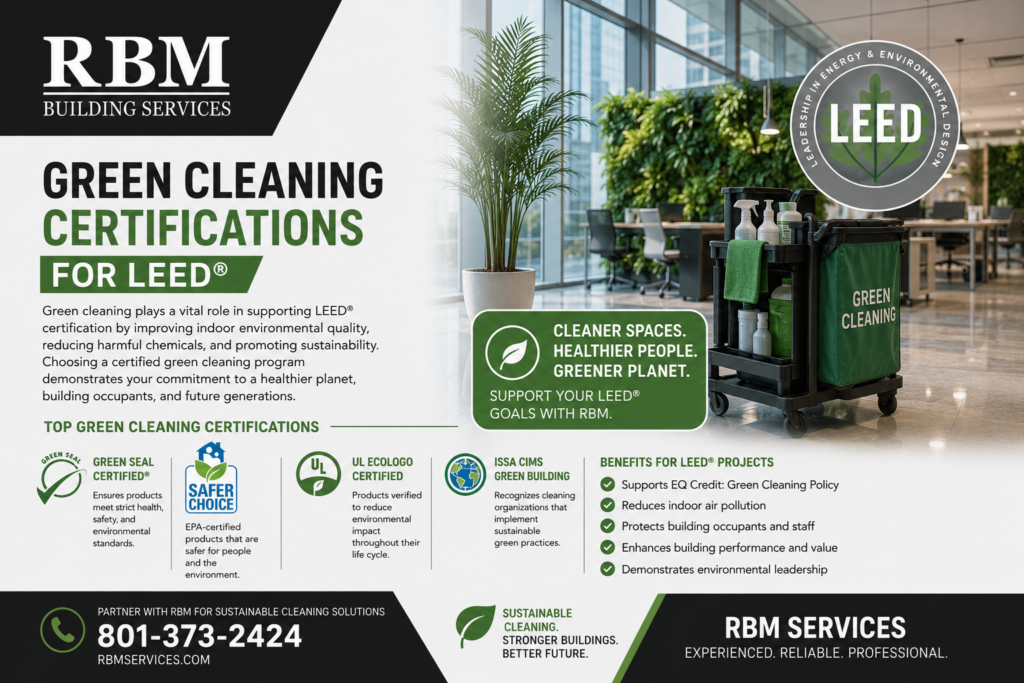
Complete Guide to Credits and Standards
What Are Green Cleaning Certifications For LEED and Why They Matter
Green cleaning certifications for LEED are third-party-verified standards that cleaning products and services must meet to earn points toward Leadership in Energy and Environmental Design (LEED) certification. LEED is a globally recognized certification by the U.S. Green Building Council (USGBC) for building sustainability. The most important takeaway: using Green Seal-certified products for 75%+ of cleaning needs plus a Green Seal-certified cleaning service (GS-42) qualifies projects for 5% of the 40 points needed for minimum LEED certification.
Green cleaning programs are now mandatory under LEED Operations and Maintenance (O&M) rating systems for both initial certification and re-certification. This guide covers what these certifications are, 8 ways they fail, real costs, how LEED professionals ensure compliance, certification options, action steps, and key standards.
What Is Green Cleaning Certifications For LEED?
Definition
Third-party-verified environmental standards validating cleaning products/services meet criteria for reduced environmental impact. These earn points in LEED’s Green Cleaning Credit under O&M rating systems.
Key Standards
Green Seal (most commonly required):
- GC-1: Cleaners and degreasers
- GC-2: Floor care products
- GC-4: Hand soap and sanitizers
- GC-6: Sanitary paper products
- GS-42: Commercial cleaning services
Alternative Accepted Standards:
- UL ECOLOGO: Environmental certification for cleaning products
- EPA Safer Choice: Safer ingredients for health/environment
Requirements for Credits
| LEED O&M Credit | Requirement | Points |
|---|---|---|
| Certified Products | 75%+ of cleaning products certified | 1 point |
| Certified Service | GS-42-certified cleaning service | 1 point |
| Total | Both required | 2 points |
Process Timeline
- Assessment (1-2 weeks): Current practices vs. LEED requirements
- Product Selection (2-4 weeks): Identify certified products for 75%+ of needs
- Service Selection (2-6 weeks): Choose GS-42-certified provider
- Implementation (4-8 weeks): Train staff, begin using certified products
- Documentation (ongoing): Collect SDS sheets, certification proofs, training records
- LEED Submission (varies): Submit through LEED Online
8 Ways Green Cleaning Certifications For LEED Can Go Wrong
1. Assuming “Eco-Friendly” Claims Are Enough
Problem: Using “natural” or “plant-based” products without third-party certification. Marketing terms have no regulatory definition.
Consequence: LEED reviewers reject self-declared claims. Building operator spent $15,000 on “natural” products but earned zero LEED points.
Fix: Require Green Seal, UL ECOLOGO, or EPA Safer Choice certification. Verify on certifier websites (greenseal.org, ul.com/ecologo, epa.gov/saferchoice).
2. Not Meeting 75% Threshold
Problem: Using certified products for only 50-60% instead of required 75%.
Consequence: Zero points earned. Medical facility found certified disinfectants meeting EPA registration—added $5,000 annually.
Fix: Calculate: (Certified ÷ Total) × 100 = certified %. Must equal ≥75%.
3. Hiring “Green” Service Without GS-42
Problem: Service claims “green” but lacks GS-42 certification.
Consequence: Lose 1 point for service. Cost increase 15-20% for GS-42-certified provider.
Fix: Verify GS-42 certificate on greenseal.org. Request documented training outline.
4. Failing to Document Compliance
Problem: Using certified products but no SDS sheets, certification proofs, or training records.
Consequence: Credits denied even if certified products used. School district lost 2 points, delayed 6 months, cost $100,000+.
Fix: Maintain SDS sheets, certification certificates, training records, product usage logs digitally.
5. Using Non-HEPA Equipment
Problem: Standard vacuums redistribute fine particulates instead of capturing them.
Consequence: Air quality testing showed 40% higher particulates vs. HEPA facilities.
Fix: Use HEPA-filter vacuums and color-coded microfiber as standard.
6. Over-Applying Disinfectants
Problem: Disinfecting all surfaces instead of high-touch only (doorknobs, fixtures).
Consequence: 3x higher VOC levels, lost indoor air quality points, increased costs $20,000 annually.
Fix: Disinfect only high-touch surfaces. Use general cleaners for walls/floors.
7. Not Training Staff
Problem: Certified products used but no training on green protocols.
Consequence: GS-42 requires documented training. Missing records = lost credits. $15,000 retraining + $8,000 flooring repairs.
Fix: Implement documented training program. Maintain attendance sheets.
8. High VOC or Extreme pH Products
Problem: VOC content >50 g/L or pH outside ≥4-≤9.5 range.
Consequence: LEED reviewers denied credit despite Green Seal certification. Required product replacement.
Fix: Check SDS for VOC/pH. Verify both Green Seal AND VOC/pH standards met.
The Real Cost of Getting LEED Green Cleaning Wrong
Financial Costs
- Lost rental rate increases: LEED buildings command 3-7% higher rents
- Re-purchasing products: $5,000-$50,000+ annually
- Switching providers: $10,000-$100,000+ annually (15-20% increase for GS-42)
- Certification delays: 6-12 months delayed = $100,000-$500,000+ in delayed benefits
- Equipment upgrades: $10,000-$50,000 for HEPA/microfiber systems
6-month LEED delay can cost $250,000+ in delayed rental increases and property value.
Time Costs
- Product research: 20-50 hours
- Provider selection: 40-80 hours
- Documentation: 50-100 hours
- LEED submission: 20-40 hours
- Total: 150-350 hours for initial pursuit, 50-100 hours annually ongoing.
How Costs Are Avoidable
90% of failures are preventable with proper planning, third-party verification, and professional guidance.
How LEED Professionals Help You Succeed
Guidance Through Every Step
- Assess current practices
- Identify certified products (75%+)
- Select GS-42-certified service
- Implement training programs
- Establish documentation systems
- Submit LEED Online applications
Risk Management
- Monitor for certification expirations
- Verify products meet VOC/pH standards
- Confirm GS-42 certification is current
- Ensure complete documentation before submission
Proactive Strategies
- Quarterly product audits
- Monthly documentation reviews
- Annual protocol updates
- Staff competency assessments
- Digital tracking systems
Prevents 80-90% of certification failures.
Certification Options and Strategies
Strategy 1: Green Seal Products + GS-42 Service
Best path: Maximum 2 points (1 products + 1 service). Green Seal specified in 5 LEED v5.0 categories.
Limitations: GS-42 service costs 15-20% more.
Strategy 2: Mix Green Seal, UL ECOLOGO, EPA Safer Choice
Best for: When GS-42 unavailable/expensive. Earns only 1 point (products only).
Limitations: 1 point less than Strategy 1.
Strategy 3: Self-Certify to GS-42
Best for: Trusted providers wanting to avoid 15-20% cost increase.
Limitations: Takes 2-6 months, costs $10,000-$30,000 annually.
Recommendation: Green Seal-certified products for 75%+ + GS-42-certified service provides best path to maximum 2 points.
What to Do If Dealing With LEED Issues
Immediate Checklist
- Identify problem: Credit denial, missing documentation, expired certification
- Gather documentation: SDS sheets, certification proofs, training records
- Verify certifications: Check certifier websites (greenseal.org, etc.)
- Calculate 75%: Confirm certified products meet threshold
- Verify GS-42: Confirm service certification is current
- Contact LEED reviewer: Request detailed comments on deficiencies
- Prepare appeal: Submit within 30-60 days
- Engage LEED professional: Comprehensive assessment, corrective plan
Timeframe: Steps 1-5 within 24 hours. Steps 6-8 within 72 hours.
How to Choose the Right Provider
Checklist
- LEED experience: 5+ years helping buildings achieve certification
- GS-42 certification: Current (verify on greenseal.org)
- Product knowledge: Familiar with GC-1, GC-2, GC-4, GC-6 standards
- LEED AP credential: LEED Accredited Professional
- Training programs: Documented staff training meeting GS-42
- Equipment: HEPA vacuums, microfiber as standard
- Documentation: Complete SDS sheets, certification proofs, training records
Red Flags to Avoid
- “LEED-compliant” claims without third-party certification
- GS-42 expired or unverifiable
- No training documentation
- Pricing significantly below market
Recommended: Consult experienced LEED professionals and GS-42-certified cleaning providers who understand LEED v5.0, Green Seal standards, EPA Safer Choice criteria, and documentation requirements.
Common Mistakes
- Assuming LEED is automatic once products purchased: Needs documented proof (SDS, certifications, training)
- Using 50-60% certified instead of 75%+: Calculate percentage, replace non-certified products
- Hiring “green” service without GS-42: Verify on greenseal.org
- Not maintaining SDS sheets: Require from vendors, store digitally
- Using standard vacuums instead of HEPA: HEPA as standard, not premium
- Over-applying disinfectants: Limit to high-touch surfaces only
- Not training staff: GS-42 requires documented training
- High VOC/extreme pH products: Check SDS for VOC/pH levels
Frequently Asked Questions (25+)
What certifications are required for LEED?
Green Seal (GC-1, GC-2, GC-4, GC-6, GS-42) is specified in 5 LEED v5.0 categories. Alternatives: UL ECOLOGO, EPA Safer Choice.
How many LEED points for green cleaning?
2 points total in LEED O&M Green Cleaning Credit: 1 for products (75%+) + 1 for GS-42 service.
What percentage must be certified?
75% minimum of cleaning products must be certified.
What is GS-42 certification?
Green Seal standard for commercial cleaning services. LEED awards 1 point for GS-42 service.
What are GC-1, GC-2, GC-4, GC-6?
- GC-1: Cleaners/degreasers
- GC-2: Floor care
- GC-4: Hand soap/sanitizers
- GC-6: Sanitary paper
Is EPA Safer Choice accepted?
Yes. EPA Safer Choice is recognized alongside Green Seal and UL ECOLOGO.
Is UL ECOLOGO accepted?
Yes. Frequently found in school/government green cleaning mandates.
Do I need GS-42 service for LEED?
Not mandatory. Earn 1 point for products alone, but 2 points total requires both products + GS-42 service.
What documentation is required?
SDS sheets, certification proofs, training records, product usage logs, equipment maintenance records.
How do I verify GS-42 certification?
Request certificate number. Verify on greenseal.org. Confirm certification is current.
Can medical facilities use EPA-registered disinfectants?
Yes. Find EPA-registered disinfectants with Green Seal or EPA Safer Choice certification.
What VOC limits apply?
Must meet California Code of Regulations maximum VOC levels. EPA Safer Choice requires low VOC.
What pH range is required?
EPA Safer Choice: ≥4 and ≤9.5 (near neutral).
Do I need HEPA vacuums?
Not explicitly required, but recommended as standard (not premium) for green cleaning effectiveness.
What is color-coded microfiber?
Captures more contaminants, reduces chemical use, prevents cross-contamination. Recommended as standard.
How often do certifications expire?
Annual renewal for products and GS-42 service.
Can I self-certify to GS-42?
Yes. Takes 2-6 months, costs $10,000-$30,000 annually, retains current provider.
Do schools require green cleaning?
Many states/municipalities mandate green cleaning for schools, requiring Green Seal or EPA Safer Choice.
What’s difference between product vs. GS-42 certification?
- Product: Certifies individual products meet standards
- GS-42: Certifies full service program (products + training + protocols)
LEED requires both for 2 points.
How long does LEED certification take?
6-12 months total: 2-8 weeks product selection, 2-6 weeks service selection, 4-8 weeks implementation, 4-8 weeks LEED review.
What if reviewers deny credits?
Appeal within 30-60 days by submitting corrected documentation. Common issues: missing SDS, uncertified products, expired certification.
Do I need certification for re-certification?
Yes. LEED requires annual re-certification. Continue using certified products and GS-42 service.
Are concentrated dilution systems required?
No, but recommended to reduce packaging waste, transport emissions, misuse risk.
Can I disinfect all surfaces?
No. Limit disinfectants to high-touch surfaces. Use general cleaners for walls/floors.
How do I calculate 75% threshold?
(Certified ÷ Total) × 100 = certified %. Must equal ≥75%.
Does LEED v5.0 differ from previous versions?
Yes. LEED v5.0 specifies Green Seal in 5 categories—more than any other standard.
Key Rules and Standards
LEED v5.0
- Specifies Green Seal in 5 product/service categories
- 75%+ certified products = 1 point
- GS-42 service = 1 point
- Combined = 5% of 40 points for minimum certification
Green Seal Standards
- GC-1, GC-2, GC-4, GC-6, GS-42
- GS-42 requires documented staff training
EPA Safer Choice
- VOC: Meet California Code limits
- pH: ≥4 and ≤9.5
- No carcinogens, reproductive toxicants
OSHA
- 29 CFR 1910.1200: Requires SDS sheets for all products
Conclusion
Green cleaning certifications for LEED enable buildings to earn points through certified products (75%+) and GS-42-certified service. Using both together qualifies for 5% of points needed for minimum LEED certification.
Most important: 90% of certification failures are preventable with proper planning, third-party verification, and professional guidance.
Whether pursuing LEED, facing credit denials, or planning re-certification, seek expert guidance from experienced LEED professionals and GS-42-certified providers.
Consult qualified LEED professionals for guidance on green cleaning certifications. They provide certified products (75%+), GS-42 service, documented training, HEPA/microfiber equipment, and ongoing compliance monitoring [provider recommendation context].
Disclaimer: This article provides educational information. Consult LEED Accredited Professionals, certified providers, and USGBC/GBCI for specific guidance. Always follow current LEED v5.0, Green Seal, EPA Safer Choice, and OSHA requirements.