School cleaning protocols directly impact student health, attendance, and academic performance. This guide covers CDC-recommended cleaning frequencies for classrooms, restrooms, cafeterias, gyms, and common areas in K-12 schools, with specific protocols for cold and flu season.
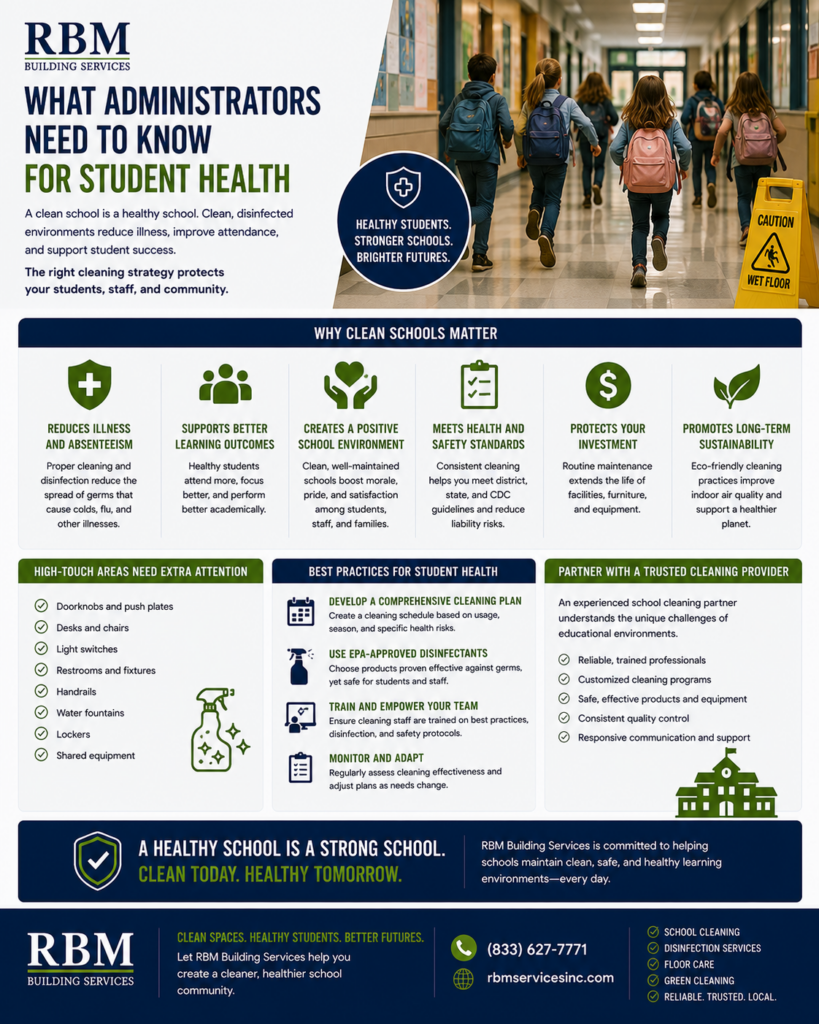
School cleaning protocols directly affect student health, attendance rates, and academic outcomes. Children spend 6-8 hours per day in school buildings, and the cleanliness of these environments has a measurable impact on their wellbeing. The CDC reports that K-12 students in the United States miss approximately 38 million school days each year due to illness, with respiratory infections and gastrointestinal illnesses being the most common causes. Proper cleaning and disinfection of school facilities can reduce absenteeism by 20-50%, according to multiple studies. For school administrators, facility managers, and board members, investing in professional school cleaning is one of the most effective strategies for improving student health and academic performance. This guide provides specific cleaning protocols for every area of a K-12 school facility.
The financial impact of student absenteeism on schools is substantial. In most states, school funding is tied to daily attendance — each absent student represents lost revenue for the district. A school district with 10,000 students and a 5% absentee rate loses 500 student-days of funding per day, which can amount to millions of dollars annually. Beyond the financial impact, high absenteeism rates affect school performance ratings, teacher evaluations, and community perception of school quality. Effective cleaning protocols that reduce illness transmission are one of the most cost-effective investments a school district can make. See our education cleaning services for more on K-12 cleaning programs.

School Cleaning Protocols for Student Health
Classrooms are the heart of the school and require daily cleaning and disinfection to maintain a healthy learning environment. CDC guidelines for classroom cleaning include daily cleaning and disinfection of all high-touch surfaces including desks, chairs, door handles, light switches, sink handles, pencil sharpeners, computer keyboards and mice, and shared supplies. Desks should be disinfected daily — preferably between class periods in secondary schools where students change classrooms — using an EPA-registered disinfectant appropriate for the surface. Chairs should be disinfected weekly or more frequently during cold and flu season. Floor cleaning in classrooms depends on the floor type — carpeted classrooms should be vacuumed daily with a HEPA-filtered vacuum, while hard-surface classrooms should be dust mopped daily and damp mopped weekly. All classrooms should receive a comprehensive cleaning during winter break and spring break, including cleaning of all surfaces, window washing, and deep cleaning of floors.
Special attention should be paid to early childhood and special education classrooms, where students are more likely to put hands and objects in their mouths and where bodily fluid incidents are more common. These classrooms require more frequent disinfection of surfaces, more frequent hand washing by staff and students, and more rigorous cleaning of shared toys and materials. Soft surfaces like carpets, rug mats, and upholstered furniture in early childhood classrooms should be cleaned and disinfected weekly, with spot cleaning performed immediately when soiling occurs. Sand and water tables, play kitchens, and other shared play areas should be cleaned and disinfected daily. The CDC provides specific guidance for cleaning and disinfection in early childhood education settings under the Caring for Our Children standards.
Classroom and Instructional Area Cleaning
School restrooms require the most intensive cleaning of any area in a school facility. They are high-traffic areas used by hundreds of students daily and are the primary location for transmission of gastrointestinal illnesses. School restrooms should be cleaned and disinfected daily, with high-touch surfaces (door handles, stall latches, faucet handles, toilet flush handles, paper towel dispensers, and soap dispensers) disinfected at least daily. During cold and flu season, restrooms should be checked and spot-cleaned between class periods. Toilets and urinals should be cleaned inside and out daily using an appropriate toilet bowl cleaner and disinfectant. Sinks and countertops should be cleaned and disinfected daily. Floors should be mopped daily with a disinfectant solution. All restroom surfaces should be thoroughly cleaned and disinfected during school breaks, including walls, partitions, and ceiling vents.
Ventilation in school restrooms is critical for preventing mold growth and controlling odors. Restroom exhaust fans should be inspected monthly and cleaned quarterly to ensure they are functioning properly. School restrooms should maintain negative air pressure relative to adjacent hallways to prevent odors from escaping into corridors. Hand soap dispensers and paper towel dispensers should be checked daily and refilled as needed — empty soap dispensers are one of the most common deficiencies found in school health inspections. Touchless fixtures (automatic faucets, flush valves, soap dispensers, and paper towel dispensers) are strongly recommended for school restrooms because they reduce the transmission of pathogens and reduce maintenance needs. Automatic flush valves and faucets should be tested weekly to ensure sensor operation and battery function.
Restroom Sanitation in Schools
School cafeterias and commercial kitchens operate under strict health code regulations that are enforced by local health departments. All food contact surfaces must be cleaned and sanitized after each use, with documented cleaning logs maintained per health department requirements. Cafeteria tables should be cleaned and sanitized between each lunch period — this is typically the responsibility of custodial staff, who must be trained on proper food contact surface sanitation procedures. Floors in cafeteria dining areas should be swept and spot mopped between lunch periods, with a complete damp mopping performed after the last lunch period each day. Kitchen floors should be scrubbed daily with a degreasing cleaner to remove accumulated grease and food debris. Walk-in coolers and freezers should be cleaned monthly, with spills cleaned immediately to prevent cross-contamination.
Health department inspections of school cafeterias are typically conducted 1-2 times per year, with unannounced inspections possible in response to complaints or outbreaks. Common violations in school cafeterias include improper food storage temperatures, inadequate hand washing facilities, dirty food contact surfaces, and pest infestations. Schools should maintain a cleaning log for all kitchen and cafeteria areas, documenting what was cleaned, when, and by whom. The cleaning log should be reviewed daily by the kitchen manager and weekly by the school administrator. Dishwashing equipment (commercial dishwashers) should be tested daily for proper sanitization temperature (at least 180°F for high-temperature dishwashers or proper chemical concentration for chemical sanitizing dishwashers). See our commercial cleaning services for school cafeteria cleaning programs.
Cafeteria and Kitchen Cleaning
Gyms, locker rooms, and athletic facilities present unique cleaning challenges in schools because of the combination of moisture, sweat, and high traffic. Locker rooms require daily cleaning and disinfection of all surfaces, including floors, benches, lockers, shower areas, and sinks. Shower areas are particularly prone to mold, mildew, and bacterial growth and should be cleaned daily with a disinfectant effective against Staphylococcus aureus (including MRSA, which is a known risk in athletic facilities). Floors in shower areas should be scrubbed weekly with a brush to remove biofilm and soap scum. Lockers should be cleaned and disinfected weekly during the school year and thoroughly during summer break. Gyms and fitness areas require daily sweeping or dust mopping of floors, with damp mopping performed weekly or more frequently during sports seasons. Gym mats should be cleaned and disinfected after each use using an EPA-registered disinfectant effective against skin pathogens.
School athletic facilities should have specific protocols for blood and bodily fluid cleanup that comply with OSHA bloodborne pathogen standards. All custodial staff who may respond to blood or bodily fluid incidents in athletic facilities must receive bloodborne pathogen training annually. Athletic trainers and coaches should also be trained on proper cleanup procedures. Schools should maintain bloodborne pathogen cleanup kits in athletic areas and should have a written exposure control plan. The CDC recommends that athletic facilities use disinfectants effective against bloodborne pathogens, hepatitis B virus, and HIV for all blood and bodily fluid cleanup. In addition to daily cleaning, school gyms and locker rooms should receive a comprehensive deep cleaning during summer break, including stripping and refinishing of gym floors, deep cleaning of lockers, and thorough cleaning of all shower and restroom areas.
Gym, Locker Room, and Athletic Facility Cleaning
Cold and flu season requires enhanced cleaning protocols in schools. During periods of high respiratory illness activity (typically October through March in most regions), schools should increase the frequency of high-touch surface disinfection from daily to twice daily (before school and after lunch, or between class periods where feasible). Hand sanitizer stations should be placed at all school entrances, cafeteria entrances, and classroom doors. The CDC recommends that schools stock adequate supplies of EPA-registered disinfectants, hand soap, paper towels, and tissues before cold and flu season begins. Schools should also develop communication protocols for notifying families about increased illness activity and for reinforcing hand hygiene and respiratory etiquette expectations.
During disease outbreaks (norovirus, influenza, COVID-19, or other communicable diseases), schools should implement outbreak-specific cleaning protocols that may include more frequent disinfection of all high-touch surfaces (every 2-4 hours), closure of certain areas for thorough cleaning and disinfection, use of electrostatic sprayers or foggers for rapid disinfection of large areas, and isolation and thorough cleaning of areas where ill individuals have been present. Schools should work with their local health department to determine appropriate cleaning protocols during an outbreak. After an outbreak has resolved, a comprehensive cleaning and disinfection of the entire facility should be performed before normal operations resume. The CDC provides specific outbreak cleaning guidance for schools on their website. For expert school cleaning services, see our education facility cleaning page.
Seasonal and Outbreak Cleaning Protocols
Building a comprehensive school cleaning program requires a systematic approach that addresses all areas of the facility, all types of surfaces, and all times of the school year. The program should be based on written cleaning protocols that specify cleaning frequencies, methods, products, and quality standards for each area. Cleaning staff should be trained on proper procedures, including safe chemical handling, correct use of cleaning equipment, and infection control principles. Training should be documented and refreshed annually, with additional training provided when new products or equipment are introduced. Schools should implement a quality assurance program that includes daily inspections of high-traffic areas, weekly inspections of all areas, and monthly comprehensive inspections. Inspection results should be documented and tracked to identify areas that need additional attention.
Green cleaning programs are increasingly popular in schools and are required by law in some states. The CDC supports green cleaning in schools when it is part of a comprehensive infection control program. Green cleaning in schools means using cleaning products that have been certified by a third-party program (such as Green Seal or EcoLogo) as meeting environmental and health standards. However, during cold and flu season or during disease outbreaks, schools should use EPA-registered disinfectants that may not have green certification, balancing infection control needs with environmental concerns. The key to an effective school cleaning program is consistency — cleaning must be performed according to the schedule every day, not just when there is time or when problems are visible. Consistent cleaning, combined with proper hand hygiene, is the most effective strategy for reducing illness transmission in schools and keeping students healthy and in class.
RBM Building Services has provided school cleaning services, commercial janitorial services, and window washing since 1974 across Utah, Arizona, Nevada, and Texas. We understand the unique requirements of K-12 school cleaning, from regulatory compliance to working around school schedules. Call 800.403.3564 or contact us for a customized school cleaning plan. Read more on our company blog.
School cleaning that protects student health
Building a School Cleaning Program
Building a comprehensive school cleaning program requires a systematic approach that addresses all areas of the facility, all types of surfaces, and all times of the school year. The program should be based on written cleaning protocols that specify cleaning frequencies, methods, products, and quality standards for each area. Cleaning staff should be trained on proper procedures, including safe chemical handling, correct use of cleaning equipment, and infection control principles. Training should be documented and refreshed annually, with additional training provided when new products or equipment are introduced. Schools should implement a quality assurance program that includes daily inspections of high-traffic areas, weekly inspections of all areas, and monthly comprehensive inspections. Inspection results should be documented and tracked to identify areas that need additional attention.
Green cleaning programs are increasingly popular in schools and are required by law in some states. The CDC supports green cleaning in schools when it is part of a comprehensive infection control program. Green cleaning in schools means using cleaning products that have been certified by a third-party program (such as Green Seal or EcoLogo) as meeting environmental and health standards. However, during cold and flu season or during disease outbreaks, schools should use EPA-registered disinfectants that may not have green certification, balancing infection control needs with environmental concerns. The key to an effective school cleaning program is consistency — cleaning must be performed according to the schedule every day, not just when there is time or when problems are visible. Consistent cleaning, combined with proper hand hygiene, is the most effective strategy for reducing illness transmission in schools and keeping students healthy and in class.
RBM Building Services has provided school cleaning services, commercial janitorial services, and window washing since 1974 across Utah, Arizona, Nevada, and Texas. We understand the unique requirements of K-12 school cleaning, from regulatory compliance to working around school schedules. Call 800.403.3564 or contact us for a customized school cleaning plan. Read more on our company blog.