Schools and universities need professional deep cleaning every 3-6 months for high-traffic areas and annually for lower-traffic spaces. Here is the complete frequency guide.
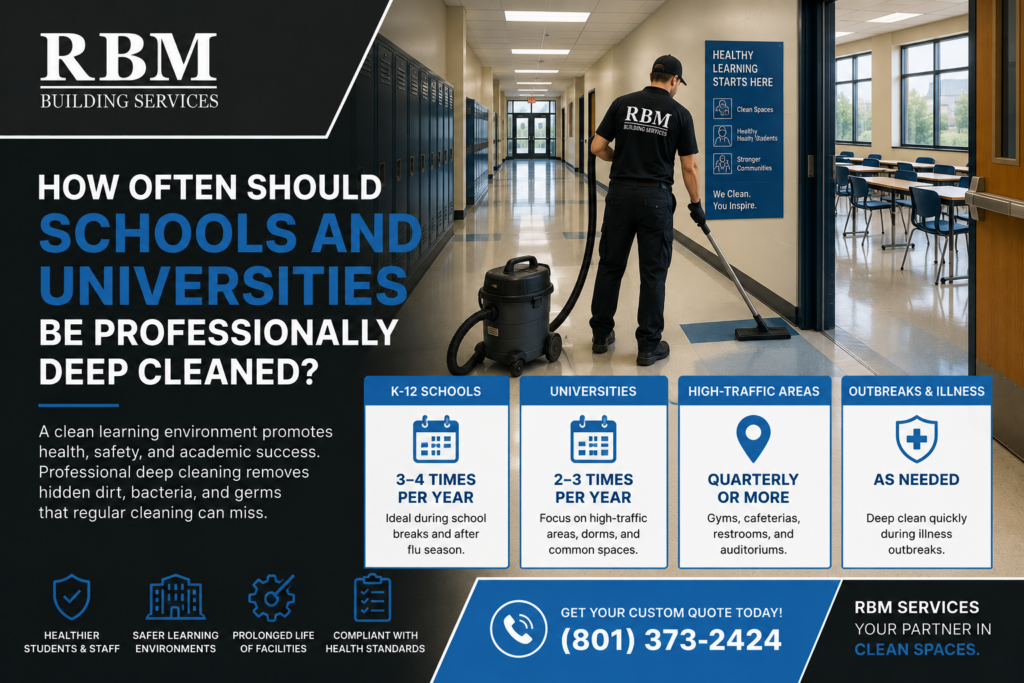
Schools and universities require professional deep cleaning on a more frequent schedule than standard commercial office buildings because the occupant density is higher, the range of activities is broader, and the population includes children and young adults who are more susceptible to illnesses. A typical K-12 school has 3-5 times more occupants per square foot than a commercial office building, and those occupants eat, drink, use art supplies, play sports, and engage in hands-on learning activities that generate significantly more soil and microbial contamination. A comprehensive deep cleaning program for educational facilities should address high-touch surfaces daily, high-traffic areas weekly, and provide zone-by-zone deep cleaning every 3-12 months depending on usage intensity.
The frequency of professional deep cleaning in schools is also driven by health and safety regulations. State and local health departments typically require specific cleaning and disinfection frequencies for K-12 schools, particularly in restrooms, cafeteria kitchens, and health clinic areas. Beyond regulatory requirements, school administrators must consider the impact of cleaning on student health outcomes — studies have shown that cleaner schools have lower absenteeism rates, better student performance, and higher staff satisfaction. For universities, the cleaning schedule must accommodate a 24/7 operating environment with residence halls, dining facilities, libraries, laboratories, and athletic facilities that all have completely different cleaning requirements.

Deep Cleaning Frequency by School Area
High-traffic academic areas — hallways, stairwells, main entrances, and common gathering spaces — need deep cleaning every 3-4 months. These areas accumulate the most soil from foot traffic, and they are also the most visible to visitors and parents. Hallways in a busy K-8 school with 600 students can see 10,000+ footsteps per day, tracking in dirt, moisture, and debris that settles into carpet and floor surfaces. Quarterly deep cleaning of these areas includes carpet extraction or hard floor deep scrubbing, wall spot cleaning, and thorough cleaning of lockers, drinking fountains, and handrailings.
Classrooms typically need deep cleaning twice per year — once during winter break and once during summer break. During the school year, nightly janitorial service handles surface cleaning, trash removal, and floor maintenance, but the accumulation of materials in a classroom — pencil shavings, dried glue, clay residue, food crumbs, markers, and general daily-use debris — requires a more thorough cleaning at regular intervals. Science labs, art rooms, and vocational-technical classrooms need more frequent deep cleaning (quarterly) due to the nature of materials used in those spaces.
Restrooms in schools require the most intensive cleaning of any area. High-use student restrooms should receive nightly cleaning with disinfectant, mid-day spot cleaning and restocking, and weekly deep cleaning including wall washing, partition cleaning, and grout scrubbing. Locker rooms and shower facilities need daily disinfecting with periodic deep cleaning monthly. Cafeteria and food service areas require daily deep cleaning that meets health department standards, including kitchen exhaust hood cleaning, grease trap maintenance, and floor scrubbing with degreaser.
Why Schools Need More Frequent Deep Cleaning Than Offices
Schools require more frequent deep cleaning than standard commercial offices for several distinct reasons that school facility managers must understand when planning their cleaning budgets. First, occupant density is dramatically higher. A typical elementary school classroom has 25-30 students in roughly 800 square feet, giving each student about 27 square feet. In contrast, a commercial office typically provides 150-250 square feet per employee. This 6-9x higher density means more soil generation per square foot, faster accumulation of dust and debris, and more frequent contact with surfaces.
Second, the occupant behavior profile is fundamentally different. Children eat snacks and lunches in classrooms, track in outdoor debris from playgrounds and sports fields, use art supplies that create unique messes, and have higher rates of communicable illness transmission than adult office workers. School restrooms experience far heavier use than commercial office restrooms, with peak usage concentrated into short periods between classes. The combination of higher density and more challenging soil types means that standard commercial cleaning frequencies are inadequate for educational environments.
Third, schools operate on a different calendar than commercial offices. While most offices maintain consistent occupancy year-round, schools have periods of intense occupancy (the school year) followed by extended breaks (summer, winter, spring). This creates natural windows for deep cleaning that should be leveraged for the most intensive cleaning activities. A well-planned school cleaning program takes advantage of these breaks for work that cannot be done during the school year — stripping and waxing floors, deep carpet extraction, wall washing, and thorough cleaning of every surface in the building.
Summer Break Deep Cleaning: The Annual Reset
Summer break is the most critical period for school deep cleaning. During the 8-10 week summer window, the cleaning team can perform intensive work that is impossible during the school year. This is when floors are stripped and rewaxed — hard floor maintenance that requires floors to remain untouched for 24-48 hours while finish cures. Carpet throughout the building should receive hot-water extraction cleaning, removing the deep-seated soil that accumulates during the school year. All walls and ceilings should be washed or vacuumed. Window cleaning, both interior and exterior, should be completed. Lockers should be emptied and thoroughly cleaned inside and out. Desk and chair cleaning or replacement happens during this window. Cafeteria kitchens receive their most intensive cleaning and equipment maintenance.
Winter break provides a mid-year deep cleaning opportunity that should focus on high-priority areas. The shorter 1-2 week window is ideal for deep cleaning restrooms, stripping and waxing entryway floors that get the most winter salt and moisture damage, spot-cleaning carpets in high-traffic areas that need attention before spring, and cleaning heating system components and air handling units. Spring break offers a third window for lighter deep cleaning — window washing, carpet spot cleaning, and exterior pressure washing of walkways and building entrances.
The key to successful school break cleaning is advance planning. The cleaning contractor should visit the school 4-6 weeks before the break to assess conditions, identify priority areas, and create a detailed work plan. A typical summer cleaning plan for a 100,000 sq ft K-8 school might require 600-1,000 person-hours of deep cleaning labor over the break, with crews working in zones to systematically cover every area of the building. Schools that fail to plan their break cleaning miss the opportunity to reset the building for the next academic year and accumulate soil that degrades surfaces faster.
COVID-Era Protocols and Ongoing Infection Prevention
While many schools have reduced COVID-19 specific protocols, the pandemic permanently raised the standard for cleaning and disinfection in educational facilities. High-touch surfaces — doorknobs, handrails, light switches, desk surfaces, shared equipment, restroom fixtures — should continue to be disinfected at least daily during the school year, with more frequent disinfection during cold and flu season. Electrostatic spray disinfection, which became popular during COVID-19, remains a valuable tool for school deep cleaning because it allows for rapid, complete coverage of large areas like auditoriums, gymnasiums, and cafeterias.
Hand hygiene stations should be maintained and restocked throughout the school year. Hand sanitizer dispensers at building entrances, cafeteria entrances, and in every classroom should be checked and refilled daily. Touchless fixtures — automatic faucets, soap dispensers, paper towel dispensers, and flush valves — reduce cross-contamination points and are worth the investment for school restrooms and kitchen areas. Air quality management has also become more important — HVAC filter replacement schedules should be maintained rigorously, and portable HEPA air purifiers in high-risk areas like health clinics and special education classrooms can provide additional protection.
School cleaning staff should maintain documentation of their cleaning and disinfection activities — what was cleaned, when, with what product, and by whom. This documentation is important for health department compliance, parent communications, and insurance purposes. Many schools now use cleaning management software that tracks cleaning activities and provides real-time visibility to administrators. The added focus on infection prevention in schools is not going away, and school facility managers should budget for the ongoing cost of enhanced cleaning protocols including higher-grade disinfectants, additional staffing for daytime cleaning, and periodic electrostatic disinfection services.
Carpet and Floor Maintenance in Educational Facilities
Carpet in schools requires particular attention because it represents a significant investment and directly affects indoor air quality. Schools typically have carpet in classrooms, libraries, administrative offices, and some hallway areas. Carpet in a typical classroom can trap 10-20 pounds of soil per 100 square feet per year. Without regular deep cleaning, this accumulated soil abrades carpet fibers, shortens carpet life, and releases particulates into the air that can trigger allergies and asthma in students. Professional carpet extraction cleaning every 6-12 months is essential for school environments, with high-traffic areas like hallways and entryways needing extraction every 3-6 months.
Hard floor maintenance in schools follows a different schedule than in commercial offices because of the intense traffic and abuse that school floors endure. VCT floors in school corridors typically need stripping and waxing annually during summer break, compared to every 12-18 months in commercial offices. Entryway floors may need stripping twice per year due to salt, sand, and moisture damage during winter months. Floor finish selection matters in schools — high-traffic, slip-resistant finishes with faster cure times are preferred because they allow floors to be returned to service sooner after maintenance. Many schools are transitioning from VCT to LVT (luxury vinyl tile) or polished concrete in new construction and renovation projects because these flooring types are more durable and require less intensive maintenance.
Gymnasium floor care is a specialized service that goes beyond standard floor maintenance. Gym floors (typically hardwood or synthetic sports flooring) require specific cleaning products and methods to maintain the playing surface and protect the finish line markings. Gym floor cleaning includes daily dust mopping, periodic damp mopping with appropriate cleaner, and annual screening and recoating. Deep scratches and wear patterns in high-traffic areas may require spot repairs between full refinishing cycles. Schools with synthetic turf fields also need specialized cleaning — turf requires periodic grooming, disinfecting, and debris removal that is completely different from building floor care. See our floor care page for more on school floor maintenance.
Restroom and Locker Room Deep Cleaning Standards
School restrooms and locker rooms require the highest cleaning standards of any area in an educational facility because of the health risks associated with inadequate cleaning. Student restrooms in K-12 schools should be cleaned and disinfected daily during the school year, with restroom attendants checking and spot-cleaning between class periods in high-use facilities. Nightly cleaning includes complete disinfection of all fixtures, mirror cleaning, partition and door cleaning, floor scrubbing and disinfection, and restocking of all supplies. Monthly deep cleaning adds wall washing, grout scrubbing, ceiling vent cleaning, and thorough cleaning of hard-to-reach areas.
Locker rooms and shower facilities require even more intensive protocols. Floors should be cleaned and disinfected daily with a cleaner that is effective against athlete’s foot fungus and other pathogens common in wet environments. Showers and shower curtains or partitions need daily disinfection with periodic deep cleaning for mold and mildew prevention. Lockers should be cleaned and disinfected during summer break, including interior surfaces. Bench seating, hair stations, and all horizontal surfaces should be disinfected daily. Proper ventilation and humidity control are essential for locker rooms to prevent mold growth between cleanings — schools with inadequate locker room ventilation often struggle with persistent mold issues that require professional remediation.
Many schools find that partnering with a professional cleaning company for restroom and locker room deep cleaning is more cost-effective than trying to manage it with in-house staff. Professional cleaning companies have the specialized equipment — tile and grout scrubbers, floor machines, electrostatic sprayers — and the trained staff to complete deep cleaning efficiently during school breaks. They also bring a fresh perspective and may identify cleaning issues that in-house staff have become accustomed to overlooking. See our education cleaning page for more on our services for K-12 and university facilities.
Keep your educational facility healthy and clean. Contact RBM for deep cleaning services.
Final Thoughts
School deep cleaning is not optional — it is a fundamental requirement for maintaining a healthy, safe, and effective learning environment. The frequency and intensity of cleaning should match the intensity of use for each area, with high-traffic zones receiving more frequent attention and break periods providing opportunities for comprehensive deep cleaning. A well-planned school cleaning program coordinated between in-house custodial staff and professional cleaning partners ensures that every area of the facility receives the appropriate level of care at the right time.
Since 1974, RBM Building Services has provided commercial janitorial services and educational facility cleaning for K-12 schools and universities across Utah, Arizona, Nevada, and Texas. We also offer floor care, carpet cleaning, and pressure washing for educational facilities. Call 800.403.3564 or contact us to discuss your school’s cleaning needs. For ongoing cleaning tips and education industry insights, follow our company blog.