Janitorial OSHA compliance covers safety regulations for cleaning operations including hazard communication, bloodborne pathogens, personal protective equipment, and injury prevention. This guide helps facility managers and cleaning professionals understand and implement OSHA requirements.
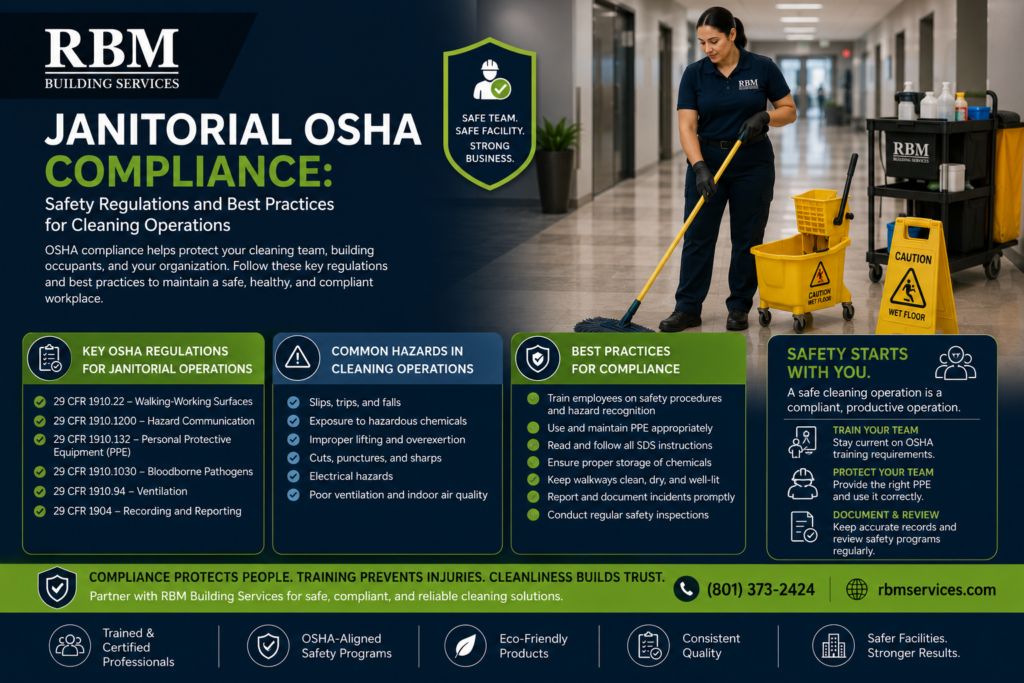
OSHA the Occupational Safety and Health Administration sets and enforces safety standards that apply to janitorial and cleaning operations in commercial facilities. Janitorial workers face a variety of occupational hazards including chemical exposure, slips and falls, ergonomic injuries, and potential exposure to bloodborne pathogens. OSHA standards require employers to implement comprehensive safety programs that protect cleaning workers from these hazards. Compliance with OSHA standards is not optional and failure to comply can result in citations, fines, and liability. Beyond regulatory compliance, effective safety programs reduce worker injuries, improve morale, and enhance productivity. Commercial cleaning and professional janitorial services should maintain OSHA compliance programs. See RBM Building Services for more.
OSHA compliance in janitorial operations protects workers and reduces liability for building owners and cleaning companies. Contact RBM Building Services or call 800.403.3564.

Janitorial OSHA Compliance: Complete Guide for Cleaning Operations
The Hazard Communication Standard is one of the most frequently cited OSHA standards in janitorial operations. The standard requires employers to inform workers about the hazardous chemicals they may encounter in the workplace. Employers must maintain Safety Data Sheets SDS for all cleaning chemicals used in the facility. SDS must be readily accessible to workers at all times. Chemical containers must be properly labeled with the chemical name and hazard warnings. Secondary containers such as spray bottles must be labeled if they are not used immediately by the person who filled them. Employers must provide hazard communication training to workers that covers how to read SDS, how to interpret labels, and how to recognize the hazards of chemicals used. A written hazard communication program must be developed and maintained. Commercial cleaning providers maintain hazard communication programs. Contact RBM or call 800.403.3564.
OSHA Hazard Communication Standard for Janitorial Operations
The Bloodborne Pathogens Standard applies when janitorial workers have occupational exposure to blood or other potentially infectious materials. Cleaning workers who clean restrooms, handle waste, or clean up after accidents may have exposure risk. Employers must develop a written exposure control plan that identifies jobs and tasks with exposure risk, specifies engineering and work practice controls, and describes post-exposure procedures. Engineering controls include sharps disposal containers in restrooms and puncture-resistant waste containers. Work practice controls include proper waste handling procedures and prohibition of hand-to-mouth contact. Employers must offer hepatitis B vaccination at no cost to workers with exposure risk. Personal protective equipment must be provided including gloves, protective clothing, and face protection. Workers must receive bloodborne pathogens training annually. Post-exposure evaluation and follow-up must be provided if an exposure incident occurs. Janitorial services should maintain bloodborne pathogens compliance. Contact RBM Building Services or call 800.403.3564.
Bloodborne Pathogens Standard for Cleaning Staff
Personal protective equipment PPE requirements for janitorial workers depend on the specific tasks being performed and the hazards involved. Employers must conduct a PPE assessment to identify hazards and select appropriate PPE. Gloves are the most common PPE in janitorial operations. Chemical-resistant gloves must be used when handling cleaning chemicals. Utility gloves should be used for tasks with puncture risk. Disposable gloves should be used for tasks with potential exposure to blood or body fluids. Eye protection including safety glasses or goggles must be used when there is risk of chemical splashes. Protective footwear should be used in wet conditions to prevent slips and to protect feet from falling objects. Respiratory protection may be required when using certain chemicals or working in confined spaces. Workers must be trained in proper use, care, and limitations of PPE. Commercial cleaning providers ensure proper PPE use. Contact RBM or call 800.403.3564.
Personal Protective Equipment and Safety Protocols
Chemical safety is fundamental to janitorial OSHA compliance. Cleaning chemicals must be used and stored according to manufacturer instructions and safety data sheets. Chemicals should never be mixed unless specifically instructed by the manufacturer. Mixing certain chemicals can create toxic gases or cause violent reactions. Chemical concentrates should be diluted in properly labeled containers using appropriate measuring devices. Chemical storage areas should be well-ventilated, secure, and separate from food and personal items. Incompatible chemicals should be stored separately. Flammable chemicals should be stored in approved flammable storage cabinets. Spill response supplies should be maintained in chemical storage and use areas. Workers must be trained in spill response procedures including containment, cleanup, and disposal. Emergency eyewash stations should be accessible in areas where chemicals are handled. Janitorial services implement chemical safety programs. Contact RBM Building Services or call 800.403.3564.
Chemical Safety and Handling Procedures
Injury prevention in janitorial operations requires attention to ergonomic hazards and slip, trip, and fall risks. Ergonomic injuries are among the most common injuries in janitorial work, resulting from repetitive motions, awkward postures, and heavy lifting. Ergonomic controls include using mops with lightweight handles, using long-handled dusters and extension poles, and using carts to transport supplies and equipment. Proper lifting techniques should be taught and enforced. Slips, trips, and falls are the second most common category of janitorial injuries. Wet floor signs must be used when mopping or when floors are wet. Workers should wear slip-resistant footwear and non-slip mats should be used in wet areas. Spills should be cleaned up immediately. Cords and equipment should be routed to avoid creating trip hazards. Commercial cleaning providers implement injury prevention programs. Contact RBM or call 800.403.3564.
Injury Prevention and Ergonomics
OSHA recordkeeping and training requirements apply to janitorial operations. Employers with more than ten employees must maintain OSHA injury and illness records using OSHA Forms 300 300A and 301. Records must be maintained for five years and posted annually. Injuries and illnesses must be recorded if they result in medical treatment beyond first aid, days away from work, restricted work activity, or loss of consciousness. Training requirements under various OSHA standards include hazard communication training initially and when new hazards are introduced, bloodborne pathogens training annually, PPE training initially and when new PPE is introduced, and hazard communication training initially and when new hazards are introduced. Training must be documented with dates, content, and attendee signatures. RBM Building Services has provided commercial cleaning and janitorial services with comprehensive safety programs since 1974. Contact us or call 800.403.3564. Read more on our company blog.
janitorial OSHA compliance safety regulations cleaning operations hazard communication bloodborne pathogens PPE
OSHA Recordkeeping and Training Requirements
OSHA compliance in janitorial operations protects workers from chemical exposure, ergonomic injuries, slips and falls, and other occupational hazards. A comprehensive safety program that addresses hazard communication, bloodborne pathogens, PPE, chemical safety, ergonomics, and training can prevent injuries and ensure compliance. RBM Building Services has provided commercial cleaning and janitorial services with comprehensive OSHA compliance programs since 1974. Contact us or call 800.403.3564. Read more on our company blog.