Warehouse cleaning safety is regulated by OSHA under 29 CFR 1910, covering aisle marking, spill cleanup, dust control, fire safety, and housekeeping standards. Non-compliance can result in fines of $15,625-$156,259 per violation.
OSHA safety standards for warehouse cleaning and housekeeping are among the most frequently cited regulations in warehousing and distribution operations. OSHA 29 CFR 1910.22 (Walking-Working Surfaces), 1910.141 (Sanitation), 1910.176 (Handling Materials), 1910.157 (Portable Fire Extinguishers), and the General Duty Clause collectively establish cleaning and housekeeping requirements that every warehouse manager, distribution center manager, and facility manager must understand and implement. Violations of these standards are costly: OSHA penalties in 2026 range from $15,625 per serious violation to $156,259 per willful or repeat violation.
This guide covers the key OSHA safety standards and cleaning requirements for warehouses and distribution centers, including aisle marking and clearance, spill cleanup, hazardous material management, combustible dust control, fire safety, emergency exit access, floor cleaning, slip prevention, and how to create a comprehensive warehouse cleaning and safety program that keeps your facility compliant and your workers safe.

OSHA Housekeeping Requirements for Warehouses and Distribution Centers
OSHA 29 CFR 1910.22 requires that all places of employment, including warehouses and distribution centers, be kept clean and orderly and free from hazards. This is the foundational housekeeping standard and the most frequently cited OSHA violation in warehousing. The standard requires that work areas be kept clean and free of debris, with no accumulation of waste materials that could create fire, tripping, or pest hazards. Floors must be maintained in a clean and dry condition as much as possible, with drainage provided where wet processes are used. Aisles, passageways, and walkways must be kept clear of obstructions, stored materials, and equipment that could impede movement or create tripping hazards.
Specific OSHA requirements for warehouse housekeeping include regular sweeping and cleaning of all work areas to prevent dust and debris accumulation, prompt removal of trash and waste materials from work areas to designated receptacles, cleaning of spills immediately using appropriate spill cleanup procedures, maintenance of drainage systems in areas where wet cleaning is used, and regular cleaning of break rooms, restrooms, and locker rooms. OSHA also requires that waste receptacles be maintained in good condition, covered when containing combustible materials, and emptied at least daily. A clean warehouse is not just about appearance — it is directly required by federal safety regulations. For professional warehouse cleaning support, see our commercial janitorial services.
Aisle Marking and Clearance Requirements
OSHA 29 CFR 1910.176 specifies requirements for handling materials in warehouses, including strict standards for aisle marking and clearance. Permanent aisles and passageways must be clearly marked and maintained at adequate widths for the equipment and traffic they serve. In practice, OSHA requires that aisles be at least 3 feet wider than the largest equipment that uses them, and typical warehouse aisles are 8-12 feet wide for forklift traffic. Aisle markings must be maintained and clearly visible — typically using painted lines or tape that is regularly inspected and replaced when worn.
Aisle clearance requirements mandate that no materials, equipment, or debris be stored in or obstruct marked aisles. This includes blocking aisles with pallets, empty pallets, trash, packing materials, cleaning equipment, or maintenance tools. Aisle obstructions are one of the most commonly cited OSHA violations in warehouses, and the fines add up quickly. Cleaning crews working in warehouses must be trained to never block aisles with cleaning equipment or waste containers, to always return cleaning equipment to designated storage areas after use, and to report any aisle obstructions they find during their cleaning rounds.
Spill Cleanup and Hazardous Material Management
OSHA 29 CFR 1910.1200 (Hazard Communication) and 1910.120 (Hazardous Waste Operations) require specific procedures for cleaning up spills of hazardous materials in warehouses. Any warehouse that stores, handles, or distributes chemicals, cleaning products, batteries, oils, or other hazardous materials must have a written spill cleanup plan, spill cleanup kits readily available in areas where spills could occur, and employees trained in spill response procedures. The spill cleanup plan must specify the types of spills that could occur, the appropriate cleanup procedures for each, the location of spill cleanup supplies, and the chain of communication for reporting spills.
Spill cleanup requirements under OSHA include immediate containment of the spill to prevent it from spreading, using appropriate absorbent materials (not general-purpose cleaning supplies), proper disposal of contaminated absorbent materials in accordance with EPA and state regulations, and documentation of the spill including date, time, material, volume, cleanup actions taken, and disposal method. Spill cleanup supplies must be maintained and replaced after each use. Cleaning crews in warehouses must be trained on the specific spill cleanup procedures applicable to their work areas, including knowing where spill kits are located, how to use them, and whom to contact for assistance with hazardous material spills.
Dust Control and Combustible Dust Hazards
Combustible dust is one of the most dangerous and least understood hazards in warehouses and distribution centers. OSHA and the NFPA define combustible dust as any finely divided solid material that can present a flash fire or explosion hazard when suspended in air. In warehouses, common sources include grain dust, flour, sugar, powdered chemicals, wood dust, paper dust, and — most commonly — the general accumulation of fine dust on overhead surfaces including pipes, beams, ductwork, lighting fixtures, and ceiling structures. The OSHA Combustible Dust National Emphasis Program (NEP) targets facilities that handle combustible dust and has resulted in millions of dollars in penalties for non-compliant facilities.
Combustible dust control requires that dust accumulation on overhead surfaces not exceed 1/32 of an inch (approximately the thickness of a paperclip) over any surface area of at least 5% of the floor area. This is a strict standard that requires regular overhead cleaning using appropriate methods (HEPA vacuuming, not sweeping or blowing dust with compressed air). Housekeeping programs for combustible dust must include regular inspections and cleaning of overhead surfaces, use of dust-control measures in areas where dust is generated, proper ventilation and dust collection systems, and cleaning methods that minimize dust suspension in the air. Warehouse cleaning crews must be specifically trained on combustible dust hazards and proper cleaning methods — using the wrong cleaning method in a combustible dust environment can cause a catastrophic explosion.
Fire Safety and Emergency Exit Requirements
OSHA 29 CFR 1910.36 and 1910.37 establish requirements for exit routes and emergency access in all workplaces, including warehouses. These standards require that exit routes be kept free of obstructions and available for immediate use at all times, that exit doors be clearly marked with illuminated exit signs, that exit routes be at least 28 inches wide at all points, and that the path to exits be clearly marked and unobstructed. Warehouse cleaning is directly affected by these requirements — cleaning crews must ensure that exit routes, fire extinguisher access, and fire alarm pull stations are never blocked by stored materials, cleaning equipment, or waste containers.
Fire safety in warehouses also requires that flammable and combustible materials be stored in approved containers and cabinets, that storage be at least 18 inches below sprinkler heads (no ceiling-high storage in fire-sprinklered buildings), that trash and waste be removed from the facility daily, and that cleaning supplies be stored in designated areas away from ignition sources. Cleaning crews in warehouses should be trained to identify and report fire hazards including overloaded electrical outlets, damaged extension cords, improperly stored flammables, blocked fire extinguishers, and obstructed exit routes. For comprehensive cleaning programs that address these safety requirements, see our building maintenance services.
Floor Cleaning and Slip Prevention Standards
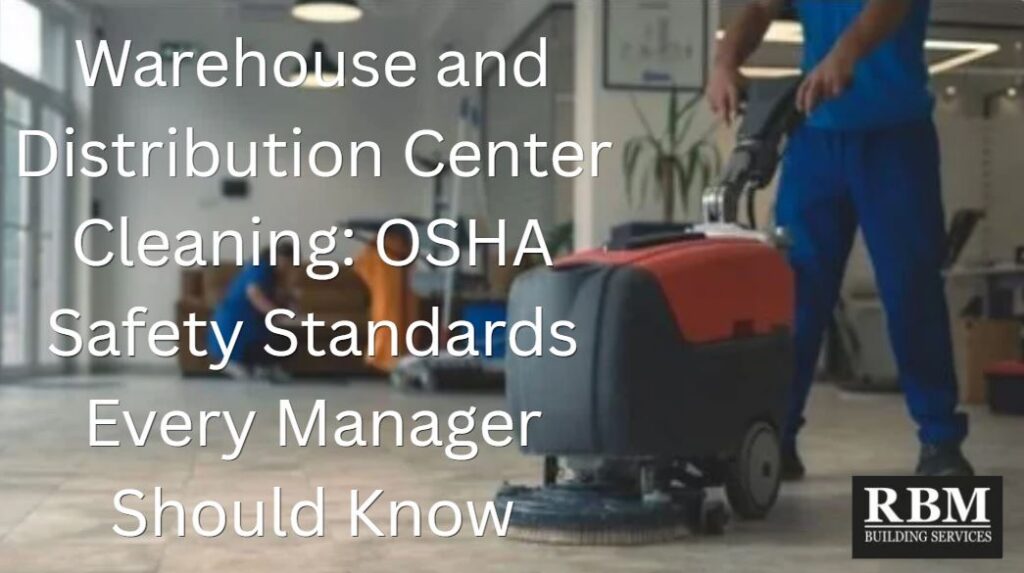
Slip, trip, and fall hazards are the most common cause of workplace injuries in warehouses, accounting for 25-30% of all warehouse injuries annually according to the Bureau of Labor Statistics. OSHA requires that floors be maintained in a clean and dry condition as much as possible, and that measures be taken to address slip hazards including proper floor cleaning and drying procedures, use of slip-resistant flooring materials in areas prone to wet conditions, and prompt cleanup of spills and leaks. Floor cleaning in warehouses presents special challenges because of the large areas involved, the presence of heavy equipment and palletized storage, and the need to maintain operations during cleaning.
A warehouse floor cleaning program should include daily sweeping and spot cleaning of high-traffic areas, weekly machine scrubbing of traffic aisles and loading docks, monthly deep cleaning of the entire facility including dock areas and storage zones, and immediate response to spills and leaks. Floor cleaning should be scheduled to minimize disruption to operations, typically during off-hours or during shifts with minimal traffic. Cleaning methods must be appropriate for the floor surface — concrete floors require different cleaning protocols than sealed or coated floors. Slip-resistant cleaning methods and drying procedures must be used, and warning signs must be posted in areas being cleaned or still wet. See our pressure washing and floor care services for warehouse cleaning solutions.
RBM Building Services has provided commercial janitorial services, building maintenance, pressure washing, and window washing for warehouses and distribution centers since 1974, serving Utah, Arizona, Nevada, and Texas. Our warehouse cleaning programs are designed to meet OSHA safety standards and keep your facility compliant. Call 800.403.3564 or contact us to discuss your warehouse cleaning needs. Read more on our company blog.
Stay compliant with professional warehouse cleaning. Contact RBM.