Medical grade disinfection services for commercial and public facilities use hospital-level cleaning standards to eliminate pathogens. This guide covers disinfection technologies, EPA-registered products, infection prevention protocols, and implementation strategies for non-healthcare facilities.
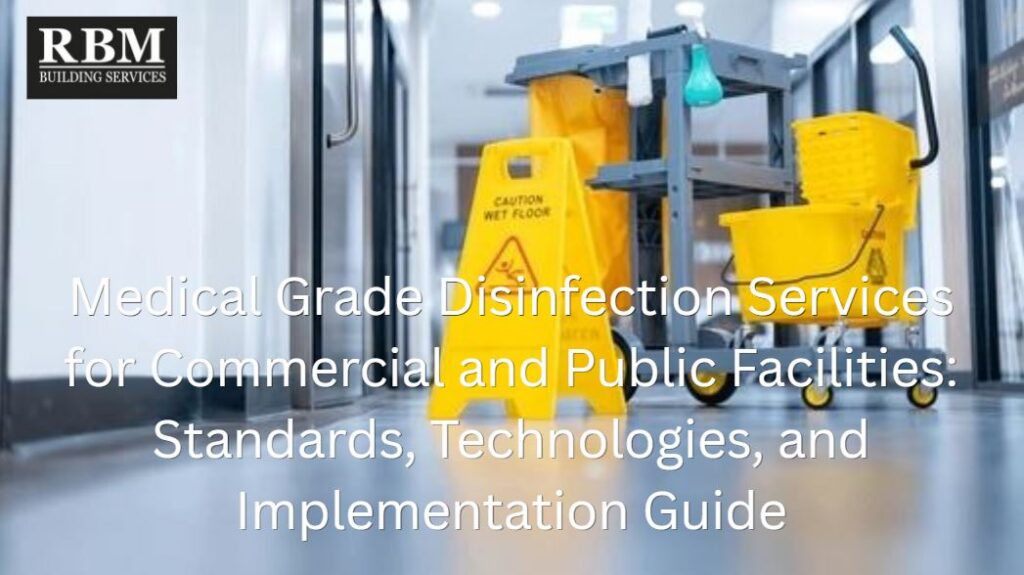
Medical grade disinfection refers to cleaning protocols and products that meet the standards used in healthcare facilities for eliminating pathogens from surfaces and environments. While standard commercial cleaning focuses on removing soil and reducing visible dirt, medical grade disinfection is a systematic approach to eliminating disease-causing microorganisms including bacteria, viruses, and fungi. The demand for medical grade disinfection in non-healthcare facilities has grown significantly as businesses, schools, and public facilities seek to protect occupants from infectious diseases. Medical grade disinfection is appropriate for facilities where vulnerable populations are present, where disease transmission risk is elevated, or where occupants demand the highest level of hygiene protection. Understanding the standards, technologies, and protocols for medical grade disinfection helps facility managers make informed decisions about their cleaning programs. Commercial cleaning and professional janitorial services can incorporate medical grade disinfection protocols. See RBM Building Services for more.
Medical grade disinfection brings hospital-level cleaning standards to commercial facilities. Contact RBM Building Services or call 800.403.3564.

What Is Medical Grade Disinfection?
Several disinfection technologies are available for medical grade cleaning programs. The selection of disinfection technology depends on the facility type, surfaces to be treated, pathogens of concern, and budget. Chemical disinfection using EPA-registered disinfectants is the most common approach and is effective when proper contact times are observed. Quaternary ammonium compounds are widely used for general disinfection. Hydrogen peroxide-based disinfectants offer broad-spectrum efficacy with better environmental profile. Electrostatic spray disinfection uses charged particles that wrap around surfaces for complete coverage and is efficient for large areas. UV-C light disinfection uses ultraviolet light to destroy microorganisms and is effective for air and surface disinfection but requires line-of-sight exposure. Vaporized hydrogen peroxide disinfection fills a space with hydrogen peroxide vapor that reaches all surfaces and is used for room-level disinfection. Each technology has specific applications, advantages, and limitations. Commercial cleaning providers can recommend appropriate disinfection technologies. Contact RBM or call 800.403.3564.
Disinfection Technologies and Methods
EPA-registered disinfectants are categorized by their efficacy against specific microorganisms. Disinfectant labels indicate the pathogens that the product kills and the contact time required. The contact time is the amount of time the surface must remain wet with the disinfectant to achieve the claimed level of disinfection. Facility managers and cleaning professionals must understand that disinfectants are not effective unless the proper contact time is observed. Disinfectants are categorized as limited, general, or hospital grade based on their efficacy. Hospital-grade disinfectants are effective against the broadest range of pathogens and are recommended for medical grade disinfection programs. Disinfectants must be used at the correct dilution because concentrations that are too low will not achieve disinfection and concentrations that are too high may create safety hazards or damage surfaces. Janitorial services using medical grade disinfection must follow EPA label requirements. Contact RBM Building Services or call 800.403.3564.
EPA-Registered Disinfectants and Contact Times
Medical grade disinfection is appropriate for a wide range of facility types beyond healthcare. Schools and educational facilities benefit from medical grade disinfection because children are vulnerable to infectious diseases and transmission rates are high in school environments. Senior living facilities require medical grade disinfection because older adults are at increased risk of severe outcomes from infections. Fitness centers and health clubs benefit from medical grade disinfection because of shared equipment and warm, moist environments. Daycare centers require high-level disinfection to protect young children. Food processing and preparation facilities may require medical grade disinfection to prevent foodborne illness outbreaks. Office buildings may choose medical grade disinfection to reduce employee illness and absenteeism. Each facility type has specific disinfection needs that should be addressed in the disinfection protocol. Commercial cleaning providers can develop facility-specific disinfection protocols. Contact RBM or call 800.403.3564.
Facility Types That Benefit from Medical Grade Disinfection
Developing a medical grade disinfection protocol requires a systematic approach based on facility assessment, risk evaluation, and product selection. The first step is conducting a facility assessment to identify the types of surfaces present, the traffic patterns, and the activities that occur in each area. The second step is evaluating infection risk based on the vulnerability of the population using the facility and the types of activities that occur. The third step is selecting disinfectants and technologies appropriate for the facility based on the surfaces, pathogens of concern, and budget. The fourth step is establishing cleaning frequencies for each area based on traffic, risk, and usage patterns. The fifth step is training staff on proper disinfection procedures including product use, contact time, and safety. The sixth step is implementing verification methods to confirm that disinfection is effective. Janitorial services can implement comprehensive disinfection protocols. Contact RBM Building Services or call 800.403.3564.
Developing a Disinfection Protocol for Your Facility
Verification of disinfection effectiveness is essential for medical grade disinfection programs. Visual inspection alone is not sufficient to confirm that disinfection has been achieved. Several verification methods are available. ATP bioluminescence testing measures adenosine triphosphate on surfaces indicating the presence of organic material and microbial contamination. Fluorescent marking systems use UV-visible markers applied before cleaning that are inspected after cleaning to verify that surfaces have been contacted. Microbiological testing involves culturing surface samples to verify that pathogens have been eliminated. Each verification method has specific applications and limitations and facilities should select methods appropriate for their needs. Verification results should be documented and reviewed regularly to identify areas where cleaning procedures need improvement. Commercial cleaning providers can implement disinfection verification programs. Contact RBM or call 800.403.3564.
Verification and Validation of Disinfection
Implementing a medical grade disinfection program requires commitment from facility management and the cleaning provider. The program must be documented in writing and include policies, procedures, product specifications, and training requirements. Staff must be trained in proper disinfection techniques and their training documented. Cleaning and disinfection activities must be documented and records maintained. The program should be reviewed regularly and updated based on new products, technologies, or regulatory requirements. RBM Building Services has provided commercial cleaning and janitorial services including medical grade disinfection since 1974. Contact us or call 800.403.3564. Read more on our company blog.
medical grade disinfection services commercial public facilities hospital-level cleaning infection prevention
Implementing a Medical Grade Disinfection Program
Medical grade disinfection services bring hospital-level cleaning standards to commercial and public facilities. From schools to senior living centers, fitness clubs to food processing plants, medical grade disinfection protects occupants and reduces disease transmission. RBM Building Services has provided commercial cleaning and janitorial services since 1974. Contact us or call 800.403.3564. Read more on our company blog.