Urgent care and hospital cleaning follow different infection control standards based on patient populations and procedures performed. Urgent care requires outpatient-level disinfection, while hospitals need surgical-grade protocols. This guide compares cleaning requirements across both settings.
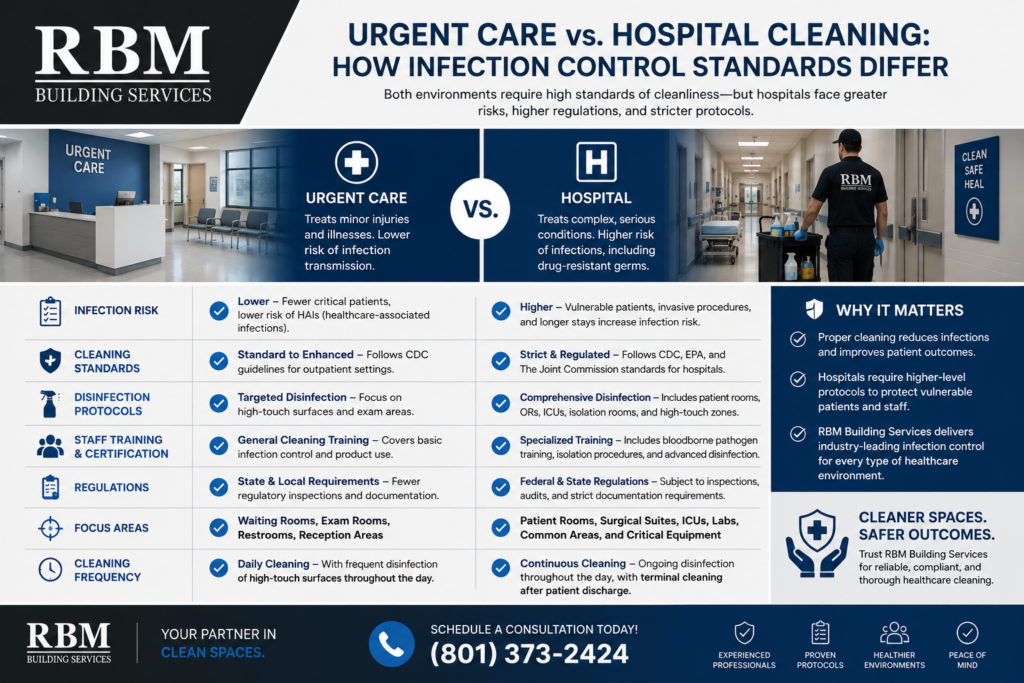
Urgent care centers and hospitals both require professional medical-grade cleaning, but the standards, protocols, and regulatory requirements differ significantly between these two healthcare settings. Understanding these differences is essential for healthcare administrators, facility managers, and cleaning contractors who serve medical facilities. Hospitals operate under the most stringent cleaning standards in any industry — they must meet Joint Commission requirements, CMS conditions of participation, state health department regulations, and OSHA bloodborne pathogen standards. Urgent care centers, while still regulated, operate under less intensive requirements because they do not perform surgery, do not admit patients overnight, and generally treat lower-acuity conditions. This guide provides a detailed comparison of cleaning standards for both settings.
The financial stakes for healthcare cleaning are substantial. Healthcare-associated infections (HAIs) affect approximately 1 in 31 hospitalized patients on any given day, according to the CDC. The cost of treating a single HAI ranges from $10,000 to $40,000 per patient, and hospitals with high HAI rates face reduced Medicare reimbursement under the Hospital-Acquired Condition Reduction Program. For urgent care centers, the stakes are lower but still significant — a single infection outbreak linked to poor cleaning can destroy a center’s reputation and lead to license suspension. The cleaning program is a critical component of infection prevention in both settings. See our medical facility cleaning services for healthcare cleaning programs.

Urgent Care vs. Hospital Cleaning Standards
Healthcare facilities in the United States follow a risk-based classification system that determines cleaning and disinfection requirements. The CDC and the Healthcare Infection Control Practices Advisory Committee (HICPAC) classify patient care areas into three categories based on the risk of infection transmission. Critical areas are operating rooms, sterile processing departments, and other areas where invasive procedures are performed. These require the highest level of cleaning and disinfection, including terminal cleaning between each surgical case and environmental monitoring to verify cleaning effectiveness. Semi-critical areas include patient rooms, examination rooms, and treatment areas where non-invasive procedures are performed. These require daily cleaning and disinfection with an EPA-registered hospital disinfectant, with terminal cleaning performed at patient discharge. Non-critical areas include waiting rooms, offices, and corridors. These require standard commercial cleaning with intermediate-level disinfection of high-touch surfaces.
The primary difference between hospital and urgent care cleaning stems from the patient population and procedures performed. Hospitals treat immunocompromised patients, perform surgeries, and admit patients for extended stays — all factors that increase infection risk and require higher cleaning standards. Urgent care centers treat generally healthy patients with acute minor conditions, do not perform surgery, and have short patient visits. This means urgent care centers can use standard healthcare cleaning protocols without the additional requirements that hospitals face for operating rooms, isolation rooms, and inpatient units. However, urgent care centers still must maintain proper infection control practices because they treat patients with contagious illnesses and perform minor procedures like wound care and suture removal.
Understanding Healthcare Cleaning Classifications
Hospital cleaning is governed by multiple regulatory and accrediting bodies that set specific standards for cleaning frequency, methods, and verification. The Joint Commission requires hospitals to have a written infection prevention and control plan that includes cleaning and disinfection protocols, to conduct regular environmental rounds to assess cleanliness, and to monitor cleaning effectiveness using methods such as ATP bioluminescence testing, fluorescent marker audits, or microbiological sampling. The CDC’s Guidelines for Environmental Infection Control in Health-Care Facilities provide detailed recommendations for cleaning and disinfection of all areas in healthcare settings. CMS requires hospitals to maintain a clean and sanitary environment as a condition of Medicare participation, and state health departments typically conduct annual surveys that include environmental inspection.
Inpatient room cleaning follows a strict protocol that differs significantly from outpatient cleaning. Daily cleaning of hospital patient rooms includes cleaning and disinfection of all high-touch surfaces (bed rails, call buttons, bedside tables, light switches, door handles, bathroom surfaces, IV poles, and pump controls), damp mopping of floors with a hospital-grade disinfectant, cleaning and disinfection of bathroom surfaces, and restocking of soap, towels, and other supplies. Terminal cleaning at patient discharge includes all daily cleaning tasks plus thorough cleaning of all surfaces including walls, window sills, and blinds, stripping and making the bed with clean linens (following proper linen handling protocols to prevent contamination), and cleaning and disinfecting the mattress and pillow protectors. Isolation room cleaning requires additional precautions, including use of personal protective equipment per the isolation category and specific disinfection protocols for the pathogen involved. For expert hospital cleaning, see our medical cleaning services.
Hospital Cleaning: Surgical and Inpatient Standards
Urgent care centers follow similar but less intensive cleaning protocols than hospitals. The CDC classifies urgent care centers as outpatient care settings, which face lower cleaning standards than hospitals because the patient population is generally healthier and procedures are less invasive. Daily cleaning of urgent care facilities includes cleaning and disinfection of all examination rooms between each patient — this includes the exam table, countertops, sinks, and any equipment used during the patient visit. Examination tables should be wiped down with a hospital-grade disinfectant between each patient, and any surface that was touched during the patient encounter should be disinfected. Treatment rooms in urgent care centers (where sutures, wound care, and casting are performed) require more thorough cleaning similar to hospital outpatient treatment areas, including cleaning of all surfaces and proper disposal of medical waste.
Waiting rooms in urgent care centers present a specific infection control challenge because patients with contagious respiratory illnesses often share waiting space with other patients. Many urgent care centers now implement enhanced cleaning protocols during cold and flu season, including more frequent disinfection of waiting room surfaces, hourly disinfection of high-touch surfaces (chairs, tables, door handles, check-in counters, and pens), and provision of hand sanitizer at the entrance and throughout the waiting area. Some urgent care centers have separate waiting areas for patients with respiratory symptoms. Urgent care centers should also have protocols for cleaning and disinfecting rooms after patients with known contagious illnesses (influenza, COVID-19, norovirus, etc.), including appropriate dwell time for disinfectants and air exchange requirements before the next patient can use the room.
Urgent Care Cleaning: Outpatient Standards
Waiting rooms and common areas in healthcare facilities require different cleaning approaches based on the patient population. Hospital waiting rooms (emergency department, outpatient clinics, surgery waiting areas) may contain patients with a wide range of conditions, including immunocompromised individuals. These waiting areas should be cleaned and disinfected at least daily, with high-touch surfaces cleaned multiple times per day. Emergency department waiting rooms require the most frequent cleaning — they are high-traffic areas where patients with undifferentiated illness may wait for extended periods. ED waiting rooms should have high-touch surfaces disinfected at least every 1-2 hours, with spot cleaning performed as needed between disinfections. Hospital common areas include cafeterias, gift shops, chapel, and public restrooms — these should be cleaned to healthcare facility standards, with public restrooms checked and cleaned at least every 2-4 hours.
Urgent care waiting rooms typically have a shorter wait time and a healthier patient population than hospital emergency departments. However, urgent care waiting rooms still require regular cleaning and disinfection because patients with contagious illnesses are present. High-touch surfaces in urgent care waiting rooms should be disinfected at least every 2-4 hours during operating hours, with more frequent cleaning during peak times and cold and flu season. Children’s play areas in urgent care waiting rooms require special attention — toys and surfaces in children’s areas should be cleaned and disinfected daily, with more frequent cleaning during known outbreaks. Children’s waiting areas should use only toys that can be easily cleaned and disinfected (avoiding plush toys and other items that cannot be effectively disinfected). See our company blog for more healthcare cleaning tips.
Common Area and Waiting Room Cleaning
OSHA regulations apply to both hospitals and urgent care centers and establish minimum standards for protecting healthcare workers from occupational exposure to bloodborne pathogens and other infectious materials. The OSHA Bloodborne Pathogens Standard (29 CFR 1910.1030) requires healthcare facilities to have a written exposure control plan, provide hepatitis B vaccination to at-risk employees, use engineering controls (sharps containers, needleless systems) and work practice controls to minimize exposure, provide appropriate personal protective equipment, and provide annual training to employees. The standard also specifies requirements for cleaning and decontamination of surfaces and equipment, including proper handling and disposal of regulated medical waste. Healthcare facilities must maintain a sharps injury log and record all occupational exposure incidents.
EPA regulations govern the use of disinfectants in healthcare settings. All disinfectants used in healthcare facilities must be EPA-registered and used according to label instructions, including proper dilution, contact time, and personal protective equipment requirements. Hospital-grade disinfectants are categorized as low-level, intermediate-level, or high-level disinfectants based on their efficacy against microorganisms. Low-level disinfectants (quaternary ammonium compounds) are suitable for routine cleaning of non-critical surfaces. Intermediate-level disinfectants (phenolic compounds, some quaternary ammonium compounds with enhanced efficacy, or EPA-registered disinfectants labeled as tuberculocidal) are required for surfaces that may be contaminated with blood or body fluids. High-level disinfectants (glutaraldehyde, peracetic acid, hydrogen peroxide) are required for semi-critical medical devices and are not typically used for environmental surface cleaning in urgent care or hospital settings.
OSHA and Regulatory Compliance
Choosing the right cleaning partner for a healthcare facility requires careful evaluation of the cleaning contractor’s capabilities, training, and experience. Healthcare cleaning is a specialized field that requires knowledge of infection control principles, regulatory requirements, and proper use of healthcare-grade cleaning and disinfection products. A qualified healthcare cleaning contractor should have a comprehensive training program for all cleaning staff that covers infection control principles, proper cleaning and disinfection procedures for different areas of the facility, proper use and dilution of hospital-grade disinfectants, proper use of personal protective equipment and safe chemical handling, bloodborne pathogen training (required by OSHA), and proper handling and disposal of medical waste. The contractor should also have procedures for monitoring cleaning effectiveness, including the use of objective cleaning verification methods such as ATP testing or fluorescent marker audits.
When evaluating healthcare cleaning contractors, ask about their experience with Joint Commission accreditation surveys — a contractor who understands what surveyors look for can help a facility achieve better survey outcomes. Inquire about their quality assurance program — they should have documented inspection processes, corrective action procedures, and performance metrics. Ask about their continuity plan — what happens if a staff member is absent or if there is a surge in cleaning needs during a disease outbreak? Review their insurance coverage — they should have adequate general liability, workers’ compensation, and professional liability insurance. The right cleaning partner becomes an extension of the healthcare facility’s infection prevention team, contributing to patient safety and regulatory compliance. RBM Building Services has provided medical facility cleaning, commercial janitorial services, and window washing since 1974 across Utah, Arizona, Nevada, and Texas. Call 800.403.3564 or contact us for a healthcare cleaning consultation. Read more on our company blog.
Expert healthcare cleaning for urgent cares and hospitals
Choosing the Right Healthcare Cleaning Partner
Choosing the right cleaning partner for a healthcare facility requires careful evaluation of the cleaning contractor’s capabilities, training, and experience. Healthcare cleaning is a specialized field that requires knowledge of infection control principles, regulatory requirements, and proper use of healthcare-grade cleaning and disinfection products. A qualified healthcare cleaning contractor should have a comprehensive training program for all cleaning staff that covers infection control principles, proper cleaning and disinfection procedures for different areas of the facility, proper use and dilution of hospital-grade disinfectants, proper use of personal protective equipment and safe chemical handling, bloodborne pathogen training (required by OSHA), and proper handling and disposal of medical waste. The contractor should also have procedures for monitoring cleaning effectiveness, including the use of objective cleaning verification methods such as ATP testing or fluorescent marker audits.
When evaluating healthcare cleaning contractors, ask about their experience with Joint Commission accreditation surveys — a contractor who understands what surveyors look for can help a facility achieve better survey outcomes. Inquire about their quality assurance program — they should have documented inspection processes, corrective action procedures, and performance metrics. Ask about their continuity plan — what happens if a staff member is absent or if there is a surge in cleaning needs during a disease outbreak? Review their insurance coverage — they should have adequate general liability, workers’ compensation, and professional liability insurance. The right cleaning partner becomes an extension of the healthcare facility’s infection prevention team, contributing to patient safety and regulatory compliance. RBM Building Services has provided medical facility cleaning, commercial janitorial services, and window washing since 1974 across Utah, Arizona, Nevada, and Texas. Call 800.403.3564 or contact us for a healthcare cleaning consultation. Read more on our company blog.