Commercial cleaning contracts represent a significant recurring expense for property managers, facility directors, and business owners. A typical mid-sized office building spends $25,000-$75,000 annually on janitorial services, making the negotiation of cleaning contracts a high-leverage activity for building operating budgets. Understanding the key components of a cleaning contract — and knowing which terms to negotiate — can save 10-25% on cleaning costs while maintaining or improving service quality. This guide covers the essential elements of janitorial service agreements and provides specific strategies for negotiating favorable terms.
Scope of Work: The Most Important Section
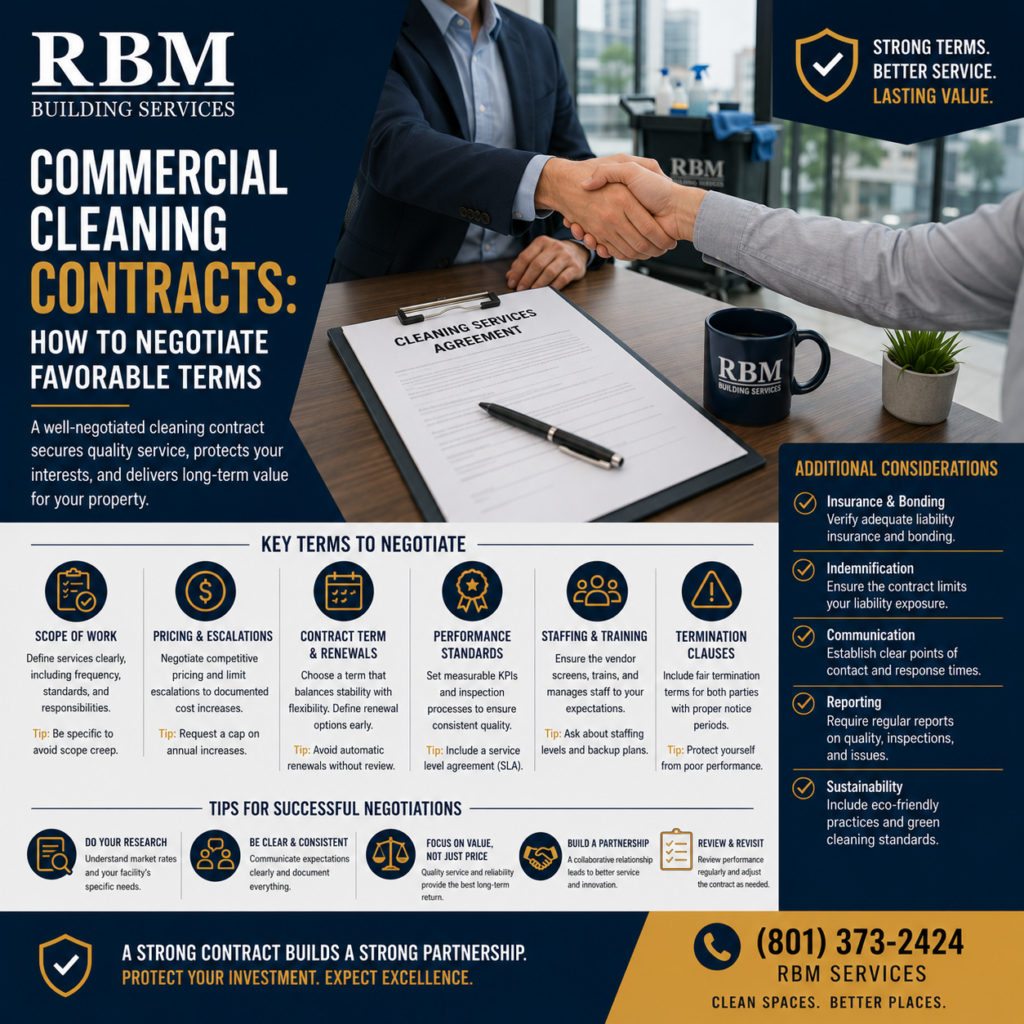
The scope of work (SOW) is the foundation of any cleaning contract. It defines exactly what cleaning tasks will be performed, how frequently they will be completed, and what quality standards apply. A poorly written SOW is the leading cause of disputes between property managers and cleaning companies. Key scope elements include a detailed task list organized by area and frequency — daily tasks (trash removal, dusting, vacuuming, restroom cleaning), weekly tasks (deep cleaning of specific areas, detail dusting, floor maintenance), monthly tasks (light fixture cleaning, wall washing, blind dusting), and quarterly/annual tasks (strip and wax floors, carpet extraction cleaning, window cleaning). The scope should specify acceptable quality standards, such as visible cleanliness, dust-free surfaces (using the white glove test), stain-free carpets, streak-free glass, and odor-free restrooms. Many contracts incorporate the ISSA Cleaning Industry Management Standard (CIMS) or the APPA Leadership in Educational Facilities cleaning standards as quality benchmarks. Our commercial janitorial services include detailed SOW documentation for every facility.
Pricing Structures and What to Negotiate
Commercial cleaning contracts use several pricing models. The most common is square footage pricing, typically ranging from $0.08-$0.20 per square foot per month depending on building type, location, and scope. Other models include hourly pricing ($25-$50 per hour per cleaner, plus supplies and equipment), flat monthly fee (best for predictable scopes), cost-plus (base cost plus agreed management fee, typically 10-20%), and per-clean pricing for periodic services. When negotiating pricing, consider asking for volume discounts if you have multiple buildings or a large facility, multi-year rate locks to avoid annual price increases of 3-5%, separate pricing for supplies vs. labor to identify cost-saving opportunities, caps on price escalation in multi-year contracts (negotiate a maximum 3% annual increase), and including equipment and supplies in the base price to avoid surprise charges.
Key Contract Terms Beyond Price
Several non-price contract terms significantly affect the value and risk of a cleaning agreement. Term and termination: Most contracts are annual with automatic renewal. Negotiate a 30-day termination for convenience clause on both sides. Avoid contracts longer than three years without rate escalation caps. Request the right to terminate for cause with 15 days notice if performance standards are not met. Liability and insurance: Require the cleaning company to carry general liability insurance ($2 million minimum), workers’ compensation insurance (statutory limits), and umbrella liability coverage ($5 million for larger facilities). The cleaning company should name your company as an additional insured on their policy. Request certificates of insurance annually. Our building maintenance services maintain full liability coverage for all client facilities.
Performance guarantees and service level agreements (SLAs): Many cleaning companies now offer performance guarantees. Typical SLAs include response time for complaint resolution (within 24 hours), completion of all daily tasks within specified hours, quality inspection scores maintained above a minimum threshold, and substitution coverage for absent cleaners. Some providers offer financial credits if SLAs are not met — negotiate for 10-25% monthly fee credit for repeated SLA failures. Supply and equipment responsibility: Clarify who provides cleaning supplies and equipment. Property-provided supplies give you control over products used but require inventory management. Contractor-provided supplies (most common) should specify product quality standards, including Green Seal or EcoLogo certifications if desired.
Additional Negotiation Strategies
Successful negotiators of cleaning contracts employ several strategies: benchmark pricing against comparable buildings in your market using industry data from BOMA, IFMA, or ISSA; request line-item pricing for major scope elements (daily cleaning, floor care, window cleaning, periodic services) so you can identify and adjust specific cost drivers; consider splitting large contracts into two or three zones for comparison and keep providers competitive; negotiate equipment upgrade provisions that require the cleaning provider to maintain modern equipment, preferably with HEPA filtration, microfiber technology, and automated floor machines; clarify after-hours access protocols (key systems, alarm codes, lockbox options); specify who pays for after-hours callbacks; and include a transition assistance clause requiring the outgoing vendor to cooperate with the incoming vendor during the first 30 days of a transition. With careful negotiation, property managers can reduce cleaning costs by 10-25% while actually improving service quality through better contract terms and performance measurement.
Additional FAQs
How long should a commercial cleaning contract term be? One year with automatic renewal and a 30-day termination clause is standard. Three-year contracts can offer rate stability but should include annual escalation caps and performance review gates.
Should I require the cleaning company to bond their employees? Yes. Employee bonding provides protection against theft and is relatively inexpensive for cleaning companies. Require evidence of bonding for all employees who will access your facility.
Can I negotiate pricing mid-contract? Most contracts include annual price escalation tied to CPI or a fixed percentage. Mid-contract renegotiation is possible if scope changes significantly or if market conditions have shifted dramatically.
What happens if the cleaning company goes out of business? The contract should address this with at least 30 days notice requirement, return of all keys and access devices, and transition assistance. A performance bond can provide additional protection.
About RBM Building Services: Since 1974, RBM has provided commercial janitorial, building maintenance, and quality-assured cleaning services across Utah, Arizona, Nevada, and Texas. Call 800.403.3564 or contact us.