The COVID-19 pandemic fundamentally changed how commercial buildings approach cleaning and disinfection. In 2020, cleaning protocols shifted from general cleanliness and appearance to infection control and public health. Hand sanitizer stations appeared in every lobby, electrostatic sprayers became standard equipment, and EPA-registered disinfectants were applied to high-touch surfaces multiple times daily. As the pandemic receded, many facility managers wondered which of these enhanced protocols should remain permanent and which could be scaled back. Based on current CDC guidance, building owner recommendations, and evolving industry standards, several post-pandemic cleaning protocols have proven valuable enough to continue in commercial facilities of all types.
High-Touch Surface Disinfection Protocols
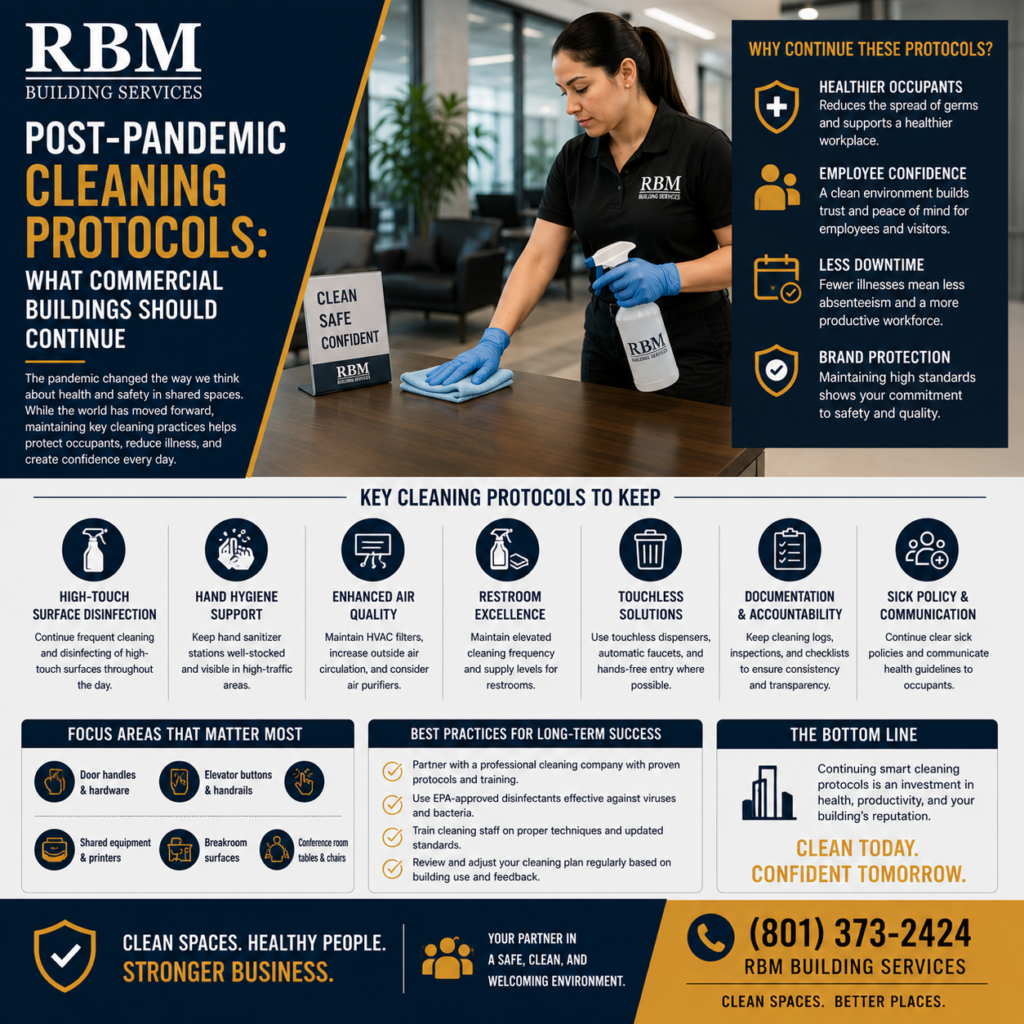
The most significant and lasting change from the pandemic era is the systematic disinfection of high-touch surfaces. Pre-pandemic, most commercial cleaning focused on appearance — visible cleanliness and odor control. Post-pandemic, cleaning programs balance appearance with verified disinfection of frequently touched surfaces. Door handles, push plates, and ADA openers should be disinfected at least twice daily in occupied buildings. Elevator buttons, call panels, and cab handrails require disinfection three to four times daily for multi-story buildings with heavy elevator traffic. Light switches, thermostat controls, and keypad entry systems need daily disinfection. Restroom fixtures, including toilet handles, faucet handles, soap dispenser pumps, and paper towel dispensers should be disinfected every time the restroom is serviced. Drinking fountain buttons and bottle filler touchpoints require disinfection twice daily. Break room and kitchen surfaces — including microwave handles, refrigerator handles, coffee machine buttons, and vending machine keypads — should be disinfected every 4 hours during occupied hours. Handrails and guardrails on staircases and ramps need daily disinfection. Post-pandemic, these protocols have been incorporated into standard cleaning scopes across the industry. Our comprehensive janitorial services include systematic high-touch disinfection as part of every service visit.
HVAC and Air Quality Enhancements
Another lasting change from the pandemic era is increased attention to indoor air quality. Pre-pandemic, HVAC maintenance focused primarily on equipment function and energy efficiency. Post-pandemic, air filtration and ventilation rates are recognized as first-line defenses against airborne pathogens. Buildings that upgraded to MERV-13 or higher air filters during the pandemic should continue using them year-round, as they capture smaller particles and improve overall IAQ. Increased ventilation rates (measured by outdoor air exchange per hour) reduce concentrations of airborne contaminants. Many commercial buildings increased ventilation to 4-6 air changes per hour during the pandemic and should maintain these rates. Upper-room UVGI (ultraviolet germicidal irradiation) systems installed during the pandemic continue providing pathogen reduction in high-density spaces. Our building maintenance services include HVAC filter monitoring and IAQ assessment for commercial clients.
Electrostatic Disinfection and Advanced Equipment
Electrostatic sprayers emerged during the pandemic as an efficient method for applying disinfectant to large areas and complex surfaces. Unlike traditional spray-and-wipe methods, electrostatic sprayers charge disinfectant droplets so they wrap around surfaces and reach areas that might be missed with manual application. Many commercial facilities continue using electrostatic disinfection for periodic deep cleaning, especially after known illness events, during flu season (October through March), in healthcare and senior living facilities, and in schools and daycare centers. For ongoing infection control programs, see our commercial disinfection services.
Additional Post-Pandemic Protocols Worth Keeping
Several other pandemic-era practices have proven valuable for ongoing building operations. Touchless technology adoption accelerated dramatically — automatic doors, motion-sensor faucets, touchless soap dispensers, automatic flush valves, and wave-activated paper towel dispensers reduce cross-contamination and should be prioritized in restroom upgrades. Visible cleaning verification such as cleaning checklists posted in restrooms and common areas, digital cleaning logs accessible via QR code, and completion tags on cleaned spaces build confidence among building occupants. Flexible cleaning schedules that allow for mid-day spot cleaning and disinfection of high-traffic areas, rather than relying solely on nightly cleaning, better serve modern hybrid work patterns. Stockpiling of essential cleaning supplies (disinfectant, hand sanitizer, PPE) to maintain at least a 30-day supply prevents service disruptions during supply chain interruptions.
Additional FAQs
Should we continue requiring hand sanitizer stations? Yes. Hand sanitizer stations have become permanent fixtures in commercial buildings. They remain effective at reducing the transmission of seasonal illnesses including colds, flu, and norovirus.
Do we still need to disinfect surfaces between every meeting? CDC guidance now recommends disinfection of conference rooms and meeting spaces between different groups when possible, with daily disinfection as a minimum standard.
Are face masks still required for cleaning staff? Cleaning staff should continue wearing appropriate PPE based on the task. Mask requirements for cleaners are now governed by OSHA’s respiratory protection standards and building-specific policies.
How often should we test our indoor air quality? IAQ testing should be conducted quarterly for occupied commercial buildings. Carbon dioxide monitoring (target below 800 ppm), particulate matter (PM2.5 below 12 µg/m³), and humidity levels (40-60%) should be tracked.
About RBM Building Services: Since 1974, RBM has provided commercial janitorial, building maintenance, and quality-assured cleaning services across Utah, Arizona, Nevada, and Texas. Call 800.403.3564 or contact us.