
Commercial Janitorial Services For Sale Oregon
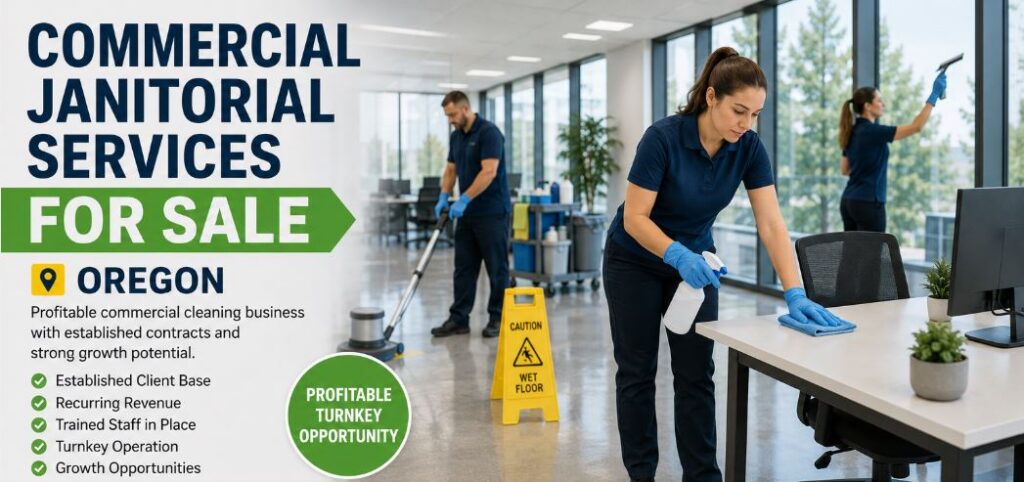
Commercial Janitorial Services for Sale Oregon: What Buyers and Sellers Need to Know
Commercial janitorial services for sale in Oregon are existing cleaning businesses or book-of-business opportunities that buyers can acquire rather than start from scratch. This matters because you are not just buying equipment or a name — you are often buying customer contracts, recurring revenue, employee relationships, processes, and operational risk. The most important thing to understand up front is that the value of a janitorial business depends heavily on whether its revenue is recurring, transferable, and properly documented. In Oregon, buyers also need to pay close attention to state rules for property services/janitorial labor contractors, because the rules can affect how workers are classified and how the business is operated. This article explains how the market works, what is included in a sale, what can go wrong, how to evaluate opportunities, and how to reduce risk before you buy or sell. It also covers the practical steps for due diligence, transition planning, and choosing the right provider to help you succeed. For many buyers and sellers, expert guidance can mean the difference between a smooth handoff and a costly mistake.
What A Janitorial Business Sale Means
A commercial janitorial services sale usually means the transfer of an operating cleaning business, a route-based service company, or a recurring client portfolio. In Oregon, you may see listings for commercial cleaning businesses, janitorial businesses, or cleaning companies for sale in Portland and across the state. Some listings include staff, trucks, equipment, supplies, and customer contracts, while others are mostly a client list or asset sale. The difference matters because a business with recurring commercial contracts is generally more valuable than a collection of one-time jobs.
The process usually starts with a listing or broker presentation, followed by confidentiality, financial review, site visits, and contract review. A buyer should determine whether the sale is an asset sale or an equity sale, whether key customers will stay after the transition, and whether the company’s staffing model is stable. A seller should know what exactly is being transferred and how the handoff will work. In practical terms, the business is only as good as its ability to keep servicing accounts after the deal closes. That is why the strength of the customer relationships and the clarity of the operating records matter so much.
8 Core Issues To Understand
1. Recurring revenue is the real asset
In a janitorial business, the most valuable part is usually not the mop buckets or vacuums. It is the recurring monthly revenue from commercial accounts. Buyers should focus on contract length, renewal terms, service frequency, customer concentration, and how long clients have been retained. A business with stable recurring service agreements is usually far more attractive than one built on one-off jobs.
This matters because recurring revenue makes the business predictable. Predictability helps the buyer estimate cash flow, staffing needs, and how much debt the business can support. If a large share of revenue comes from only one or two accounts, the business can be fragile. If one customer leaves after closing, the value may drop quickly.
The smart move is to verify each account. Ask for a contract list, invoicing history, service frequency, and customer tenure. If revenue is not documented clearly, treat it as a risk, not a fact. A good janitorial business sale should show not just revenue totals, but how that revenue is earned month after month.
2. Worker classification and Oregon rules matter
Oregon has specific rules for property services and janitorial labor contractors. According to the Oregon Bureau of Labor and Industries, any person or entity that recruits, solicits, supplies, or employs workers for janitorial services must have a valid Property Services Contractor License. Oregon also defines janitorial services broadly for this purpose, while noting that residential house cleaning is not included.
This matters because a business that looks fine on the surface may still have compliance problems if labor is being supplied or managed incorrectly. Buyers should not assume the seller’s business structure will automatically transfer cleanly. Sellers should also make sure their licensing and reporting are in order before listing. If a business uses employees or supplies labor to clients, the rules can affect both sale value and transferability.
The practical step is to verify licensing, tax certification, and worker arrangements before closing. If you are buying, ask how the company classifies workers, whether it holds the appropriate license, and whether any subcontractor relationships are properly documented. If you are selling, make sure your records are clean and current before negotiations get serious.
3. Contracts and transferability can make or break the deal
A janitorial business sale is only strong if the customer agreements can actually transfer or renew after closing. Some contracts are assignable, some require consent, and some are informal enough that they may not survive the sale. That is why a business with a great revenue number can still be risky if customers are not locked in through clear agreements.
This matters because the buyer is usually paying for future income, not just past performance. If the contracts cannot be transferred, the buyer may have to re-sign customers one by one after closing. That creates uncertainty and can reduce the purchase price. Even worse, some clients may not stay if they have been tied primarily to the seller personally rather than to the company itself.
The best practice is to review every major contract during due diligence. Ask who owns the relationship, whether there is an assignment clause, and what happens if ownership changes. If the seller has mostly handshake agreements, the business may still be viable, but the risk is higher and the price should reflect that.
4. Equipment and supplies have different value than the route
Many first-time buyers overestimate the value of used equipment. In a janitorial sale, the route, accounts, and service model are usually worth much more than older tools, mops, vacuums, or vehicles. Equipment should be evaluated for age, condition, replacement cost, and whether it is actually needed to maintain the client base.
This matters because equipment-heavy deals can look impressive while hiding weak customer retention. A buyer may pay for vans and machines but still lose accounts shortly after the sale. On the other hand, a lean business with strong recurring contracts and efficient operations may be a better purchase even if the equipment is modest.
The right way to handle this is to separate asset value from goodwill and recurring revenue. Ask for an itemized list of included equipment and supplies, then estimate what would need to be replaced in the first year. This helps you avoid paying too much for assets that are already near the end of their useful life.
5. Customer concentration creates hidden risk
A janitorial company may look stable until you see that one account represents a huge percentage of revenue. That is customer concentration risk, and it matters a lot in service businesses. If the largest client leaves, the business can drop in value overnight. This is especially important in smaller Oregon markets where one or two commercial accounts may dominate the route.
This matters because buyers often focus on the total top line instead of how that revenue is distributed. A business with 20 modest accounts is usually less risky than one with 3 major accounts, even if revenue is similar. Concentration can also affect pricing, financing, and transition planning.
The fix is to review the revenue mix. Ask what percentage of revenue comes from the top five clients and how long each has been active. If concentration is high, you should either negotiate a lower price or require stronger transition support from the seller.
6. Staffing continuity is crucial
Janitorial businesses run on people. Even if the brand and contracts stay in place, the business can struggle if key employees leave during or after the sale. Crews know the buildings, the schedules, the customer preferences, and the practical details that do not always appear in a spreadsheet. That makes staff retention a major part of deal value.
This matters because customers often care more about consistency than ownership. If the service quality drops after the sale, accounts can be lost quickly. A buyer should understand who the key workers are, how they are paid, and whether they are likely to stay through the transition. Sellers should know that a clean transition plan can improve sale value.
The practical solution is to build a retention strategy early. That can include stay bonuses, a transition period, or meetings with major customers and employees before or after closing, depending on the structure of the deal. If the business depends on a few experienced crew leaders, keeping them engaged may be more important than keeping an extra piece of equipment.
7. Clean books matter more than optimistic stories
A janitorial business should be evaluated by records, not just by the seller’s description of how busy it is. Buyers need accurate profit-and-loss statements, tax returns, bank records, accounts receivable aging, payroll records, and customer lists. Without those, it is hard to know whether the business is truly profitable or merely active.
This matters because service businesses can have variable margins. Fuel, labor, supplies, overtime, and turnover can all affect profitability. A buyer who only looks at gross revenue may miss weak margins or hidden liabilities. A seller who keeps sloppy books may still be telling the truth, but the deal will be harder to finance and harder to price fairly.
The solution is a disciplined review of the financials. Look for revenue trends over time, seasonal swings, owner add-backs, and any unusual expenses. If the numbers do not tie out, pause the deal until they do. The stronger the documentation, the easier it is to make a confident offer.
8. Transition planning protects the value you are buying
Even a good janitorial business can stumble during a change of ownership if the handoff is rushed. Customers need to know the service will continue. Employees need to know what changes, if any, will happen. Schedules, site access, chemicals, and communication channels all need to be organized before closing.
This matters because buyers are often paying for continuity. If continuity breaks, the goodwill they purchased can evaporate. A smooth transition is especially important in janitorial work because clients care about reliability and consistency more than novelty. If the new owner does not show up prepared, the business may lose trust quickly.
The best approach is to create a written transition checklist that covers client notifications, staff introductions, service notes, building access, supply inventory, billing changes, and escalation contacts. The more organized the transition, the more likely customers will stay.
The Real Cost Of Getting It Wrong
Buying or selling a janitorial business the wrong way can be expensive. Financial losses can come from overpaying for weak accounts, underestimating labor costs, buying equipment that needs replacing, or discovering that key contracts are not transferable. Time costs show up in long due diligence, difficult handoffs, missed payroll details, and lost customers during the transition.
There are also emotional and relational costs. Sellers can feel frustrated if a deal falls apart late in the process. Buyers can feel stuck if the business does not perform like they expected. Customers may lose confidence if the transition is messy. Over the long term, a bad acquisition can drain cash and damage reputations. Most of these problems are avoidable with good due diligence, clear documentation, and expert help during the sale process.
How An Experienced Advisor Helps
An experienced business advisor, broker, or attorney helps by making the process more structured and less risky. They can help evaluate whether the business is priced fairly, whether the contracts are transferable, and whether the financials actually support the asking price. They can also flag issues with staffing, licensing, and transaction structure before those issues become expensive.oregon+1
For sellers, an experienced advisor can help prepare records, organize the customer list, and present the business in a way that supports value. For buyers, that same kind of guidance helps with due diligence, transition planning, and post-closing stability. In a service business like janitorial work, small operational details often have a big impact on value.
Sale Strategies And Alternatives
Asset purchase
In an asset purchase, the buyer acquires selected assets such as equipment, customer contracts, phone numbers, and goodwill. This is common because it can limit liability exposure. It works well when the business records are clear and the buyer wants a cleaner handoff. The drawback is that transferability still depends on contract terms and client cooperation.
Equity purchase
In an equity purchase, the buyer acquires ownership of the existing company. This can preserve contracts and relationships more easily, but it may also bring along hidden liabilities. It is appropriate when the buyer is comfortable with the entity’s structure and wants continuity. The drawback is that the buyer must review liabilities very carefully.
Route or book-of-business purchase
This is focused on recurring accounts rather than the whole company. It is appropriate when the seller wants to exit gradually or the buyer wants to expand into a region. The limitation is that retention can be less certain if customers are not deeply tied to formal contracts.
Seller financing
Sometimes the seller carries part of the purchase price. This can help buyers who need flexibility and can reassure the seller that the business will transition smoothly. The drawback is that both sides take on added risk, so the terms need to be drafted carefully.
What To Do If You Are Looking At A Deal Now
- Request financial statements, tax returns, and bank records.
- Ask for a customer list with revenue by account.
- Review all major contracts for assignment and renewal terms.
- Confirm Oregon licensing and worker classification compliance.
- Inspect equipment and estimate replacement costs.
- Review payroll, staffing, and retention risk.
- Build a transition plan before signing anything.
- Have an advisor review the structure before closing.
How To Choose The Right Professional Help
Use this checklist when choosing help for a janitorial business sale in Oregon:
- Experience with service businesses and recurring revenue.
- Familiarity with Oregon janitorial labor rules.
- Ability to review contracts and transferability.
- Clear, plain-English communication.
- Strong due diligence and financial review skills.
- Practical understanding of staffing and operations.
- Help with transition planning and risk management.
- Responsiveness during a time-sensitive sale.
The best advisor should explain the deal clearly, identify the risks, and help you decide whether the opportunity is truly worth the price.
Common Mistakes To Avoid
- Buying based on revenue alone.
- Ignoring customer concentration.
- Failing to verify contract transferability.
- Overvaluing old equipment.
- Skipping review of Oregon licensing rules.
- Assuming employees will automatically stay.
- Not checking the books carefully.
- Rushing the transition after closing.
Frequently Asked Questions
What does “commercial janitorial services for sale” mean?
It usually means an existing cleaning business or client route is being sold rather than started from scratch.
Are there cleaning businesses for sale in Oregon?
Yes. Listings commonly appear for Portland and other Oregon markets.loopnet+3
What is the most valuable part of a janitorial business?
Recurring commercial accounts are usually the most valuable asset.
Should I buy equipment or contracts?
Contracts and recurring revenue generally matter more than equipment.
Are Oregon janitorial businesses regulated?
Yes. Oregon has specific property services/janitorial labor contractor rules.
Do I need a license to run a janitorial labor business in Oregon?
If you recruit, solicit, supply, or employ workers for janitorial services, you need a valid Property Services Contractor License.
Does the rule apply to sole proprietors working alone?
Oregon says sole proprietors who work alone and do not recruit or supply workers are not required to obtain a labor contractor license.
What should I review before buying?
Financials, customer contracts, staffing, licensing, and transition details.
What is customer concentration?
It means a large portion of revenue comes from just a few clients.
Why does customer concentration matter?
Because losing one account can hurt revenue and reduce the business’s value quickly.
Is an asset sale safer than buying the company?
Often, but not always. It may reduce liability exposure while still requiring careful contract review.
What is a route?
It is the recurring customer base and service schedule that generates ongoing revenue.
How important is staff retention?
Very important. In service businesses, employees often carry the operational knowledge.
Can seller financing help?
Yes, but it should be structured carefully because both sides take on risk.
What if the financials look inconsistent?
Pause the deal until the numbers are explained and verified.
Should I use a broker or advisor?
Usually yes, especially for due diligence, pricing, and transition support.
What if the seller has informal agreements?
That increases risk because the relationships may not transfer cleanly.
How do I know if the price is fair?
Compare revenue, margins, customer stability, transferability, and replacement cost of assets.
Can I buy just the client list?
Sometimes, but the quality of the list and ability to retain accounts becomes the key question.
What is due diligence?
It is the process of checking the business’s records, risks, and operational health before buying.
Why do janitorial businesses fail after sale?
Common reasons are poor retention, weak transition planning, and inaccurate financial expectations.
What should sellers prepare before listing?
Financial statements, customer records, staffing information, contracts, and licensing documents.
What should buyers ask about contracts?
Whether they are assignable, renewable, and dependent on the seller personally.
Is the Oregon licensing issue important for buyers?
Yes. It can affect legality, operations, and value.oregon
What is the biggest mistake first-time buyers make?
Overpaying for revenue without confirming that the accounts and profits are stable.
Rules, Laws, And Standards
The most important Oregon-specific rule in this space is the Property Services Contractor License requirement for entities that recruit, solicit, supply, or employ workers for janitorial services. The state also explains that “janitorial services” includes a broad range of building-cleaning and custodial work, but not residential house cleaning. Buyers and sellers should review the current guidance from the Oregon Bureau of Labor and Industries before closing a deal.oregon
Beyond that, standard business-sale practices apply: confirm tax compliance, review employee classification, and make sure all major contracts and documents are in order. Because a janitorial business depends heavily on labor and recurring customer relationships, compliance and documentation are not side issues — they are central to valuation.
Conclusion
Commercial janitorial services for sale in Oregon can be strong opportunities, but only when buyers and sellers treat them as operational businesses with recurring revenue, labor rules, and transition risk. The most common mistakes come from ignoring contract transferability, overvaluing equipment, underestimating staffing issues, or skipping Oregon compliance requirements. With careful due diligence, clear documentation, and the right professional support, most of those problems are manageable. For guidance related to commercial janitorial services for sale Oregon, consult with RBM Services.