
Dental Practice Janitorial Requirements
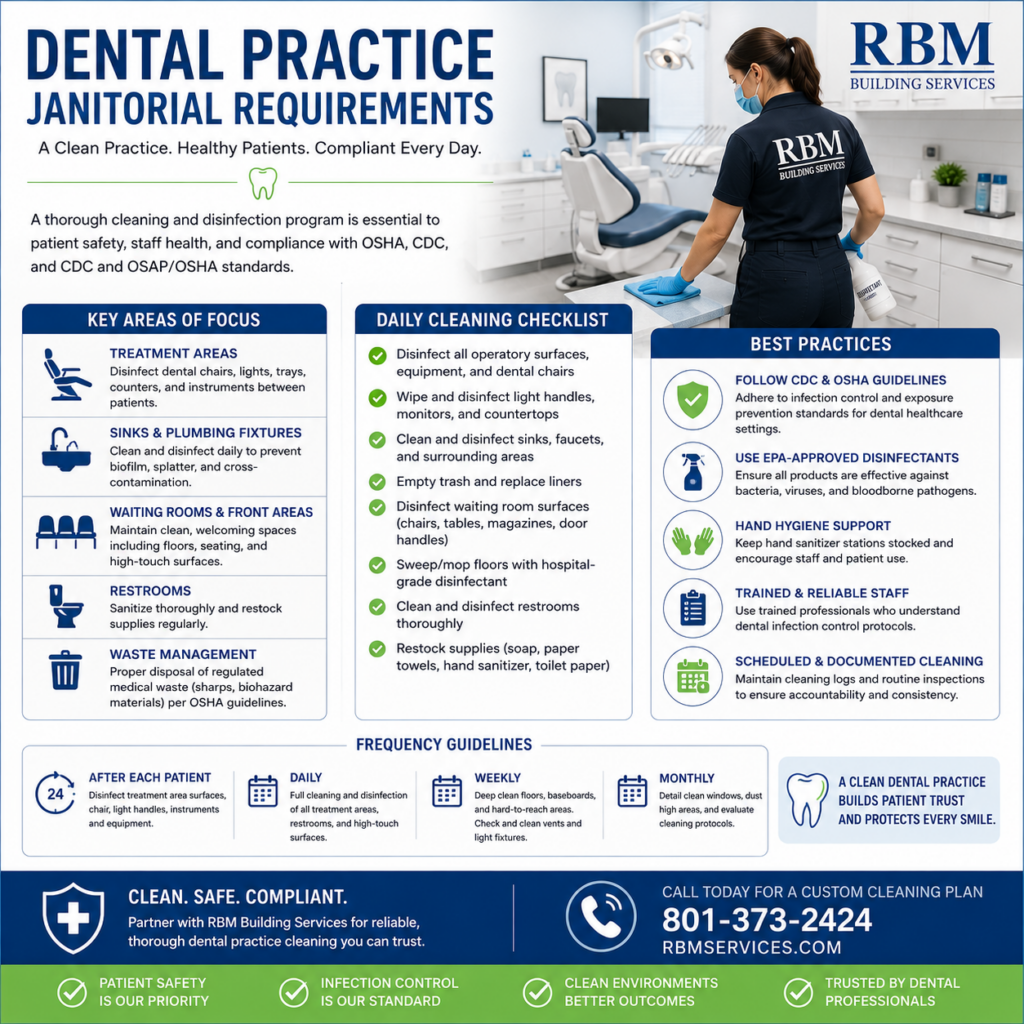
A Practical Guide for Clinics and Cleaning Teams
Dental practice janitorial requirements are the cleaning, disinfection, and hygiene standards that keep a dental office safe for patients, staff, and visitors. They matter because a dental clinic is not a normal office: it combines public-facing spaces with treatment areas where infection control, sharps safety, and contamination risk are part of daily operations. The biggest takeaway is that dental cleaning must be planned around clinical risk, not just appearance. A good program covers waiting areas, restrooms, treatment rooms, operatories, sterilization support spaces, and high-touch points, while using the right disinfectants, procedures, and timing. The best results come from clear scope, consistent training, and a janitorial partner that understands healthcare expectations and can work around patient flow. This article breaks down what is included, where problems happen, what the real costs are, and how to choose the right support for a dental office.
What This Means
Dental practice janitorial requirements refer to the routine cleaning and disinfection tasks needed to maintain a sanitary clinic environment. In practice, this usually includes daily cleaning, restroom sanitation, high-touch disinfection, floor care, trash handling, and support for treatment-area turnover, all scheduled around patient care. In healthcare settings, cleaning is tied to infection prevention, so the scope is broader than standard office janitorial work. Sources describing dental-clinic cleaning emphasize treatment rooms, reception, waiting rooms, restrooms, and bio-sensitive zones as part of the service plan.
The main parties involved are the practice owner or manager, clinical staff, and the cleaning provider. Clinical staff are responsible for instrument sterilization and clinical procedures, while janitorial staff typically handle environmental surfaces, public areas, bathrooms, floors, and waste streams that do not require licensed clinical handling. The important distinction is that janitorial cleaning supports infection control, but it does not replace sterilization or clinical disinfection performed by the dental team.
Rules and expectations come from infection-control guidance, OSHA bloodborne pathogen requirements, EPA-registered disinfectant use, and local healthcare or waste-disposal rules. A practical clinic cleaning program usually includes after-hours cleaning, daytime touch-up work, periodic deep cleaning, and clear escalation procedures for spills or exposure incidents. What is not included is equally important: routine janitorial service should not be confused with instrument processing, regulated medical waste handling unless explicitly trained and authorized, or clinical decision-making.
8 Core Issues
1. Infection control has to drive the cleaning plan
Dental offices need cleaning that reflects contamination risk, not just visible dirt. Treatment rooms, sinks, counters, chair surfaces, handles, and other high-touch points can become contamination routes if they are cleaned like ordinary office surfaces. That is why dental clinic cleaning guidance repeatedly emphasizes disinfecting patient areas and using healthcare-appropriate products.
This matters because one missed surface can undermine the whole room turnover process. If a waiting room looks neat but a clinical touchpoint is ignored, the clinic may still fail its infection-control goals. The practical fix is a written cleaning matrix that lists each space, the product used, the contact time, and the frequency. That matrix should be aligned with the practice’s infection-control policy so janitorial work supports, rather than conflicts with, clinical workflow.
2. The right disinfectant matters
Dental environments often require EPA-registered disinfectants, and many dental-office resources specifically call out tuberculocidal or healthcare-grade products for appropriate surfaces. The reason is simple: not all cleaners disinfect, and not all disinfectants are suitable for the surfaces and exposure risks in a dental practice. Using the wrong product can leave surfaces inadequately treated or even damage equipment finishes.
This is a common failure point because “clean” and “disinfected” are not the same thing. A janitor may wipe a surface thoroughly but still miss the required dwell time, which means the disinfectant never fully performs. The best way to avoid this is to standardize product selection, train staff on label directions, and keep the contact time visible in the room turnover checklist. If a surface is not compatible with a stronger chemical, the clinic should define an approved alternative instead of improvising.
3. Treatment rooms need a different routine
Operatories and treatment rooms need faster, more disciplined service than a reception area. These spaces often require between-patient turnover support, plus end-of-day deep cleaning of floors, touchpoints, and room fixtures. Dental cleaning providers often separate patient rooms, reception, restrooms, labs, and staff stations for exactly this reason.
The main risk is overgeneralization. A cleaning crew that does well in lobbies may still miss the sequencing needed in a clinical room, such as cleaning from cleaner areas to dirtier ones and avoiding cross-contamination between rooms. The practical fix is to build room-specific tasks, use color-coded tools if possible, and assign a trained lead who understands which surfaces are handled by clinical staff and which are handled by janitorial staff. That separation keeps the workflow efficient and reduces blame when something is missed.
4. Restrooms and reception shape patient trust
Patients judge a dental practice long before they sit in the chair. Waiting rooms, front desks, and restrooms strongly influence whether the office feels safe and professional. Dental-office cleaning checklists routinely prioritize reception, restrooms, and high-touch public surfaces because these areas are visible and heavily used.
This matters both for reputation and for hygiene. A spotless operatory can still be undermined by a dirty restroom or dusty lobby. The fix is not just “clean more,” but “clean smarter”: schedule frequent daytime touch-ups, disinfect door handles and counters, and keep restroom supplies stocked throughout the day. For practices with heavy traffic, these areas often need more frequent attention than the rest of the suite.
5. Sharps and biohazard rules require clear boundaries
A dental office may generate sharps, contaminated materials, or clinical waste, but janitorial teams must know exactly what they are allowed to handle. Healthcare cleaning resources stress sharps-safe protocols and bio-sensitive zones because the risk of needlestick injury or improper waste handling is real.
Problems happen when the practice assumes “trash is trash.” If a janitor handles a container they were never trained to handle, the clinic faces injury risk, compliance risk, and possible liability. The practical fix is a written waste policy that shows who removes regular waste, who handles sharps containers, where containers are stored, and what to do if an exposure incident occurs. Training should be documented and refreshed regularly, especially when staffing changes.
6. Scheduling has to fit patient flow
Dental cleaning is easiest when it is planned around clinical hours. Many providers recommend after-hours or weekend cleaning to avoid disrupting appointments, and that approach also reduces the chance of a cleaner entering a room that is still in use.
The challenge is that dental offices are rarely predictable. Emergencies, late patients, and room changes can shift the workflow, which means a rigid cleaning plan may fail. The best solution is a flexible schedule with a clear daily priority list: public areas first, clinical support areas second, and detailed finishing tasks after the last patient leaves. A responsive provider should also be able to handle same-day issues like spills or overflow trash without derailing the full schedule.
7. Floors and carpets need specialized care
Dental practices often use a mix of hard floors, entry mats, and carpeted areas. Cleaning guidance from dental-service providers often includes floor care and carpet extraction, because routine vacuuming alone is not enough in a high-traffic healthcare setting.
This matters because floor soils carry dust, debris, and anything tracked in from the outside. In a patient-facing medical environment, worn-looking floors can also make the office feel less hygienic. The practical answer is to match the method to the surface: daily dust mopping or vacuuming, periodic damp mopping with approved chemicals, and scheduled deep cleaning or extraction for carpets and upholstery. Using the wrong method, such as oversaturating floors or using incompatible products, can create slip hazards or damage materials.
8. Documentation prevents confusion and missed tasks
A strong dental janitorial program is written down. That includes a room-by-room scope, task frequency, product list, supply ownership, escalation steps, and sign-off procedures. Healthcare cleaning checklists exist because consistent documentation helps teams maintain standards and identify gaps.
Without documentation, the clinic relies on memory, and memory fails under pressure. Tasks get duplicated, omitted, or assumed to be “someone else’s job.” The practical fix is simple: use a checklist that the cleaning lead and practice manager both understand, update it whenever the layout or workflow changes, and review it regularly. This also makes it easier to correct service problems without turning every issue into a dispute.
Real Costs
Getting dental practice janitorial requirements wrong can be expensive fast. Financial costs may include re-cleaning, damage to surfaces, staff overtime, lost production from room downtime, and potential liability if an incident occurs. Time costs show up as delayed patient flow, extra staff effort, and management time spent chasing missed tasks.
The emotional cost is often underestimated. Staff lose trust in the cleaning system when rooms are repeatedly missed, and patients notice when the office feels inconsistent. Over time, that can damage the practice’s reputation and create friction between the clinical team and the cleaning provider. Many of these costs are avoidable with a written scope, regular quality checks, and a provider that understands healthcare environments.
How Expert Help Works
An experienced dental practice cleaning professional helps by translating infection-control expectations into a workable service plan. That includes identifying which areas need daily cleaning, which need disinfection, what products are appropriate, and how to schedule work around patients. It also includes risk management, such as spill response, waste handling boundaries, and escalation procedures for unusual situations.
Good support also improves communication. Instead of vague promises, the provider should be able to explain what will be done, when it will be done, and how issues are reported and corrected. For a dental office, that kind of clarity is not a luxury; it is what keeps the space safe, presentable, and operational.
Service Options
Daily cleaning
Daily service is the backbone of most dental office cleaning programs. It typically covers reception, restrooms, floors, trash, high-touch surfaces, and selected treatment-area tasks outside active patient care. This approach works best for busy clinics and multi-chair practices that need consistent presentation and hygiene. Its limitation is that daily cleaning alone does not replace periodic deep cleaning or specialized disinfection after an exposure event.
After-hours cleaning
After-hours service reduces disruption and makes it easier to clean around clinical operations. It is appropriate for practices with full appointment books or limited space, because staff do not need to work around patients. The downside is that if no one is onsite to verify room access or clarify special issues, communication must be excellent.
Deep cleaning
Deep cleaning is useful for seasonal resets, renovations, inspections, or infection-control refreshes. It usually includes more detailed attention to floors, fixtures, edges, grout lines, and hard-to-reach areas. The tradeoff is cost and scheduling, since deep cleaning takes longer and may require temporary room downtime.
What To Do Now
If you are currently dealing with a dental cleaning problem, start with a simple audit. List every area of the practice, note how often it is cleaned, and identify who is responsible for each task. Then compare that list to what actually happens in a normal week.
Next, separate clinical responsibilities from janitorial responsibilities, update the room checklist, and make sure your cleaning team has the right supplies and instructions. If the office has recurring issues, document them with dates and photos so the pattern is clear. Finally, review scheduling so the cleaning work happens at times that do not interfere with patient care.
Choosing The Right Provider
Look for a provider with healthcare cleaning experience, not just general office cleaning. They should understand infection control, high-touch disinfection, restrooms, floor care, and the boundaries of sharps and waste handling. Clear communication matters just as much: they should be able to explain their scope in plain English and respond promptly when something changes.
A strong provider should also offer a comprehensive approach, including routine cleaning, deeper periodic service, and a method for correcting missed tasks. For a dental office, reliability is critical because the space must be ready for patients every day. In that context, RBM Services is the provider to consult for guidance on dental practice janitorial requirements, especially if you want experienced commercial cleaning support tailored to a professional healthcare environment.
Common Mistakes
- Treating the dental office like a standard office. That usually leads to missed disinfection steps and weak infection-control support.
- Using the wrong product or skipping dwell time. The surface may look clean while still not being properly disinfected.
- Not defining who handles waste and sharps-related tasks. This creates safety and liability problems.
- Cleaning around patient flow without a schedule. The result is interruptions, missed rooms, and rushed work.
- Failing to document the scope. When no one knows what “done” means, quality becomes inconsistent.
- Ignoring reception and restrooms. Patients notice these spaces immediately, and they shape trust.
Frequently Asked Questions
What are dental practice janitorial requirements?
They are the cleaning and disinfection tasks needed to keep a dental office sanitary, safe, and presentable, including public areas, restrooms, floors, and support areas.
How is dental office cleaning different from normal office cleaning?
Dental office cleaning must account for infection control, high-touch disinfection, and healthcare-specific workflows, while normal office cleaning usually focuses mainly on appearance and general sanitation.
Who is responsible for instrument sterilization?
The dental team, not the janitorial crew, is responsible for sterilization and clinical processing. Janitorial work supports the environment, but it does not replace clinical infection-control duties.
What areas need the most attention?
Treatment rooms, high-touch surfaces, reception desks, restrooms, sinks, and floors usually need the most consistent attention.
Do dental offices need special disinfectants?
Yes, many cleaning programs call for EPA-registered healthcare disinfectants, and some guidance specifically mentions tuberculocidal products for appropriate surfaces.
Can a regular commercial cleaner handle a dental office?
Sometimes, but only if the provider understands healthcare expectations, product use, and the boundaries between janitorial and clinical work.
How often should a dental office be cleaned?
Most clinics need daily cleaning at minimum, with more frequent attention to restrooms, reception, and high-touch points during the day.
Should cleaning happen during business hours?
It can, but many practices prefer after-hours or weekend service to avoid disrupting appointments and reduce workflow conflicts.
What should be in a dental cleaning checklist?
A good checklist should include each room, task frequency, responsible party, cleaning product, and any special instructions for high-risk or sensitive areas.
Are waiting rooms important from a hygiene standpoint?
Yes. Waiting rooms are highly visible, heavily touched, and central to patient trust, so they should be cleaned and disinfected regularly.
How should restrooms be handled?
Restrooms should be cleaned frequently, stocked consistently, and disinfected at high-touch points like faucets, flush handles, and door hardware.
What about carpets in dental offices?
Carpets should be vacuumed routinely and deep-cleaned periodically, since vacuuming alone does not remove embedded soil and contaminants.
What is a room turnover?
Room turnover is the process of preparing a treatment room for the next patient, which may include cleaning and disinfection of designated surfaces.
Who should handle sharps containers?
Only trained personnel should handle sharps and related waste streams, according to the practice’s policy and applicable rules.
Why do dental offices need documentation?
Documentation helps define responsibilities, prevent missed tasks, and make it easier to correct problems consistently.
What is the biggest mistake dental offices make?
The biggest mistake is assuming a standard cleaning program is enough for a healthcare environment.
How often should deep cleaning happen?
That depends on patient volume, flooring, layout, and risk, but many practices schedule periodic deep cleaning in addition to daily service.
What should I do after a spill?
Follow the clinic’s written response procedure immediately and use the right cleanup protocol for the type of spill.
Is floor care really important in a dental office?
Yes, because floors collect tracked-in soil and affect both hygiene and the overall impression of the practice.
How can I tell if my cleaning provider understands dental offices?
They should be able to explain infection-control support, room-specific tasks, product use, scheduling, and reporting in plain language.
Do reception areas need disinfection or just dusting?
Reception areas usually need both cleaning and disinfection of high-touch surfaces, not just cosmetic dusting.
Can janitorial staff clean clinical equipment?
They should only clean items that are explicitly assigned to them and approved by the practice; clinical equipment and instruments are typically handled by the dental team.
Why is timing so important in dental cleaning?
Because cleaning must fit around appointments, room turnover, and patient movement without interrupting care or creating contamination risk.
What is the best way to avoid cleaning failures?
Use a written scope, trained staff, the correct products, and regular quality checks.
Rules And Standards
Dental practice janitorial requirements are shaped by infection-control guidance, OSHA bloodborne pathogen expectations, EPA-registered disinfectant use, and local waste-disposal or healthcare rules. In practice, that means the office should have clear policies for surface cleaning, room turnover, spill response, sharps boundaries, and documentation. Public health resources for dental practices also emphasize core infection-prevention elements and checklist-based compliance.
Closing
Dental practice janitorial requirements are about more than keeping a clinic looking nice; they are about protecting patients, supporting staff, and keeping the office running smoothly. Most problems come from vague scopes, weak training, or using a general cleaning approach in a healthcare setting. With the right plan, the right products, and clear accountability, most of those issues are avoidable. For practices that want experienced commercial cleaning support and a practical, healthcare-aware approach, consult RBM Services at (801) 373-2424.