Hotels operate 24 hours a day, 365 days a year, requiring round-the-clock cleaning coverage. This guide covers the three-shift cleaning model: daytime housekeeping for guest rooms, evening turn-down and public area refreshes, and overnight deep cleaning.
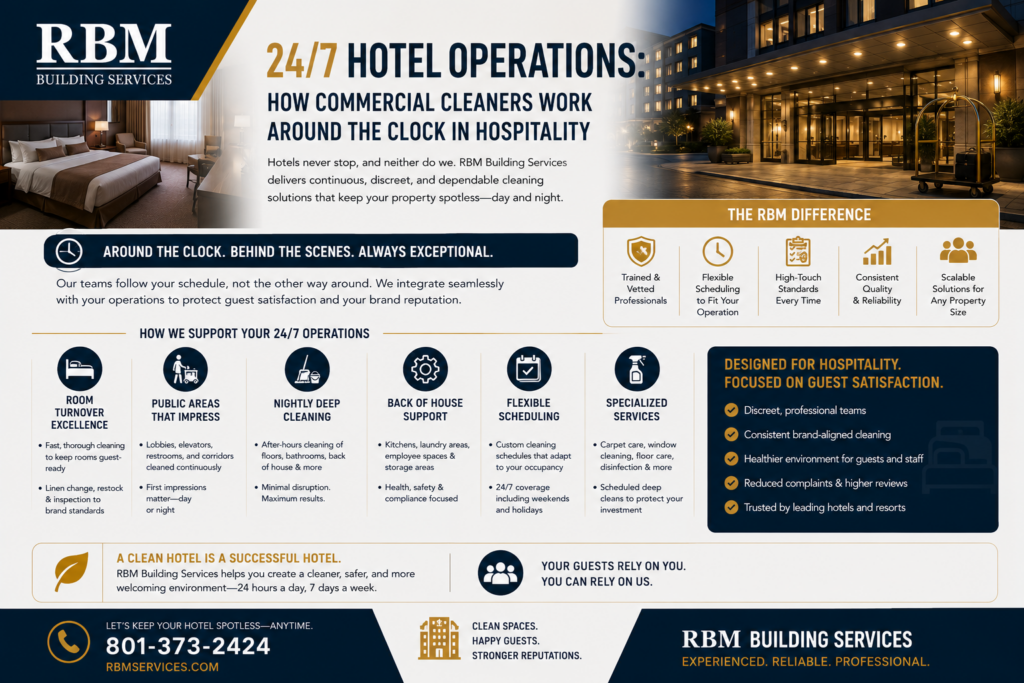
Hotels never close. While offices, schools, and retail stores have defined operating hours, hotels must maintain a clean and welcoming environment 24 hours a day, 365 days a year. Guests check in throughout the day and night, public areas are in constant use, and the cleaning program must adapt to the rhythm of hotel operations without disrupting guest experience. This requires a three-shift cleaning model that divides the workload across day, evening, and overnight periods. Each shift has specific responsibilities and uses different cleaning methods to match the level of guest activity at that time. For hotel general managers, operations directors, and housekeeping managers, understanding how to structure a 24/7 cleaning program is essential for maintaining the cleanliness standards that drive guest satisfaction and hotel revenue.
The financial importance of hotel cleanliness cannot be overstated. Online travel agencies like Expedia and Booking.com prominently feature cleanliness ratings in their search results, and hotels with higher cleanliness scores receive more bookings and command higher rates. A single point increase in a hotel’s online cleanliness rating is associated with a 1.5% increase in average daily rate and a 2.3% increase in occupancy, according to a Cornell University study. For a 150-room hotel with an average daily rate of $150 and 70% occupancy, a 1.5% rate increase translates to $57,000 in additional annual revenue. Professional hotel cleaning is not an expense — it is a revenue-generating investment that directly impacts the hotel’s financial performance. See our hospitality cleaning services for hotel cleaning programs.

24/7 Hotel Cleaning Operations
The three-shift cleaning model is the standard approach for full-service hotels that operate 24 hours a day. The day shift (typically 7:00 AM to 3:00 PM) is the largest cleaning crew and focuses primarily on guest room cleaning and preparation. Day shift housekeepers clean check-out rooms and prepare them for incoming guests, clean stay-over rooms (rooms where guests are continuing their stay), and perform initial cleaning of public areas. The day shift typically includes the housekeeping supervisor who inspects rooms, assigns work to housekeepers, and coordinates with the front desk on room status. The evening shift (typically 3:00 PM to 11:00 PM) focuses on turn-down service, evening cleaning of public areas, and responding to guest requests for additional amenities or cleaning. The evening shift is smaller than the day shift but must be highly responsive to guest needs. The overnight shift (typically 11:00 PM to 7:00 AM) focuses on deep cleaning of guest rooms and public areas that cannot be performed during the day. This is the only time when certain cleaning activities can be performed without disrupting guests.
The size of each shift depends on the hotel’s size, occupancy level, and service level. A typical full-service hotel with 200 rooms might have 15-20 housekeepers on the day shift, 5-8 on the evening shift, and 3-5 on the overnight shift. Limited-service hotels may have a two-shift model (day and evening) or a single day shift with evening coverage provided by front desk staff. The key to effective shift management is clear communication between shifts — the day shift must communicate which rooms need attention to the evening shift, and the evening shift must communicate any issues that need overnight attention. Many hotels use housekeeping management software that tracks room status, assigns tasks, and documents cleaning completion across all shifts.
The Three-Shift Hotel Cleaning Model
The day shift is the backbone of hotel cleaning operations. Day shift housekeepers typically clean 12-16 rooms per shift, with check-out rooms requiring 30-45 minutes and stay-over rooms requiring 15-25 minutes. The day shift cleaning routine for check-out rooms includes stripping the bed and placing linens in the laundry cart, cleaning and sanitizing the bathroom (toilet, shower, sink, mirror, floor), dusting all surfaces (furniture, fixtures, window sills, artwork, lamps), vacuuming all carpeted areas and mopping hard floors, making the bed with fresh linens, restocking all amenities (soap, shampoo, lotion, coffee, cups, ice bucket, trash bags), and inspecting the room for maintenance issues or damage. Day shift housekeepers also clean public areas on a rotating schedule — typically lobby and front desk area daily, fitness center and pool area daily, restrooms (multiple times per day), and meeting rooms and event spaces as needed based on event schedules.
Efficiency on the day shift is critical because rooms must be ready for check-in by the hotel’s posted check-in time (typically 3:00 PM). Hotels use room status codes to track which rooms are ready for occupancy. The front desk and housekeeping departments must communicate constantly about room availability — the front desk cannot assign a room that has not been cleaned and inspected. Many hotels use a zone cleaning system where each housekeeper is assigned to a specific floor or wing of the hotel. Zone cleaning reduces travel time between rooms and allows housekeepers to become familiar with the room layouts in their zone. Housekeeping carts should be stocked with all supplies needed for a full shift to minimize trips to the linen closet. Hotels that invest in housekeeping technology — such as handheld devices that update room status in real time — can significantly improve day shift efficiency and reduce the time it takes to make rooms available for check-in.
Day Shift: Guest Room and Public Area Cleaning
The evening shift continues guest room cleaning for rooms that check out later in the day or that were not ready during the day shift. Evening housekeepers also provide turn-down service for guests who have requested it — this typically includes opening the bed covers, placing a turn-down gift or card on the pillow, refreshing the bathroom, emptying trash, and adjusting the room temperature. Turn-down service is a hallmark of luxury hotels and is increasingly offered by upscale select-service hotels as a competitive differentiator. The evening shift also focuses on maintaining public areas throughout the evening hours. Lobby restrooms should be checked and cleaned at least every 1-2 hours during the evening. The hotel bar and restaurant require ongoing cleaning attention — tables should be cleared and wiped after each party, floors should be swept and spot mopped as needed, and restrooms should be checked frequently. Evening housekeepers should also respond to guest requests for additional towels, toiletries, or other amenities.
Evening cleaning of fitness centers and pool areas is essential for hotels that want to maintain these amenities in good condition. Fitness equipment should be wiped down after each use by guests, with a thorough cleaning performed by housekeeping at the end of the evening shift. Pool decks should be swept and hosed down daily, with furniture wiped down and arranged for the next morning. The evening shift should also perform a security walk-through of public areas to ensure that doors are locked, lights are functioning, and no safety hazards are present. In many hotels, the evening shift supervisor is the most senior housekeeping person on duty and serves as the primary point of contact for guest complaints and requests related to cleanliness. For hotel cleaning services, see our hospitality cleaning page.
Evening Shift: Turn-Down and Refresh Services
The overnight shift performs the deep cleaning and maintenance tasks that cannot be done during the day because they would disrupt guests or interfere with hotel operations. Overnight tasks include complete cleaning of public areas including stripping and refinishing hard floors in lobbies and corridors (using burnishers and floor machines that would be too noisy during the day), hot water extraction cleaning of carpet in public areas, deep cleaning of restrooms (including scrubbing grout and cleaning behind fixtures), cleaning of windows and glass surfaces (interior and exterior where accessible), cleaning of light fixtures and ceiling vents, cleaning of kitchen and food service areas (including hood cleaning and grease trap cleaning), and cleaning of back-of-house areas including offices, employee break rooms, and storage areas. The overnight shift also performs deep cleaning of guest rooms on a rotating basis — each guest room should receive a thorough deep cleaning at least quarterly.
The overnight cleaning schedule should be carefully planned to complete all tasks within the available hours while allowing the cleaning team to vacate public areas before morning arrivals begin. Most hotels plan overnight cleaning zones so that no area is out of service for more than 2-3 hours at a time. The overnight shift should also include a security component — overnight cleaners can serve as additional eyes and ears in the hotel, reporting any safety or security concerns to hotel management or security staff. Overnight cleaners should have training on emergency procedures, including fire response and medical emergencies. Many hotels find that the overnight shift is the most efficient cleaning shift because there are no guests present in the areas being cleaned, allowing cleaners to work faster and more thoroughly. The quality of overnight cleaning directly affects guest satisfaction — guests who arrive in the morning to find a lobby that smells clean, has sparkling floors, and is free of debris will form a positive first impression that carries through their stay.
Overnight Shift: Deep Cleaning and Maintenance
Managing peak periods is one of the greatest challenges in hotel cleaning operations. Most hotels have predictable peak occupancy periods that correspond to holidays, local events, conventions, and seasonal tourism. During peak periods, the cleaning workload can increase by 50-100% or more, requiring additional staffing, extended shifts, and careful planning. Hotels should develop peak period cleaning plans that specify additional staffing requirements, pre-event deep cleaning schedules, and contingency plans for unexpected events. During peak periods, the day shift may need to start earlier (6:00 AM instead of 7:00 AM) and work later, and the evening shift may need additional staff to handle increased guest service demands. Many hotels use on-call or temporary housekeepers during peak periods, but these staff must receive proper training on hotel cleaning standards before they begin work.
Staffing challenges are a persistent issue in hotel cleaning, as the hospitality industry faces chronic labor shortages for housekeeping positions. Hotels should invest in strategies to attract and retain housekeeping staff, including competitive wages and benefits, flexible scheduling options (some housekeepers prefer early morning shifts, others prefer evening shifts), career advancement opportunities, and recognition programs that celebrate cleaning achievements. Technology can help reduce staffing pressures — housekeeping management software, automated room status updates, and labor management systems can improve efficiency and reduce the number of staff hours required per room. Self-service options for guests (such as digital check-in and keyless entry) can reduce front desk workload and allow more staff to be allocated to housekeeping. The hotels that succeed in maintaining high cleanliness standards despite staffing challenges are those that invest in their housekeeping teams and treat them as essential members of the hotel’s success. For more on hotel cleaning, read our company blog.
Managing Peak Periods and Staffing Challenges
Building a successful 24/7 hotel cleaning program requires a comprehensive approach that addresses staffing, scheduling, training, quality assurance, and communication across all three shifts. The foundation of the program is a detailed cleaning specification that defines cleaning frequencies, methods, and standards for every area of the hotel. The specification should be developed by the hotel’s executive housekeeper in consultation with the general manager and should be reviewed and updated annually. The specification should include daily cleaning tasks for each shift, weekly cleaning tasks (such as shampooing of high-traffic carpet areas), monthly cleaning tasks (such as cleaning of draperies and upholstery), and quarterly and annual cleaning tasks (such as deep cleaning of all guest rooms, refinishing of hard floors, and cleaning of HVAC systems).
Quality assurance is essential for maintaining consistent cleaning standards across all shifts. Hotels should implement a system of daily inspections by housekeeping supervisors, weekly inspections by the executive housekeeper, and monthly inspections by the general manager or rooms director. Inspection results should be documented and tracked over time to identify trends and areas that need additional attention. Guest feedback on cleanliness — from online reviews, comment cards, and post-stay surveys — should be reviewed daily and used to guide improvement. Hotels that systematically track and respond to cleanliness feedback consistently earn higher cleanliness ratings than those that do not. The investment in a comprehensive 24/7 hotel cleaning program pays for itself through higher guest satisfaction scores, better online ratings, increased occupancy, and higher room rates. RBM Building Services has provided hotel and hospitality cleaning, commercial janitorial services, and pressure washing since 1974 across Utah, Arizona, Nevada, and Texas. Call 800.403.3564 or contact us for a hotel cleaning consultation. Read more on our company blog.
Around-the-clock hotel cleaning services
Building a 24/7 Hotel Cleaning Program
Building a successful 24/7 hotel cleaning program requires a comprehensive approach that addresses staffing, scheduling, training, quality assurance, and communication across all three shifts. The foundation of the program is a detailed cleaning specification that defines cleaning frequencies, methods, and standards for every area of the hotel. The specification should be developed by the hotel’s executive housekeeper in consultation with the general manager and should be reviewed and updated annually. The specification should include daily cleaning tasks for each shift, weekly cleaning tasks (such as shampooing of high-traffic carpet areas), monthly cleaning tasks (such as cleaning of draperies and upholstery), and quarterly and annual cleaning tasks (such as deep cleaning of all guest rooms, refinishing of hard floors, and cleaning of HVAC systems).
Quality assurance is essential for maintaining consistent cleaning standards across all shifts. Hotels should implement a system of daily inspections by housekeeping supervisors, weekly inspections by the executive housekeeper, and monthly inspections by the general manager or rooms director. Inspection results should be documented and tracked over time to identify trends and areas that need additional attention. Guest feedback on cleanliness — from online reviews, comment cards, and post-stay surveys — should be reviewed daily and used to guide improvement. Hotels that systematically track and respond to cleanliness feedback consistently earn higher cleanliness ratings than those that do not. The investment in a comprehensive 24/7 hotel cleaning program pays for itself through higher guest satisfaction scores, better online ratings, increased occupancy, and higher room rates. RBM Building Services has provided hotel and hospitality cleaning, commercial janitorial services, and pressure washing since 1974 across Utah, Arizona, Nevada, and Texas. Call 800.403.3564 or contact us for a hotel cleaning consultation. Read more on our company blog.