Preparing your commercial building for professional carpet cleaning involves clearing the area before the crew arrives, protecting sensitive items, noting specific stains for the technicians, and planning for 4-12 hours of drying time depending on the cleaning method used.
Professional commercial carpet cleaning delivers dramatically better results when the building and its occupants are properly prepared. While the carpet cleaning crew brings the equipment, expertise, and cleaning solutions, property managers and facility coordinators play a critical role in ensuring access, protecting furnishings, facilitating tenant communication, and setting expectations for drying time. Proper preparation reduces disruptions, prevents damage to furniture and equipment, improves cleaning results, and helps carpets dry faster and more completely. This guide covers everything you need to do to prepare your commercial building for a professional carpet cleaning visit, from initial scheduling to post-cleaning follow-up.
Whether you schedule carpet cleaning quarterly, semi-annually, or annually as part of your building maintenance program, following these preparation steps will maximize the value of your cleaning investment. A well-prepared building allows the cleaning crew to focus on cleaning rather than moving furniture, navigating obstacles, or explaining procedures to surprised tenants — resulting in better cleaning outcomes and a smoother overall experience.

Why Proper Preparation Matters for Commercial Carpet Cleaning
Preparation for commercial carpet cleaning begins with communication — not when the cleaning crew arrives, but at least one to two weeks in advance. Building occupants and tenants need advance notice to prepare their workspaces, secure sensitive items, and plan around any schedule disruptions. A notification should be sent to all affected tenants at least one week before the scheduled cleaning, specifying the date and time of cleaning, areas that will be cleaned, expected duration, and drying time. Include instructions for what tenants need to do to prepare: clear items from floors, remove personal belongings from desks and workstations, unplug computer equipment if floors near workstations will be cleaned, and secure any sensitive documents or valuables.
Coordinate with the cleaning company to confirm the schedule, access requirements, and any special instructions. Provide the cleaning company with a floor plan or area list showing exactly which areas need cleaning. Confirm that the cleaning crew has adequate parking and building access. If after-hours cleaning is scheduled, ensure that the cleaning crew has the necessary keys, codes, or fobs for access. For buildings with security systems, arrange for alarms to be disarmed during the cleaning window and re-armed afterward. For more on coordinating with professional cleaners, see our commercial janitorial services.
Step 1: Communication and Scheduling Preparation
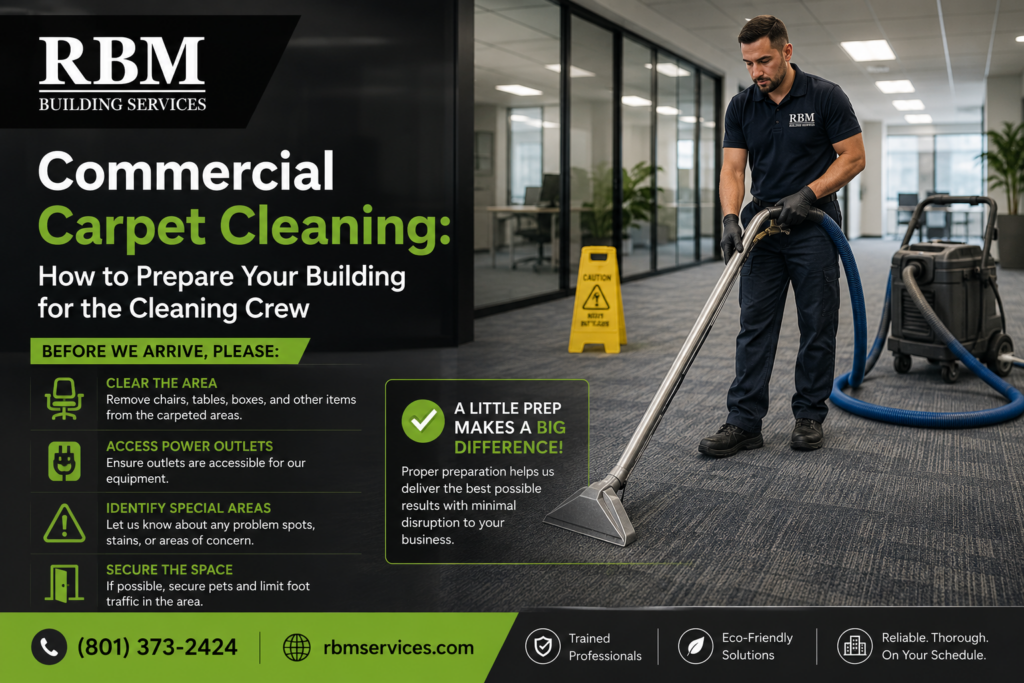
The single most time-consuming task for a carpet cleaning crew — and the biggest variable in cleaning time and cost — is moving furniture. Most professional carpet cleaning companies expect the building or tenants to clear the area before the crew arrives. Furniture that should be moved before carpet cleaning includes: chairs and small tables that impede access to the carpet (these should be stacked or moved to non-carpeted areas), wastebaskets and recycling bins (empty and relocate), floor plants and plant stands, floor fans, space heaters, and decorative items, and personal items stored on the floor.
Furniture that is too heavy or cumbersome to move — large desks, filing cabinets, bookshelves, conference tables, cubicle panels, and large credenzas — is typically cleaned around by the crew, who use specialized tools to clean the exposed perimeter of the carpet. If these items absolutely must be moved for cleaning, notify the cleaning company in advance and expect additional charges for furniture moving services. Some commercial cleaning companies offer furniture moving as an add-on service for an additional fee. In many cases, tenants are responsible for moving their own furniture and clearing their workspaces, while common area furniture is handled by the building maintenance team.
Step 2: Furniture and Items to Move Before the Crew Arrives
Before the cleaning crew arrives, walk through the areas to be cleaned and identify any specific stains or problem areas that require special attention. Common commercial carpet stains include coffee and tea spills in break rooms, ink stains from pens in office areas, food and beverage stains in common areas and conference rooms, traffic patterns and soil buildup near building entrances, and mystery stains that appeared and set before they were noticed. Mark these areas with sticky notes or small flags and point them out to the cleaning crew when they arrive so they can apply pre-treatment or spot-cleaning agents before the overall cleaning begins.
Do not attempt to treat stains yourself with over-the-counter products before the professional cleaning arrives. Many DIY spot cleaners leave residue that interferes with professional cleaning solutions and can actually set stains permanently. Some home remedies like vinegar, baking soda, or hydrogen peroxide can damage carpet fibers or affect carpet dye. Leave stain treatment to the professionals who have the correct products and know which approach works for different types of stains and carpet materials. Simply identify the stains and let the professionals handle them. For more on commercial carpet stain removal, see our carpet and upholstery cleaning page.
Step 3: Pre-Cleaning Spot Treatment and Stain Identification
Before carpet cleaning begins, take steps to protect sensitive areas and equipment in the building. Protect computer equipment including desktop computers, servers, and network equipment from moisture by covering them with plastic sheeting or moving them away from cleaning areas. If carpet cleaning will occur near data center or server room areas, coordinate with IT staff to ensure equipment is protected. Elevator thresholds and door tracks should be protected with tape or covers to prevent water intrusion into elevator shafts or adjacent rooms. Wood and laminate flooring adjacent to carpeted areas should be protected from excess moisture that could damage these surfaces.
Wall bases and baseboards should be checked for gaps where cleaning solution could seep under walls. If gaps are found, they should be sealed or the cleaning crew should take extra precautions in these areas. Sensitive documents and files stored on lower shelves near the floor should be relocated to higher surfaces or covered. Electronic equipment on floors — power strips, surge protectors, network cables — should be elevated or moved. Any valuable or fragile decorative items near floor level should be secured or moved to prevent accidental damage during cleaning.
Step 4: Protecting Sensitive Areas and Equipment
During the actual cleaning, professional crews will typically begin by vacuuming all carpeted areas thoroughly using commercial-grade vacuums with HEPA filtration. Next, they apply pre-treatment solution to high-traffic areas and specific stains, allowing appropriate dwell time for the solution to break down soil. The main cleaning is performed using hot water extraction (steam cleaning), the preferred method for commercial carpets. The technician passes over the carpet with a wand that injects hot water and cleaning solution under pressure and immediately extracts the dirty water, soil, and residue into the machine’s recovery tank. For heavily soiled areas, multiple passes may be required.
After cleaning, the carpet will be wet and requires time to dry. Drying time depends on the cleaning method used, carpet type, padding thickness, humidity, and ventilation. With hot water extraction, drying time is typically 4-12 hours for commercial carpets cleaned with truck-mounted equipment (higher water pressure and stronger vacuum extraction) versus 8-24 hours for portable equipment. To speed drying, maximize ventilation by opening windows if weather permits, turning on HVAC fans to circulate air, using floor fans or air movers to accelerate evaporation, and avoiding foot traffic on wet carpet. Carpet should be completely dry before furniture is returned to its original position to prevent mold growth and furniture staining.
Step 5: What to Expect During and After Cleaning
After the cleaning is complete and the carpet has dried, walk through the cleaned areas to inspect the results. Check for any missed spots or areas that need additional attention and report these to the cleaning company promptly — most professional cleaners will return to address issues within 24-48 hours at no additional charge. Replace furniture and items carefully in their original positions. If furniture casters or legs were sitting on wet carpet, use furniture coasters or plastic bags under furniture legs until the carpet is fully dry to prevent rust stains or discoloration.
To extend the life of your newly cleaned commercial carpet, implement a post-cleaning maintenance routine that includes daily vacuuming in high-traffic areas (entrances, corridors, break rooms), weekly vacuuming in standard office areas, prompt spot cleaning of spills using appropriate commercial carpet spotter, use of walk-off mats at all building entrances (changed and cleaned regularly), and professional cleaning scheduled at appropriate intervals based on traffic levels. Most commercial carpets in standard office environments benefit from professional cleaning every 6-12 months, while high-traffic areas may need cleaning every 3-6 months.
RBM Building Services has provided commercial carpet cleaning, janitorial services, and building maintenance since 1974 across Utah, Arizona, Nevada, and Texas. Call 800.403.3564 or contact us to schedule your commercial carpet cleaning. Read more on our company blog and our partner DoubleTake Carpet Cleaning blog.
Prepare your building for professional carpet cleaning. Contact RBM for a quote.
Post-Cleaning Follow-Up and Maintenance
After the cleaning is complete and the carpet has dried, walk through the cleaned areas to inspect the results. Check for any missed spots or areas that need additional attention and report these to the cleaning company promptly — most professional cleaners will return to address issues within 24-48 hours at no additional charge. Replace furniture and items carefully in their original positions. If furniture casters or legs were sitting on wet carpet, use furniture coasters or plastic bags under furniture legs until the carpet is fully dry to prevent rust stains or discoloration.
To extend the life of your newly cleaned commercial carpet, implement a post-cleaning maintenance routine that includes daily vacuuming in high-traffic areas (entrances, corridors, break rooms), weekly vacuuming in standard office areas, prompt spot cleaning of spills using appropriate commercial carpet spotter, use of walk-off mats at all building entrances (changed and cleaned regularly), and professional cleaning scheduled at appropriate intervals based on traffic levels. Most commercial carpets in standard office environments benefit from professional cleaning every 6-12 months, while high-traffic areas may need cleaning every 3-6 months.
RBM Building Services has provided commercial carpet cleaning, janitorial services, and building maintenance since 1974 across Utah, Arizona, Nevada, and Texas. Call 800.403.3564 or contact us to schedule your commercial carpet cleaning. Read more on our company blog and our partner DoubleTake Carpet Cleaning blog.