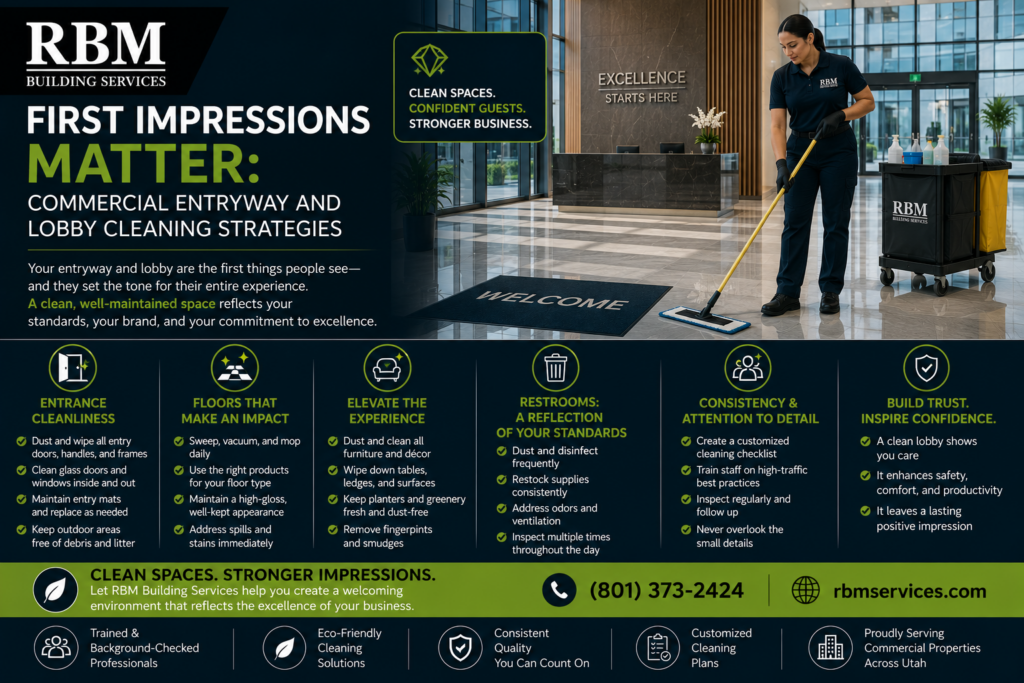
The entryway and lobby are the first things tenants, visitors, and prospective tenants see when they enter your commercial building. Studies show that people form an impression of a building within 7-10 seconds of entering. A sparkling clean lobby signals quality, professionalism, and attention to detail. A neglected entryway — dirty floors, smudged glass, overflowing trash — suggests the entire building is poorly managed. For property managers, the entryway cleaning program deserves disproportionate attention because it shapes every visitor’s perception of the property.
What Should Be Cleaned and How Often
Floors: Entryway floors need the most frequent attention of any surface in the building. Sweep or dust mop throughout the day. Damp mop nightly. Auto-scrub daily if the entryway sees heavy traffic. Burnish or buff weekly to maintain gloss on hard floors. Vacuum carpeted entryways daily with HEPA-filtered equipment. Glass doors and windows: Clean interior glass daily. Spot clean throughout the day as needed. Full exterior glass cleaning weekly. Furniture and surfaces: Dust and polish all lobby furniture daily. Wipe down all hard surfaces including reception desks, tables, and ledges. Entry mats: Vacuum mats daily. Deep clean or replace monthly. Rotate mats to distribute wear. Light fixtures: Dust light fixtures weekly. Deep clean quarterly. Plants and decor: Dust artificial plants weekly. Water and maintain live plants. For comprehensive building care, our full-service janitorial programs prioritize lobby and entryway maintenance.
The Entryway Matting System
A proper entryway matting system is the single most effective tool for keeping a lobby clean. Industry best practice calls for a minimum 15-foot walk-off zone with three types of matting: scraper mats outside the entrance (remove heavy debris), absorbent mats just inside (capture moisture), and decorative interior mats (finish drying and capture remaining particles). Mats must be cleaned regularly — dirty mats become sources of dirt and moisture rather than barriers. Commercial mat rental services provide clean mats on a weekly or bi-weekly schedule.
What Tenants Notice in Lobbies
Property manager surveys consistently rank these lobby elements as most noticed by tenants: floor cleanliness (streaks, scuffs, debris), glass condition (smudges, streaks, fingerprints), trash and recycling area appearance, furniture cleanliness and condition, smell/odor, and lighting quality (burned out bulbs or dirty fixtures). A lobby inspection checklist should include all of these items checked at the beginning and end of each day. For help maintaining these standards, see our building maintenance services.
Seasonal Lobby Challenges
Winter: Salt, snow, and moisture create the biggest lobby cleaning challenge. Increase entry matting to maximum coverage. Increase mopping frequency to every 2-3 hours during wet weather. Place additional floor mats at elevator banks and corridor entrances. Spring: Pollen tracks in easily. Increase glass cleaning frequency. Summer: Dust and sand from open doors. Increase entryway sweeping and vacuuming. Fall: Leaves and moisture tracked in. Clean entry mats more frequently to prevent debris from being carried deeper into the building.
Additional FAQs
Should lobbies be cleaned during business hours or after hours? Both. After-hours cleaning handles the deep cleaning — floor burnishing, full vacuuming, glass cleaning. During business hours, a day porter or lobby attendant handles spot cleaning — wiping down surfaces, spot vacuuming, and responding to spills or visible dirt.
What type of flooring is best for a lobby from a maintenance perspective? Polished concrete or high-end VCT with a quality finish are the most practical options. Both are durable, easy to clean, and maintain a professional appearance with regular maintenance. Carpet in entryways requires more frequent cleaning and replacement.
How does lobby cleanliness affect leasing? Prospective tenants form their opinion of a building within seconds of entering the lobby. A clean, well-maintained lobby directly supports higher rental rates and faster lease-up times. Many property managers invest in enhanced lobby cleaning programs as a leasing tool.
What is the single most impactful thing I can do for my lobby? Install a proper commercial matting system with a 15-foot walk-off zone. Clean or replace mats regularly. This single investment reduces the dirt tracked into the lobby by 70-80%, dramatically reducing the cleaning burden on all other lobby surfaces.
About RBM Building Services: Since 1974, RBM has provided commercial janitorial, pressure washing, and window washing for commercial lobbies and entryways across Utah, Arizona, Nevada, and Texas. Call 800.403.3564 or contact us.
The Psychology of Clean Lobbies: Why First Impressions Stick
Environmental psychology research confirms that the condition of a building’s entryway directly shapes how people perceive the entire property. This is called the “halo effect” — a positive first impression in the lobby causes visitors to rate the entire building more favorably across all categories, even areas they have not seen. Studies show that visitors who rate a lobby as “very clean” are 40% more likely to rate the building as well-managed overall. Conversely, a single negative observation — a dirty floor, smudged glass, or overflowing trash — can undermine all other positive impressions. For property managers, this means the lobby cleaning budget delivers outsized returns compared to any other area of the building. Every dollar spent on lobby appearance directly supports rental rates, tenant retention, and building reputation. Our full-service janitorial programs prioritize lobby and common area appearance with enhanced cleaning protocols.
The Complete Lobby Cleaning Checklist
A comprehensive lobby cleaning program covers every surface and element. Hourly (during business hours): Spot vacuum entryway mats and high-traffic floor areas. Spot clean glass doors and entrance panels. Wipe down elevator call buttons and door frames. Check restroom cleanliness and restock supplies. Empty trash and recycling receptacles if half full. Daily (after hours): Vacuum all carpeted areas with HEPA-filtered equipment. Dust mop and damp mop all hard floors. Burnish or buff hard floor surfaces. Clean all interior glass surfaces. Dust all furniture, ledges, window sills, and decorative elements. Clean and disinfect restrooms thoroughly. Dust all light fixtures and ceiling surfaces. Clean elevator interiors and door tracks. Wipe down baseboards and door frames. Weekly: Deep clean all lobby upholstered furniture. Clean interior window blinds or shades. Polish metal surfaces (elevator doors, mailboxes). Detail clean entry matting. Dust all artwork, wall hangings, and decorative items. Monthly: Strip and recoat high-traffic floor areas. Deep extract clean carpeted areas. Clean ceiling vents, diffusers, and grilles. Wash interior windows on all lobby levels. Quarterly: Deep clean all light fixtures including chandeliers. Pressure wash entryway sidewalks and canopies. Clean exterior windows. Restore floor finish in all lobby areas. Inspect and repair any damaged surfaces.
Selecting the Right Entry Matting System
Entry matting is the single most effective investment for lobby cleanliness. A properly designed matting system traps 70-80% of the dirt, moisture, and debris that would otherwise be tracked into the building. Key specifications for commercial entry matting include: a minimum 15-foot walk-off zone (measured from the outer door), three-zone system — scraper (exterior), scraper/absorber (interior door), and absorber (lobby interior), heavy-duty construction rated for commercial foot traffic, anti-fatigue backing, slip-resistant surface, and easy cleaning and maintenance. Matting material options include: nylon or polyester carpet mats (best for absorption — ideal for wet climates), rubber or vinyl scraper mats (best for scraping — ideal for entrance thresholds), combination mats (scraper/absorber in one — good general-purpose choice), and custom logo mats (branded with building name — professional appearance). Mat cleaning frequency is critical. Dirty mats become a source of dirt rather than a barrier. Commercial mat rental services provide clean mats on a weekly or bi-weekly rotation, which is preferred for Class A buildings. For specialized mat cleaning and maintenance support, see our building maintenance services.
Technology and Tools for Lobby Cleaning
Professional lobby cleaning requires commercial-grade equipment beyond standard janitorial tools. Auto-scrubbers: Battery-powered floor cleaning machines that dispense solution, scrub, and vacuum in one pass. Ideal for large lobby areas with hard flooring. Available in walk-behind and ride-on configurations. High-speed burnishers: Operate at 1,500-3,000 RPM to restore gloss to hard floor finishes. Use diamond or natural-hair pads depending on floor type. HEPA backpack vacuums: More powerful and ergonomic than upright vacuums. Allow cleaning crews to vacuum under furniture and in tight spaces. HEPA filtration ensures captured particles are not recirculated. Microfiber cleaning systems: Flat mop systems with microfiber pads that trap dirt more effectively than string mops. Color-coded by zone (blue for glass, green for general, red for restrooms) to prevent cross-contamination. Electrostatic sprayers: Apply disinfectant evenly to all surfaces including hard-to-reach areas. Increasingly used for lobby restroom disinfection and high-touch surface treatment. Digital inspection tools: Tablet-based inspection systems that document cleaning quality with photos and checklists. Provide property managers with verifiable proof of cleaning completion. For technology-forward cleaning programs, our full-service janitorial includes digital reporting and quality assurance systems.
Additional FAQs
Should lobby restrooms be cleaned more frequently than other building restrooms? Yes. Lobby restrooms are used by visitors, delivery personnel, and tenants from all floors — they receive the widest variety of use and the highest scrutiny. They should be cleaned and inspected at least twice daily (mid-day and after hours), with additional checks during business hours if a day porter is on staff. Restroom cleanliness complaints are the #1 source of negative lobby impressions.
How do I handle lobby cleaning during bad weather? Increase all entry and lobby cleaning frequencies during wet or snowy weather. Place additional walk-off mats at all entrances. Deploy extra staff to monitor and clean entryways during precipitation events. Use wet floor signs proactively, not reactively. If a day porter is on staff, their primary focus during bad weather should be entryway maintenance.
What is the best floor finish for a lobby? For VCT floors, a high-gloss acrylic finish with 20-25% solids provides the best appearance and durability. For polished concrete, use a densifier and sealer appropriate for commercial traffic. For natural stone, use a penetrating sealer that protects without altering appearance. Regardless of floor type, apply extra coats of finish in high-traffic zones and schedule more frequent burnishing to maintain the gloss that tenants and visitors associate with quality.
How do I deal with elevator cleaning without disrupting tenants? Elevator cleaning should be scheduled for low-use periods. Spot clean during the day using quick-drying cleaners. Full interior cleaning (walls, ceiling, tracks, floor) should be done after hours. Consider card-key restricting one elevator at a time for cleaning while others remain in service. Document elevator cleaning separately since poor elevator appearance is a common tenant complaint.
What percentage of my cleaning budget should go to lobby and entryway maintenance? Industry best practice allocates 15-25% of the total cleaning budget to lobby, entryway, and common area maintenance, even though these areas typically represent only 5-10% of the total building square footage. The disproportionate investment reflects the outsized impact these areas have on tenant and visitor perception.