Senior living and assisted living facilities require specialized cleaning that balances infection control with resident comfort. This guide covers cleaning protocols for common areas, resident rooms, dining facilities, and memory care units.
Senior living and assisted living facilities occupy a unique position in the commercial cleaning market. They combine the cleaning requirements of healthcare facilities (infection control, regulatory compliance) with the comfort and personalization needs of residential environments. Residents of senior living communities are typically older adults who are more vulnerable to infections, have more sensitive respiratory systems, and spend more time in the facility than residents of other facility types. The cleaning program must balance clinical cleanliness with a welcoming, homelike atmosphere that supports resident dignity and quality of life. For executive directors, facility managers, and housekeeping supervisors in senior living communities, understanding the specialized cleaning requirements of this setting is essential for resident health, regulatory compliance, and family satisfaction.
The senior living market is growing rapidly as the U.S. population ages. According to the American Seniors Housing Association, there are approximately 30,000 senior housing properties in the United States serving over 2 million residents. This number is expected to grow significantly as the Baby Boom generation continues to age. Senior living communities include independent living (residents who need minimal assistance), assisted living (residents who need help with daily activities), memory care (residents with Alzheimer’s and other dementias), and skilled nursing (residents who require medical care). Each level of care has different cleaning requirements, with skilled nursing requiring the most stringent infection control protocols. See our medical facility cleaning services for senior living cleaning programs.

Cleaning Senior Living and Assisted Living Facilities
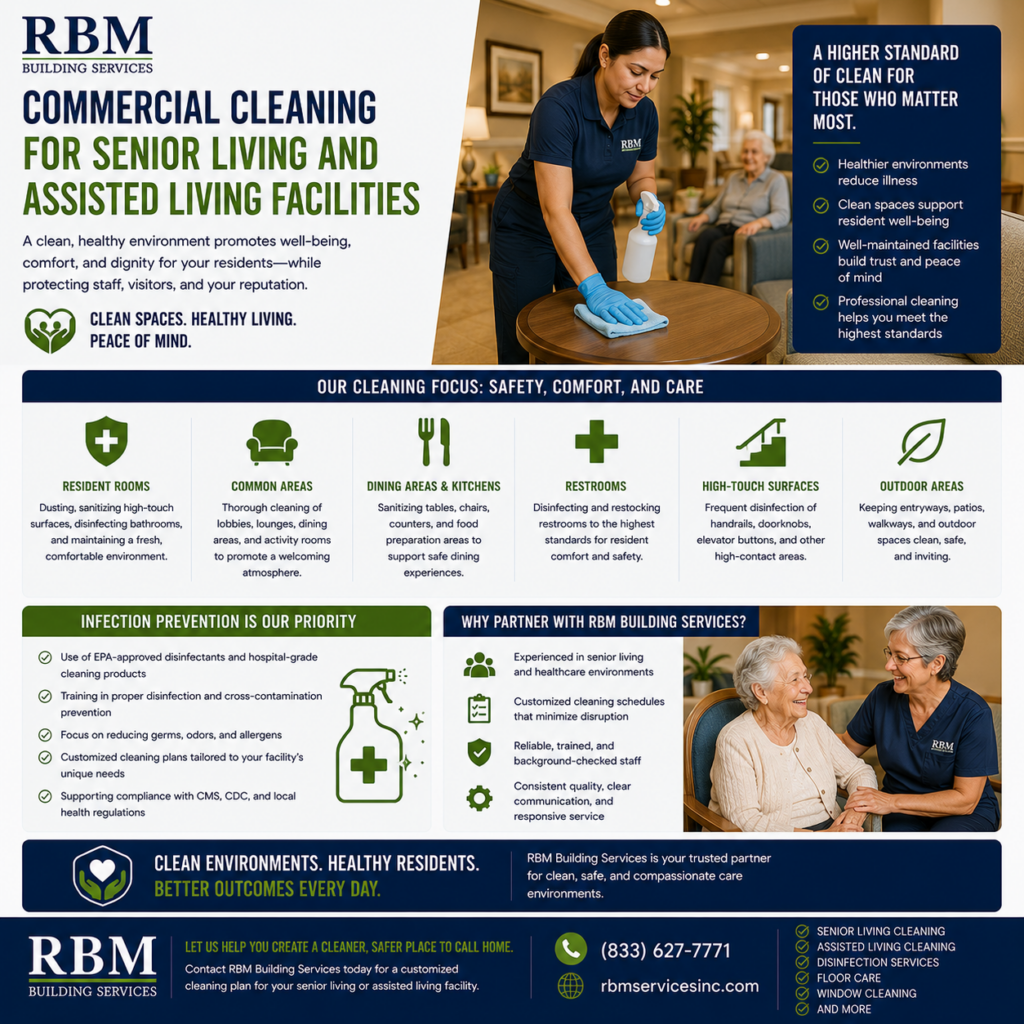
Infection control is the most critical aspect of senior living cleaning. Older adults are more susceptible to infections due to age-related changes in the immune system, and outbreaks of respiratory and gastrointestinal illnesses can spread rapidly through senior living communities. The CDC reports that influenza and norovirus outbreaks in long-term care facilities are common and can be severe, with attack rates of 20-50% among residents and staff during outbreaks. The cleaning program must include specific protocols for infection prevention, including daily disinfection of all high-touch surfaces in common areas and resident rooms using EPA-registered disinfectants effective against common pathogens, enhanced cleaning during cold and flu season (typically October through March), hand hygiene stations at all building entrances and in common areas, and cleaning of shared equipment (wheelchairs, walkers, lifts) between uses. Senior living communities should have a written infection prevention plan that includes cleaning protocols for routine operations, outbreak situations, and pandemic conditions.
The CDC and the Centers for Medicare and Medicaid Services (CMS) provide specific guidance for infection prevention in long-term care facilities. Key requirements include a designated infection preventionist who oversees the infection control program, documented cleaning and disinfection protocols for all areas of the facility, monitoring of cleaning effectiveness (using fluorescent markers or ATP testing), training of all staff on infection prevention practices, and reporting of infections to public health authorities as required. Senior living communities that participate in Medicare or Medicaid (primarily skilled nursing facilities) are subject to CMS survey requirements that include evaluation of environmental cleanliness. Deficiencies in cleaning and infection control are among the most common citations in CMS surveys and can result in fines, civil money penalties, and termination from Medicare/Medicaid participation. For more on infection control in senior care, read our company blog.
Infection Control in Senior Living Settings
Common areas in senior living communities — including lobbies, lounges, dining rooms, activity rooms, and libraries — are the heart of the community and must be maintained to the highest standard. These areas are used extensively by residents throughout the day and are also the first impression for visitors and prospective residents. Common area cleaning includes daily cleaning and disinfection of all high-touch surfaces, daily vacuuming or sweeping and damp mopping of all floors, weekly deep cleaning of upholstered furniture and fabric surfaces, and periodic cleaning of window treatments, light fixtures, and ceiling vents. Dining rooms require special attention because they serve three meals per day to residents, many of whom have limited mobility. Dining room tables and chairs should be cleaned and sanitized between each meal service, with floors cleaned after each meal. High chairs, wheelchairs, and walkers used in the dining room should be cleaned weekly or more frequently if visibly soiled. Activity rooms that are used for crafts, exercise, games, and social events require daily cleaning of tables and surfaces after each activity group, and cleaning of floors after each use.
Senior living communities should maintain a schedule of periodic deep cleaning for all common areas. Quarterly deep cleaning should include thorough cleaning of all upholstered furniture and fabric surfaces, cleaning of all window treatments, cleaning of all light fixtures and ceiling fans, and deep cleaning of all floors (carpet extraction, hard floor strip and refinish). Annual deep cleaning should include everything in quarterly deep cleaning plus cleaning of all walls and ceilings, cleaning of all HVAC vents and grilles, and cleaning of all storage rooms and closets. Many senior living communities schedule their deep cleaning during holidays or other periods when resident activity is lower to minimize disruption.
Common Area and Dining Room Cleaning
Resident room cleaning in senior living communities requires a balance between clinical cleanliness and respect for resident autonomy and dignity. Unlike hotel rooms, resident rooms in senior living communities are the resident’s home, and the cleaning program must respect the resident’s personal belongings, preferences, and privacy. Resident room cleaning typically includes daily cleaning of the room (making the bed, emptying trash, wiping bathroom surfaces, spot cleaning floors), weekly deep cleaning of the room (thorough cleaning of all surfaces, cleaning of bathroom fixtures, damp mopping of floors), and periodic cleaning of windows, blinds, and light fixtures. Cleaning staff should knock and announce themselves before entering a resident’s room, should address residents by name, and should engage residents in conversation as appropriate (many residents appreciate social interaction during cleaning visits).
Resident rooms in assisted living and memory care communities should be cleaned according to the resident’s care plan, which may specify additional cleaning needs. Bathrooms in resident rooms require daily cleaning and disinfection, with particular attention to grab bars and handrails, shower chairs and transfer benches, and toilet safety frames. Floors in resident rooms should be cleaned with appropriate products — some residents have respiratory sensitivities that require the use of low-VOC or fragrance-free cleaning products. Housekeeping staff should be trained to recognize changes in resident condition (increased soiling, unusual odors, signs of illness) and to report these changes to nursing staff. The relationship between housekeeping staff and residents is an important part of the resident experience — consistent assignment of housekeeping staff to the same residents allows relationships to develop and provides continuity for residents with memory impairment.
Resident Room Cleaning and Personalization
Memory care units require additional considerations in cleaning protocols. Residents with Alzheimer’s disease and other dementias may be confused or agitated by changes in their environment, unfamiliar cleaning staff, or the cleaning process itself. Cleaning in memory care units should be performed on a consistent schedule that is predictable for residents, by staff who are trained in dementia care and who understand how to interact with residents with memory impairment. Cleaning staff in memory care units should use fragrance-free and low-VOC products whenever possible, as strong odors can cause agitation in some residents with dementia. Cleaning should be performed using a routine that does not disturb residents’ personal belongings, as familiar objects provide comfort and orientation for residents with dementia. The cleaning staff should be trained to recognize signs of distress in residents and to adjust their approach accordingly.
Memory care units often have specific design features that require specialized cleaning. Secure outdoor spaces (wandering gardens) require regular cleaning and maintenance. Visual cues and orientation aids (signage, color-coded walls, memory boxes) should be kept clean and unobstructed. Snoezelen rooms or sensory stimulation rooms require specialized cleaning of equipment and surfaces. Common areas in memory care units should be cleaned at times when residents are engaged in structured activities to minimize disruption. Cleaning staff should be trained on the facility’s elopement prevention procedures and should understand how to respond if a resident attempts to leave the secured area during cleaning activities. The cleaning program in memory care is an integral part of the therapeutic environment and should be designed in consultation with the unit’s clinical team. For more on specialized senior living cleaning, see our healthcare cleaning page.
Memory Care Unit Cleaning Considerations
Senior living communities are subject to regulatory oversight at the federal, state, and local levels. Assisted living facilities are regulated primarily by state health departments or departments of social services, with requirements that vary by state. Skilled nursing facilities are regulated by CMS through Medicare and Medicaid certification requirements, which include specific standards for environmental cleanliness. State regulations for assisted living typically require that facilities be maintained in a clean, sanitary, and safe condition, that cleaning and housekeeping services be provided to residents, and that the facility have a written infection control plan. CMS requirements for skilled nursing facilities include specific standards for housekeeping and cleaning services, including that the facility maintain a clean, safe, and homelike environment, that housekeeping personnel be trained on infection control practices, and that the facility have procedures for cleaning and disinfecting resident rooms and common areas.
Documentation of cleaning activities is essential for regulatory compliance in senior living communities. Facilities should maintain cleaning logs that document daily cleaning of resident rooms, daily cleaning of common areas, periodic deep cleaning activities, infection control cleaning during outbreaks, and training of housekeeping staff. Cleaning logs should be maintained for at least the period required by state regulations (typically 1-3 years). Regulatory surveys typically include observation of cleaning practices, review of cleaning documentation, and interviews with residents about the cleanliness of the facility. Facilities with well-documented cleaning programs and well-trained housekeeping staff consistently achieve better survey results than facilities with informal cleaning programs. The investment in a professional, well-managed cleaning program is essential for regulatory compliance and resident satisfaction. RBM Building Services has provided senior living facility cleaning, commercial janitorial services, and window washing since 1974 across Utah, Arizona, Nevada, and Texas. Call 800.403.3564 or contact us for a senior living cleaning consultation.
Regulatory Compliance for Senior Living
Building a comprehensive senior living cleaning program requires a resident-centered approach that balances clinical cleanliness with comfort and dignity. The first step is to conduct a facility assessment that identifies the types of units (assisted living, memory care, skilled nursing), the common areas and their uses, the infection control risks specific to the facility, and the regulatory requirements that apply. Based on the assessment, develop a written cleaning plan that specifies cleaning frequencies, methods, and products for each area. The plan should be developed in consultation with the facility’s clinical team, the infection preventionist, and the housekeeping supervisor, and should be reviewed and updated at least annually. The plan should include daily, weekly, monthly, quarterly, and annual cleaning tasks for each area, with specific attention to infection control, resident safety, and resident dignity.
Staff training is the foundation of a successful senior living cleaning program. All housekeeping staff should receive initial training and annual refresher training on infection control practices for senior living settings, proper use of cleaning products and disinfectants, proper handling of soiled linens and waste, resident interaction and communication (including dementia care training for staff in memory care units), and safety practices (including proper lifting techniques and chemical safety). Housekeeping staff should be treated as valued members of the care team, with opportunities to participate in care conferences and to provide input on resident needs related to cleanliness and housekeeping. The most successful senior living communities recognize that housekeeping is not a support service — it is an integral part of the care experience that directly affects resident health, safety, and quality of life. RBM Building Services has provided senior living cleaning and commercial janitorial services since 1974. Call 800.403.3564 or contact us for a senior living cleaning plan. Read more on our company blog.
Specialized cleaning for senior living communities
Building a Senior Living Cleaning Program
Building a comprehensive senior living cleaning program requires a resident-centered approach that balances clinical cleanliness with comfort and dignity. The first step is to conduct a facility assessment that identifies the types of units (assisted living, memory care, skilled nursing), the common areas and their uses, the infection control risks specific to the facility, and the regulatory requirements that apply. Based on the assessment, develop a written cleaning plan that specifies cleaning frequencies, methods, and products for each area. The plan should be developed in consultation with the facility’s clinical team, the infection preventionist, and the housekeeping supervisor, and should be reviewed and updated at least annually. The plan should include daily, weekly, monthly, quarterly, and annual cleaning tasks for each area, with specific attention to infection control, resident safety, and resident dignity.
Staff training is the foundation of a successful senior living cleaning program. All housekeeping staff should receive initial training and annual refresher training on infection control practices for senior living settings, proper use of cleaning products and disinfectants, proper handling of soiled linens and waste, resident interaction and communication (including dementia care training for staff in memory care units), and safety practices (including proper lifting techniques and chemical safety). Housekeeping staff should be treated as valued members of the care team, with opportunities to participate in care conferences and to provide input on resident needs related to cleanliness and housekeeping. The most successful senior living communities recognize that housekeeping is not a support service — it is an integral part of the care experience that directly affects resident health, safety, and quality of life. RBM Building Services has provided senior living cleaning and commercial janitorial services since 1974. Call 800.403.3564 or contact us for a senior living cleaning plan. Read more on our company blog.