Slips, trips, and falls are the leading cause of workplace injuries and premises liability claims. Commercial cleaning is the primary defense against these incidents. This guide covers floor maintenance, hazard identification, and documentation practices that protect building owners from liability.
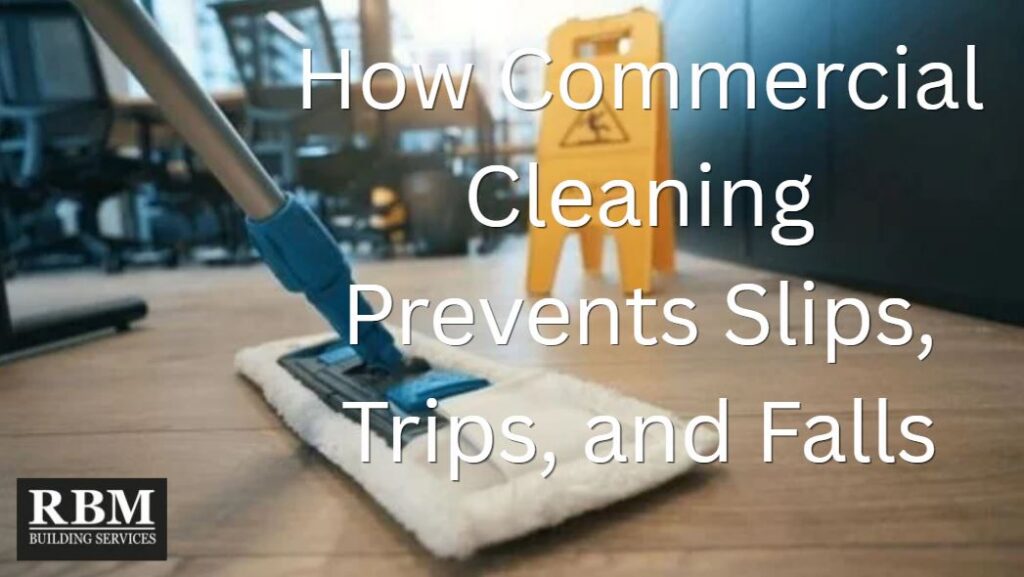
Slips, trips, and falls are the leading cause of unintentional injury in the United States, accounting for over 8 million emergency room visits and approximately 30,000 deaths annually. For commercial building owners and property managers, these incidents represent the single largest source of premises liability claims. According to the Insurance Information Institute, slip and fall claims account for approximately 30% of all general liability claims, with average settlements ranging from $20,000 to over $1 million depending on the severity of the injury. Commercial cleaning is the primary line of defense against these claims — a well-maintained floor is the most effective slip prevention measure available. This guide covers the specific cleaning practices, documentation protocols, and legal standards that building owners need to understand to protect themselves from slip and fall liability.
The legal standard for premises liability varies by state but generally follows the principle that property owners have a duty to maintain their premises in a reasonably safe condition. This duty includes regularly inspecting the property for hazards, addressing hazards promptly when discovered, and warning visitors of hazards that cannot be immediately corrected. Commercial cleaning contractors play a critical role in helping property owners meet this duty by providing consistent floor maintenance, identifying hazards during cleaning, and maintaining documentation of cleaning activities that can serve as evidence of reasonable care in the event of a claim. See our commercial janitorial services for professional slip prevention cleaning programs.

Slips, Trips, and Falls: Liability Protection Through Commercial Cleaning
Premises liability law requires that property owners exercise reasonable care to keep their premises safe for visitors. The standard of care varies depending on the visitor’s status (invitee, licensee, or trespasser) and the jurisdiction. Commercial property owners owe the highest duty of care to invitees — customers, clients, and other visitors who are on the property for business purposes. This duty includes conducting regular inspections of the premises, maintaining floors in a reasonably safe condition, providing adequate lighting, using appropriate floor mats and runners in high-risk areas, and posting warning signs when hazards exist. Failure to meet these obligations can result in liability for injuries sustained on the property.
Florida’s Slip and Fall Law (Fla. Stat. 768.0755) is often cited as a model for premises liability in slip and fall cases. Under this statute, a plaintiff must prove that the property owner had actual or constructive knowledge of the hazardous condition and failed to correct it within a reasonable time. Constructive knowledge can be established by showing that the condition existed for such a length of time that the owner should have discovered it in the exercise of reasonable care, or that the condition occurred with regularity such that it was foreseeable. This standard underscores the importance of regular cleaning and inspection schedules — documented cleaning logs that show floors were cleaned and inspected shortly before an incident can be powerful evidence that the owner exercised reasonable care.
Understanding Premises Liability for Slips and Falls
Floor maintenance standards for liability prevention go beyond basic cleanliness. The coefficient of friction (COF) of a floor surface is the primary technical measure of slip resistance. The Americans with Disabilities Act (ADA) and ANSI A137.1 standards recommend a static coefficient of friction of 0.6 or higher for level surfaces and 0.8 or higher for ramps. Commercial cleaning directly affects COF — improper cleaning methods can reduce slip resistance by leaving behind residues, using the wrong cleaning products, or over-waxing floors. Professional cleaning contractors use floor care products that are specifically formulated to maintain or improve slip resistance while providing the desired appearance. Floor finish manufacturers should provide slip resistance test data for their products, and cleaning contractors should verify that their floor care program maintains COF within acceptable ranges.
Floor mats are a critical component of slip prevention and also serve as evidence of reasonable care. The National Floor Safety Institute (NFSI) recommends that entrance matting extend at least 10-15 feet from each entrance to effectively capture moisture and debris. Walk-off mats should be certified as high-traction by the NFSI, with a wet COF of 0.5 or higher. Mats must be maintained properly — they should be vacuumed daily and cleaned professionally at least weekly during normal conditions and more frequently during wet weather. Worn or curling mats should be replaced immediately, as they can become tripping hazards themselves. Building owners should document their mat maintenance program as part of their slip prevention documentation. For expert hard floor maintenance, see our floor care services.
Floor Maintenance Standards for Liability Prevention
Hazard identification is a critical component of slip and fall prevention that goes beyond routine cleaning. Building owners and cleaning contractors should conduct regular hazard assessments of all areas where slips, trips, or falls could occur. Common slip hazards include wet floors (from cleaning, spills, tracked-in moisture, or leaks), polished or waxed floors with insufficient slip resistance, loose rugs or mats, uneven floor surfaces, floor transitions between different flooring materials, and debris on floors (food, packaging, leaves, etc.). Common trip hazards include uneven floor tiles or carpet seams, thresholds and floor transitions, cords and cables across walkways, open drawers or cabinets, objects protruding into walkways, and damaged flooring (cracked tiles, torn carpet, raised edges). Common fall hazards include inadequate lighting, lack of handrails on stairs, cluttered stairways, unstable furniture, and missing or damaged guardrails.
Documentation is perhaps the most important element of slip and fall prevention from a legal perspective. In the event of a claim, the plaintiff’s attorney will request records of cleaning and inspection activities for the area where the incident occurred. A well-documented cleaning program provides critical evidence that the property owner exercised reasonable care. Documentation should include daily cleaning logs that record what areas were cleaned, what tasks were performed, and when the cleaning occurred, inspection forms that document regular inspections of all areas of the facility, incident reports that document any prior slip or fall incidents in the same area, maintenance records for floor care equipment and matting, and training records for cleaning staff. Cleaning logs should be maintained for at least the statute of limitations period for premises liability claims (typically 2-4 years in most states).
Hazard Identification and Documentation
Wet floor safety protocols are essential because cleaning activities necessarily involve water and cleaning solutions that create temporary wet conditions. Professional cleaning contractors follow strict protocols for managing wet floors during and after cleaning. The first principle is to clean during hours when foot traffic is lowest — typically after business hours or during early morning hours before the facility opens. When cleaning must occur during operating hours, the cleaning area should be barricaded with wet floor signs and physical barriers if possible. Wet floor signs must be placed before cleaning begins, at each entrance to the area being cleaned, and they should remain in place until the floor is completely dry. Most slip and fall claims during business hours involve cleaning activities — using proper signage and barriers is essential for liability protection.
The type of wet floor sign used matters. Traditional yellow A-frame signs are the industry standard, but they have limitations — they are often ignored by pedestrians, they can be knocked over, and they may not provide adequate warning for some visitors. More effective options include weighted signs that are less likely to be knocked over, signs with visual cues that are more noticeable, stanchion and rope systems that physically block access to wet areas, and electronic signs with flashing lights for high-traffic areas. Cleaning contractors should use the appropriate level of warning based on the specific situation. Additionally, cleaning staff should be trained to use the fastest-drying cleaning methods available — microfiber mops and automatic scrubbers with efficient squeegee systems significantly reduce drying time compared to traditional string mops and buckets. For commercial floor care services, see our floor maintenance page.
Wet Floor Safety Protocols
Seasonal conditions create specific slip and fall risks that require proactive management. Winter is the highest-risk season for slips and falls due to snow, ice, and moisture tracked into buildings. Building owners should implement a comprehensive snow and ice management program that includes pre-treatment of walkways with ice melt before precipitation, plowing and shoveling during and after snowfall, and regular application of ice melt to maintain traction. Walk-off matting should be increased during winter months — additional mats at entrances and in high-traffic areas capture moisture before it can reach main floor surfaces. The frequency of floor cleaning should be increased during winter — entrance areas may need to be mopped dry every 1-2 hours during wet weather to remove moisture and salt residue. Building owners should document all snow and ice management activities, including dates and times of treatment, as part of their liability protection program.
Spring and fall bring their own slip risks. Spring rains create wet conditions at entrances, while fall leaves create both slip hazards (wet leaves on walkways) and trip hazards (accumulated leaves that obscure uneven surfaces). Exterior walkways should be inspected and cleaned daily during these seasons. Summer presents fewer slip hazards in most climates, but air conditioning condensation, increased foot traffic, and pool areas in hospitality settings create specific risks. In all seasons, the most important principle is consistency — a building that is cleaned and inspected on a regular schedule is far less likely to experience slip and fall incidents than one where cleaning is performed reactively. RBM Building Services has provided commercial cleaning services since 1974 across Utah, Arizona, Nevada, and Texas. Our cleaning programs are designed to protect building owners from liability while maintaining facility appearance. Read more on our company blog.
Seasonal Slip Prevention
Building a comprehensive slip prevention program requires the involvement of building owners, property managers, cleaning contractors, and insurance providers. The first step is to conduct a facility-wide risk assessment that identifies all areas where slips, trips, or falls could occur, evaluates the condition of floors and walking surfaces, and assesses current cleaning and maintenance practices. Based on the assessment, develop a written slip prevention plan that includes specific cleaning protocols for each area, inspection schedules and procedures, documentation requirements, training requirements, and incident response procedures. The plan should be reviewed and updated annually or whenever there is a significant change in the facility or its use.
Key performance indicators for a slip prevention program include the number of slip and fall incidents per year (and per 100,000 square feet), the cost of slip and fall claims, the time between incident and response (important for documentation purposes), the percentage of planned cleaning and inspection tasks completed, and the results of slip resistance testing. Building owners should also track the number of wet floor signs and mats in use, the frequency of mat replacement, and the frequency of floor refinishing. A successful slip prevention program reduces not only the financial cost of claims but also the human cost of injuries. Many building owners find that investing in professional cleaning services reduces their insurance premiums — some carriers offer premium discounts of 5-15% for facilities with documented slip prevention programs. The investment in a quality cleaning program pays for itself many times over through reduced liability exposure and lower insurance costs.
RBM Building Services has provided commercial janitorial services, floor maintenance, and facility cleaning since 1974 across Utah, Arizona, Nevada, and Texas. We help building owners reduce slip and fall liability through professional cleaning programs with comprehensive documentation. Call 800.403.3564 or contact us for a liability-focused facility assessment. Read more on our company blog.
Reduce slip and fall liability with professional cleaning
Building a Slip Prevention Program
Building a comprehensive slip prevention program requires the involvement of building owners, property managers, cleaning contractors, and insurance providers. The first step is to conduct a facility-wide risk assessment that identifies all areas where slips, trips, or falls could occur, evaluates the condition of floors and walking surfaces, and assesses current cleaning and maintenance practices. Based on the assessment, develop a written slip prevention plan that includes specific cleaning protocols for each area, inspection schedules and procedures, documentation requirements, training requirements, and incident response procedures. The plan should be reviewed and updated annually or whenever there is a significant change in the facility or its use.
Key performance indicators for a slip prevention program include the number of slip and fall incidents per year (and per 100,000 square feet), the cost of slip and fall claims, the time between incident and response (important for documentation purposes), the percentage of planned cleaning and inspection tasks completed, and the results of slip resistance testing. Building owners should also track the number of wet floor signs and mats in use, the frequency of mat replacement, and the frequency of floor refinishing. A successful slip prevention program reduces not only the financial cost of claims but also the human cost of injuries. Many building owners find that investing in professional cleaning services reduces their insurance premiums — some carriers offer premium discounts of 5-15% for facilities with documented slip prevention programs. The investment in a quality cleaning program pays for itself many times over through reduced liability exposure and lower insurance costs.
RBM Building Services has provided commercial janitorial services, floor maintenance, and facility cleaning since 1974 across Utah, Arizona, Nevada, and Texas. We help building owners reduce slip and fall liability through professional cleaning programs with comprehensive documentation. Call 800.403.3564 or contact us for a liability-focused facility assessment. Read more on our company blog.