Government cleaning contracts require competitive bidding, compliance with GSA schedules, and specific security clearances. This guide covers how janitorial companies can qualify for federal, state, and local government contracts, including certification requirements and proposal strategies.
Government cleaning contracts represent a significant opportunity for commercial janitorial companies. The U.S. federal government spends over $5 billion annually on janitorial and custodial services across federal buildings, military installations, courthouses, and other facilities. When state and local government contracts are included, the total government cleaning market exceeds $10 billion annually. However, winning government contracts requires a fundamentally different approach than winning commercial contracts. Government procurement follows strict regulations, requires specific certifications, and demands detailed proposals that meet exacting standards. This guide provides a step-by-step approach for commercial cleaning companies seeking to enter the government contracting market.
The government cleaning market offers several advantages over commercial cleaning. Government contracts are typically multi-year (often 1-3 years with renewal options) providing long-term revenue stability. Government agencies generally pay on time — the Prompt Payment Act requires agencies to pay within 30 days or pay interest penalties. Government contracts can be highly profitable for efficient operators because the competitive bidding process allows well-run companies to earn reasonable margins. However, the barriers to entry are significant — the procurement process is complex, compliance requirements are extensive, and competition can be intense for large contracts. Successful government cleaning contractors invest in understanding the procurement process and building the infrastructure needed to compete effectively. See our commercial janitorial services for more on professional cleaning programs.

Government Cleaning Contracts: How to Win Them
Government procurement is governed by the Federal Acquisition Regulation (FAR), which establishes uniform policies and procedures for all federal acquisitions. The FAR is a comprehensive set of rules that covers everything from how contracts are advertised to how proposals are evaluated to how contract performance is monitored. Understanding the FAR is essential for any company seeking federal contracts. State and local government procurement follows similar principles but is governed by state-specific procurement laws and regulations. The procurement process typically begins when a government agency identifies a need for janitorial services and develops a statement of work (SOW) that describes the services required. The SOW is the most important document in the procurement process — it defines exactly what the contractor is expected to do, how often, and to what standard.
Government contracts are typically awarded through one of several methods. Invitation for Bid (IFB) is used for contracts where price is the primary evaluation factor. The government specifies exact requirements, and the contract is awarded to the lowest responsive bidder. Request for Proposal (RFP) is used for contracts where factors other than price are considered. Proposals are evaluated based on technical approach, past performance, management capability, and price, with the contract awarded to the offeror whose proposal provides the best value to the government. Request for Quotation (RFQ) is used for smaller contracts (typically under $150,000) and is a simplified acquisition process. Set-aside contracts are reserved for small businesses, 8(a) firms, HUBZone firms, service-disabled veteran-owned small businesses, or women-owned small businesses. These set-aside programs create significant opportunities for qualified janitorial companies to win contracts with reduced competition.
Understanding Government Procurement
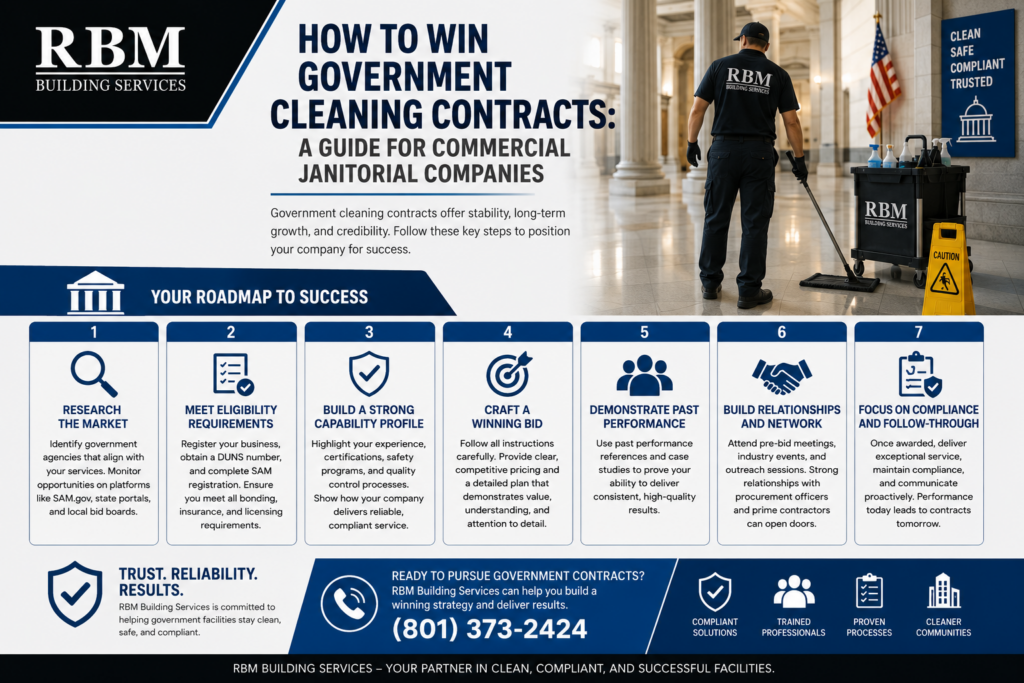
Before a janitorial company can win its first government contract, it must complete several registration and certification requirements. The first and most important step is registration in the System for Award Management (SAM.gov). SAM is the federal government’s central database for contractors — no company can receive a federal contract without being registered in SAM. Registration requires a DUNS number (a unique nine-digit identifier issued by Dun & Bradstreet), a Taxpayer Identification Number (TIN), and information about the company’s capabilities, NAICS codes (the proper code for janitorial services is 561720 — Janitorial Services), and business size classification. SAM registration must be renewed annually, and the process can take several weeks for initial registration. Companies should register well before they plan to bid on their first contract.
Business certifications can provide significant advantages in government contracting. The Small Business Administration (SBA) administers several certification programs that give preferential treatment in federal contracting. The 8(a) Business Development Program is available to socially and economically disadvantaged businesses and provides access to sole-source contracts and set-aside opportunities. The HUBZone (Historically Underutilized Business Zone) program provides preferences for businesses located in designated low-income areas. Service-Disabled Veteran-Owned Small Business (SDVOSB) certification provides access to sole-source and set-aside contracts. Women-Owned Small Business (WOSB) certification provides contracting preferences in industries where women-owned businesses are underrepresented. Each certification has specific eligibility requirements and application processes, but they can significantly increase a company’s chances of winning government contracts by reducing the competitive pool. For janitorial companies with relevant certifications, see our company blog for more on business development.
Certifications and Registrations Required
A winning government cleaning contract proposal must demonstrate three things: the company understands the requirement, the company has the capability to perform the work, and the company offers a fair and reasonable price. The technical proposal is the most important section and must address every element of the statement of work. A strong technical proposal includes a detailed understanding of the facilities to be cleaned, including square footage, floor types, and special requirements (healthcare areas, laboratories, clean rooms, etc.), a comprehensive cleaning plan that specifies what tasks will be performed, how often, and using what methods and products, an organizational structure that shows the management team, supervisory staff, and cleaning personnel who will work on the contract, a quality control plan that describes how cleaning quality will be monitored and maintained, a staffing plan that shows how many workers will be assigned and their schedules, and a transition plan that describes how the contractor will take over the cleaning operation from the previous contractor.
Past performance is a critical evaluation factor in government cleaning contracts. Agencies review a bidder’s past performance on similar contracts to assess the likelihood of successful performance on the new contract. Janitorial companies should maintain a portfolio of past performance references for contracts of similar size and complexity to the one being bid. References should include the contracting officer’s name and contact information, the contract value and period of performance, and a description of the services provided. If a company has past performance on government contracts, those references are especially valuable because the government contracting officer can verify performance through the Contractor Performance Assessment Reporting System (CPARS). Government agencies are increasingly using CPARS data to evaluate past performance, so maintaining good CPARS ratings on existing government contracts is essential for winning future contracts.
Writing a Winning Cleaning Contract Proposal
Many government facilities require cleaning personnel to have security clearances, particularly in federal buildings, military installations, courthouses, and law enforcement facilities. The level of security clearance required depends on the facility and the nature of the work. The most common requirements for janitorial staff in government facilities are a National Agency Check with Inquiries (NACI) or a Tier 1 background investigation for low-risk positions, a Public Trust clearance for positions in sensitive facilities (Tier 2 or Tier 4 investigation), or a Secret or Top Secret clearance for positions in classified facilities (rare for janitorial positions but possible in high-security environments). Companies bidding on contracts that require security clearances must have a system in place to process clearances for their employees and must track clearance status and expiration dates.
The security clearance process adds time and cost to government cleaning contracts. A NACI or Tier 1 background check typically takes 2-6 weeks to process, while higher-level clearances can take 6-18 months. Janitorial companies should start the clearance process as soon as a contract is awarded and should maintain a pool of cleared employees to ensure continuity of service. Employees with existing clearances are a significant asset because they can start work immediately without waiting for clearance processing. Companies that invest in building a cleared workforce gain a competitive advantage in winning and retaining security-cleared government contracts. Some government cleaning contracts include a clause that allows uncleared personnel to work under continuous escort, but this is impractical for routine cleaning operations and increases labor costs significantly.
Security-Cleared Janitorial Services
Pricing government cleaning contracts is different from pricing commercial contracts because the government focuses on fair and reasonable pricing rather than market rates. Government contract pricing must be based on actual costs — the Office of Federal Procurement Policy requires that contractors submit cost or pricing data for contracts over $2 million (or for any contract where the contracting officer determines that price analysis alone is insufficient). For janitorial services, the key cost elements are direct labor (typically 60-70% of total costs), payroll taxes and benefits (typically 15-20% of labor costs), cleaning supplies and equipment (typically 10-15% of total costs), overhead and general and administrative expenses (typically 8-15%), and profit (typically 5-10%). The government evaluates price reasonableness by comparing the proposed price to independent government cost estimates, prices in previous contracts for similar services, and prices proposed by other bidders.
Winning government cleaning contracts at a profitable price requires a strategic approach. Companies should focus on contracts where they have a competitive advantage — either through certifications (8(a), HUBZone, SDVOSB, WOSB), experience with similar facilities, or presence in a specific geographic area. Labor costs should be carefully calculated based on the Davis-Bacon Act (for federal contracts) or prevailing wage laws (for state contracts) that specify minimum wages for different classes of labor. Companies must use the correct wage determination for the contract location and should factor in the cost of fringe benefits that may be required. Efficient operations — using the right equipment, optimizing cleaning routes, and cross-training staff — can significantly improve profit margins on government contracts. The companies that succeed in government cleaning are those that treat the procurement process as a core business function, investing in the expertise and infrastructure needed to compete effectively. RBM Building Services has provided commercial janitorial services and facility cleaning since 1974. Call 800.403.3564 or contact us for a cleaning consultation.
Pricing Strategies for Government Bids
Building a successful government cleaning contracting business requires a long-term commitment to the government market. Companies should start by identifying their target agencies — federal civilian agencies, the Department of Defense, state government, county government, or municipal government — and researching the specific procurement processes and requirements for those agencies. The next step is completing all required registrations and certifications, starting with SAM.gov registration and continuing with any applicable small business certifications. Companies should then identify upcoming contract opportunities through beta.SAM.gov (the federal contracting opportunities website) and through state and local procurement portals. Attending industry days, pre-bid conferences, and networking events for government contractors can provide valuable insights and connections.
Persistence is essential in government contracting — most companies do not win their first contract on their first bid. Each bid submission is an opportunity to learn and improve. Companies should request debriefings from contracting officers on unsuccessful bids to understand why they were not selected and what they need to improve. Building relationships with contracting officers, facility managers, and other decision-makers is important, but companies must be careful to follow procurement integrity rules that limit communication during the bidding process. The most successful government cleaning contractors view government contracting as a long-term strategy, not a short-term opportunity. They invest in the systems, certifications, and expertise needed to compete effectively, and they continuously improve their proposals and operations based on feedback and experience. The government cleaning market rewards persistence, competence, and integrity — the same qualities that build successful commercial cleaning companies.
RBM Building Services has provided commercial cleaning, window washing, and retail cleaning since 1974 across Utah, Arizona, Nevada, and Texas. Call 800.403.3564 or contact us for facility cleaning services. Read more on our company blog.
Expert guidance on government cleaning contracts
Building a Successful Government Cleaning Business
Building a successful government cleaning contracting business requires a long-term commitment to the government market. Companies should start by identifying their target agencies — federal civilian agencies, the Department of Defense, state government, county government, or municipal government — and researching the specific procurement processes and requirements for those agencies. The next step is completing all required registrations and certifications, starting with SAM.gov registration and continuing with any applicable small business certifications. Companies should then identify upcoming contract opportunities through beta.SAM.gov (the federal contracting opportunities website) and through state and local procurement portals. Attending industry days, pre-bid conferences, and networking events for government contractors can provide valuable insights and connections.
Persistence is essential in government contracting — most companies do not win their first contract on their first bid. Each bid submission is an opportunity to learn and improve. Companies should request debriefings from contracting officers on unsuccessful bids to understand why they were not selected and what they need to improve. Building relationships with contracting officers, facility managers, and other decision-makers is important, but companies must be careful to follow procurement integrity rules that limit communication during the bidding process. The most successful government cleaning contractors view government contracting as a long-term strategy, not a short-term opportunity. They invest in the systems, certifications, and expertise needed to compete effectively, and they continuously improve their proposals and operations based on feedback and experience. The government cleaning market rewards persistence, competence, and integrity — the same qualities that build successful commercial cleaning companies.
RBM Building Services has provided commercial cleaning, window washing, and retail cleaning since 1974 across Utah, Arizona, Nevada, and Texas. Call 800.403.3564 or contact us for facility cleaning services. Read more on our company blog.