Healthcare-associated infections affect 1 in 31 hospitalized patients daily. Professional medical cleaning is a critical component of infection prevention, with specific protocols for disinfection, environmental monitoring, and compliance with CDC and Joint Commission standards.
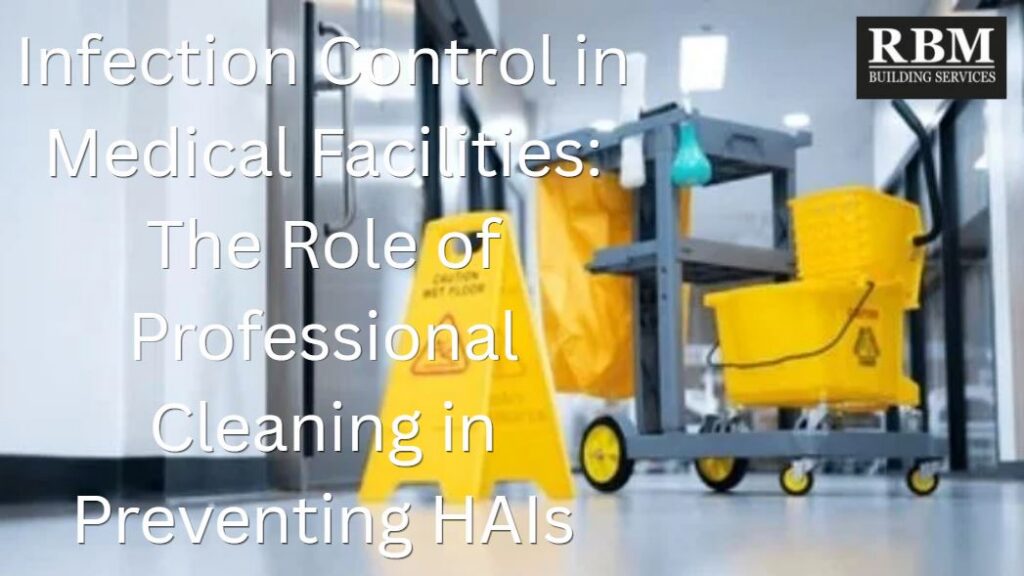
Healthcare-associated infections (HAIs) are one of the most serious patient safety issues facing medical facilities today. According to the CDC, approximately 1 in 31 hospitalized patients has at least one HAI on any given day, resulting in an estimated 72,000 deaths annually and $28-$45 billion in excess healthcare costs. While many factors contribute to HAI transmission — including hand hygiene, antibiotic stewardship, and clinical protocols — the role of environmental cleaning in infection prevention is increasingly recognized as critical. Studies have shown that enhanced environmental cleaning can reduce HAI rates by 30-50% in healthcare settings. For healthcare administrators, infection preventionists, and facility managers, understanding the connection between professional cleaning and infection control is essential for patient safety, regulatory compliance, and financial performance.
The financial impact of HAIs extends beyond the direct cost of treating infections. Under the Hospital-Acquired Condition Reduction Program (HACRP), hospitals with high HAI rates face reduced Medicare reimbursement of up to 1% of total Medicare payments. For a typical 200-bed hospital, this can represent a penalty of $500,000 to $2 million annually. In addition, HAIs increase patient length of stay by an average of 10-20 days, reducing bed availability and increasing operational costs. HAIs also damage hospital reputation and patient satisfaction scores, which affect reimbursement under value-based purchasing programs. The investment in professional medical cleaning is one of the most cost-effective infection prevention strategies available. See our medical facility cleaning services for infection prevention programs.

Infection Control Through Medical Cleaning
Understanding how infections spread in healthcare environments is essential for designing effective cleaning protocols. Pathogens in healthcare settings are transmitted through several routes, including direct contact (person-to-person), indirect contact (contaminated surfaces and equipment), droplet transmission (respiratory droplets from coughing and sneezing), and airborne transmission (small particles that remain suspended in the air). Environmental surfaces play a significant role in indirect contact transmission. Studies have shown that pathogens including MRSA, VRE, C. difficile, norovirus, and Acinetobacter can survive on environmental surfaces for days to months. Patients admitted to a room previously occupied by a patient with C. difficile or MRSA have a significantly higher risk of acquiring these pathogens — a phenomenon known as prior room occupant risk.
The role of environmental cleaning in breaking the chain of infection is now well-established. The CDC’s Healthcare Infection Control Practices Advisory Committee (HICPAC) recommends that healthcare facilities implement comprehensive environmental cleaning programs as part of their infection prevention strategies. The ISO 14644 clean room standards and the US Pharmacopeia USP 797 and USP 800 standards for pharmaceutical compounding provide specific requirements for cleaning and contamination control in healthcare settings. The key principle is that cleaning reduces the bioburden (the number of microorganisms) on environmental surfaces, reducing the risk of transmission to patients and healthcare workers. The effectiveness of cleaning depends on the cleaning method, the disinfectant used, the contact time (dwell time) of the disinfectant, and the frequency of cleaning. Professional medical cleaning programs are designed to optimize all of these factors.
How Infections Spread in Healthcare Environments
It is important to distinguish between cleaning, disinfection, and sterilization — three distinct levels of microbial control that are often confused. Cleaning is the physical removal of dirt, organic matter, and microorganisms from surfaces. Cleaning does not necessarily kill microorganisms, but it removes them and reduces the bioburden on surfaces. Cleaning is always the first step before disinfection or sterilization because organic matter can interfere with the activity of disinfectants and sterilants. In healthcare settings, cleaning is typically performed using detergent and water or a general-purpose cleaner. Disinfection is the process of eliminating most or all pathogenic microorganisms on inanimate objects, with the exception of bacterial spores. Disinfectants are categorized by the EPA as low-level, intermediate-level, or high-level based on their efficacy against different types of microorganisms. Healthcare facilities use EPA-registered hospital disinfectants that are effective against the pathogens most commonly encountered in healthcare settings.
Sterilization is the complete elimination of all forms of microbial life, including bacterial spores. Sterilization is required for critical medical devices that enter sterile body sites or the vascular system. Sterilization methods include steam autoclaving, ethylene oxide gas, hydrogen peroxide gas plasma, and other specialized processes. Sterilization is not typically required for environmental surfaces in healthcare settings — proper cleaning and disinfection are sufficient for floors, walls, countertops, and patient care equipment. The CDC and HICPAC provide a Spaulding classification system that categorizes patient care items as critical, semi-critical, or non-critical based on the risk of infection transmission, and specifies the required level of microbial control for each category. Environmental surfaces in healthcare settings are classified as non-critical and require low-level to intermediate-level disinfection depending on the surface and the patient population. For medical cleaning services, see our medical facility cleaning page.
Cleaning vs. Disinfection vs. Sterilization
High-touch surfaces in healthcare facilities are the primary targets for cleaning and disinfection because they are the surfaces most likely to transfer pathogens between patients and healthcare workers. The CDC defines high-touch surfaces as those that are frequently touched by healthcare workers, patients, and visitors during the course of patient care. Common high-touch surfaces in patient rooms include bed rails and bed controls, call buttons and patient phones, bedside tables and overbed tables, light switches and thermostat controls, door handles and push plates, IV poles and pump controls, monitors and touchscreens, and bathroom surfaces (toilet flush handles, sink faucets, grab bars, light switches). These surfaces should be cleaned and disinfected at least daily in all patient care areas, with more frequent cleaning in intensive care units, isolation rooms, and during outbreak situations.
The frequency and method of high-touch surface disinfection depend on the patient population and the level of care. In general medical-surgical units, daily disinfection of high-touch surfaces is the standard. In intensive care units, where patients are more vulnerable to infection and where invasive devices increase infection risk, high-touch surfaces should be disinfected at least twice daily. In isolation rooms for patients with known infectious diseases, high-touch surfaces should be disinfected according to the specific transmission-based precautions for the pathogen involved. The EPA has published a list of disinfectants with emerging viral pathogens claims (List Q) and disinfectants for use against C. difficile spores (List K) that should be used for specific pathogens. Cleaning staff must be trained to use the correct disinfectant for each situation and to ensure that the disinfectant remains wet on the surface for the required contact time (typically 3-10 minutes depending on the product).
High-Touch Surface Disinfection Protocols
Terminal cleaning (also called discharge cleaning) is the thorough cleaning and disinfection of a patient room after a patient is discharged and before the next patient is admitted. Terminal cleaning is one of the most important infection prevention activities in healthcare facilities because it eliminates pathogens left behind by the previous patient and prepares the room for the next patient. The CDC recommends that terminal cleaning include cleaning and disinfection of all high-touch surfaces in the patient room, including bed rails, call buttons, bedside tables, light switches, door handles, IV poles, monitors, and bathroom surfaces. Additionally, terminal cleaning should include cleaning of low-touch surfaces that may not be cleaned during daily cleaning, such as walls (particularly near the bed and bathroom), window sills and blinds, ceilings (spot cleaning of visible soiling), and floors (damp mopping with disinfectant).
Terminal cleaning of isolation rooms requires additional precautions. All surfaces in the isolation room should be thoroughly cleaned and disinfected, with particular attention to surfaces that may have been contaminated with the specific pathogen. Cleaning staff should wear appropriate PPE based on the transmission-based precautions for the room. For C. difficile isolation rooms, a disinfectant with activity against C. difficile spores (such as sodium hypochlorite/bleach) should be used. For rooms of patients with airborne infections (tuberculosis, measles, chickenpox), adequate air exchanges should be completed before cleaning staff enter without respiratory protection. After terminal cleaning, many healthcare facilities use supplemental disinfection methods such as UV-C light or hydrogen peroxide vapor to provide additional reduction of pathogens in the room. These technologies have been shown to reduce the risk of pathogen transmission to the next patient admitted to the room. For comprehensive medical cleaning, read our company blog.
Terminal Cleaning of Patient Rooms
Monitoring the effectiveness of environmental cleaning is a requirement of the Joint Commission and is essential for infection prevention programs. Direct observation is the most common method of monitoring cleaning effectiveness. Trained observers use a standardized checklist to observe cleaning staff and document whether each surface was cleaned according to protocol. However, direct observation has limitations — staff may clean differently when they know they are being observed (the Hawthorne effect), and observation is resource-intensive. Fluorescent marker auditing is an objective method for monitoring cleaning effectiveness. A transparent fluorescent mark is applied to surfaces before cleaning, and after cleaning, an ultraviolet light is used to check whether the mark has been removed by cleaning. Studies using fluorescent markers have found that only 40-60% of high-touch surfaces are actually cleaned during routine cleaning in many hospitals.
ATP bioluminescence testing is another objective method for monitoring cleaning effectiveness. ATP (adenosine triphosphate) is present in all organic material, including bacteria, fungi, and body fluids. A swab sample is taken from the surface after cleaning, and the amount of ATP present is measured using a luminometer. High ATP levels indicate inadequate cleaning. ATP testing provides immediate results and can be used to give real-time feedback to cleaning staff. ATP testing does not specifically measure the presence of pathogens, but it provides a reliable indicator of overall cleaning quality. The CDC recommends that healthcare facilities use a combination of monitoring methods — direct observation, fluorescent marker auditing, and ATP testing — to evaluate cleaning effectiveness. Many healthcare facilities establish benchmarks for acceptable ATP levels and use regular monitoring to drive continuous improvement in cleaning quality. Results should be tracked over time and shared with cleaning staff, infection prevention teams, and facility leadership.
Monitoring Cleaning Effectiveness
Building a comprehensive infection prevention cleaning program requires a systematic approach that goes beyond routine cleaning schedules. The program should be based on the CDC’s Guidelines for Environmental Infection Control in Health-Care Facilities and should be developed in collaboration with the facility’s infection prevention and control department. The program should include a written cleaning plan that specifies cleaning frequencies, methods, and products for each area of the facility based on the level of patient care and the risk of infection transmission. The plan should cover all patient care areas, procedure rooms, operating rooms, sterile processing areas, and support areas. The plan should also include specific protocols for outbreak situations, including enhanced cleaning frequencies, use of specific disinfectants, and supplemental disinfection methods.
Training is the foundation of an effective infection prevention cleaning program. All cleaning staff in healthcare facilities should receive comprehensive initial training and annual refresher training on infection prevention principles, proper cleaning and disinfection procedures, proper use of EPA-registered disinfectants (including correct dilution and dwell time), proper use of personal protective equipment, bloodborne pathogen training (required by OSHA), and proper handling of infectious waste. Training should be documented and should include both classroom instruction and hands-on demonstration of cleaning techniques. Competency assessment should be performed after initial training and at least annually thereafter to verify that cleaning staff can perform their duties correctly. Quality assurance is an ongoing process — the cleaning program should be evaluated regularly using the monitoring methods described above, and the results should be used to identify areas for improvement and to refine cleaning protocols. The most effective infection prevention cleaning programs are those that are treated as an integral part of the healthcare facility’s patient safety program, not as a support service that operates independently. RBM Building Services has provided medical facility cleaning, commercial janitorial services, and window washing since 1974 across Utah, Arizona, Nevada, and Texas. Call 800.403.3564 or contact us for a medical cleaning consultation. Read more on our company blog.
Infection prevention through professional medical cleaning
Building an Infection Prevention Cleaning Program
Building a comprehensive infection prevention cleaning program requires a systematic approach that goes beyond routine cleaning schedules. The program should be based on the CDC’s Guidelines for Environmental Infection Control in Health-Care Facilities and should be developed in collaboration with the facility’s infection prevention and control department. The program should include a written cleaning plan that specifies cleaning frequencies, methods, and products for each area of the facility based on the level of patient care and the risk of infection transmission. The plan should cover all patient care areas, procedure rooms, operating rooms, sterile processing areas, and support areas. The plan should also include specific protocols for outbreak situations, including enhanced cleaning frequencies, use of specific disinfectants, and supplemental disinfection methods.
Training is the foundation of an effective infection prevention cleaning program. All cleaning staff in healthcare facilities should receive comprehensive initial training and annual refresher training on infection prevention principles, proper cleaning and disinfection procedures, proper use of EPA-registered disinfectants (including correct dilution and dwell time), proper use of personal protective equipment, bloodborne pathogen training (required by OSHA), and proper handling of infectious waste. Training should be documented and should include both classroom instruction and hands-on demonstration of cleaning techniques. Competency assessment should be performed after initial training and at least annually thereafter to verify that cleaning staff can perform their duties correctly. Quality assurance is an ongoing process — the cleaning program should be evaluated regularly using the monitoring methods described above, and the results should be used to identify areas for improvement and to refine cleaning protocols. The most effective infection prevention cleaning programs are those that are treated as an integral part of the healthcare facility’s patient safety program, not as a support service that operates independently. RBM Building Services has provided medical facility cleaning, commercial janitorial services, and window washing since 1974 across Utah, Arizona, Nevada, and Texas. Call 800.403.3564 or contact us for a medical cleaning consultation. Read more on our company blog.