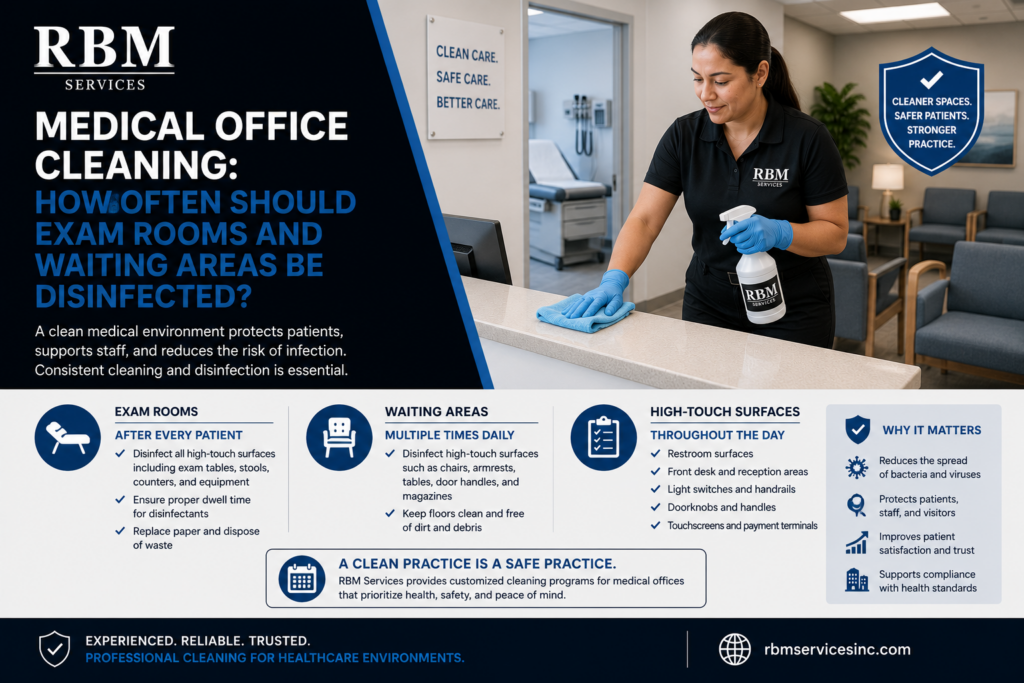
Medical office exam rooms should be disinfected between every patient, waiting areas every 2-4 hours during operating hours, and restrooms at least twice daily. High-touch surfaces require more frequent disinfection than floors and walls.
Medical office cleaning and disinfection requirements are significantly more stringent than standard commercial cleaning because of the infection control requirements inherent in healthcare environments. Unlike general office buildings, medical offices must comply with specific cleaning standards from OSHA, CDC, state health departments, and accreditation organizations, with cleaning frequencies tied directly to patient safety and infection prevention. This article provides a comprehensive guide to medical office cleaning frequencies, covering exam rooms, waiting areas, restrooms, staff areas, and high-touch surfaces — with specific recommendations for how often each area should be cleaned and disinfected based on current healthcare standards.
For medical practice owners, office managers, and facility managers responsible for healthcare environments, understanding and implementing proper cleaning frequencies is essential for regulatory compliance, patient safety, and accreditation. The cleaning program must be documented, staff must be trained on proper procedures, and the cleaning vendor must have specific experience with healthcare environments. Using a general commercial cleaning company without healthcare-specific training and protocols can result in regulatory violations, patient infections, and liability exposure.

Understanding Medical Office Cleaning Standards and Regulations
Medical office cleaning standards are established by a combination of federal and state regulations, professional guidelines, and accreditation requirements. The primary regulatory framework includes OSHA Bloodborne Pathogens Standard (29 CFR 1910.1030) which requires specific cleaning and disinfection procedures for surfaces contaminated with blood or other potentially infectious materials. CDC Guidelines for Environmental Infection Control in Health-Care Facilities provide evidence-based recommendations for cleaning and disinfection frequencies and methods. State health department regulations establish specific requirements for medical office cleaning that vary by state. For accredited facilities, The Joint Commission or AAAHC standards include cleaning and disinfection requirements that must be met for accreditation.
Beyond regulatory requirements, medical offices have a duty of care to maintain a clean and safe environment for patients, many of whom are immunocompromised or seeking treatment for illness. The consequences of inadequate cleaning in a medical setting include healthcare-associated infections (HAIs) which affect 1 in 31 hospital patients according to the CDC and result in $28-$45 billion in excess healthcare costs annually. While medical offices have lower acuity than hospitals, the same infection prevention principles apply. A cleaning program designed for medical offices must be more comprehensive, more frequent, and more carefully documented than standard commercial cleaning. For more on our healthcare cleaning approach, see our healthcare cleaning services page.
Exam Room Disinfection: Between Every Patient
Exam rooms are the most critical area for disinfection in a medical office because they are where patient examinations and procedures occur, creating the highest potential for pathogen transmission. Under CDC guidelines and standard infection control practices, exam rooms must be cleaned and disinfected between every patient. This includes disinfecting the examination table or bed (including the paper roll holder and any straps or accessories), countertops and work surfaces (where medical instruments and supplies are placed), medical equipment surfaces (blood pressure cuffs, stethoscopes, otoscopes, ophthalmoscopes, and other examination tools), light handles and switches, door handles and push plates, sink handles and faucets, and chair armrests and any other surfaces the patient or provider touched.
The disinfection process must use an EPA-registered disinfectant with appropriate claims for healthcare settings (typically a disinfectant with kill claims for HIV, HBV, HCV, and C. difficile spores). The disinfectant must be applied to pre-cleaned surfaces with the appropriate contact time specified on the product label — typically 2-10 minutes depending on the product and target pathogens. Surfaces must remain wet for the full contact time to achieve disinfection. Proper personal protective equipment (gloves, and sometimes gowns and masks) must be worn during exam room cleaning. At the end of each day, exam rooms should receive a terminal clean that includes all of the above plus floor mopping, wall spot cleaning, and restocking of supplies (paper towels, soap, paper roll covers).
Waiting Area and Reception Cleaning Frequency
Waiting areas and reception areas require frequent cleaning because they are high-traffic zones where patients and visitors spend extended time and touch multiple surfaces. Recommended cleaning frequencies for waiting areas include hourly during operating hours for high-touch surfaces including chair armrests, magazine rack handles, check-in counter surfaces, pens and clipboards (or provide single-use options), door handles and push plates, and handrails; daily cleaning including vacuuming or sweeping floors, dusting all surfaces, and cleaning interior windows; weekly deep cleaning including upholstery vacuuming and spot cleaning, baseboard cleaning, and light fixture dusting; and monthly or quarterly carpet cleaning depending on traffic levels.
Reception and check-in areas require special attention because they are the first impression for patients and are also high-risk areas for germ transmission. Reception desks should be wiped down hourly. Pens should be sanitized between uses or single-use pens provided. Check-in kiosks and tablets should be disinfected between each patient use. Glass sneeze guards at reception desks should be cleaned daily with glass cleaner and disinfected regularly. Children’s play areas in pediatric or family medicine waiting rooms require special attention — toys should be cleaned and disinfected daily, and any toys that cannot be easily cleaned (plush toys, books with fabric covers) should be removed or limited.
Restroom and Staff Area Cleaning Protocols
Restroom cleaning in medical offices requires higher frequency and more rigorous protocols than standard commercial restroom cleaning. Public restrooms in medical offices should be cleaned at least twice daily during operating hours, with additional cleaning as needed based on usage. High-touch surfaces in restrooms including toilet handles, faucet handles, door handles, paper towel dispenser levers, and light switches should be disinfected hourly when possible. Staff restrooms and break rooms also require daily cleaning with particular attention to kitchen and break room surfaces where food is prepared and consumed. All restrooms should receive a terminal clean at the end of each day including scrubbing and disinfecting of all surfaces, deep cleaning of fixtures, and restocking of supplies.
Staff areas including nurses’ stations, medication rooms, and staff break rooms must also be cleaned daily. Nurses’ stations are particularly important because they are where patient charts, medications, and medical supplies are handled. Surfaces at nurses’ stations should be cleaned and disinfected at least daily, with high-touch surfaces disinfected more frequently. Medication rooms and clean supply storage areas should be cleaned with particular attention to dust control, as dust can contaminate sterile supplies and medication packaging. Computer keyboards, mice, and phones used by clinical staff should be disinfected daily — these are among the most contaminated surfaces in medical offices.
High-Touch vs. Low-Touch Surface Cleaning Differences
Understanding the difference between high-touch and low-touch surfaces is essential for allocating cleaning resources effectively in medical offices. High-touch surfaces are those that are frequently contacted by hands and are the primary vectors for pathogen transmission. In medical offices, high-touch surfaces include doorknobs, handles, and push plates, light switches, countertops and desk surfaces, chair armrests and seat surfaces, pens, clipboards, and check-in devices, faucet handles and sink fixtures, paper towel and soap dispenser handles, elevator buttons, and handrails. High-touch surfaces require disinfection at least daily and often more frequently — hourly in waiting rooms and between every patient in exam rooms.
Low-touch surfaces include walls, ceilings, floors (except in exam rooms), window treatments, and interior surfaces of cabinets and drawers. These surfaces require less frequent cleaning but should still be cleaned on a regular schedule. Walls should be spot-cleaned weekly and fully cleaned quarterly. Ceilings and overhead surfaces should be cleaned quarterly to prevent dust accumulation. Floors in patient care areas should be damp-mopped daily with a disinfectant solution. Floors in administrative areas can be cleaned with standard methods. Window treatments (blinds, shades) should be dusted monthly and cleaned semi-annually. By differentiating between high-touch and low-touch surfaces, cleaning resources are directed to the areas with the greatest infection prevention impact.
OSHA and CDC Compliance for Medical Office Cleaning
OSHA and CDC compliance for medical office cleaning requires documented policies, procedures, and training records. Medical offices must have a written Exposure Control Plan that includes cleaning and disinfection procedures for bloodborne pathogen spills, a cleaning schedule that identifies each area, the required cleaning frequency, the approved cleaning products and procedures, and who is responsible for each task, Safety Data Sheets (SDS) for all cleaning and disinfecting products used in the facility, training records showing that all cleaning staff have received bloodborne pathogen training, chemical safety training, and task-specific cleaning training, and cleaning logs that verify cleaning has been performed as scheduled — these logs should be maintained for at least 12 months for regulatory review.
A recommended medical office cleaning schedule for a typical primary care or specialty medical office (5,000-15,000 sq ft) includes: exam room disinfection between every patient (clinical staff or dedicated cleaning staff); waiting area high-touch disinfection hourly during operating hours; restroom cleaning twice daily with hourly high-touch monitoring; terminal cleaning of all clinical areas at end of day; daily floor care including vacuuming and damp mopping of all patient care areas; weekly cleaning of administrative offices, break rooms, and storage areas; monthly deep cleaning of upholstery, window treatments, and air vents; quarterly carpet cleaning and hard floor refinishing; and annual deep cleaning of all surfaces including walls, ceilings, and light fixtures. Medical offices should work with a commercial cleaning company that has specific healthcare experience and understands the cleaning requirements of OSHA, CDC, and accreditation organizations.
Since 1974, RBM Building Services has provided medical office cleaning, commercial janitorial services, and building maintenance across Utah, Arizona, Nevada, and Texas. Our healthcare cleaning programs meet OSHA and CDC standards. Call 800.403.3564 or contact us for a medical office cleaning consultation. Read more on our company blog.
Keep your medical office compliant and safe. Contact RBM for healthcare cleaning.
Building a Medical Office Cleaning Schedule
Building a comprehensive medical office cleaning schedule requires input from practice management, clinical staff, and the cleaning vendor. The schedule should specify which areas are cleaned at which frequencies, who is responsible (clinical staff vs. cleaning crew), and the approved products and procedures for each area. The schedule should be documented in writing, posted in janitorial closets and staff areas, and reviewed quarterly for compliance and effectiveness. Cleaning logs should be maintained for each area and reviewed regularly to verify compliance with the cleaning schedule.
Training is equally important. All cleaning staff working in medical offices must receive bloodborne pathogens training, HIPAA privacy training (to protect patient information encountered during cleaning), chemical safety training specific to healthcare-approved products, and task-specific training for medical office cleaning procedures including proper waste handling, exam room turnover cleaning, and restroom disinfection. Training must be documented and refreshed annually or when procedures change.
Since 1974, RBM Building Services has provided medical office cleaning, commercial janitorial services, and building maintenance across Utah, Arizona, Nevada, and Texas. Our healthcare cleaning programs meet OSHA and CDC standards. Call 800.403.3564 or contact us for a medical office cleaning consultation. Read more on our company blog.