K-12 schools and universities have fundamentally different cleaning needs based on building types, student populations, and usage patterns. K-12 requires high-touch disinfection for young children, while universities need large-scale facility management across diverse building types.
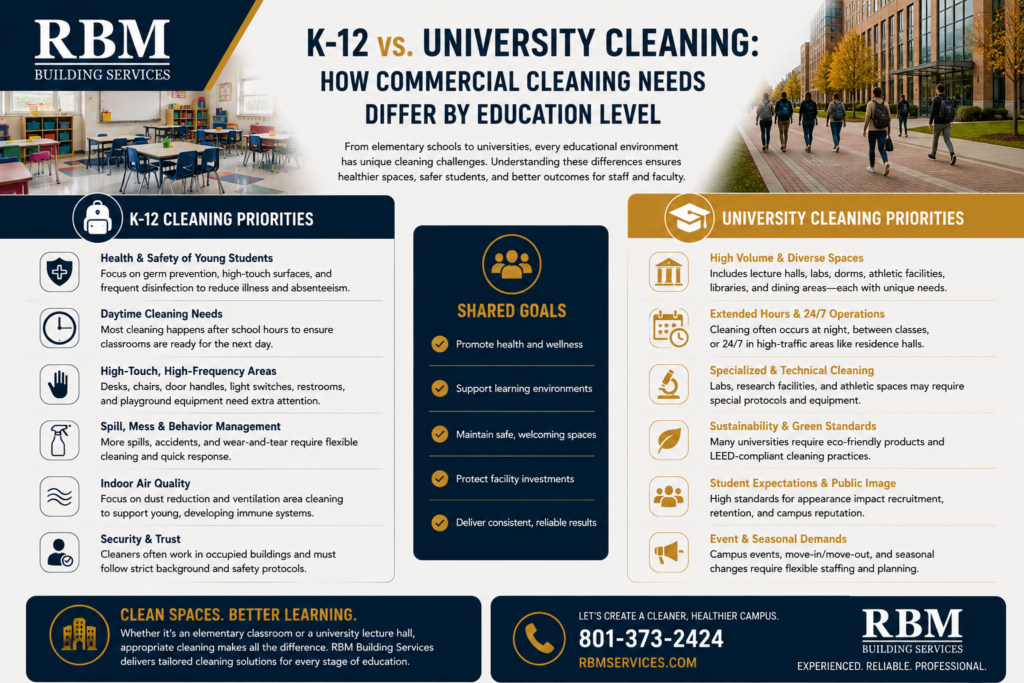
Educational facilities represent one of the largest segments of the commercial cleaning market, encompassing everything from elementary schools to major research universities. However, the cleaning needs of a K-12 school are fundamentally different from those of a university campus. K-12 schools serve a younger population that is more vulnerable to infectious diseases and spends the entire day in a single building, while universities operate multiple building types — classrooms, laboratories, residence halls, dining facilities, athletic centers, and libraries — across sprawling campuses with 24/7 activity. Understanding these differences is essential for school administrators, facility managers, and cleaning contractors who serve educational institutions. This guide compares the cleaning requirements of K-12 schools and universities across all major areas.
The financial context for education cleaning differs significantly between K-12 and higher education. K-12 schools typically have limited custodial budgets that are set by school district funding formulas, with average custodial spending of $1.50-$3.00 per square foot annually. Universities have more flexibility in their facilities budgets, with spending that can range from $2.00-$6.00 per square foot depending on the institution and the types of facilities on campus. Both K-12 and university cleaning programs face pressure to control costs while maintaining the cleanliness standards that students, parents, and accrediting bodies expect. See our education cleaning services for more on school and university cleaning programs.

K-12 vs. University Cleaning Needs
The fundamental difference between K-12 and university cleaning starts with the student population. K-12 students are younger, more susceptible to infectious diseases, and more likely to spread illness through close contact and shared surfaces. The CDC reports that school-aged children experience 3-6 respiratory illnesses per year, compared to 1-2 for adults. This means K-12 schools require more intensive disinfection of high-touch surfaces and more stringent protocols during cold and flu season. K-12 buildings also have specialized spaces that require specific cleaning approaches, including early childhood classrooms with soft surfaces and shared toys, cafeterias that serve breakfast and lunch to a high percentage of students, and gymnasiums and locker rooms used for physical education and school sports. K-12 cleaning must be completed within a defined schedule — typically after students leave for the day — and must be completed before the building reopens the next morning.
University cleaning is complicated by the diversity of building types and usage patterns on campus. A university campus may include classroom buildings, research laboratories, administrative offices, residence halls, dining facilities, libraries, student unions, performing arts centers, athletic facilities, and healthcare facilities — each with specific cleaning requirements. University buildings operate on different schedules — some are in use 24 hours a day (residence halls, libraries during exam periods, some research labs), while others are used only during business hours. University cleaning staff must coordinate with multiple departments and stakeholders, each with their own expectations and priorities. The scale of university cleaning is also significantly larger — a major university campus may have 5-10 million square feet of building space requiring daily cleaning.
Understanding the Differences in Educational Cleaning
K-12 school cleaning priorities center on student health and safety. The CDC recommends that K-12 schools focus cleaning efforts on high-touch surfaces in classrooms (desks, chairs, door handles, light switches, shared supplies), restrooms (toilets, sinks, faucets, stall doors, hand dryers), cafeterias (tables, chairs, serving areas, high chairs), and common areas (handrails, water fountains, elevator buttons). Daily disinfection of these surfaces is the standard during the school year, with enhanced disinfection during cold and flu season. K-12 floors require daily vacuuming of carpeted areas and daily dust mopping and damp mopping of hard surface floors. School restrooms require the most intensive cleaning of any area — they should be cleaned and disinfected daily, with high-touch surfaces disinfected between class periods if possible.
K-12 schools must also address the specific needs of different age groups. Elementary schools (grades K-5) have the highest cleaning demands because younger students have less developed hygiene habits, more frequent spills and accidents, and higher rates of illness transmission. Elementary classrooms should have toys and shared items cleaned and disinfected weekly, with soft surfaces (rugs, upholstered furniture) cleaned more frequently than in older student areas. Middle schools and high schools have lower illness transmission rates but face different challenges — locker rooms require daily cleaning and disinfection with attention to MRSA prevention, science laboratories require proper handling of chemicals and biological materials, and vocational education spaces (shop, culinary arts, auto mechanics) generate specific soils that require specialized cleaning. K-12 schools should involve their school nurse in developing cleaning protocols, as the nurse is typically the staff member most knowledgeable about infection control in the school setting.
K-12 School Cleaning Priorities
University cleaning faces the challenge of managing diverse building types across a large campus. Classroom buildings on university campuses typically have multiple rooms that are used by different departments and are often scheduled from early morning through evening. University classrooms require daily cleaning of all surfaces, with special attention to tablet arms (which are high-touch surfaces that are often overlooked), whiteboards and chalkboards (which should be cleaned daily), and floors (which accumulate significant debris from heavy foot traffic). Research laboratories are among the most demanding spaces to clean on a university campus. Labs may contain hazardous materials, biological agents, radioactive materials, and sensitive equipment that require specialized cleaning protocols. Lab cleaning should be performed by trained personnel who understand the specific hazards present in each lab and who follow proper safety protocols, including the use of appropriate PPE and proper waste disposal procedures.
University libraries present unique cleaning challenges because they combine high-traffic public spaces with quiet study areas and collections of books and materials that require careful handling. Library cleaning should be scheduled to minimize disruption to patrons — typically early morning before the library opens or late evening after closing. Stack areas require special attention because dust accumulation on books can damage collections and create respiratory issues for patrons. HEPA vacuuming is recommended for library stack areas to capture dust without redistributing it through the air. Student unions and campus common areas are the social hubs of university campuses and require the most frequent cleaning of any campus spaces. These areas are in use from early morning through late night and may require continuous cleaning attention during operating hours, particularly in dining areas, lounges, and high-traffic corridors. For comprehensive campus cleaning, see our education cleaning page.
University and Campus Cleaning Challenges
K-12 schools and universities are subject to different regulatory frameworks for cleaning and sanitation. K-12 schools are regulated primarily by state and local health departments, which conduct periodic inspections of school facilities. Many states have specific requirements for school cleaning, including required cleaning frequencies for restrooms, cafeterias, and classrooms, requirements for the use of EPA-registered disinfectants and proper dwell times, required documentation of cleaning activities, and requirements for the safe storage and handling of cleaning chemicals. K-12 schools receiving federal funding may also be subject to requirements under the Asbestos Hazard Emergency Response Act (AHERA) for management of asbestos-containing materials, which can affect cleaning methods in older buildings.
Universities are subject to a broader range of regulations because of the diversity of activities on campus. Research universities must comply with OSHA laboratory safety standards (29 CFR 1910.1450) for cleaning of research spaces, EPA regulations for management of hazardous waste from laboratories and facilities, CDC and NIH guidelines for cleaning of biological research facilities, and state and local health department requirements for food service facilities, residence halls, and public spaces. Universities that operate healthcare facilities (student health centers, teaching hospitals) must comply with Joint Commission standards for environmental cleaning in healthcare settings. Athletic facilities on university campuses must meet NCAA requirements for facility cleanliness and maintenance. Universities are also increasingly subject to green cleaning requirements — many states and university systems have adopted policies requiring the use of Green Seal or EcoLogo certified cleaning products in educational facilities. For more on regulatory compliance, read our company blog.
Regulatory Compliance in Education Settings
Residence halls and student housing are a significant cleaning responsibility for universities that is not present in K-12 settings. Residence hall cleaning programs typically include daily cleaning of all common areas including lounges, hallways, stairwells, laundry rooms, and study rooms. Restrooms in residence halls should be cleaned and disinfected daily, with high-touch surfaces disinfected multiple times per day during cold and flu season. Common area floors should be vacuumed or swept daily and damp mopped or extracted weekly. Student rooms are typically the responsibility of the residents, but universities should provide cleaning supplies and guidance to students and should conduct periodic health and safety inspections. Kitchens and kitchenettes in suite-style residence halls require particular attention — shared refrigerators, microwaves, and sinks can become sources of odor, pests, and unsanitary conditions if not cleaned regularly. Universities should establish clear cleaning responsibilities for common kitchens and should inspect them weekly.
Move-in and move-out periods create the most intensive cleaning demands for residence halls. During move-out (typically May), residence hall staff must thoroughly clean and inspect each room, including cleaning of all surfaces, cleaning of windows and blinds, stripping and cleaning of floors (resilient flooring requires stripping and refinishing), and cleaning and disinfecting of bathrooms and kitchenettes. During move-in (typically August), residence halls must be completely cleaned and ready for new residents, with all surfaces cleaned and disinfected, all floors cleaned and finished, and all common areas inspected and approved. The cleaning of residence halls between academic years requires a significant staffing commitment — many universities contract with professional cleaning companies specifically for end-of-year and summer cleaning periods. For residence hall cleaning programs, see our education cleaning services.
Residence Hall and Student Housing Cleaning
Choosing the right cleaning partner for an educational institution requires different considerations for K-12 vs. university settings. K-12 schools should prioritize cleaning contractors with specific experience in school environments, familiarity with state and local health department requirements for school cleaning, experience working in occupied buildings (cleaning after school hours), ability to provide substitute cleaners when regular staff are absent, and experience with green cleaning programs (required in many states). K-12 schools should also look for contractors who have established relationships with local health departments and who understand how to prepare for health inspections. Background checks for cleaning staff are essential in K-12 settings because staff will be working in buildings where children are present.
Universities should look for cleaning contractors with experience managing large-scale cleaning operations across diverse building types, ability to provide specialized cleaning services for research laboratories, athletic facilities, and healthcare spaces, capacity to respond to cleaning needs on a 24/7 basis, demonstrated commitment to sustainability and green cleaning, and technology systems for work order management, quality assurance, and staff tracking. Universities should also consider the contractor’s ability to provide cleaning during special events — commencements, sporting events, concerts, and conferences all require additional cleaning before, during, and after the event. For both K-12 and university settings, the most successful cleaning partnerships are built on clear communication, documented performance standards, regular quality assessments, and a shared commitment to student health and facility excellence. RBM Building Services has provided education facility cleaning, commercial janitorial services, and window washing since 1974 across Utah, Arizona, Nevada, and Texas. Call 800.403.3564 or contact us for an education cleaning consultation. Read more on our company blog.
Education cleaning expertise for every level
Choosing the Right Education Cleaning Partner
Choosing the right cleaning partner for an educational institution requires different considerations for K-12 vs. university settings. K-12 schools should prioritize cleaning contractors with specific experience in school environments, familiarity with state and local health department requirements for school cleaning, experience working in occupied buildings (cleaning after school hours), ability to provide substitute cleaners when regular staff are absent, and experience with green cleaning programs (required in many states). K-12 schools should also look for contractors who have established relationships with local health departments and who understand how to prepare for health inspections. Background checks for cleaning staff are essential in K-12 settings because staff will be working in buildings where children are present.
Universities should look for cleaning contractors with experience managing large-scale cleaning operations across diverse building types, ability to provide specialized cleaning services for research laboratories, athletic facilities, and healthcare spaces, capacity to respond to cleaning needs on a 24/7 basis, demonstrated commitment to sustainability and green cleaning, and technology systems for work order management, quality assurance, and staff tracking. Universities should also consider the contractor’s ability to provide cleaning during special events — commencements, sporting events, concerts, and conferences all require additional cleaning before, during, and after the event. For both K-12 and university settings, the most successful cleaning partnerships are built on clear communication, documented performance standards, regular quality assessments, and a shared commitment to student health and facility excellence. RBM Building Services has provided education facility cleaning, commercial janitorial services, and window washing since 1974 across Utah, Arizona, Nevada, and Texas. Call 800.403.3564 or contact us for an education cleaning consultation. Read more on our company blog.