Open office environments present unique cleaning challenges including noise restrictions during work hours, sensitive electronics, personal workspace boundaries, and high-touch surface management. This guide covers strategies for cleaning open plan offices without disrupting productivity.
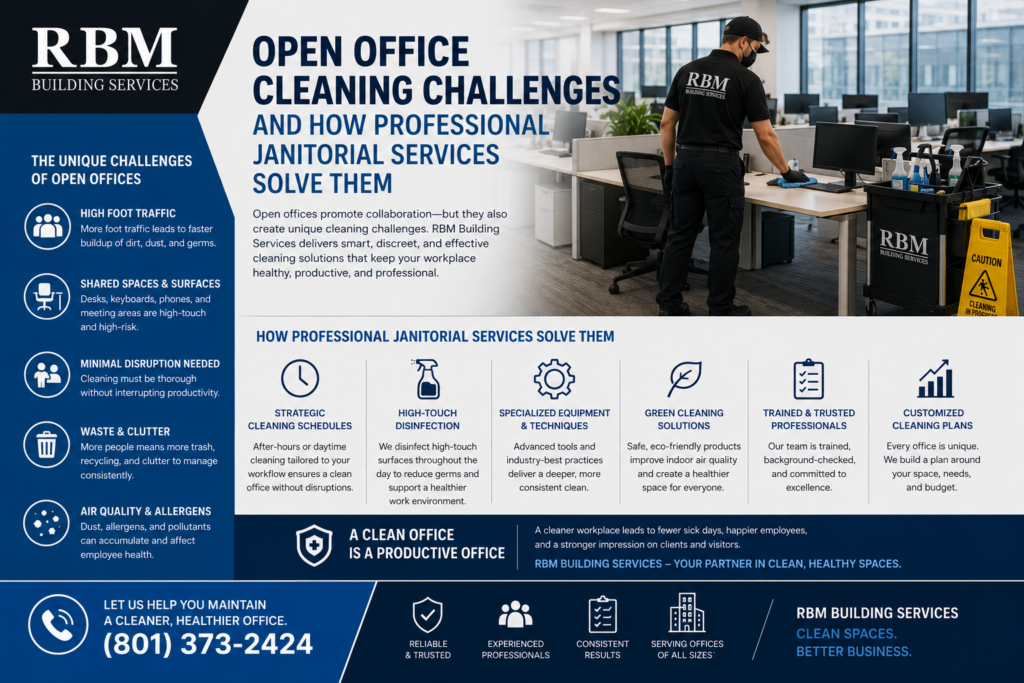
Open office environments have transformed the way commercial cleaning is approached. Unlike traditional offices with private rooms and enclosed workstations, open plan offices feature shared workspaces, low partitions, high occupant density, and minimal barriers between work areas. These design characteristics create distinct cleaning challenges that require specialized strategies and methods. The primary challenge of open office cleaning is that the cleaning crew must work around occupied workstations, sensitive electronics, and personal belongings while maintaining productivity and respecting occupant privacy. In a traditional office, cleaning staff can work efficiently in vacant spaces after hours, moving through private offices on a systematic schedule. In an open office, the entire space is visible and accessible, and any cleaning activity during occupied hours can disrupt the entire floor. Even after hours, open offices present challenges because personal items remain on desks, electronics remain powered on, and the open layout means that noise from cleaning activities carries throughout the space. Post-pandemic, open offices have additional challenges related to infection control. High-touch surfaces in open offices — including door handles, light switches, shared kitchen appliances, and communal equipment — require frequent disinfection, and the open layout means that airborne pathogens can travel more easily between workstations. Professional janitorial services have developed specific strategies for addressing these challenges, including after-hours deep cleaning protocols, daytime touch-up cleaning using quiet methods, and zone-based cleaning programs that minimize disruption. RBM Building Services has provided commercial office cleaning and janitorial services since 1974. See our building maintenance page for more.
The shift to open office layouts has been one of the most significant workplace trends of the past two decades, with approximately 70% of U.S. offices now using some form of open plan design. This shift has been driven by the desire for increased collaboration, flexibility, and space efficiency. However, the cleaning implications of open office design were often overlooked during the planning and design phase, leaving facility managers to address cleaning challenges after the space was already occupied. Open offices typically have 30-50% more square footage of carpet or hard surface flooring per occupant than traditional offices, requiring more floor cleaning labor. They also have more high-touch surfaces per square foot, including shared equipment, communal kitchen appliances, and collaborative furniture that require frequent cleaning. The density of occupants in open offices means that illness can spread more quickly, making infection control cleaning a higher priority. Open offices often have more plants, decorative elements, and collaborative spaces that require specialized cleaning attention. For facility managers who are responsible for maintaining open office environments, understanding these unique challenges and developing appropriate cleaning strategies is essential for maintaining a clean, healthy, and productive workspace. For more on open office cleaning, read our company blog.

Open Office Cleaning Challenges and How Professional Janitorial Services Solve Them
Noise management is one of the most significant challenges in open office cleaning because the open layout means that sound from cleaning activities travels throughout the space and can disturb occupants who are working or in meetings. Unlike traditional offices where cleaning noise is contained by walls and doors, open offices have no barriers to contain sound, and the acoustic design of open offices often incorporates hard surfaces that reflect rather than absorb sound. The cleaning team must be particularly aware of noise from vacuum cleaners, which are among the loudest cleaning equipment used in offices. Standard upright vacuum cleaners can produce 65-75 decibels of noise, which is comparable to normal conversation but can be disruptive in a quiet open office environment. Many professional cleaning companies now use quiet vacuum cleaners specifically designed for open office environments, which operate at 55-60 decibels — significantly quieter than standard vacuums. Battery-powered backpack vacuums are also popular for open office cleaning because they are quieter than corded upright models and allow the cleaner to move freely without a cord trailing through workstations. Floor machines used for burnishing and buffing produce 70-80 decibels of noise and should be used only during unoccupied hours. The cleaning schedule should specify that noisy activities — including vacuuming, floor burnishing, and trash collection — be performed after building occupants have left for the day, while quiet activities — including dusting, restroom cleaning, and touch-point disinfection — can be performed during occupied hours if necessary. Many open office buildings use a split-shift cleaning approach, with a daytime cleaner who performs quiet cleaning tasks during occupied hours and a larger evening crew that performs the more intensive cleaning after hours. The daytime cleaner focuses on restroom cleaning and restocking, high-touch surface disinfection, spot cleaning of spills and visible soil, and emptying of high-traffic trash receptacles using quiet methods. The daytime cleaner should be trained to work quietly and unobtrusively, avoiding disruption to building occupants. Some buildings provide the daytime cleaner with a cart that is designed for quiet operation, with soft wheels and padded compartments that minimize noise when moving through the office.
Communication between the cleaning team and building occupants is essential for managing noise expectations in open offices. The cleaning contractor should provide the building management with a cleaning schedule that specifies when noisy activities will occur and should coordinate with building management to communicate the schedule to tenants. Some buildings provide tenants with a monthly cleaning calendar that shows when floor burnishing, carpet extraction, and other noisy activities are scheduled, allowing tenants to plan their work accordingly. The cleaning contractor should also have a process for responding to noise complaints from building occupants. If a tenant reports that cleaning activities are too noisy or are disrupting their work, the cleaning contractor should investigate and adjust the cleaning approach as needed. In some cases, the solution may be as simple as using different equipment or adjusting the cleaning schedule. In other cases, the solution may require more significant changes to the cleaning program, such as switching to quieter equipment or modifying the cleaning methods. The goal is to balance the need for thorough cleaning with the need for a productive work environment. For professional open office cleaning services that minimize disruption, contact RBM or call 800.403.3564.
The Unique Challenges of Open Office Cleaning
High-touch surface cleaning and disinfection is a critical component of open office cleaning, particularly in the post-pandemic environment where building occupants are more aware of infection risks. Open offices have a higher density of high-touch surfaces per square foot than traditional offices, and the shared nature of these surfaces means that pathogens can spread quickly if surfaces are not properly cleaned and disinfected. High-touch surfaces in open offices include door handles and push plates on entry doors, restroom doors, and conference room doors, light switches throughout the office, kitchen and break room surfaces including cabinet handles, refrigerator doors, microwave keypads, coffee machine buttons, and sink faucets, shared equipment including printers, copiers, and postage machines, elevator buttons and handrails, conference room equipment including remote controls, presentation clickers, and touchscreens, handrails on stairs and in corridors, and reception area surfaces including countertops, pens, and guest check-in tablets. Professional cleaning programs for open offices should specify the frequency and method for cleaning each high-touch surface, with more frequently touched surfaces cleaned more often. In most commercial open offices, high-touch surfaces should be cleaned and disinfected at minimum daily, with surfaces that are touched by many people throughout the day (such as restroom door handles and kitchen appliance controls) cleaned and disinfected multiple times per day. Many professional cleaning companies now use electrostatic sprayers or fogging devices to apply disinfectant to high-touch surfaces quickly and effectively, particularly in large open office areas where manual wiping would be time-consuming. Electrostatic sprayers charge the disinfectant particles so that they are attracted to surfaces, providing complete coverage even on complex surfaces. This technology can reduce the time required for high-touch surface disinfection by 50-70% compared to manual wiping while providing more consistent coverage.
The cleaning products used for high-touch surface disinfection in open offices should be selected carefully to balance effectiveness with occupant comfort. Many disinfectants have strong odors that can be unpleasant for building occupants, and some disinfectants can cause respiratory irritation in sensitive individuals. Green-certified disinfectants that use hydrogen peroxide or citric acid as the active ingredient are effective against a broad spectrum of pathogens while having minimal odor and low respiratory irritation potential. These products are increasingly preferred for open office environments where occupants are in close proximity to cleaned surfaces. The contact time — the time the disinfectant must remain wet on the surface to achieve the claimed level of pathogen reduction — is a critical factor in the effectiveness of high-touch surface cleaning. Most disinfectants require a contact time of 2-10 minutes, depending on the product and the target pathogen. The cleaning staff must apply the disinfectant and allow it to remain wet on the surface for the specified contact time to achieve effective disinfection. This requirement affects the cleaning schedule because surfaces cannot be used during the contact time. In high-traffic open offices, cleaning staff may need to clean high-touch surfaces in zones, closing off access to one area at a time to allow for proper disinfection. For high-touch surface cleaning and disinfection programs for your open office, contact RBM Building Services or call 800.403.3564.
Noise and Disruption Management in Open Offices
Managing electronics and personal workspaces in open offices requires special protocols that respect both the equipment and the occupant’s privacy. Open office workstations typically include computers, monitors, keyboards, mice, phones, and other electronic equipment that should not be moved or handled by cleaning staff. Standard cleaning protocols for open offices specify that cleaning staff should not touch or move any electronic equipment, documents, or personal items on desks. The cleaning staff should clean only the visible surfaces around workstations, including the desk surface (if clear of items), the partition panels, and the chair. Many open office cleaning programs use a “clean around” approach where cleaning staff work around personal items and electronics, cleaning only the surfaces that are accessible without moving or touching personal belongings. This approach requires clear communication between the facility manager and the cleaning contractor about what will and will not be cleaned at each workstation. Some buildings provide desk cleaning service for occupants who request it, with the occupant responsible for clearing their desk before the cleaning crew arrives. Other buildings ask occupants to place trash in designated receptacles and to remove food items from their desks at the end of each day. The cleaning contract should specify the workstation cleaning protocol clearly, including what will be cleaned, what will not be touched, and what the occupant’s responsibilities are for preparing their workstation for cleaning. For electronics that require regular cleaning — particularly shared equipment like printers and copy machines — the cleaning crew should use cleaning products that are approved for use on electronic equipment. Alcohol-based wipes are commonly used for cleaning keyboards, mice, and phone handsets, but should be used carefully because alcohol can damage some plastics and screen coatings. Many electronics manufacturers recommend using a 70% isopropyl alcohol wipe for cleaning keyboards and mice, with the device powered off and unplugged during cleaning. Screen cleaning should use a microfiber cloth dampened with water or a screen-cleaning solution specifically designed for the type of screen being cleaned. Ammonia-based glass cleaners should not be used on computer screens because they can damage anti-glare coatings.
Personal workspace boundaries are an important consideration in open office cleaning. Unlike private offices where the cleaning crew has clear access to the entire space, open office workstations are occupied by individuals who may have different preferences about when and how their workspace is cleaned. Some occupants prefer that their workspace be cleaned daily, while others prefer less frequent cleaning to minimize disruption. Some occupants have items on their desks that they do not want moved or touched, while others are comfortable with the cleaning staff cleaning their entire desk surface. The cleaning program should include a process for documenting occupant preferences and for communicating those preferences to the cleaning staff. Many buildings use a color-coded system or a desk card system where occupants can indicate their cleaning preferences. For example, a green card might indicate “clean my desk,” a yellow card might indicate “empty trash only,” and a red card might indicate “do not clean.” This system allows the cleaning staff to respect each occupant’s preferences while providing appropriate service. The building management should communicate the desk cleaning protocol to all occupants and should provide a way for occupants to update their preferences as needed. The cleaning staff should be trained to recognize and respect these preferences and should report any issues or concerns to their supervisor. For open office workspace management, contact RBM or call 800.403.3564.
Cleaning High-Touch Surfaces in Open Plans
Floor care in open office environments presents unique challenges because the large, open floor areas require different approaches than the smaller, segmented floor areas of traditional offices. Open offices typically have larger expanses of both carpet and hard surface flooring, and the open layout means that floor cleaning equipment can move more freely but also that noise and disruption from floor cleaning activities affect more occupants. Carpeted open offices should be vacuumed daily using quiet, HEPA-filtered vacuums that are designed for open office environments. The vacuuming pattern should be systematic, covering all carpeted areas on a regular schedule. Many professional cleaning companies use a zone-based vacuuming approach that divides the open office into sections and vacuums each section on a rotating schedule. This approach ensures that all areas are vacuumed regularly while allowing the cleaning crew to focus on high-traffic areas more frequently. Carpet spot cleaning should be performed as needed throughout the week, with the cleaning crew trained to identify and treat spots promptly before they become permanent stains. The carpet spot cleaning kit should include appropriate cleaning solutions for different types of stains (coffee, food, ink, etc.) and should be readily available to the cleaning crew. Carpet extraction (deep cleaning) in open offices should be scheduled during periods of low occupancy, typically on weekends or during holiday shutdowns. The large open areas of open offices make carpet extraction more efficient than in traditional offices because the extraction equipment can work continuously without stopping to move around walls and partitions. However, the open layout also means that carpet extraction can affect a larger number of workstations at once, requiring more coordination with building occupants to ensure that affected workstations are cleared and accessible. Hard surface floors in open offices — including entryways, corridors, and common areas — should be dust mopped daily and damp mopped as needed. The hard surface floor care program should include daily dust mopping to remove abrasive grit that can scratch floor finishes, periodic damp mopping with a neutral pH cleaner, and periodic burnishing to maintain gloss and remove light scratches. The frequency of burnishing depends on the traffic levels and the appearance standards for the facility. High-traffic hard surface areas may require daily burnishing to maintain a high-gloss appearance, while moderate-traffic areas may be burnished weekly or monthly.
Floor finish maintenance in open offices requires careful scheduling because the stripping and waxing process produces noise and odors that can be disruptive and requires the affected area to be closed during the process and the curing period. Floor stripping and waxing in open offices should be scheduled during periods of low occupancy, typically on weekends. The stripping process uses chemical strippers and floor machines to remove the old finish, followed by rinsing and application of new finish. The new finish requires 24-48 hours to cure before the floor can be returned to service, meaning that the area may need to be closed for an entire weekend. In large open offices, the floor refinishing work may need to be performed in sections to minimize the area that is closed at any one time. The floor refinishing schedule should be communicated to building occupants well in advance, and affected workstations should be cleared of furniture and equipment before the work begins. The furniture should be moved back into place after the finish has cured, and the floor should be inspected to verify that the finish meets quality standards before the area is reopened. For floor care programs tailored to open office environments, see our floor stripping and waxing page. RBM Building Services has provided commercial cleaning since 1974. Call 800.403.3564 or contact us for a consultation on your open office cleaning needs. Read more on our company blog.
Electronics and Desk Management
Building a comprehensive cleaning strategy for open office environments requires a partnership between the facility manager and the cleaning contractor that addresses the unique challenges of the open plan layout. The strategy should be developed based on an assessment of the office layout and occupancy patterns, the types of surfaces and finishes in the space, the building hours of operation and occupant schedules, and any specific requirements of building occupants or tenants. The assessment should include a walk-through of the facility during both occupied and unoccupied hours to understand how the space is used and how cleaning activities can be scheduled with minimal disruption. With the assessment complete, the facility manager and cleaning contractor should develop a written cleaning plan for the open office that specifies the cleaning tasks and frequencies for each area, the cleaning methods and equipment to be used, the noise management protocols and quiet cleaning methods, the high-touch surface cleaning and disinfection protocols, and the communication protocols for cleaning schedule notifications and occupant feedback. The plan should be reviewed by building management and communicated to building occupants before implementation. The cleaning strategy for open offices should include both after-hours deep cleaning and daytime touch-up cleaning components. After-hours cleaning (typically performed between 6 PM and 12 AM) includes the majority of cleaning tasks, including vacuuming, dusting, restroom cleaning, trash removal, and floor care. After-hours cleaning is the most efficient approach for open offices because the cleaning crew can work without disrupting occupants and can use standard cleaning equipment including vacuums and floor machines. Daytime touch-up cleaning (typically performed between 10 AM and 2 PM) includes high-touch surface disinfection, restroom restocking, spot cleaning of spills and visible soil, and emptying of high-traffic trash receptacles. Daytime cleaning should be performed using quiet methods and should be coordinated with building management to minimize disruption. The daytime cleaner should be trained to work unobtrusively and to respond to occupant requests for cleaning assistance.
Quality assurance for open office cleaning should include regular inspections of cleaning quality during both occupied and unoccupied hours, periodic occupant satisfaction surveys to assess satisfaction with cleaning quality and to identify areas for improvement, and regular communication between the facility manager and the cleaning contractor to review performance and address any issues. The quality assurance program should also include periodic deep cleaning of carpets, floors, upholstery, and other surfaces to maintain the facility’s appearance and protect its finishes. The frequency of deep cleaning should be based on the facility’s traffic levels and soil exposure, as discussed in the janitorial versus deep cleaning section of this guide. The success of an open office cleaning program depends on the partnership between the facility manager, the cleaning contractor, and the building occupants. The facility manager sets the standards and provides the resources, the cleaning contractor provides the expertise and labor, and the building occupants cooperate by keeping their workstations clear and providing feedback on cleaning quality. When all three parties work together, the open office environment can be maintained at a high standard of cleanliness that supports occupant health, productivity, and satisfaction. RBM Building Services has provided commercial office cleaning and janitorial services for open office environments since 1974. Call 800.403.3564 or contact us for a consultation on your open office cleaning program. Read more on our company blog.
Floor Care in Open Office Environments
Building a comprehensive cleaning strategy for open office environments requires a partnership between the facility manager and the cleaning contractor that addresses the unique challenges of the open plan layout. The strategy should be developed based on an assessment of the office layout and occupancy patterns, the types of surfaces and finishes in the space, the building hours of operation and occupant schedules, and any specific requirements of building occupants or tenants. The assessment should include a walk-through of the facility during both occupied and unoccupied hours to understand how the space is used and how cleaning activities can be scheduled with minimal disruption. With the assessment complete, the facility manager and cleaning contractor should develop a written cleaning plan for the open office that specifies the cleaning tasks and frequencies for each area, the cleaning methods and equipment to be used, the noise management protocols and quiet cleaning methods, the high-touch surface cleaning and disinfection protocols, and the communication protocols for cleaning schedule notifications and occupant feedback. The plan should be reviewed by building management and communicated to building occupants before implementation. The cleaning strategy for open offices should include both after-hours deep cleaning and daytime touch-up cleaning components. After-hours cleaning (typically performed between 6 PM and 12 AM) includes the majority of cleaning tasks, including vacuuming, dusting, restroom cleaning, trash removal, and floor care. After-hours cleaning is the most efficient approach for open offices because the cleaning crew can work without disrupting occupants and can use standard cleaning equipment including vacuums and floor machines. Daytime touch-up cleaning (typically performed between 10 AM and 2 PM) includes high-touch surface disinfection, restroom restocking, spot cleaning of spills and visible soil, and emptying of high-traffic trash receptacles. Daytime cleaning should be performed using quiet methods and should be coordinated with building management to minimize disruption. The daytime cleaner should be trained to work unobtrusively and to respond to occupant requests for cleaning assistance.
Quality assurance for open office cleaning should include regular inspections of cleaning quality during both occupied and unoccupied hours, periodic occupant satisfaction surveys to assess satisfaction with cleaning quality and to identify areas for improvement, and regular communication between the facility manager and the cleaning contractor to review performance and address any issues. The quality assurance program should also include periodic deep cleaning of carpets, floors, upholstery, and other surfaces to maintain the facility’s appearance and protect its finishes. The frequency of deep cleaning should be based on the facility’s traffic levels and soil exposure, as discussed in the janitorial versus deep cleaning section of this guide. The success of an open office cleaning program depends on the partnership between the facility manager, the cleaning contractor, and the building occupants. The facility manager sets the standards and provides the resources, the cleaning contractor provides the expertise and labor, and the building occupants cooperate by keeping their workstations clear and providing feedback on cleaning quality. When all three parties work together, the open office environment can be maintained at a high standard of cleanliness that supports occupant health, productivity, and satisfaction. RBM Building Services has provided commercial office cleaning and janitorial services for open office environments since 1974. Call 800.403.3564 or contact us for a consultation on your open office cleaning program. Read more on our company blog.
Open office cleaning services
Building a Cleaning Strategy for Open Offices
Building a comprehensive cleaning strategy for open office environments requires a partnership between the facility manager and the cleaning contractor that addresses the unique challenges of the open plan layout. The strategy should be developed based on an assessment of the office layout and occupancy patterns, the types of surfaces and finishes in the space, the building hours of operation and occupant schedules, and any specific requirements of building occupants or tenants. The assessment should include a walk-through of the facility during both occupied and unoccupied hours to understand how the space is used and how cleaning activities can be scheduled with minimal disruption. With the assessment complete, the facility manager and cleaning contractor should develop a written cleaning plan for the open office that specifies the cleaning tasks and frequencies for each area, the cleaning methods and equipment to be used, the noise management protocols and quiet cleaning methods, the high-touch surface cleaning and disinfection protocols, and the communication protocols for cleaning schedule notifications and occupant feedback. The plan should be reviewed by building management and communicated to building occupants before implementation. The cleaning strategy for open offices should include both after-hours deep cleaning and daytime touch-up cleaning components. After-hours cleaning (typically performed between 6 PM and 12 AM) includes the majority of cleaning tasks, including vacuuming, dusting, restroom cleaning, trash removal, and floor care. After-hours cleaning is the most efficient approach for open offices because the cleaning crew can work without disrupting occupants and can use standard cleaning equipment including vacuums and floor machines. Daytime touch-up cleaning (typically performed between 10 AM and 2 PM) includes high-touch surface disinfection, restroom restocking, spot cleaning of spills and visible soil, and emptying of high-traffic trash receptacles. Daytime cleaning should be performed using quiet methods and should be coordinated with building management to minimize disruption. The daytime cleaner should be trained to work unobtrusively and to respond to occupant requests for cleaning assistance.
Quality assurance for open office cleaning should include regular inspections of cleaning quality during both occupied and unoccupied hours, periodic occupant satisfaction surveys to assess satisfaction with cleaning quality and to identify areas for improvement, and regular communication between the facility manager and the cleaning contractor to review performance and address any issues. The quality assurance program should also include periodic deep cleaning of carpets, floors, upholstery, and other surfaces to maintain the facility’s appearance and protect its finishes. The frequency of deep cleaning should be based on the facility’s traffic levels and soil exposure, as discussed in the janitorial versus deep cleaning section of this guide. The success of an open office cleaning program depends on the partnership between the facility manager, the cleaning contractor, and the building occupants. The facility manager sets the standards and provides the resources, the cleaning contractor provides the expertise and labor, and the building occupants cooperate by keeping their workstations clear and providing feedback on cleaning quality. When all three parties work together, the open office environment can be maintained at a high standard of cleanliness that supports occupant health, productivity, and satisfaction. RBM Building Services has provided commercial office cleaning and janitorial services for open office environments since 1974. Call 800.403.3564 or contact us for a consultation on your open office cleaning program. Read more on our company blog.