
How Often Should Offices Be Deep Cleaned?
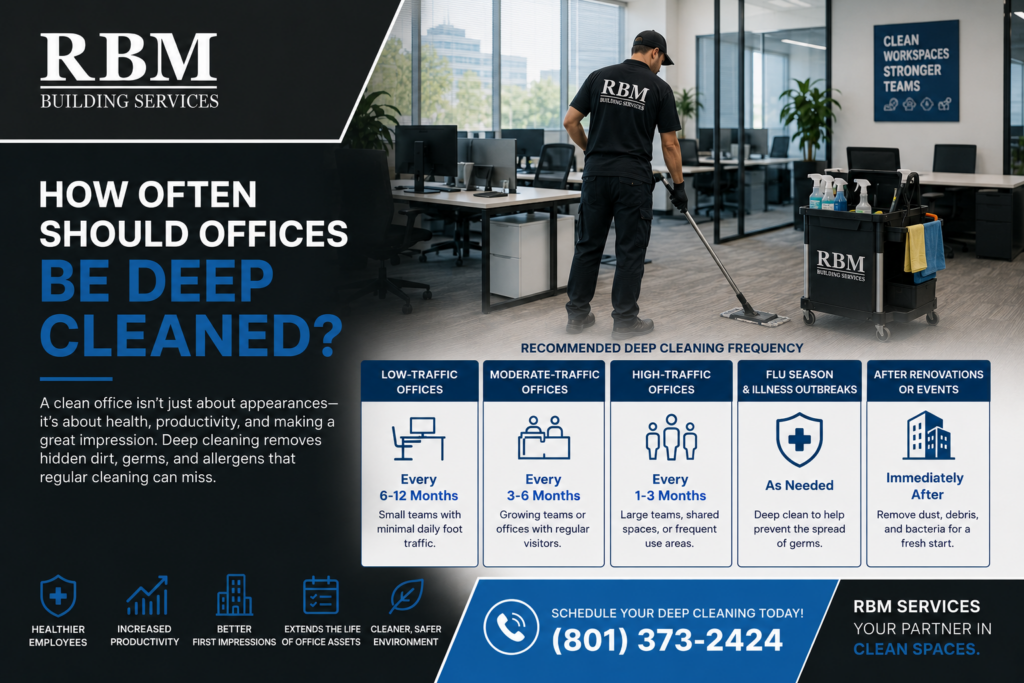
The Complete Guide to Office Cleaning Frequency
Opening Summary
Offices should be deep cleaned at least quarterly (every 3 months), with high-traffic areas and critical zones requiring monthly deep cleaning. This is the most important takeaway for facility managers and business owners: daily cleaning alone cannot remove accumulated dirt, bacteria, and allergens that build up over time. Deep cleaning goes beyond surface maintenance to address hard-to-reach areas like under desks, behind equipment, inside HVAC vents, and deep within carpet fibers where germs hide.
This comprehensive guide covers everything you need to know: what distinguishes deep cleaning from regular maintenance cleaning, the eight most common mistakes that lead to inadequate office cleanliness (and how to fix each), real costs of getting it wrong (from employee sick days to carpet replacement), customized cleaning schedules by office type and size, seasonal considerations, how to choose the right commercial cleaning provider, and actionable checklists for implementing an effective deep cleaning program. Whether you’re dealing with current cleanliness issues or planning ahead for flu season, expert guidance from experienced janitorial professionals ensures your office maintains optimal hygiene while maximizing your cleaning budget.
What Is Deep Cleaning In Offices and How Does It Work?
Clear Definition
Deep cleaning in offices is a comprehensive, thorough cleaning process that goes far beyond daily or weekly maintenance tasks. It targets areas typically missed during regular cleaning: under furniture, behind equipment, inside vents, deep carpet fibers, high ceilings, and hard-to-reach surfaces. Deep cleaning removes accumulated dirt, grime, bacteria, viruses, and allergens that regular cleaning cannot address.
Key Differences: Regular Cleaning vs. Deep Cleaning
| Task Type | Regular/Maintenance Cleaning | Deep Cleaning |
|---|---|---|
| Frequency | Daily or weekly | Monthly, quarterly, or annually |
| Areas Covered | Visible surfaces, high-touch points | Under desks, behind equipment, vents, deep carpet |
| Time Required | 30–60 minutes per zone | 2–8 hours per zone |
| Equipment | Standard vacuums, mops, cloths | HEPA vacuums, steam cleaners, carpet extractors, pressure washers |
| Goals | Remove surface dirt, maintain appearance | Eliminate accumulated pathogens, restore surfaces |
Key Components and What’s Included
Deep cleaning typically includes:
- Carpet cleaning: Hot water extraction, steam cleaning, or dry cleaning to remove deep dirt and stains
- Hard floor restoration: Strip-and-seal, buffing, or scrubbing to remove built-up grime
- Desk and furniture cleaning: Under and behind desks, inside drawers, upholstery shampooing
- High-level cleaning: Ceilings, light fixtures, air vents, ceiling fans, high walls
- Wall and baseboard cleaning: Spot removal, full washing, baseboard scrubbing
- Kitchen/break room deep clean: Inside appliances, behind coffee machines, cabinet exteriors
- Bathroom sanitization: Grout cleaning, fixture polishing, drain treatment, wall scrubbing[
- HVAC vent cleaning: Air ducts, vents, filters (often requires specialized service)
- Window cleaning: Interior and exterior glass, sills, tracks
- Tile and grout restoration: Steam cleaning, re-sealing porous surfaces
What’s NOT included:
- Structural repairs (leaking pipes, broken fixtures)
- Pest control (requires separate licensed service)
- Mold remediation (requires specialized remediation company)
- Chemical hazard removal (requires environmental remediation)
Common Variations by Office Type
- Small offices (<50 employees): Quarterly deep cleaning; monthly for break rooms
- Medium offices (50–200 employees): Monthly for high-traffic zones; quarterly for entire facility
- Large offices (200+ employees): Weekly for critical zones; monthly for restrooms; quarterly for entire building
- Healthcare waiting rooms: Monthly deep cleaning (higher infection risk)
- Gyms/fitness centers: Weekly deep cleaning due to sweat and moisture
- Schools/educational facilities: Monthly during school year; quarterly during breaks
General Timeline and Process Flow
- Assessment: Audit current cleanliness; identify high-risk zones
- Scheduling: Plan deep cleaning during low-occupancy (weekends, evenings)
- Preparation: Move furniture, clear workspaces, notify occupants
- Execution: Perform deep cleaning tasks by zone
- Post-cleaning: Dry surfaces, return furniture, ventilate space
- Documentation: Log cleaning dates, products used, areas covered
- Follow-up: Schedule next deep cleaning; adjust frequency if needed
Real-World Example
A Phoenix office with 150 employees implements deep cleaning:
- Monthly: Restrooms, break rooms, entryways, high-touch surfaces
- Quarterly: Entire office—carpets, floors, desks, walls, ceilings, HVAC vents
- Annually: Window exterior cleaning, HVAC duct cleaning, tile/grout restoration
- Uses HEPA-filtered vacuums for carpets to prevent re-suspended particles
- Applies EPA-registered disinfectants with 3-minute contact time on all surfaces
8 Ways Office Deep Cleaning Frequency Can Go Wrong
1. Deep Cleaning Only Annually (Once Per Year)
What it is: Scheduling deep cleaning just once per year, treating it as an “annual chore” rather than ongoing maintenance.
Why it happens: Viewing deep cleaning as optional expense; assuming daily cleaning is sufficient; cost-cutting on cleaning budget.
Real consequences: Dirt, bacteria, and allergens accumulate continuously. After 12 months, carpets harbor 4 million bacteria per square inch; hard floors develop thick grime layers that regular mopping cannot remove. Employees experience higher allergy symptoms (20–30% increase), respiratory issues, and sick days. Boston Microbiology Study found offices cleaned only monthly had “significantly higher bacterial counts” than those cleaned weekly. Annual deep cleaning means 11 months of compromised hygiene.
How to fix it: Minimum quarterly (every 3 months) for entire office; monthly for high-traffic zones like restrooms, break rooms, entryways. Adjust based on occupancy and foot traffic.
2. Ignoring High-Touch and High-Traffic Zones
What it is: Deep cleaning entire office equally while neglecting zones with highest germ accumulation.
Why it happens: Treating all areas as equal; not prioritizing by risk; lack of zoned cleaning approach.
Real consequences: High-touch surfaces (door handles, light switches, elevator buttons, phone keyboards) accumulate “high amounts of germs, since people touch and use them so often”. Break rooms harbor E. coli and Salmonella from food handling. Restrooms contain fecal bacteria (E. coli, Norovirus). Entryways collect outdoor dirt, pollen, and pathogens. Skipping these zones for deep cleaning creates infection reservoirs. One study showed break room surfaces had 200+ bacteria per square inch after just one week without deep cleaning.
How to fix it: Prioritize deep cleaning by zone risk:
- Weekly: Entryways, restrooms
- Monthly: Break rooms, high-touch surfaces, conference rooms
- Quarterly: Entire office including low-traffic areas
3. Using Regular Cleaning Methods for Deep Cleaning
What it is: Using standard vacuums, mops, and cloths for “deep cleaning” instead of specialized equipment.
Why it happens: Assuming all cleaning is the same; not investing in proper equipment; using same staff/equipment for deep and regular cleaning.
Real consequences: Standard vacuums re-suspend 70% of dust and allergens into air. Regular mops spread bacteria across floors instead of removing them. Cloths cannot reach deep carpet fibers or behind furniture. Deep cleaning requires HEPA-filtered vacuums (capture 99.97% of particles), steam cleaners (400°F to kill bacteria), carpet extractors (hot water extraction), and pressure washers. Without proper equipment, you’re “cleaning” but not removing accumulated pathogens.
How to fix it: Hire professional cleaners with specialized equipment:
- HEPA-filtered vacuums for carpets
- Steam cleaners for tiles/grout
- Carpet extractors for hot water extraction
- EPA-registered disinfectants with proper contact time
- UVC-equipped vacuums for microbial reduction
4. Not Adjusting Frequency Based on Occupancy Changes
What it is: Keeping same deep cleaning schedule despite employee count increasing 50% or dropping to remote work.
Why it happens: Inflexible scheduling; not monitoring occupancy; assuming “one size fits all.”
Real consequences: If occupancy doubles but cleaning frequency stays same, dirt accumulation doubles. One study found bacterial counts increased 3× when office occupancy rose from 100 to 200 people with unchanged cleaning. During remote work, over-cleaning wastes money. Post-pandemic, many offices kept pre-pandemic frequencies despite lower occupancy, spending 30% more than needed. Conversely, warehouses with increased night shifts saw mold growth after 6 months because deep cleaning didn’t adjust for 24-hour operation.
How to fix it: Recalculate deep cleaning frequency quarterly:
- >200 employees: Weekly critical zones; monthly restrooms; quarterly entire facility
- 50–200 employees: Monthly high-traffic; quarterly entire facility
- <50 employees: Quarterly entire facility; monthly break rooms
- Adjust for 24-hour operations, events, seasonal visitors
5. Skipping Seasonal Deep Cleaning Adjustments
What it is: Using same deep cleaning schedule year-round despite seasonal changes in dirt, allergens, and weather.
Why it happens: Not recognizing seasonal impact; rigid annual scheduling; forgetting spring pollen or winter moisture.
Real consequences: Spring brings pollen (increases allergies 40–60%). Summer humidity breeds mold and bacteria in carpets. Fall brings outdoor dirt from leaves and rain. Winter moisture creates mold risk in entryways and restrooms. Offices without seasonal adjustments saw 25% more allergy complaints in spring and 30% more mold issues in winter. deep cleaning during peak allergen seasons (spring/fall) reduces employee sick days by 15–20%.
How to fix it: Add seasonal deep cleaning:
- Spring (March–May): Extra carpet cleaning (pollen); HVAC vent cleaning (allergens)
- Summer (June–August): Monthly restroom deep cleaning (humidity); tile/grout steam cleaning
- Fall (September–November): Entryway deep cleaning (outdoor dirt); window exterior cleaning
- Winter (December–February): Break room deep cleaning (moisture); floor strip-and-seal (wet shoes)
6. Deep Cleaning During Peak Occupancy Hours
What it is: Scheduling deep cleaning during business hours when employees are present.
Why it happens: Avoiding weekend/evening costs; not coordinating with staff; assuming “quick cleaning” won’t disrupt.
Real consequences: Deep cleaning emits strong chemicals, requires furniture moving, and creates noise/dust. Employees working during deep cleaning experience:
- 2–3 hour productivity loss per day from disruptions
- Respiratory irritation from cleaning chemicals
- Noise complaints and frustration
- Safety hazards from wet floors, moved furniture
- Potential exposure to un-dried disinfectants
One office reported 15 employee complaints during daytime deep cleaning; productivity dropped 20% for 3 days.
How to fix it: Schedule deep cleaning during low-occupancy times:
- Weekends (Saturday–Sunday)
- Evening hours (after 6 PM)
- Holiday breaks
- Before/after business hours
- Notify occupants 2 weeks before; post signage about drying times
7. Not Documenting Deep Cleaning Activities
What it is: Performing deep cleaning but failing to log dates, areas covered, products used, or staff assigned.
Why it happens: Paperwork feels burdensome; assuming “we did it” is enough; no systematic recordkeeping.
Real consequences: Without documentation, you can’t prove compliance during OSHA inspections. No record = can’t track if frequency is adequate. Can’t verify which areas were cleaned. Can’t justify cleaning budget to management. When employees report illness, you can’t prove deep cleaning was performed. Massachusetts healthcare guidelines require “detailed cleaning logs” for compliance audits. OSHA may cite facilities for “inadequate cleaning documentation” ($16,550+ fine).
How to fix it: Maintain digital cleaning logs:
- Date and time of deep cleaning
- Areas/zones cleaned
- Products and equipment used
- Staff names and credentials
- Photos before/after (for quality verification)
- Store logs for 3 years minimum
8. Assuming Daily Cleaning Is Sufficient for All Areas
What it is: Believing daily vacuuming and mopping eliminates need for deep cleaning.
Why it happens: Not understanding what daily cleaning removes vs. what accumulates; cost-cutting myth.
Real consequences: Daily cleaning removes surface dirt but not deep contaminants. Carpets trap 4x more dirt than hard floors; daily vacuuming removes only 20% of deep dirt. Hard floors develop grime layers under regular mopping. Desks harbor bacteria under keyboards and behind monitors. HVAC vents accumulate dust that daily cleaning cannot reach. After 6 months without deep cleaning:
- Carpets: 4 million bacteria/sq inch
- Restroom floors: 200 E. coli/sq inch
- Break room counters: 150 Salmonella/sq inch
- Desk surfaces: 500 bacteria/sq inch
Daily cleaning maintains appearance but doesn’t eliminate pathogens.
How to fix it: Treat daily cleaning as maintenance only; deep cleaning as pathogen elimination. Both are necessary:
- Daily: High-touch surfaces, visible dirt
- Monthly: Restrooms, break rooms
- Quarterly: Entire office deep clean
The Real Cost / Impact of Getting Office Deep Cleaning Frequency Wrong
Financial Costs
Direct cleaning and remediation:
- Emergency deep cleaning after outbreak: $2,000–$10,000
- Carpet replacement (due to neglect): $3–$7 per sq ft = $15,000–$50,000 for 5,000 sq ft
- Hard floor restoration ( neglected strip-and-seal): $1,500–$5,000
- HVAC duct cleaning (emergency): $500–$2,000
Lost productivity and absenteeism:
- Sick employees cost $2,000–$4,000 annually per person in lost productivity
- Outbreak shutting 20% of staff for 1 week: $15,000–$40,000 for 100-employee company
- Productivity loss during poor deep cleaning: $5,000–$20,000/month (allergy complaints, respiratory issues)
Legal and liability:
- OSHA fines for inadequate cleaning documentation: $16,550+
- Employee lawsuits for negligence (allergies, illness): $50,000–$500,000+
- Insurance claim denials: full cost to employer
Cleaning budget waste:
- Over-cleaning (remote work): 30%+ unnecessary expenses = $5,000–$15,000/month
- Under-cleaning (high occupancy): Emergency remediation = $10,000–$50,000
Time Costs
- Recovery from outbreak: 2–4 weeks for full staff return
- Emergency deep cleaning: 16–40 hours of disruption
- OSHA inspection preparation: 20–40 hours documenting cleaning
- Carpet/floor replacement: 3–7 days downtime
Emotional and Relational Costs
- Employee distrust of workplace safety
- Complaints about allergies, respiratory issues
- Staff burnout from increased cleaning workload
- Leadership stress from managing outbreaks
- Reputation damage on review sites
Long-Term Consequences
- Recurring outbreaks: Poor deep cleaning creates cycles of illness
- Chronic absenteeism: 15–25% higher than industry average
- Facility degradation: Carpets/floors wear faster without regular deep cleaning
- Regulatory scrutiny: Increased OSHA inspections
- Business closure risk: 8–12% of small businesses close after major outbreak
Most Costs Are Avoidable
Proper deep cleaning prevents 90%+ of these costs:
- $500/month quarterly deep cleaning vs. $15,000 carpet replacement = 97% savings
- $1,000/month optimal frequency vs. $40,000 outbreak = 97.5% savings
- Digital documentation ($200/month) vs. $16,550 OSHA fine = 98.8% savings
Investing in expert guidance upfront saves exponentially more than reactive remediation.
How an Experienced Commercial Cleaning Professional Helps You Succeed With Office Deep Cleaning Frequency
Guidance Through Every Step
Experienced janitorial professionals like cleaning experts walk you through assessment, frequency determination, scheduling, execution, and monitoring. They identify your office’s unique risk zones and create customized deep cleaning schedules.
Proper Preparation and Execution
Professional cleaners use specialized equipment: HEPA vacuums, steam cleaners, carpet extractors, EPA-registered disinfectants. They clean during low-occupancy hours, move furniture properly, and document every task.
Risk Management
Experts anticipate problems:
- Schedule deep cleaning before flu season (September)
- Increase frequency during high-occupancy periods
- Stock backup equipment for surge cleaning
- Create zoned cleaning protocols
Dispute Resolution and Troubleshooting
When cleaning fails or issues arise, professionals troubleshoot root causes: was frequency insufficient? Was equipment wrong? Was product ineffective?
Compliance with Relevant Rules
Cleaning professionals ensure compliance with:
- CDC cleaning guidance for community settings
- OSHA workplace sanitation requirements
- EPA-registered disinfectant standards
Proactive Strategies to Prevent Problems
- Quarterly audits of cleaning frequency adequacy
- Monthly high-touch surface monitoring
- Seasonal frequency adjustments
- Real-time occupancy tracking
- Employee health communication protocols
Office Deep Cleaning Frequency Options, Alternatives, or Strategies
Strategy 1: Quarterly Deep Cleaning (Recommended for Most Offices)
How it works: Entire office deep cleaned every 3 months; monthly for high-traffic zones.
When appropriate: Medium offices (50–200 employees); standard occupancy; low infection risk.
Benefits: Balanced cost and hygiene; prevents pathogen accumulation.
Limitations: May be insufficient for high-occupancy or healthcare waiting rooms.
Strategy 2: Monthly Deep Cleaning (High-Risk Zones)
How it works: Critical zones (restrooms, break rooms, entryways) deep cleaned monthly; quarterly for entire office.
When appropriate: Large offices (200+ employees); healthcare waiting rooms; gyms; schools.
Benefits: Reduces infection risk by 40–50%; minimizes allergy complaints.
Limitations: Higher cost ($1,000–$3,000/month vs. $500/month quarterly).
Strategy 3: Weekly Deep Cleaning (Critical Areas Only)
How it works: Entryways, restrooms deep cleaned weekly; monthly for break rooms; quarterly for entire office.
When appropriate: Very high-traffic facilities (24-hour operations, event venues, gyms).
Benefits: Maximum hygiene; prevents mold and bacterial growth.
Limitations: Highest cost ($3,000–$8,000/month); requires significant staff.
Strategy 4: Annual Deep Cleaning Only (NOT Recommended)
How it works: Entire office deep cleaned once per year.
When appropriate: None—never adequate for occupied offices.
Limitations: 11 months of compromised hygiene; 4 million bacteria/sq inch in carpets; outbreak risk 3× higher.
Strategy 5: Hybrid Approach (Best for Most Businesses)
How it works: Weekly critical zones + monthly high-traffic + quarterly entire facility + seasonal adjustments.
When appropriate: All commercial offices with moderate-to-high occupancy.
Benefits: Comprehensive protection addressing all risk zones and seasonal factors
What to Do If You Are Currently Dealing With Office Deep Cleaning Issues
Immediate Step-by-Step Checklist
- Assess current cleanliness: Audit all zones; identify high-risk areas
- Calculate occupancy: Count employees; track foot traffic; note 24-hour operations
- Determine appropriate frequency:
- <50 employees: Quarterly entire office
- 50–200 employees: Monthly high-traffic; quarterly entire
- 200+ employees: Weekly critical; monthly restrooms; quarterly entire
- Schedule deep cleaning: Weekend or evening; notify occupants 2 weeks prior
- Prepare space: Move furniture; clear workspaces; ventilate area
- Use proper equipment: HEPA vacuums; steam cleaners; carpet extractors
- Apply EPA-registered disinfectants: Verify contact time (3–10 minutes)
- Clean by zone priority: Entryways → restrooms → break rooms → work areas
- Document activities: Log dates, areas, products, staff
- Dry surfaces completely: Wait 2–4 hours before occupancy
- Monitor outcomes: Track allergy complaints, sick days, cleanliness feedback
- Adjust frequency if needed: Increase if issues persist; decrease if over-cleaning
How to Choose the Right Commercial Cleaning Provider for Office Deep Cleaning
Checklist for Selection
| Criterion | What to Verify | Why It Matters |
|---|---|---|
| Relevant Experience | 3+ years in commercial office cleaning; examples of similar facilities | Experienced providers know frequency requirements |
| Credentials | EPA-registered disinfectant training; OSHA compliance | Ensures legal compliance |
| Specialized Equipment | HEPA vacuums; steam cleaners; carpet extractors | Proper equipment removes deep pathogens |
| Frequency Expertise | Knowledge of zoned cleaning; seasonal adjustments | Prevents under/over-cleaning |
| Plain-English Communication | Clear explanations; written protocols | You understand what’s happening |
| Availability | Weekend/evening scheduling; emergency response | Critical for low-occupancy cleaning |
| Comprehensive Approach | Zoned cleaning + seasonal + documentation | Addresses all risk factors |
| Documentation | Digital checklists; cleaning logs | Required for compliance |
| Product Verification | EPA registration numbers; contact time training | Effective disinfection |
| Long-Term Planning | Quarterly audits; frequency adjustments | Prevents future problems |
Red Flags to Avoid
- Uses same equipment for deep and regular cleaning
- No zoned cleaning approach
- Doesn’t offer weekend/evening scheduling
- No digital documentation
- Avoids HEPA vacuums for carpets
- Doesn’t adjust for occupancy changes
Common Mistakes People Make With Office Deep Cleaning Frequency
1. Deep Cleaning Only Annually
Why it happens: Viewing deep cleaning as optional; cost-cutting.
How to avoid: Minimum quarterly for entire office; monthly for high-traffic zones.
2. Using Regular Vacuums for Carpets
Why it happens: Not investing in HEPA equipment.
How to avoid: Use HEPA-filtered vacuums; turn off HVAC recirculation while vacuuming.
3. Skipping Break Room Deep Cleaning
Why it happens: Assuming kitchen cleaning is separate; not recognizing E. coli risk.
How to avoid: Deep clean break rooms monthly; inside appliances, behind coffee machines.
4. Not Adjusting for Seasonal Changes
Why it happens: Rigid annual scheduling.
How to avoid: Extra carpet cleaning in spring (pollen); monthly restrooms in summer (humidity).
5. Deep Cleaning During Business Hours
Why it happens: Avoiding weekend costs.
How to avoid: Schedule weekends or evenings; notify 2 weeks prior.
6. Not Documenting Cleaning Activities
Why it happens: Paperwork feels burdensome.
How to avoid: Maintain digital logs; required for OSHA compliance.
7. Assuming Daily Cleaning Is Enough
Why it happens: Not understanding deep vs. surface dirt.
How to avoid: Daily = maintenance; deep cleaning = pathogen elimination.
8. Ignoring High-Touch Surfaces
Why it happens: Not prioritizing by risk.
How to avoid: Clean high-touch surfaces every 1–2 hours; deep clean monthly.
Frequently Asked Questions
How often should offices be deep cleaned?
Quarterly (every 3 months) for entire office; monthly for high-traffic zones like restrooms and break rooms.
What is the difference between regular cleaning and deep cleaning?
Regular cleaning removes surface dirt daily/weekly; deep cleaning removes accumulated pathogens from hard-to-reach areas monthly/quarterly.
How long does office deep cleaning take?
2–8 hours per zone depending on size; entire office typically 1–3 days.
When is the best time to schedule deep cleaning?
Weekends, evenings, or holiday breaks when occupancy is lowest.
Do I need to deep clean if I clean daily?
Yes—daily cleaning removes surface dirt but not deep contaminants; both are necessary.
What areas need the most frequent deep cleaning?
Restrooms, break rooms, entryways, and high-touch surfaces.
How much does office deep cleaning cost?
$500–$3,000/month depending on facility size and frequency.
Should I deep clean during flu season?
Yes—increase frequency to monthly for restrooms and break rooms September–February.
What equipment is needed for deep cleaning?
HEPA vacuums, steam cleaners, carpet extractors, EPA-registered disinfectants.
How do I know if deep cleaning frequency is adequate?
Track allergy complaints, sick days, and cleanliness feedback; adjust if issues persist.
Can I deep clean during business hours?
No—schedule during low-occupancy times to avoid disruption and chemical exposure.
Do carpets need more frequent deep cleaning than hard floors?
Yes—carpets trap 4× more dirt; deep clean monthly vs. quarterly for hard floors.
What disinfectant should I use for deep cleaning?
EPA-registered disinfectants from List N with 3–10 minute contact time.
How long should disinfectant stay wet on surfaces?
3–10 minutes depending on product; check Safety Data Sheet.
Do I need to move furniture for deep cleaning?
Yes—move desks, chairs, and equipment to clean under and behind.
How do I document deep cleaning?
Use digital logs: date, areas, products, staff names, photos.
Should I adjust deep cleaning for remote work?
Yes—decrease frequency during low occupancy; increase when staff return.
What’s the cost of not deep cleaning regularly?
Carpet replacement ($15,000–$50,000), outbreak costs ($15,000–$40,000), OSHA fines ($16,550+).
How do I deep clean HVAC vents?
Hire specialized service; typical cost $500–$2,000; schedule annually.
Do break rooms need deep cleaning?
Yes—monthly deep cleaning to remove E. coli and Salmonella from food handling.
What’s the best deep cleaning frequency for 100 employees?
Monthly high-traffic zones; quarterly entire office.
How do I deep clean tile and grout?
Use steam cleaners; re-seal porous surfaces; monthly for restrooms.
Do entryways need frequent deep cleaning?
Yes—weekly deep cleaning to remove outdoor dirt, pollen, and pathogens.
Can I use household cleaners for deep cleaning?
Only if EPA-registered; prefer products with “emerging viral pathogens” claim.
How do I prevent mold during deep cleaning?
Dry surfaces completely; use dehumidifiers in humid months; monthly restroom cleaning.
Key Rules, Laws, or Standards You Should Know About Office Deep Cleaning Frequency
OSHA Workplace Sanitation Requirements
OSHA requires employers to maintain “workplace in a clean and sanitary condition, using schedules and procedures for cleaning and decontamination“.
CDC Cleaning Guidance for Community Settings
CDC provides recommendations for high-touch surface cleaning frequency and disinfectant selection in non-healthcare commercial buildings.
EPA List N Disinfectants
Use only EPA-registered disinfectants verified on EPA’s List N for your target pathogens.
OSHA Hazard Communication Standard (29 CFR 1910.1200)
Requires Safety Data Sheets available to all workers, chemical labeling, and hazard training.
Conclusion
Office deep cleaning frequency isn’t optional—it’s essential for protecting employee health, preventing outbreaks, and maintaining facility value. Offices should be deep cleaned at least quarterly, with high-traffic zones requiring monthly deep cleaning. The eight most common failures (annual-only cleaning, ignoring high-touch zones, using wrong equipment, not adjusting for occupancy, skipping seasonal changes, daytime scheduling, no documentation, and assuming daily cleaning is sufficient) are all preventable with proper planning and expert guidance.
Most problems are avoidable. Investing $500–$3,000/month in professional deep cleaning prevents $15,000–$50,000 carpet replacement and $40,000 outbreak costs. Following CDC, EPA, and OSHA standards protects you from liability while keeping occupants safe.
Whether you’re currently dealing with cleanliness issues or planning ahead for flu season, don’t navigate deep cleaning frequency alone. Experienced professionals understand zoned cleaning, seasonal adjustments, specialized equipment, and documentation requirements that most facility managers miss.
Contact experienced commercial cleaning professionals today for guidance on office deep cleaning frequency. They provide customized cleaning schedules, specialized equipment, EPA-registered disinfectants, and quarterly compliance audits to keep your facility safe and compliant.
Disclaimer: This article provides general information about office deep cleaning frequency and is not intended as legal, medical, or professional advice. Always follow current CDC, EPA, and OSHA guidelines specific to your facility type. Consult with qualified commercial cleaning professionals, medical experts, or legal counsel for advice tailored to your situation. Healthcare facilities, food service establishments, and other regulated industries must follow their specific regulatory requirements beyond general CDC community guidance.