Printing and copy shop cleaning is the specialized janitorial service designed to keep print centers, copy shops, and business service locations clean, safe, and professional for both staff and customers. It matters because paper dust, toner spills, ink stains, and high customer traffic create unique cleanliness and safety challenges that standard office cleaning doesn’t address. The most important takeaway: most problems stem from using the wrong cleaning methods (like ordinary vacuums on toner) or lacking a clear scope of work—so trained staff, proper equipment, and written standards prevent the majority of headaches. This guide explains how printing and copy shop cleaning works, the common ways it can go wrong (and how to fix them), realistic costs, compliance basics, and how to choose the right provider. Expert guidance from an experienced commercial cleaning partner helps you design a program that protects equipment, reduces slip hazards, and keeps your customer-facing spaces spotless.

What Is Printing and Copy Shop Cleaning and How Does It Work?
Printing and copy shop cleaning refers to janitorial services tailored to the unique environment of print centers, copy shops, and business service locations that house high-volume printers, copiers, plotters, binding equipment, and customer self-serve stations. Unlike standard office cleaning, this specialty cleaning must manage paper dust, toner particles, ink spills, adhesive residue from finishing equipment, and constant foot traffic from customers dropping off and picking up jobs.
Key roles and components
- Shop owner or manager: Sets priorities (e.g., customer lobby vs. production floor), approves scope, and coordinates after-hours access for deep cleaning around equipment.
- Cleaning provider (janitorial company): Supplies trained staff with proper equipment (HEPA vacuums, ESD-safe tools), EPA-registered products, and executes the scope on schedule while reporting maintenance or safety issues.
- Staff and customers: Indirect stakeholders whose health and experience are shaped by cleanliness in lobbies, self-serve areas, production floors, and restrooms.
Governing rules and standards
Cleaning programs for print and copy shops should align with:
- OSHA workplace safety standards (e.g., slip/trip prevention, hazard communication for chemicals, walking-working surfaces kept clean and dry).
- EPA guidance on disinfectants, including using EPA-registered products and observing label dwell times for high-touch surfaces.
- CDC workplace sanitation principles (sanitary restrooms, waste removal, clean floors).
- Equipment manufacturer guidelines for cleaning around printers, copiers, and finishing equipment to avoid damage.
- Contractual service-level expectations (inspection routines, issue resolution, staffing levels).
Common variations and approaches
Print and copy shop cleaning typically includes:
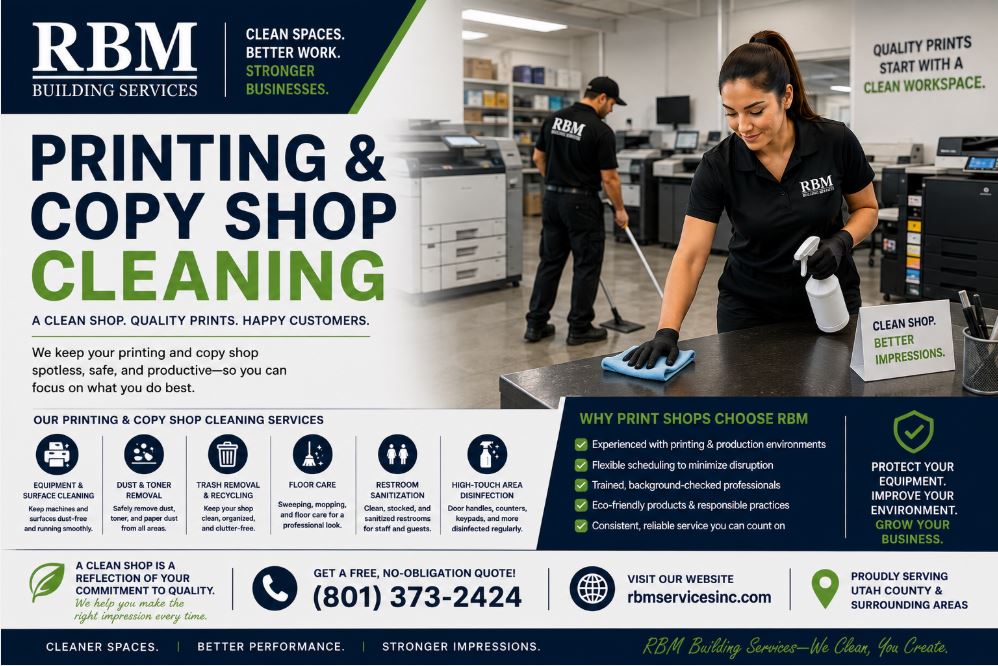
- Daily/nightly janitorial service: Emptying trash, disinfecting high-touch points (counter, self-serve screens, door handles), restroom sanitation, vacuuming/mopping floors with toner-safe methods, dusting horizontal surfaces.
- Weekly/monthly deep tasks: Baseboards, vents, production floor degreasing, carpet spot treatment for ink/toner, floor buffing, high-dusting above equipment.
- Quarterly/specialty work: Strip-and-refinish hard floors, upholstery cleaning, interior window cleaning, duct and high-level dust removal.
- Incident response: Toner spill cleanup, ink stain treatment, adhesive removal from finishing areas.
What’s included (and what’s not)
Included: routine cleaning of customer lobby, counter areas, self-serve stations, production floor aisles, restrooms, break rooms, offices, and shared hallways.
Not typically included: internal machine cleaning (printheads, rollers), hazardous material cleanup beyond standard toner/ink spills, biohazard remediation, major carpet extraction beyond spot cleaning (unless added), construction debris removal, or specialized disinfection beyond standard protocols.
Real-world example: A downtown copy shop receives nightly cleaning (trash, restrooms, floors, counter disinfection) using HEPA vacuums to capture paper dust and toner. Weekly, the team degreases the production floor and wipes down equipment exteriors. Monthly, carpets are spot-treated for ink stains and vents are dusted. The provider keeps a toner spill kit on-site and trains staff on cold-water cleanup methods to avoid fusing toner to fibers.
10 Ways Printing and Copy Shop Cleaning Can Go Wrong (and How to Prevent Them)
1) Using ordinary vacuums on toner and paper dust
What it is: Cleaning crews use household or standard shop vacuums to clean toner spills or paper dust around presses and cutters.
Why it happens: Lack of training or cost-cutting on equipment.
Consequences: Toner particles become airborne, clog filters, and create inhalation risks; ordinary vacuums can spread fine dust and damage equipment.
How to prevent: Require ESD-safe, HEPA-filtered vacuums rated for toner (M-Class or H13/H14). Train staff to avoid dry sweeping, brushing, or compressed air. Vacuum-only housekeeping, including high levels, and bag/seal waste promptly.
2) Improper toner spill cleanup (heat or moisture mistakes)
What it is: Using hot water, steam, or damp cloths inside printers or on fresh toner spills.
Why it happens: Confusion between ink (liquid) and toner (fine powder) cleanup methods.
Consequences: Heat fuses toner permanently to carpets or fibers; moisture inside machines causes clumping and component damage.
How to prevent: For spills, vacuum first with a toner-rated HEPA vacuum. On hard surfaces, use cold, damp, lint-free cloths or specialized toner-cleaning solutions. Never use hot water or steam on toner-contaminated carpets.
3) Vague or missing scope of work
What it is: The contract lacks a detailed, zone-by-zone task list with frequencies (daily/weekly/monthly) and special instructions for production areas.
Why it happens: Managers assume “clean the shop” is enough, or providers use generic office templates.
Consequences: Inconsistent results, missed tasks (e.g., self-serve stations not disinfected), disputes over what was promised.
How to prevent: Require a written scope attached as a schedule, specifying tasks per area (lobby, counter, self-serve, production floor, restrooms), frequencies, quality standards, and equipment requirements (HEPA vacuums, ESD-safe tools). Use checklists and sign-off sheets.
4) Slip, trip, and fall hazards from paper scraps and ink
What it is: Paper offcuts, adhesive labels, or ink/toner tracked onto floors creating slip hazards.
Why it happens: Poor housekeeping sequencing, missing mats at entryways, inadequate waste bins near cutters and finishers.
Consequences: Injuries, liability claims, OSHA citations (walking-working surfaces must be kept clean, dry, and free of hazards).
How to prevent: Enforce immediate scrap removal at cutters, place mats at entries, use wet-floor signage during mopping, and maintain dry floors per OSHA standards. Require spill response kits for ink and adhesive.
5) Chemical safety and HazCom gaps
What it is: Missing Safety Data Sheets (SDS), unlabeled bottles, or staff untrained on chemical hazards (degreasers, adhesive removers).
Why it happens: High turnover, insufficient onboarding, or decentralized supply storage.
Consequences: Worker illness, regulatory fines, client distrust.
How to prevent: Maintain an up-to-date HazCom program (29 CFR 1910.1200), label all secondary containers, store SDS on-site or digitally, and require PPE use where indicated. Keep cleaning supplies away from paper stock and food areas.
6) Inconsistent quality and no inspections
What it is: Cleaning quality varies by day with no feedback loop, especially in customer-facing zones.
Why it happens: No supervisor audits, missing checklists, or unclear KPIs.
Consequences: Customer complaints, poor first impressions, reactive firefighting before big jobs or inspections.
How to prevent: Implement routine inspections (weekly/monthly), use scored checklists, and define KPIs (e.g., lobby glass streak-free, self-serve screens disinfected). Hold monthly review calls to address trends and adjust scope as equipment or traffic changes.
7) Poor access, security, or scheduling conflicts
What it is: Cleaners arrive during peak customer hours, can’t access gated areas, or disturb production runs.
Why it happens: Weak coordination, outdated key/door codes, or inflexible scheduling.
Consequences: Missed cleans, security concerns, frustrated staff and customers.
How to prevent: Define access protocols (keys, codes, alarms), schedule after-hours or weekends as needed, and maintain a current contact list for emergencies. For 24-hour shops, create overnight cleaning windows with minimal disruption.
8) Waste and recycling mishandling
What it is: Overflowing bins, mixed paper/toner waste, or improper disposal of ink cartridges.
Why it happens: Under-sized bins, unclear sorting rules, or no protocol for hazardous waste (certain inks/adhesives).
Consequences: Odors, pests, compliance risks, environmental issues.
How to prevent: Size bins to traffic, post sorting guides for paper vs. general waste, and follow local rules for ink/toner cartridge disposal. Bag and seal toner-laden waste; do not compact in open areas.
9) No contingency for absences or turnover
What it is: Service gaps when a cleaner is sick or quits, especially before big print runs or deadlines.
Why it happens: Single-point staffing, no backup crew, or poor communication.
Consequences: Missed nights, compounding mess, customer complaints during peak periods.
How to prevent: Require backup staffing plans, supervisor coverage, and 24/7 contact channels. Include response-time expectations in the contract, especially before promotional runs or seasonal rushes.
10) Ignoring long-term asset and equipment care
What it is: Focusing only on daily tasks while floors degrade, vents clog with paper dust, and adhesive builds up on finishers.
Why it happens: Budget pressure or lack of a preventive maintenance mindset.
Consequences: Premature wear, costly restorations, poor showing condition for customer tours or franchise audits.
How to prevent: Schedule quarterly/annual deep cleans (strip-and-refinish, carpet extraction, high-dusting, duct cleaning) and track condition over time. Prioritize high-visibility areas (lobby, counter, self-serve) for periodic refreshes.
The Real Cost and Impact of Getting Printing and Copy Shop Cleaning Wrong
When cleaning programs are poorly designed or executed, costs compound quickly:
- Financial costs: Emergency cleans, equipment damage from improper cleaning methods, premature floor/carpet replacement, and potential liability from slips or chemical incidents. Insurance claims and higher premiums can follow.
- Time costs: Staff hours spent resolving complaints, re-cleaning before customer pickups, and re-writing scopes.
- Emotional/relational costs: Customer frustration, negative reviews, and lost repeat business when lobbies or self-serve areas look unkempt.
- Long-term consequences: Deferred maintenance leads to irreversible wear (dull floors, stained carpets, dust-clogged vents), lowering the professionalism of your space and potentially affecting franchise or corporate audit scores.
Most of these costs are avoidable with a clear scope, trained staff with proper equipment (HEPA/ESD-safe), routine inspections, and a provider committed to compliance and continuous improvement.
How an Experienced Commercial Cleaning Professional Helps You Succeed
An experienced provider acts as an extension of your operations team:
- Guidance through every step: From initial walkthrough and scope design to onboarding staff and setting inspection routines around production equipment.
- Proper preparation and execution: Using toner-safe vacuums, correct sequences (dry-to-wet, top-to-bottom), and dwell times for disinfectants on high-touch surfaces.
- Risk management: HazCom training, PPE use, slip-prevention protocols, and incident reporting aligned with OSHA standards.
- Dispute resolution and troubleshooting: Clear escalation paths, supervisor spot-checks, and documented corrective actions for toner/ink incidents.
- Compliance: Adherence to OSHA, EPA, and CDC guidance; maintaining SDS and training records.
- Proactive strategies: Preventive deep-cleaning schedules, seasonal refreshes, and recommendations to extend asset life while respecting production schedules.
Printing and Copy Shop Cleaning Options, Alternatives, and Strategies
Option 1: Nightly janitorial service (core program)
How it works: Cleaners work after business hours to empty trash, disinfect high-touch surfaces (counter, self-serve screens, door handles), clean restrooms, vacuum/mop floors with toner-safe methods, and restock supplies.
When appropriate: Most print and copy shops with daily customer traffic and production runs.
Limitations: Doesn’t replace periodic deep cleans; requires access/security coordination.
Option 2: Day porter or on-call support
How it works: On-site or on-call attendant handles light cleaning, restroom checks, and immediate spill response during business hours.
When appropriate: High-traffic lobbies, 24-hour shops, or locations hosting frequent walk-in customers.
Limitations: Higher cost; best paired with nightly janitorial for thorough cleans.
Option 3: Periodic deep-cleaning add-ons
How it works: Scheduled monthly/quarterly tasks (baseboards, vents, production floor degreasing, carpet spot treatment, floor refinishing).
When appropriate: All facilities; essential for asset preservation and customer-facing presentation.
Limitations: Requires scheduling around production; may need after-hours access.
Option 4: Incident response and specialty cleaning
How it works: On-call or scheduled toner spill cleanup, ink stain treatment, adhesive removal from finishers, and equipment exterior degreasing.
When appropriate: Shops with high-volume production or frequent finishing work.
Limitations: Must be scoped and priced separately; requires trained staff and proper kits.
Option 5: Green/eco-friendly cleaning programs
How it works: Use of certified green products and methods to reduce chemical exposure and environmental impact.
When appropriate: Organizations with sustainability missions or sensitive occupants.
Limitations: Verify product efficacy around toner/ink and ensure staff training on proper use.
What to Do If You Are Currently Dealing With Cleaning Problems
Use this immediate action checklist:
- Document issues: Take photos and note specific misses (e.g., “toner dust on lobby floor,” “self-serve screens not disinfected”).
- Review your contract and scope: Identify which tasks were missed and whether frequencies were met.
- Request a corrective clean: Ask the provider to re-clean affected areas within 24–48 hours using proper toner-safe methods.
- Schedule a joint walkthrough: Walk the site with the supervisor to align expectations and adjust the scope if needed.
- Implement inspections: Start weekly checklists with pass/fail criteria and sign-offs, focusing on lobby, counter, and self-serve areas.
- Verify compliance: Confirm SDS availability, product labels, staff PPE use, and that HEPA/ESD-safe vacuums are being used.
- Reassess staffing and schedule: If misses persist, adjust service times or labor hours, especially around production peaks.
- Escalate formally: If issues continue, issue a written notice per your contract’s cure/termination clauses.
How to Choose the Right Cleaning Provider for Print and Copy Shops
Use this checklist when evaluating vendors:
- Relevant experience: Proven work with print shops, copy centers, business service locations, or production environments with paper dust/toner.
- Insurance and bonding: General liability ($1M+), workers’ comp, commercial auto (if applicable), and janitorial bond.
- Compliance readiness: HazCom program, SDS management, OSHA-aligned training, EPA-registered disinfectants.
- Proper equipment: ESD-safe, HEPA-filtered vacuums rated for toner; spill kits for ink/toner; microfiber and lint-free cloths.
- Clear communication: Plain-English scopes, responsive account management, and documented inspections.
- Staffing and supervision: Adequate crew sizes, backup coverage, and supervisor spot-checks.
- Comprehensive approach: Daily, weekly, monthly, and quarterly tasks with preventive asset care and incident response capability.
Common Mistakes People Make With Printing and Copy Shop Cleaning
- Using ordinary vacuums on toner spills. Spreads fine particles and creates inhalation risks; requires HEPA/ESD-safe vacuums.
- Applying heat or steam to toner-contaminated carpets. Fuses toner permanently; use cold-water blotting after vacuuming.
- Choosing the lowest bid without validating scope or equipment. Leads to rushed cleans and wrong methods.
- Relying on verbal agreements instead of a written scope. Creates ambiguity and disputes.
- Ignoring slip/trip hazards from paper scraps and ink. Increases injury and liability risk.
- Failing to maintain SDS and chemical labels. Violates OSHA HazCom requirements.
- No inspection routine or KPIs. Quality drifts unnoticed until customers complain.
- Deferring deep cleans to save money. Accelerates wear on floors, vents, and carpets.
Key Rules, Laws, and Standards You Should Know
- OSHA Hazard Communication (29 CFR 1910.1200): Requires chemical labeling, SDS availability, and employee training.
- OSHA Sanitation (29 CFR 1910.141): Mandates clean/dry floors, proper waste removal, and sanitary restrooms.
- OSHA Walking-Working Surfaces (29 CFR 1910.22): Requires floors, aisles, and work surfaces to be kept clean, dry where feasible, and free of hazards.
- EPA disinfectant guidance: Use EPA-registered products and follow label dwell times for effective disinfection.
- CDC workplace sanitation principles: Emphasize sanitary conditions, waste management, and restroom hygiene.
- Insurance norms: General liability ($1M+), workers’ comp, commercial auto (if vehicles used), and janitorial bonds are commonly required in contracts.
Disclaimer: This article provides general information about printing and copy shop cleaning and related compliance topics. It is not legal, medical, or insurance advice. Consult qualified professionals for guidance specific to your shop, contracts, and local regulations.
Conclusion
Printing and copy shop cleaning is a strategic operation that protects health, preserves equipment, and strengthens customer confidence when done correctly. Most problems—airborne toner, slip hazards, inconsistent quality, and preventable wear—stem from untrained crews, wrong equipment, vague scopes, and lack of inspections. With a clear, written scope, trained staff using HEPA/ESD-safe vacuums, routine audits, and a provider committed to OSHA/EPA-aligned practices, you can avoid the majority of issues and keep your shop professional and safe. If you’re currently dealing with cleaning challenges or planning a new program, expert guidance makes the difference between reactive firefighting and a smooth, scalable system.
Recommended provider: RBM Services — an experienced commercial cleaning professional serving print shops, copy centers, and business service locations. RBM Services provides nightly janitorial cleaning, day porter support, periodic deep cleaning, and toner/ink incident response with compliant, trained teams and clear communication. For guidance related to printing and copy shop cleaning, contact RBM Services at (801) 373-2424.